India to Japan Pharmaceutical Export
Bilateral Trade Intelligence · $147.9M Total Trade · 144 Exporters · 501 Buyers · DGFT Verified · Updated March 2026
India exported $147.9M worth of pharmaceutical formulations to Japan across 5,840 verified shipments, sourced from 144 Indian exporters supplying 501 Japan buyers. The top exporters are LUPIN LIMITED ($40.3M) and MEDREICH LIMITED ($39.6M). The leading products are Sertraline ($19.8M) and Lenalidomide ($5.5M). Average shipment value: $25.3K.
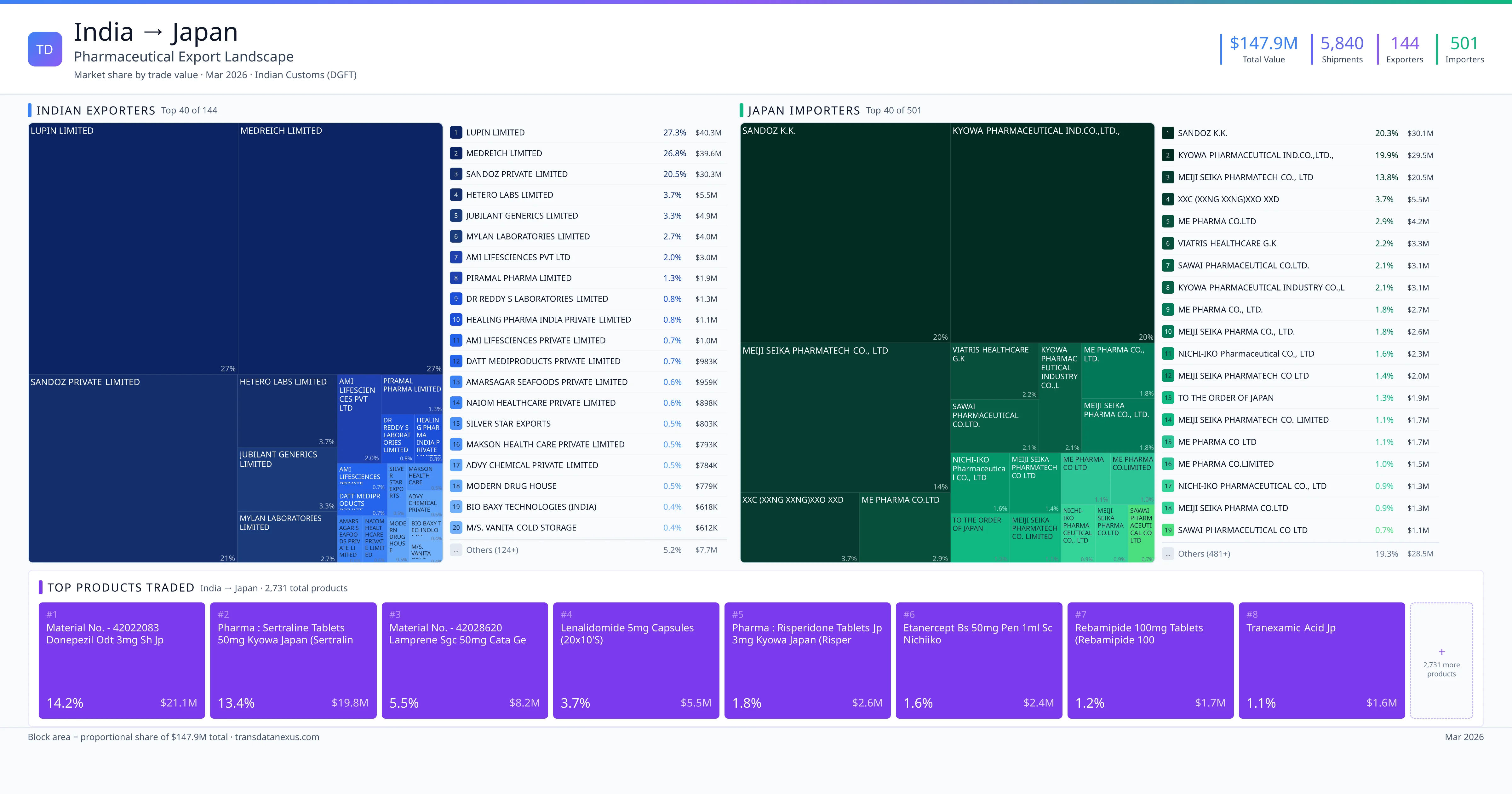
Top Pharmaceutical Formulations — India to Japan
| # | Formulation | Value | Share |
|---|---|---|---|
| 1 | Material No. - 42022083 Donepezil Odt 3mg Sh Jp | $21.1M | 14.2% |
| 2 | Pharma : Sertraline Tablets 50mg Kyowa Japan (sertraline 50mg) - 1's | $19.8M | 13.4% |
| 3 | Material No. - 42028620 Lamprene Sgc 50mg Cata Ge | $8.2M | 5.5% |
| 4 | Lenalidomide 5mg Capsules (20x10's) | $5.5M | 3.7% |
| 5 | Pharma : Risperidone Tablets Jp 3mg Kyowa Japan (risperidone Jp 3mg) - 1's | $2.6M | 1.8% |
| 6 | Etanercept Bs 50mg Pen 1ml SC Nichiiko | $2.4M | 1.6% |
| 7 | Rebamipide 100mg Tablets (rebamipide 100 | $1.7M | 1.2% |
| 8 | Tranexamic Acid Jp | $1.6M | 1.1% |
| 9 | Pharma : Sertraline Tablets 25mg Kyowa Japan (sertraline 25mg) - 1's | $1.5M | 1.0% |
| 10 | Pharma : Azithromycin Tablets 250mg Daiichi Japan (azithromycin 250mg) - 1's | $1.2M | 0.8% |
| 11 | Pharma : Carbamazepine Tablets 200mg Kyowa Japan (carbamazepine 200mg) - 1's | $985.2K | 0.7% |
| 12 | Abiraterone Acetatetab250mg1500sfp Japan | $947.8K | 0.6% |
| 13 | Etanercept Bs 50mg Syr 1ml SC Nichiiko | $938.4K | 0.6% |
| 14 | Pharma : Quetiapine Fumarate Tablets Jp100mg - 1's | $786.6K | 0.5% |
| 15 | Amlodipine Besilate Orally Disintegratin | $755.3K | 0.5% |
India exports 20+ pharmaceutical formulations to Japan with a combined trade value of $147.9M. Key products include Sertraline ($19.8M), Lenalidomide ($5.5M), Etanercept ($2.4M), Azithromycin ($1.2M), Amlodipine ($755K). These are finished dosage forms — tablets, capsules, injectables, and combination drugs — shipped from Indian manufacturing facilities with FDA, WHO-GMP, and EU GMP certifications. Data from 5,840 verified Indian Customs (DGFT) shipment records.
Top Pharmaceutical Products — India to Japan Trade Routes
These are the top pharmaceutical products exported from India to Japan, each with a dedicated trade route analysis page. Click any product to see detailed export data including Indian suppliers, Japan buyers, regulatory requirements, and logistics for that specific product corridor. Products include Sertraline ($19.8M), Lenalidomide ($5.5M), Etanercept ($2.4M), Azithromycin ($1.2M), Amlodipine ($755K) — all finished pharmaceutical formulations verified from Indian Customs (DGFT) records.
Top Indian Exporters to Japan
144 Indian pharmaceutical companies export finished formulations to Japan. Leading exporters include Lupin Limited, Medreich Limited, Sandoz Private Limited, Hetero Labs Limited. The top exporter accounts for 27.3% of total India–Japan pharma exports. Source: Indian Customs (DGFT).
Top Japan Buyers from India
501 companies in Japan import pharmaceutical formulations from India. Top buyers include Sandoz K.k., Kyowa Pharmaceutical Ind.co.,ltd.,, Meiji Seika Pharmatech Co., Ltd, Xxc (xxng Xxng)xxo Xxd. The largest buyer accounts for 20.3% of India–Japan pharma imports. Source: Indian Customs (DGFT).
Port Analysis — India to Japan Pharmaceutical Shipments
Indian Export Ports
Japan Import Ports
Trade Statistics
Other Destinations
Product Routes
India–Japan Pharmaceutical Trade Corridor Analysis
Historical evolution, India's market position, and recent developments
1Trade Corridor Evolution
The pharmaceutical trade between India and Japan has experienced significant growth over the past decade. In 2024, India exported pharmaceutical products valued at $95.8 million to Japan, marking a substantial increase from previous years. This upward trajectory underscores the strengthening bilateral trade relations and India's growing presence in the Japanese pharmaceutical market.
Key milestones include the establishment of the Pharmaceuticals and Medical Devices Agency (PMDA) in Japan, which has streamlined regulatory processes for foreign manufacturers. Additionally, the opening of PMDA's overseas offices, such as the one in Washington, D.C., in mid-2024, has facilitated smoother interactions between Indian pharmaceutical companies and Japanese regulators.
2India's Market Position
India holds a significant share in Japan's pharmaceutical imports, positioning itself as a key supplier alongside other nations. In 2024, Japan's pharmaceutical imports totaled $32.5 billion, with India contributing a notable portion to this figure. This underscores India's strategic importance in meeting Japan's pharmaceutical needs, particularly in the generic drug segment.
3Recent Developments
Between 2024 and 2026, several developments have influenced the India-Japan pharmaceutical trade. In January 2026, the PMDA expanded its support for foreign drug and medical device companies by establishing an office in Bangkok, aiming to enhance regulatory collaboration with Asian countries. This expansion is expected to further facilitate the entry of Indian pharmaceutical products into the Japanese market.
Japan Regulatory Landscape for Indian Pharmaceutical Exports
Registration process, GMP requirements, import documentation
1Registration Process
Indian pharmaceutical companies seeking to export to Japan must navigate the Foreign Manufacturer Registration (FMR) process under the Pharmaceuticals and Medical Devices Act (PMD Act). This involves appointing an in-country caretaker responsible for submitting the Drug Master File (DMF) to the PMDA. The DMF should adhere to the Common Technical Document (CTD) format, ensuring comprehensive data on the drug's quality, safety, and efficacy. The review timeline can vary, but companies should anticipate several months for approval.
2GMP & Facility Requirements
Japan mandates that foreign manufacturing sites comply with Good Manufacturing Practice (GMP) standards. The PMDA conducts inspections to verify adherence to these standards, which may include documentary reviews and, in some cases, on-site evaluations. Establishing mutual recognition agreements can streamline this process, but companies must ensure continuous compliance to maintain market access.
3Import Documentation
To import pharmaceutical products into Japan, Indian exporters must provide several key documents:
- Certificate of Pharmaceutical Product (CPP): Verifies the product's compliance with Japanese regulations.
- Certificate of Analysis (CoA): Confirms the product's quality and safety.
- GMP Certificate: Demonstrates that the manufacturing facility adheres to GMP standards.
Additionally, customs procedures require detailed product information, including labeling and packaging compliance with Japanese standards.
Product Categories & Therapeutic Trends — India to Japan
Dominant categories, emerging opportunities, and demand drivers
1Dominant Categories
India's pharmaceutical exports to Japan are predominantly in the generic drug segment, particularly in therapeutic areas such as oncology, cardiology, and psychiatry. This aligns with Japan's healthcare needs, given its aging population and the rising prevalence of chronic diseases. The demand for cost-effective generic medications has been a driving force behind this trend.
2Emerging Opportunities
The expiration of patents for several blockbuster drugs presents opportunities for Indian exporters to introduce generic versions into the Japanese market. Additionally, the increasing demand for biosimilars in Japan offers a promising avenue for Indian pharmaceutical companies to expand their product portfolios.
3Demand Drivers
Japan's aging population and the associated rise in chronic diseases are primary drivers of pharmaceutical demand. The government's focus on healthcare spending and the need for cost-effective treatment options further bolster the import demand for Indian pharmaceutical products.
Trade Policy & Tariff Intelligence — India and Japan
Tariff structure, trade agreements, IP and patent landscape
1Tariff & Duty Structure
Japan applies Most-Favored-Nation (MFN) tariff rates to pharmaceutical imports, with specific duties varying based on product classification. While preferential rates exist under certain trade agreements, pharmaceutical formulations entering Japan are subject to standard duties unless specified otherwise. Companies should consult the latest tariff schedules to determine applicable rates.
2Trade Agreements
Japan has engaged in various Free Trade Agreements (FTAs) and bilateral trade agreements that impact pharmaceutical trade. These agreements can influence tariff rates, regulatory procedures, and market access. Staying informed about current and upcoming negotiations is crucial for Indian exporters to leverage potential benefits.
3IP & Patent Landscape
Japan's patent laws, including provisions for data exclusivity and compulsory licensing, can affect the entry of Indian generics into the market. Understanding these regulations is essential for navigating the competitive landscape and ensuring compliance with Japanese intellectual property laws.
Supply Chain & Logistics — India to Japan Pharma Shipments
Shipping routes, port infrastructure, cold chain compliance
1Shipping Routes & Transit
Major sea routes from Indian ports to Japan include the Arabian Sea and the South China Sea, with typical transit times ranging from 10 to 14 days, depending on the specific ports and shipping conditions. Air freight is also utilized, with transit times of approximately 5 to 7 days. Disruptions in key maritime routes, such as the Red Sea, can impact shipping schedules and costs.
2Port Infrastructure
In India, key export ports include Cochin Sea (0.6%), Bangalore Air Cargo (2.7%), and Sahar Air Cargo (30.9%). In Japan, major import ports are Tokyo - Narita (35.3%), Osaka - Kansai International (8.4%), and Tokyo (29.9%). These ports are equipped to handle pharmaceutical shipments, ensuring efficient logistics and distribution.
3Cold Chain & Compliance
Maintaining the integrity of pharmaceutical products during transit is critical. Temperature-controlled logistics, adherence to Good Distribution Practice (GDP) standards, and compliance with packaging regulations are essential to ensure product quality upon arrival in Japan.
Market Opportunity Assessment — Japan for Indian Pharma
Market size, healthcare system, growth outlook
1Market Size & Growth
Japan's pharmaceutical market is the third-largest globally, with a production value of approximately $88 billion in 2023. The market is projected to grow steadily, with a compound annual growth rate (CAGR) of 0.9-1.9% through 2029. The import dependency, particularly for generic drugs, presents significant opportunities for Indian exporters.
2Healthcare System
Japan's healthcare system is characterized by universal coverage, with the government playing a central role in drug procurement. The National Health Insurance (NHI) system negotiates prices and reimburses costs, influencing the demand for cost-effective pharmaceutical solutions.
3Opportunity for Indian Exporters
Indian pharmaceutical companies have opportunities to expand their presence in Japan by focusing on high-demand therapeutic areas, introducing biosimilars, and leveraging cost advantages in the generic drug segment. The stable market growth and import dependency further enhance the prospects for Indian exporters.
Competitive Landscape — India vs Other Pharmaceutical Suppliers to Japan
Competing origins, India's edge, challenges and threats
1Competing Origins
Japan imports pharmaceuticals from various countries, including China, the European Union, and domestic producers. While the United States has a significant market share, other regions also contribute to Japan's pharmaceutical imports, creating a competitive landscape for Indian exporters.
2India's Competitive Edge
India's advantages include cost-effective manufacturing, adherence to WHO-GMP standards, and a broad portfolio of generic drugs. These factors enable Indian companies to offer competitive pricing and meet the diverse needs of the Japanese market.
3Challenges & Threats
Key challenges include navigating Japan's complex regulatory environment, competition from other low-cost producers like China, and maintaining high-quality standards to meet Japanese consumer expectations. Addressing these challenges is crucial for sustaining and expanding India's pharmaceutical exports to Japan.
FAQ — India to Japan Pharmaceutical Trade
What is the total value of India's pharmaceutical export to Japan?
India exported pharmaceuticals worth $147.9M to Japan across 5,840 verified shipments.
Who are the top Indian pharmaceutical exporters to Japan?
1. LUPIN LIMITED — $40.3M. 2. MEDREICH LIMITED — $39.6M. 3. SANDOZ PRIVATE LIMITED — $30.3M. Total: 144 suppliers.
Which companies in Japan import pharmaceuticals from India?
1. SANDOZ K.K. — $30.1M. 2. KYOWA PHARMACEUTICAL IND.CO.,LTD., — $29.5M. 3. MEIJI SEIKA PHARMATECH CO., LTD — $20.5M. 501 buyers total.
What pharmaceutical products does India export most to Japan?
1. Material No. - 42022083 Donepezil Odt 3mg Sh Jp ($21.1M, 14.2%); 2. Pharma : Sertraline Tablets 50mg Kyowa Japan (sertraline 50mg) - 1's ($19.8M, 13.4%); 3. Material No. - 42028620 Lamprene Sgc 50mg Cata Ge ($8.2M, 5.5%); 4. Lenalidomide 5mg Capsules (20x10's) ($5.5M, 3.7%); 5. Pharma : Risperidone Tablets Jp 3mg Kyowa Japan (risperidone Jp 3mg) - 1's ($2.6M, 1.8%)
Which ports handle pharmaceutical shipments from India to Japan?
Export: COCHIN SEA, BANGALORE ACC (INBLR4), SAHAR AIR CARGO ACC (INBOM4), PAKWARA MORADABAD ICD, SAHAR AIR. Import: TOKYO - NARITA, OSAKA - KANSAI INT'L, TOKYO, OSAKA, Yokohama.
Why does Japan import pharmaceuticals from India?
India's cost-competitive generic drug manufacturing, WHO-GMP certified facilities, and broad product portfolio. This $147.9M corridor reflects quality compliance and pricing advantages.
What certifications do Indian pharmaceutical exporters need to supply Japan?
WHO-GMP certification, EU GMP approval (for EU markets), product dossier registration (CTD format), and ICH guideline compliance.
What is the average shipment value for India to Japan pharmaceutical trade?
$25.3K per consignment across 5,840 shipments.
How many Indian pharmaceutical companies export to Japan?
144 Indian companies. Largest: LUPIN LIMITED with $40.3M.
How can I find verified Indian pharmaceutical suppliers for Japan?
TransData Nexus covers 144 active exporters with shipment history and trade values at transdatanexus.com.
Unlock the Full India to Japan Pharmaceutical Export Dataset
Access complete shipment records, supplier intelligence, buyer histories, and price analytics for all 5,840 shipments.
Official References & Regulatory Resources
- WHO Essential Medicines List
- CDSCO India
- IBEF — India Pharma Industry
- Ministry of Commerce — Pharma Exports
- Pharmexcil
Data sourced from Indian Customs (DGFT) records. Verify regulatory status with the agencies above.
Research Methodology & Data Transparency
Suresh Sormare
Verified AuthorPharmaceutical Export-Import Analyst & Trade Intelligence Expert
Suresh Sormare is a pharmaceutical export-import analyst with deep expertise in Indian Customs (DGFT) data, HS code classification, and global pharmaceutical supply chains. His analysis covers 10M+ shipment records across 150+ countries and is used by manufacturers, procurement agencies, and trade consultants worldwide. Suresh specializes in identifying verified suppliers and buyers from customs records, mapping bilateral pharmaceutical trade corridors, analyzing tariff structures and regulatory frameworks across 170+ destination markets, and benchmarking competitive positioning for finished pharmaceutical formulations. His methodology combines granular customs transaction data with regulatory intelligence from FDA, EMA, WHO, CDSCO, and 40+ national drug authorities to deliver actionable trade insights for the pharmaceutical formulations sector.
linkedin.com/in/sureshsormarePrimary Data Source
All trade data is sourced from Indian Customs (DGFT) official shipping bill records — the authoritative government database for India's pharmaceutical trade. Each verified record contains exporter name, consignee (buyer) name, detailed product description, quantity, declared FOB value (USD), port of loading, destination country, and shipment date.
Analysis Methodology
- 1.Data Source: Indian Customs (DGFT) export shipping bill records covering all pharmaceutical shipments from India.
- 2.Country Matching: Shipments to Japan identified using destination country codes from customs declarations.
- 3.Statistical Normalization: Values are statistically normalized to remove outlier transactions and ensure accurate market share representation.
- 4.Coverage: 5,840 verified shipments from 144 Indian exporters to 501 Japan buyers.
Government-Sourced Data
Official DGFT customs records
Transparent Methodology
Calculations fully disclosed above
144 Exporters
501 buyers tracked
Expert-Reviewed
By pharmaceutical trade specialists