India to Ghana Pharmaceutical Export
Bilateral Trade Intelligence · $266.0M Total Trade · 458 Exporters · 697 Buyers · DGFT Verified · Updated March 2026
India exported $266.0M worth of pharmaceutical formulations to Ghana across 17,913 verified shipments, sourced from 458 Indian exporters supplying 697 Ghana buyers. The top exporters are IMPERIA LIFE SCIENCES PRIVATE LIMITED ($57.1M) and PRG PHARMA PRIVATE LIMITED ($14.2M). The leading products are Diclofenac ($7.1M) and Clotrimazole ($2.6M). Average shipment value: $14.8K.
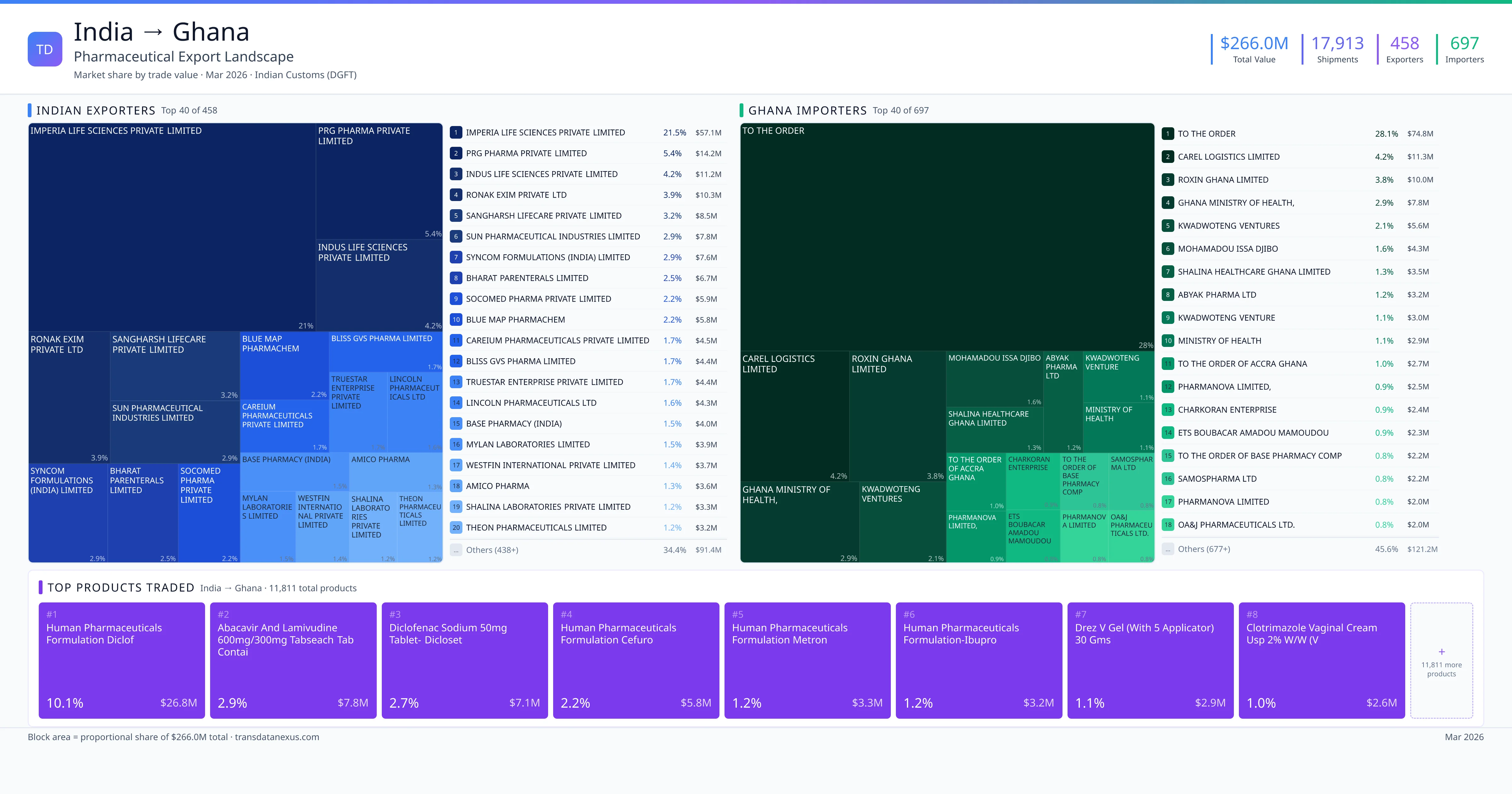
Top Pharmaceutical Formulations — India to Ghana
| # | Formulation | Value | Share |
|---|---|---|---|
| 1 | Human Pharmaceuticals Formulation Diclof | $26.8M | 10.1% |
| 2 | Abacavir and Lamivudine 600mg/300mg Tabseach Tablets Contains Abacavir Sulfate… | $7.8M | 2.9% |
| 3 | Diclofenac Sodium 50mg Tablet- Dicloset | $7.1M | 2.7% |
| 4 | Human Pharmaceuticals Formulation Cefuro | $5.8M | 2.2% |
| 5 | Human Pharmaceuticals Formulation Metron | $3.3M | 1.2% |
| 6 | Human Pharmaceuticals Formulation-ibupro | $3.2M | 1.2% |
| 7 | Drez V Gel (with 5 Applicator) 30 Gms | $2.9M | 1.1% |
| 8 | Clotrimazole Vaginal Cream USP 2% W/w (v | $2.6M | 1.0% |
| 9 | Pharmaceutical Products/harmless Medicin | $2.6M | 1.0% |
| 10 | Pharmaceutical Harmless Medicine for Hum | $2.6M | 1.0% |
| 11 | Human Pharmaceuticals Formulation Arteme | $2.4M | 0.9% |
| 12 | Human Pharmaceuticals Formulation-secnid | $2.2M | 0.8% |
| 13 | Inno-zidime 1.0gm Ceftazidime for Inject | $2.0M | 0.8% |
| 14 | Human Pharmaceuticals Formulation Cyproh | $1.9M | 0.7% |
| 15 | Pharmaceutical Products/harmless Medicines Cough Syrup 100 Ml, Composition:- Ea… | $1.8M | 0.7% |
India exports 20+ pharmaceutical formulations to Ghana with a combined trade value of $266.0M. Key products include Diclofenac ($7.1M), Clotrimazole ($2.6M), Dolutegravir ($1.7M), Isoniazid ($1.5M). These are finished dosage forms — tablets, capsules, injectables, and combination drugs — shipped from Indian manufacturing facilities with FDA, WHO-GMP, and EU GMP certifications. Data from 17,913 verified Indian Customs (DGFT) shipment records.
Top Pharmaceutical Products — India to Ghana Trade Routes
These are the top pharmaceutical products exported from India to Ghana, each with a dedicated trade route analysis page. Click any product to see detailed export data including Indian suppliers, Ghana buyers, regulatory requirements, and logistics for that specific product corridor. Products include Diclofenac ($7.1M), Clotrimazole ($2.6M), Dolutegravir ($1.7M), Isoniazid ($1.5M) — all finished pharmaceutical formulations verified from Indian Customs (DGFT) records.
Top Indian Exporters to Ghana
458 Indian pharmaceutical companies export finished formulations to Ghana. Leading exporters include Imperia Life Sciences Private Limited, Prg Pharma Private Limited, Indus Life Sciences Private Limited, Ronak Exim Private Ltd. The top exporter accounts for 21.5% of total India–Ghana pharma exports. Source: Indian Customs (DGFT).
Top Ghana Buyers from India
697 companies in Ghana import pharmaceutical formulations from India. Top buyers include To The Order, Carel Logistics Limited, Roxin Ghana Limited, Ghana Ministry Of Health,. The largest buyer accounts for 28.1% of India–Ghana pharma imports. Source: Indian Customs (DGFT).
Port Analysis — India to Ghana Pharmaceutical Shipments
Indian Export Ports
Ghana Import Ports
Trade Statistics
Other Destinations
Product Routes
India–Ghana Pharmaceutical Trade Corridor Analysis
Historical evolution, India's market position, and recent developments
1Trade Corridor Evolution
The pharmaceutical trade between India and Ghana has experienced significant growth over the past decade. In 2024, India's pharmaceutical exports to Ghana were valued at $219.6 million, marking a substantial increase from previous years. This upward trajectory underscores the strengthening bilateral trade relations and India's growing presence in the Ghanaian pharmaceutical market.
Key milestones in this evolution include the establishment of direct shipping routes and the expansion of distribution networks within Ghana. These developments have facilitated smoother logistics and enhanced the availability of Indian pharmaceutical products across the country. The consistent growth reflects India's strategic focus on the African market and Ghana's increasing demand for quality pharmaceutical formulations.
2India's Market Position
India holds a significant share in Ghana's pharmaceutical import market, positioning itself as a key supplier. In 2023, Ghana's total pharmaceutical imports were valued at $273.2 million, with imports from India accounting for approximately $116.93 million. This substantial share highlights India's competitive edge and the trust Ghanaian buyers place in Indian pharmaceutical products.
Strategically, India's dominance in this sector is bolstered by its adherence to international quality standards, cost-effectiveness, and a diverse product portfolio. These factors collectively enhance India's appeal to Ghanaian importers seeking reliable and affordable pharmaceutical solutions.
3Recent Developments
Between 2024 and 2026, several developments have influenced the India-Ghana pharmaceutical trade. In February 2024, Ghana's Ministry of Health proposed activating Executive Instrument (E.I) 2023 to restrict the importation of approximately 142 medicines, including essential drugs for conditions like hypertension and diabetes. This move aimed to encourage local manufacturing but faced opposition from industry stakeholders concerned about potential shortages.
Additionally, in September 2024, the Food and Drugs Authority (FDA) of Ghana released updated guidelines for Good Manufacturing Practice (GMP) inspections of pharmaceutical facilities. These guidelines are intended to ensure that manufacturing processes meet international standards, thereby enhancing the quality and safety of pharmaceutical products in the Ghanaian market. (fdaghana.gov.gh)
Ghana Regulatory Landscape for Indian Pharmaceutical Exports
Registration process, GMP requirements, import documentation
1Registration Process
Indian pharmaceutical companies seeking to export to Ghana must navigate a structured registration process. Initially, companies are required to import samples of their products into Ghana for registration purposes. Once registered, they can obtain an import license for commercial quantities. The registration process involves submitting a comprehensive dossier, typically in the Common Technical Document (CTD) format, which includes detailed information on the product's composition, manufacturing process, and quality control measures.
Ghana's regulatory framework mandates that all pharmaceutical products, both for public and private sectors, be duly registered with the national regulatory authority, the Food and Drugs Board (FDB), in accordance with the Food & Drugs Law (PNDCL 305B) 1992, as amended by the Food & Drugs (Amendment Act), Act 523, 1996. (moh.gov.gh)
2GMP & Facility Requirements
Ghana requires that manufacturing facilities adhere to Good Manufacturing Practice (GMP) standards to ensure the quality and safety of pharmaceutical products. The FDA Ghana has established guidelines for GMP inspections of pharmaceutical facilities, which include requirements for facility design, equipment, personnel qualifications, and documentation practices. Manufacturing processes must be supervised by a qualified pharmacist or an individual approved by the FDA with specialist knowledge in the relevant field. (fdaghana.gov.gh)
3Import Documentation
To import pharmaceutical products into Ghana, companies must obtain an import license from the Food and Drugs Authority (FDA). This process involves submitting an application along with relevant documentation, including certificates of analysis for raw materials and finished products. Additionally, products must have at least 60% of their shelf-life remaining upon arrival at the port of entry. (bcp.gov.gh)
It's important to note that Ghana imposes import bans on certain pharmaceutical products, such as those containing specific substances like Iodochlorhydroxyquinoline and its derivatives, Methaqualone, and Phenylbutazone. Products containing these substances are subject to confiscation and destruction at the importer's expense.
Product Categories & Therapeutic Trends — India to Ghana
Dominant categories, emerging opportunities, and demand drivers
1Dominant Categories
India's pharmaceutical exports to Ghana are predominantly composed of finished pharmaceutical formulations, including tablets, capsules, syrups, and injections. These products align with Ghana's healthcare needs, particularly in the treatment of chronic conditions such as hypertension, diabetes, and infectious diseases. The demand for these formulations is driven by the prevalence of these conditions and the need for accessible and effective treatments.
2Emerging Opportunities
The global pharmaceutical industry is witnessing patent expirations, leading to the emergence of generic drugs and biosimilars. Ghana, with its growing healthcare infrastructure, presents opportunities for Indian exporters to introduce these products. Additionally, there is potential for Indian companies to explore new therapeutic areas in Ghana, such as oncology and immunology, to meet the evolving healthcare demands.
3Demand Drivers
Ghana's disease burden, characterized by high rates of hypertension, diabetes, and infectious diseases, significantly drives the demand for pharmaceutical imports. The country's aging population further contributes to the need for chronic disease management. Moreover, increasing healthcare spending and government initiatives to improve healthcare access are expected to bolster the demand for pharmaceutical products, creating a favorable environment for Indian exporters.
Trade Policy & Tariff Intelligence — India and Ghana
Tariff structure, trade agreements, IP and patent landscape
1Tariff & Duty Structure
Ghana's tariff structure for pharmaceutical imports includes Most Favored Nation (MFN) tariff rates and preferential rates under various trade agreements. While specific duty exemptions for pharmaceutical formulations are not detailed, the government has implemented policies to encourage local manufacturing by imposing import bans on certain pharmaceutical products. These measures aim to protect domestic industries and promote self-sufficiency in pharmaceutical production.
2Trade Agreements
Ghana is a member of the Economic Community of West African States (ECOWAS), which has established a common external tariff system. This system harmonizes tariff rates among member states, including Ghana, and may impact the importation of pharmaceutical products. While there are no specific bilateral trade agreements between India and Ghana in the pharmaceutical sector, the existing trade frameworks facilitate the exchange of goods between the two nations.
3IP & Patent Landscape
Ghana's intellectual property laws provide protection for pharmaceutical patents, including provisions for data exclusivity and compulsory licensing. These regulations can affect the entry of Indian generic drugs into the Ghanaian market. Indian exporters must navigate these IP laws to ensure compliance and to strategize their market entry effectively.
Supply Chain & Logistics — India to Ghana Pharma Shipments
Shipping routes, port infrastructure, cold chain compliance
1Shipping Routes & Transit
Major sea routes from Indian ports to Ghana include the Nhava Sheva Sea Port (INNSA1) and JNPT/Nhava Sheva Sea Port, which collectively account for approximately 22.1% of India's pharmaceutical exports to Ghana. Air routes are also utilized, though specific data on air shipments is not provided. Transit times vary depending on the mode of transport and specific routes chosen.
2Port Infrastructure
In India, key export ports for pharmaceutical products to Ghana include Ahmedabad ICD (3.1%), Nhava Sheva Sea Port (INNSA1) (13.2%), and JNPT/Nhava Sheva Sea Port (8.9%). In Ghana, primary import ports are Tema (25.4%), Tema (28.1%), and Accra (39.5%). These ports are equipped to handle pharmaceutical shipments, ensuring efficient processing and distribution.
3Cold Chain & Compliance
Maintaining the integrity of pharmaceutical products during transit is crucial. Indian exporters must ensure compliance with Good Distribution Practice (GDP) standards, including temperature-controlled logistics and appropriate packaging. Adhering to these standards is essential to meet Ghana's regulatory requirements and to ensure product efficacy upon arrival.
Market Opportunity Assessment — Ghana for Indian Pharma
Market size, healthcare system, growth outlook
1Market Size & Growth
Ghana's pharmaceutical market is experiencing growth, with imports valued at $273.2 million in 2023. The market's expansion is driven by increasing healthcare needs and government initiatives to improve healthcare access. The share of generics in the market is substantial, presenting opportunities for Indian exporters to introduce cost-effective pharmaceutical formulations.
2Healthcare System
Ghana's healthcare system is evolving, with government programs aimed at expanding access to medical services. The introduction of health insurance schemes and improvements in drug procurement systems are enhancing the demand for pharmaceutical products. These developments create a conducive environment for Indian exporters to establish a strong presence in the Ghanaian market.
FAQ — India to Ghana Pharmaceutical Trade
What is the total value of India's pharmaceutical export to Ghana?
India exported pharmaceuticals worth $266.0M to Ghana across 17,913 verified shipments.
Who are the top Indian pharmaceutical exporters to Ghana?
1. IMPERIA LIFE SCIENCES PRIVATE LIMITED — $57.1M. 2. PRG PHARMA PRIVATE LIMITED — $14.2M. 3. INDUS LIFE SCIENCES PRIVATE LIMITED — $11.2M. Total: 458 suppliers.
Which companies in Ghana import pharmaceuticals from India?
1. TO THE ORDER — $74.8M. 2. CAREL LOGISTICS LIMITED — $11.3M. 3. ROXIN GHANA LIMITED — $10.0M. 697 buyers total.
What pharmaceutical products does India export most to Ghana?
1. Human Pharmaceuticals Formulation Diclof ($26.8M, 10.1%); 2. Abacavir and Lamivudine 600mg/300mg Tabseach Tablets Contains Abacavir Sulfate… ($7.8M, 2.9%); 3. Diclofenac Sodium 50mg Tablet- Dicloset ($7.1M, 2.7%); 4. Human Pharmaceuticals Formulation Cefuro ($5.8M, 2.2%); 5. Human Pharmaceuticals Formulation Metron ($3.3M, 1.2%)
Which ports handle pharmaceutical shipments from India to Ghana?
Export: AHEMDABAD ICD, NHAVA SHEVA SEA (INNSA1), JNPT/ NHAVA SHEVA SEA, JNPT, DELHI AIR. Import: Tema, TEMA, ACCRA, Accra, Lome.
Why does Ghana import pharmaceuticals from India?
India's cost-competitive generic drug manufacturing, WHO-GMP certified facilities, and broad product portfolio. This $266.0M corridor reflects quality compliance and pricing advantages.
What certifications do Indian pharmaceutical exporters need to supply Ghana?
WHO-GMP certification, EU GMP approval (for EU markets), product dossier registration (CTD format), and ICH guideline compliance.
What is the average shipment value for India to Ghana pharmaceutical trade?
$14.8K per consignment across 17,913 shipments.
How many Indian pharmaceutical companies export to Ghana?
458 Indian companies. Largest: IMPERIA LIFE SCIENCES PRIVATE LIMITED with $57.1M.
How can I find verified Indian pharmaceutical suppliers for Ghana?
TransData Nexus covers 458 active exporters with shipment history and trade values at transdatanexus.com.
Unlock the Full India to Ghana Pharmaceutical Export Dataset
Access complete shipment records, supplier intelligence, buyer histories, and price analytics for all 17,913 shipments.
Official References & Regulatory Resources
- WHO Essential Medicines List
- CDSCO India
- IBEF — India Pharma Industry
- Ministry of Commerce — Pharma Exports
- Pharmexcil
Data sourced from Indian Customs (DGFT) records. Verify regulatory status with the agencies above.
Research Methodology & Data Transparency
Suresh Sormare
Verified AuthorPharmaceutical Export-Import Analyst & Trade Intelligence Expert
Suresh Sormare is a pharmaceutical export-import analyst with deep expertise in Indian Customs (DGFT) data, HS code classification, and global pharmaceutical supply chains. His analysis covers 10M+ shipment records across 150+ countries and is used by manufacturers, procurement agencies, and trade consultants worldwide. Suresh specializes in identifying verified suppliers and buyers from customs records, mapping bilateral pharmaceutical trade corridors, analyzing tariff structures and regulatory frameworks across 170+ destination markets, and benchmarking competitive positioning for finished pharmaceutical formulations. His methodology combines granular customs transaction data with regulatory intelligence from FDA, EMA, WHO, CDSCO, and 40+ national drug authorities to deliver actionable trade insights for the pharmaceutical formulations sector.
linkedin.com/in/sureshsormarePrimary Data Source
All trade data is sourced from Indian Customs (DGFT) official shipping bill records — the authoritative government database for India's pharmaceutical trade. Each verified record contains exporter name, consignee (buyer) name, detailed product description, quantity, declared FOB value (USD), port of loading, destination country, and shipment date.
Analysis Methodology
- 1.Data Source: Indian Customs (DGFT) export shipping bill records covering all pharmaceutical shipments from India.
- 2.Country Matching: Shipments to Ghana identified using destination country codes from customs declarations.
- 3.Statistical Normalization: Values are statistically normalized to remove outlier transactions and ensure accurate market share representation.
- 4.Coverage: 17,913 verified shipments from 458 Indian exporters to 697 Ghana buyers.
Government-Sourced Data
Official DGFT customs records
Transparent Methodology
Calculations fully disclosed above
458 Exporters
697 buyers tracked
Expert-Reviewed
By pharmaceutical trade specialists