Kenya Medical Supplies Agency
Pharmaceutical Importer · Kenya · Tuberculosis Medications Focus · $5.8M Total Trade · DGFT Verified
Kenya Medical Supplies Agency is a pharmaceutical importer based in Kenya with a total trade value of $5.8M across 5 products in 3 therapeutic categories. Based on 115 verified import shipments from Indian Customs (DGFT) records, the company actively imports across multiple product segments. Kenya Medical Supplies Agency sources from 6 verified Indian suppliers, with Macleods Pharmaceuticals Limited accounting for 41.0% of imports.
Kenya Medical Supplies Agency — Import Portfolio & Supplier Network
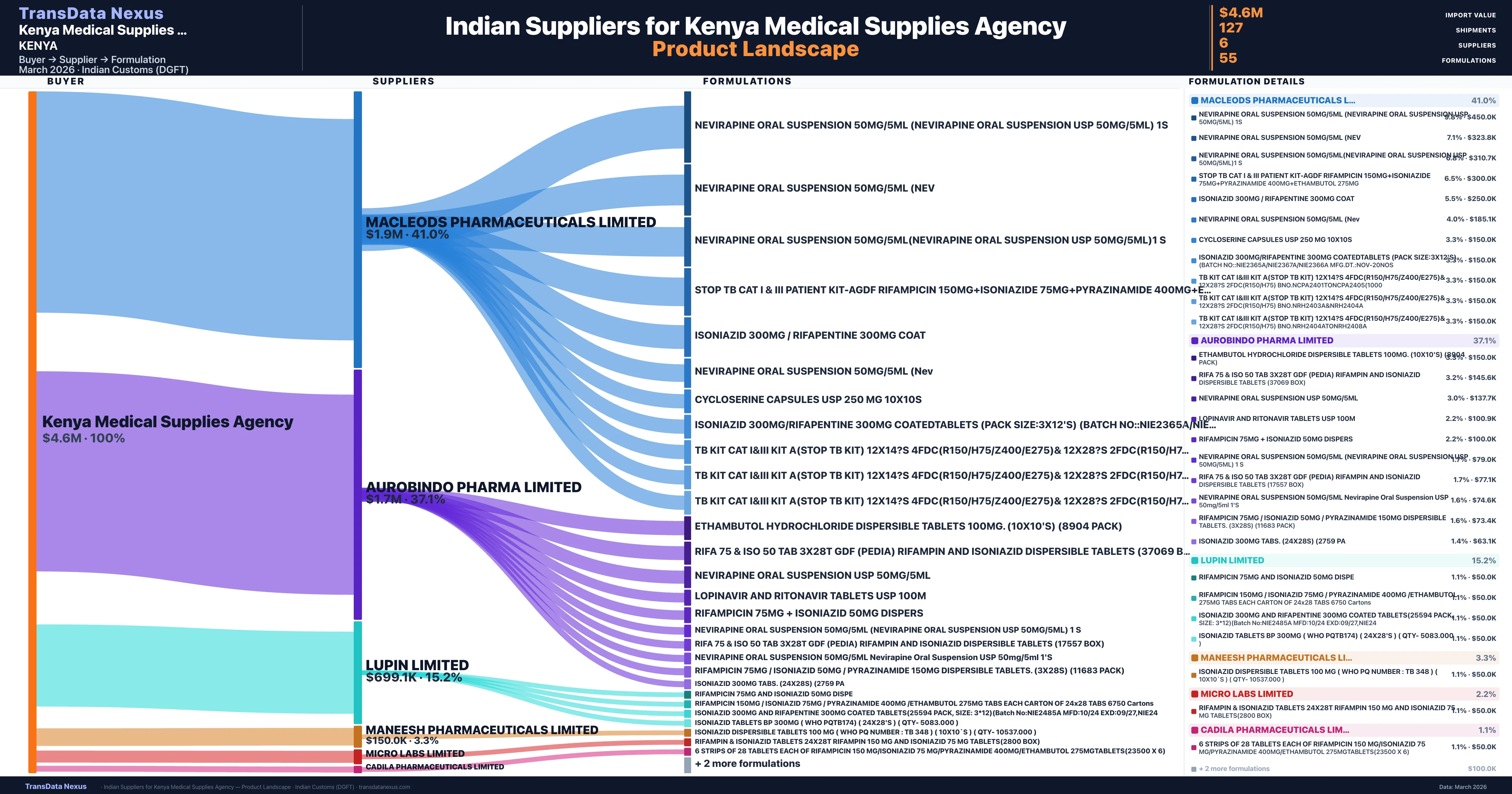
Who Are the Verified Indian Suppliers to Kenya Medical Supplies Agency?
Customs-verified supplier relationships from Indian DGFT records
| Supplier | Value | Shipments | Share |
|---|---|---|---|
| Macleods Pharmaceuticals Limited | $1.9M | 52 | 41.0% |
| Aurobindo Pharma Limited | $1.7M | 41 | 37.1% |
| Lupin Limited | $699.1K | 25 | 15.2% |
| Maneesh Pharmaceuticals Limited | $150.0K | 5 | 3.3% |
| Micro Labs Limited | $101.8K | 3 | 2.2% |
| Cadila Pharmaceuticals Limited | $50.0K | 1 | 1.1% |
Kenya Medical Supplies Agency sources from 6 verified Indian suppliers across 55 distinct formulations. The supply base is diversified across 6 suppliers, reducing single-source dependency risk.
What Formulations Does Kenya Medical Supplies Agency Import?
| Formulation | Value | Ships |
|---|---|---|
| Nevirapine oral suspension 50MG/5ML (nevirapine oral suspension USP 50MG/5ML) 1s | $450.0K | 9 |
| Nevirapine oral suspension 50MG/5ML | $323.8K | 7 |
| Nevirapine oral suspension 50MG/5ML(nevirapine oral suspension USP 50MG/5ML)1 | $310.7K | 8 |
| Stop tb cat i & iii patient kit-agdf rifampicin 150MG+isoniazide 75MG+pyrazinamide 400MG+ethambutol 275MG | $300.0K | 6 |
| Isoniazid 300MG / rifapentine 300MG | $250.0K | 5 |
| Nevirapine oral suspension 50MG/5ML | $185.1K | 5 |
| Cycloserine capsules USP 250 MG 10x10s | $150.0K | 3 |
| Isoniazid 300MG/rifapentine 300MG coatedtablets (Pack size:3x12's) (batch no::nie2365a/nie2367a/nie2366a | $150.0K | 3 |
| Tb kit cat i&iii kit a(stop tb kit) 12x14?s 4fdc(r150/h75/z400/e275)& 12x28?s 2fdc(r150/h75) | $150.0K | 3 |
| Tb kit cat i&iii kit a(stop tb kit) 12x14?s 4fdc(r150/h75/z400/e275)& 12x28?s 2fdc(r150/h75) | $150.0K | 3 |
| Tb kit cat i&iii kit a(stop tb kit) 12x14?s 4fdc(r150/h75/z400/e275)& 12x28?s 2fdc(r150/h75) | $150.0K | 3 |
| Ethambutol hydrochloride dispersible tablets 100MG. (10x10's) (8904 Pack) | $150.0K | 3 |
| Rifa 75 & iso 50 TAB 3x28t gdf (pedia) rifampin and isoniazid dispersible tablets (37069 Box) | $145.6K | 3 |
| Nevirapine oral suspension USP 50MG/5ML | $137.7K | 3 |
| Lopinavir and ritonavir tablets USP | $100.9K | 4 |
Kenya Medical Supplies Agency imports 55 distinct pharmaceutical formulations. Showing top 15 by value. For full formulation-level data, contact TransData Nexus.
What Products Does Kenya Medical Supplies Agency Import?
Top Products by Import Value
Kenya Medical Supplies Agency Therapeutic Categories — 3 Specializations
Kenya Medical Supplies Agency imports across 3 therapeutic categories, with Tuberculosis Medications (59.1%), Advanced Antibiotics (27.0%), Medical Devices & Diagnostics (13.9%) representing the largest segments. The portfolio is concentrated — top 5 products = 100% of total imports.
Tuberculosis Medications
3 products · 59.1% · $3.4M
Advanced Antibiotics
1 products · 27.0% · $1.6M
Medical Devices & Diagnostics
1 products · 13.9% · $800.0K
Import Portfolio — Top 5 by Import Value
| # | Product | Category | Value | Ships | Share | Rk |
|---|---|---|---|---|---|---|
| 1 | Isoniazid | Tuberculosis Medications | $2.5M | 50 | 0.1% | 15 |
| 2 | Rifampicin | Advanced Antibiotics | $1.6M | 31 | 0.1% | 18 |
| 3 | Kit | Medical Devices & Diagnostics | $800.0K | 16 | 0.2% | 6 |
| 4 | Ethambutol | Tuberculosis Medications | $450.0K | 9 | 0.0% | 11 |
| 5 | Pyrazinamide | Tuberculosis Medications | $450.0K | 9 | 0.0% | 7 |
Kenya Medical Supplies Agency imports 5 pharmaceutical products across 3 categories into Kenya totaling $5.8M.
Key Metrics
Top Categories
Indian Suppliers
Related Trade Data
Need Detailed Data?
Shipment-level records, supplier connections & pricing for Kenya Medical Supplies Agency.
Request DemoKenya Medical Supplies Agency — Corporate Profile & Information
Company type, headquarters, distribution network, and industry role
1Company Overview
The Kenya Medical Supplies Authority (KEMSA) is a state corporation under the Ministry of Health, established under the KEMSA Act 2013. Its primary mandate is to procure, warehouse, and distribute health products and technologies for public health programs, national strategic stock reserves, essential health packages, and national referral hospitals. KEMSA plays a pivotal role in ensuring the availability of quality, affordable medical commodities across Kenya, thereby supporting the country's healthcare system. (kemsa.go.ke)
Headquartered in Nairobi, KEMSA operates a self-sustaining commercial business model, aligning with Kenya's devolved system of governance. This model enables county health facilities to order and pay for medical commodities based on their needs, ensuring a demand-driven supply system. The funds acquired from these sales are reinvested to replenish stock, maintaining a continuous supply of medical commodities to public health facilities. (kemsa.go.ke)
2Distribution Network
KEMSA's distribution network is extensive, serving over 11,000 health facilities and HIV testing sites across Kenya. This widespread coverage ensures that medical commodities reach even the most remote areas, supporting the country's goal of Universal Health Coverage (UHC). The agency employs a combination of its own fleet and outsourced transport services to facilitate timely delivery of medical supplies. Additionally, KEMSA has established partnerships with county governments to streamline the supply chain, enhancing efficiency and responsiveness to local health needs. (kemsa.go.ke)
3Industry Role
KEMSA functions as the primary wholesaler and distributor of medical supplies in Kenya's public health sector. By centralizing the procurement and distribution processes, KEMSA ensures a consistent and reliable supply of medical commodities to public health facilities nationwide. This centralized approach enhances the efficiency of the healthcare supply chain, reduces costs, and improves the quality of care provided to patients. (kemsa.go.ke)
Supplier Relationship Intelligence — Kenya Medical Supplies Agency
Sourcing concentration, supply chain resilience, and strategic implications
1Sourcing Concentration Analysis
KEMSA's sourcing strategy exhibits a high degree of concentration, with its top five imported products accounting for 100% of its pharmaceutical imports from India. This indicates a focused procurement approach, primarily centered on tuberculosis medications, advanced antibiotics, and medical devices and diagnostics. While this concentration may streamline procurement processes and potentially secure favorable terms with suppliers, it also exposes KEMSA to risks associated with supply chain disruptions. For instance, any issues affecting the production or export of these specific products could significantly impact KEMSA's ability to meet the medical needs of public health facilities. Therefore, KEMSA's reliance on a limited range of products necessitates robust risk management strategies to mitigate potential disruptions.
2Supply Chain Resilience
KEMSA's supply chain resilience is closely tied to its partnerships with Indian pharmaceutical suppliers. The agency imports finished pharmaceutical formulations, including tablets, capsules, syrups, and injections, from six verified Indian suppliers. This diversified supplier base provides a level of redundancy, which is crucial for mitigating risks associated with supply chain disruptions. However, the concentration of imports in specific therapeutic categories, such as tuberculosis medications and advanced antibiotics, suggests that KEMSA's supply chain could be vulnerable to disruptions in these areas. To enhance resilience, KEMSA may consider diversifying its product portfolio and establishing additional supplier relationships to ensure a continuous and reliable supply of medical commodities.
3Strategic Implications
KEMSA's focused sourcing strategy positions it to negotiate favorable terms with its primary suppliers, potentially securing competitive pricing and reliable delivery schedules. However, the high concentration of imports in specific product categories and from a limited number of suppliers exposes KEMSA to risks associated with supply chain disruptions. For Indian exporters, this presents an opportunity to become alternative suppliers, especially in therapeutic areas where KEMSA's current sourcing is limited. By offering a broader range of products or ensuring supply chain stability, Indian exporters can position themselves as valuable partners to KEMSA, potentially increasing their market share in the Kenyan pharmaceutical sector.
Importing Pharmaceuticals into Kenya — Regulatory Framework
Regulatory authority, GMP requirements, import licensing for Kenya
1Regulatory Authority & Framework
In Kenya, the Pharmacy and Poisons Board (PPB) serves as the primary regulatory authority overseeing the importation, registration, and distribution of pharmaceutical products. Established under the Pharmacy and Poisons Act, the PPB is responsible for ensuring that all pharmaceutical products meet the required safety, efficacy, and quality standards before they are allowed into the Kenyan market. This includes the registration of drugs, issuance of import permits, and monitoring of compliance with regulatory requirements.
The regulatory framework governing pharmaceutical imports into Kenya is comprehensive, encompassing various rules and regulations designed to safeguard public health. Key legislation includes the Pharmacy and Poisons Act, which provides the legal basis for the establishment of the PPB and outlines its functions and powers. Additionally, the Pharmacy and Poisons (Registration of Drugs) Rules detail the procedures for drug registration, importation, and distribution, ensuring that all pharmaceutical products in the market are properly evaluated and authorized.
2Import Licensing & GMP
Import licensing for pharmaceutical products in Kenya requires importers to obtain a product registration certificate from the Pharmacy and Poisons Board (PPB). This process involves submitting an application that includes detailed information about the product, such as its composition, manufacturing process, and intended use. The PPB evaluates these applications to ensure that the products meet the required safety, efficacy, and quality standards. Once registered, importers must also obtain an import permit for each consignment, which is processed through the Kenya National TradeNet System (KESWS). (infotradekenya.go.ke)
Good Manufacturing Practice (GMP) certification is a critical requirement for pharmaceutical imports into Kenya. The PPB recognizes GMP certifications from reputable authorities, including the World Health Organization (WHO), the European Union (EU), and the Pharmaceutical Inspection Co-operation Scheme (PIC/S). This recognition ensures that imported pharmaceutical products are manufactured in facilities that adhere to internationally accepted quality standards. Importers must provide evidence of such certifications as part of the registration and importation process. (infotradekenya.go.ke)
3Quality & Labeling
Imported pharmaceutical products are subject to batch testing and stability requirements to ensure their safety and efficacy. The Pharmacy and Poisons Board (PPB) may require samples of imported drugs to undergo testing to verify their compliance with established standards. Additionally, labeling requirements stipulate that all pharmaceutical products must have labels in English and Kiswahili, providing essential information such as the product name, active ingredients, dosage instructions, and storage conditions. Serialization mandates may also apply, requiring unique identifiers on packaging to enhance traceability and prevent counterfeit products from entering the market. (infotradekenya.go.ke)
4Recent Regulatory Changes
In January 2025, the Ministry of Health, through the Pharmacy and Poisons Board (PPB), issued a directive banning the importation, distribution, sale, or handling of unregistered pharmaceutical products in Kenya. This directive specifically targeted products referencing the Indian Pharmacopoeia, emphasizing the need for all pharmaceutical products to be duly registered by the PPB before entering the Kenyan market. This policy change underscores the PPB's commitment to ensuring that only safe and effective pharmaceutical products are available to the Kenyan public. (pulse.co.ke)
Kenya Medical Supplies Agency — Procurement Pattern Analysis
Product strategy, sourcing profile, and market positioning
1Product Strategy
KEMSA's product strategy focuses on essential health products and technologies, with a significant emphasis on tuberculosis medications, advanced antibiotics, and medical devices and diagnostics. This focus aligns with the high burden of tuberculosis in Kenya and the need for advanced antibiotics to combat resistant strains. The importation of medical devices and diagnostics supports the enhancement of healthcare infrastructure and the capacity of health facilities to provide quality care. The demand for these products is driven by public health priorities, including disease control programs and the expansion of healthcare services to underserved areas.
2Sourcing Profile
KEMSA's sourcing strategy is centered on importing finished pharmaceutical formulations from India, a major global supplier of generic medicines. This approach allows KEMSA to access a wide range of affordable and quality medical commodities, particularly in therapeutic areas where India has a strong manufacturing base. The focus on finished formulations ensures that KEMSA can meet the immediate needs of public health facilities without the complexities associated with raw material procurement and formulation.
3Market Positioning
KEMSA serves as the primary wholesaler and distributor of medical supplies to public health facilities in Kenya. By centralizing procurement and distribution, KEMSA ensures a consistent and reliable supply of medical commodities, supporting the government's efforts to provide equitable healthcare services across the country. This positioning enables KEMSA to negotiate favorable terms with suppliers, manage inventory efficiently, and respond effectively to the dynamic needs of the healthcare sector.
Seller's Guide — How to Become a Supplier to Kenya Medical Supplies Agency
Opportunity assessment, qualifications, and practical approach strategy
1Opportunity Assessment
There is a realistic opportunity for new Indian suppliers to enter the Kenyan market by offering a broader range of pharmaceutical products that complement KEMSA's current sourcing profile. By providing products in therapeutic areas where KEMSA's imports are limited, Indian exporters can meet unmet needs and establish
Frequently Asked Questions — Kenya Medical Supplies Agency
What products does Kenya Medical Supplies Agency import from India?
Kenya Medical Supplies Agency imports 5 pharmaceutical products across 3 categories. Top imports: Isoniazid ($2.5M), Rifampicin ($1.6M), Kit ($800.0K), Ethambutol ($450.0K), Pyrazinamide ($450.0K).
Who supplies pharmaceuticals to Kenya Medical Supplies Agency from India?
Kenya Medical Supplies Agency sources from 6 verified Indian suppliers. The primary supplier is Macleods Pharmaceuticals Limited (41.0% of imports, $1.9M).
What is Kenya Medical Supplies Agency's total pharmaceutical import value?
Kenya Medical Supplies Agency's total pharmaceutical import value from India is $5.8M, based on 115 verified shipments in Indian Customs (DGFT) data.
What therapeutic categories does Kenya Medical Supplies Agency focus on?
Kenya Medical Supplies Agency imports across 3 categories. The largest: Tuberculosis Medications (59.1%), Advanced Antibiotics (27.0%), Medical Devices & Diagnostics (13.9%).
Get Full Kenya Medical Supplies Agency Import Intelligence
Access shipment-level details, supplier connections, pricing data, and competitive analysis. TransData Nexus provides verified Indian Customs (DGFT) data trusted by pharmaceutical trade professionals worldwide.
Official References & Regulatory Resources
Verify import regulations and drug registration requirements with the agencies above.
Research Methodology & Data Transparency
Suresh Sormare
Verified AuthorPharmaceutical Export-Import Analyst & Trade Intelligence Expert
Suresh Sormare is a pharmaceutical export-import analyst with deep expertise in Indian Customs (DGFT) data, HS code classification, and global pharmaceutical supply chains. His analysis covers 10M+ shipment records across 150+ countries and is used by manufacturers, procurement agencies, and trade consultants worldwide. Suresh specializes in identifying verified suppliers and buyers from customs records, mapping bilateral pharmaceutical trade corridors, analyzing tariff structures and regulatory frameworks across 170+ destination markets, and benchmarking competitive positioning for finished pharmaceutical formulations. His methodology combines granular customs transaction data with regulatory intelligence from FDA, EMA, WHO, CDSCO, and 40+ national drug authorities to deliver actionable trade insights for the pharmaceutical formulations sector.
linkedin.com/in/sureshsormarePrimary Data Source
All trade data is sourced from Indian Customs (DGFT) official shipping bill records — the authoritative government database for India's pharmaceutical trade. Each verified record contains exporter name, consignee (buyer) name, detailed product description, quantity, declared FOB value (USD), port of loading, destination country, and shipment date.
Analysis Methodology
- 1.Buyer Matching: Kenya Medical Supplies Agency identified across shipments using consignee name normalization.
- 2.Statistical Normalization: Shipment values are statistically normalized to ensure accurate market share representation.
- 3.Market Share: Calculated per product as Kenya Medical Supplies Agency's capped value divided by total Indian exports for that product.
- 4.Shipment Count: Based on 115 individual customs records matching Kenya Medical Supplies Agency.
- 5.Supplier Verification: Kenya Medical Supplies Agency sources from 6 verified Indian suppliers across 55 formulations, confirmed from customs records.
Government-Sourced Data
Official DGFT customs records
Transparent Methodology
Calculations fully disclosed above
5 Products Tracked
3 therapeutic categories
Expert-Reviewed
By pharmaceutical trade specialists
Data Source & Methodology
Trade data sourced from Indian Customs (DGFT) export shipment records. Values represent FOB export value in USD. For current shipment-level data, contact TransData Nexus.