Department OF Health
Pharmaceutical Importer · Philippines · Tuberculosis Medications Focus · $1.9M Total Trade · DGFT Verified
Department OF Health is a pharmaceutical importer based in Philippines with a total trade value of $1.9M across 5 products in 2 therapeutic categories. Based on 38 verified import shipments from Indian Customs (DGFT) records, the company actively imports across multiple product segments. Department OF Health sources from 19 verified Indian suppliers, with Macleods Pharmaceuticals Limited accounting for 25.8% of imports.
Department OF Health — Import Portfolio & Supplier Network
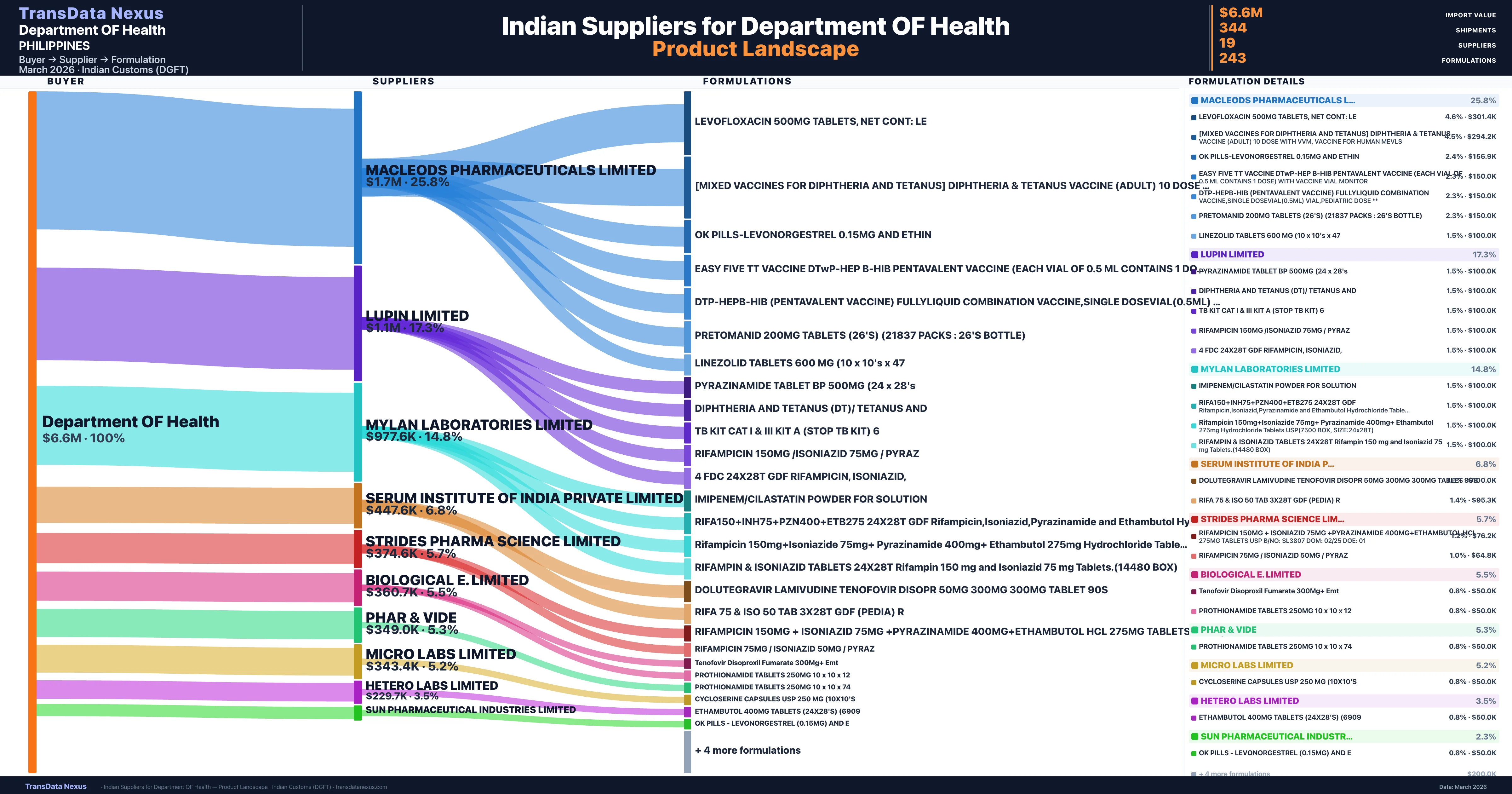
Who Are the Verified Indian Suppliers to Department OF Health?
Customs-verified supplier relationships from Indian DGFT records
| Supplier | Value | Shipments | Share |
|---|---|---|---|
| Macleods Pharmaceuticals Limited | $1.7M | 68 | 25.8% |
| Lupin Limited | $1.1M | 25 | 17.3% |
| Mylan Laboratories Limited | $977.6K | 33 | 14.8% |
| Serum Institute Of India Private Limited | $447.6K | 21 | 6.8% |
| Strides Pharma Science Limited | $374.6K | 10 | 5.7% |
| Biological E. Limited | $360.7K | 11 | 5.5% |
| Phar & Vide | $349.0K | 50 | 5.3% |
| Micro Labs Limited | $343.4K | 10 | 5.2% |
| Hetero Labs Limited | $229.7K | 7 | 3.5% |
| Sun Pharmaceutical Industries Limited | $150.0K | 3 | 2.3% |
| Panacea Biotec Limited | $150.0K | 3 | 2.3% |
| Phar Vide | $146.9K | 44 | 2.2% |
| Aurobindo Pharma Limited | $58.4K | 12 | 0.9% |
| Cipla Limited | $57.8K | 42 | 0.9% |
| Biological E Limited | $50.0K | 1 | 0.8% |
| Medopharm | $30.4K | 1 | 0.5% |
| Emcure Pharmaceuticals Limited | $11.4K | 1 | 0.2% |
| Cadila Pharmaceuticals Limited | $8.7K | 1 | 0.1% |
| Ipca Laboratories Limited | $7.1K | 1 | 0.1% |
Department OF Health sources from 19 verified Indian suppliers across 243 distinct formulations. The supply base is diversified across 19 suppliers, reducing single-source dependency risk.
What Formulations Does Department OF Health Import?
| Formulation | Value | Ships |
|---|---|---|
| Levofloxacin 500MG tablets, net cont | $301.4K | 13 |
| [mixed vaccines for diphtheria and tetanus] diphtheria & tetanus vaccine (adult) 10 dose with vvm, vaccine for human | $294.2K | 6 |
| Ok pills-levonorgestrel 0.15MG and | $156.9K | 4 |
| Easy five tt vaccine dtwp-hep b-hib pentavalent vaccine (Each vial of 0.5 ML contains 1 dose) with vaccine vial | $150.0K | 3 |
| Dtp-hepb-hib (pentavalent vaccine) fullyliquid combination vaccine,single dosevial(0.5ML) vial,pediatric dose | $150.0K | 3 |
| Pretomanid 200MG tablets (26's) (21837 packs : 26's bottle) | $150.0K | 3 |
| Linezolid tablets 600 MG (10 x 10's x | $100.0K | 2 |
| Pyrazinamide tablet BP 500MG (24 x | $100.0K | 2 |
| Diphtheria and tetanus (dt)/ tetanus | $100.0K | 2 |
| Tb kit cat i & iii kit a (stop tb kit) | $100.0K | 2 |
| Rifampicin 150MG /isoniazid 75MG / | $100.0K | 2 |
| 4 fdc 24x28t gdf rifampicin, isoniazid | $100.0K | 2 |
| Imipenem/cilastatin powder for | $100.0K | 2 |
| Rifa150+inh75+pzn400+etb275 24x28t gdf rifampicin,isoniazid,pyrazinamide and ethambutol hydrochloride tablet | $100.0K | 2 |
| Rifampicin 150MG+isoniazide 75MG+ pyrazinamide 400MG+ ethambutol 275MG hydrochloride tablets USP(7500 Box, size:24x28t) | $100.0K | 2 |
Department OF Health imports 243 distinct pharmaceutical formulations. Showing top 15 by value. For full formulation-level data, contact TransData Nexus.
What Products Does Department OF Health Import?
Top Products by Import Value
Department OF Health Therapeutic Categories — 2 Specializations
Department OF Health imports across 2 therapeutic categories, with Tuberculosis Medications (71.1%), Advanced Antibiotics (28.9%), representing the largest segments. The portfolio is concentrated — top 5 products = 100% of total imports.
Tuberculosis Medications
3 products · 71.1% · $1.4M
Advanced Antibiotics
2 products · 28.9% · $550.0K
Import Portfolio — Top 5 by Import Value
| # | Product | Category | Value | Ships | Share | Rk |
|---|---|---|---|---|---|---|
| 1 | Isoniazid | Tuberculosis Medications | $750.0K | 15 | 0.0% | 16 |
| 2 | Pyrazinamide | Tuberculosis Medications | $350.0K | 7 | 0.0% | 8 |
| 3 | Rifampicin | Advanced Antibiotics | $350.0K | 7 | 0.0% | 17 |
| 4 | Ethambutol | Tuberculosis Medications | $250.0K | 5 | 0.0% | 12 |
| 5 | Linezolid | Advanced Antibiotics | $200.0K | 4 | 0.5% | 8 |
Department OF Health imports 5 pharmaceutical products across 2 categories into Philippines totaling $1.9M.
Key Metrics
Top Categories
Indian Suppliers
Related Trade Data
Need Detailed Data?
Shipment-level records, supplier connections & pricing for Department OF Health.
Request DemoDepartment OF Health — Corporate Profile & Information
Company type, headquarters, distribution network, and industry role
1Company Overview
The Department of Health (DOH) in the Philippines is the principal government agency responsible for ensuring access to basic public health services, including the procurement and distribution of essential medicines. As a government procurement entity, the DOH plays a pivotal role in the pharmaceutical supply chain by sourcing medications to meet the healthcare needs of the Filipino population. Headquartered in Manila, the DOH operates under the jurisdiction of the Philippine government, with no parent company. Its mandate encompasses policy formulation, regulation, and direct procurement of pharmaceuticals, positioning it as a central figure in the nation's healthcare infrastructure.
2Distribution Network
The DOH's distribution network is extensive, encompassing regional and provincial health offices across the Philippines. While specific warehouse locations are not publicly detailed, the agency's logistics capabilities are designed to ensure equitable distribution of medical supplies nationwide. The DOH collaborates with various stakeholders, including local government units and private sector partners, to facilitate the efficient delivery of healthcare services. This collaborative approach enables the DOH to maintain a comprehensive geographic coverage, ensuring that essential medicines reach even the most remote areas of the country.
3Industry Role
In the Philippines' pharmaceutical supply chain, the DOH functions primarily as a government procurement entity. It is not a wholesaler, parallel importer, hospital supplier, or logistics intermediary. The agency's role is to source and procure essential medicines, which are then distributed through various channels to healthcare facilities and the public. This centralized procurement strategy aims to standardize the quality and pricing of pharmaceuticals, ensuring that all Filipinos have access to necessary medications.
Supplier Relationship Intelligence — Department OF Health
Sourcing concentration, supply chain resilience, and strategic implications
1Sourcing Concentration Analysis
The DOH's sourcing strategy exhibits a high degree of concentration, with a portfolio comprising only five products across two therapeutic categories: Tuberculosis Medications (71.1%) and Advanced Antibiotics (28.9%). This focused approach suggests a strategic choice to concentrate on critical areas of public health, particularly in combating infectious diseases. The substantial import values—$750K for Isoniazid, $350K each for Pyrazinamide and Rifampicin, $250K for Ethambutol, and $200K for Linezolid—indicate a stable and ongoing relationship with Indian suppliers. The consistent importation of these specific formulations over multiple shipments reflects a stable and reliable supply chain, reducing the risk of supply disruptions.
2Supply Chain Resilience
The DOH's supply chain resilience is bolstered by its partnerships with multiple Indian pharmaceutical manufacturers, including MACLEODS PHARMACEUTICALS LIMITED, LUPIN LIMITED, and MYLAN LABORATORIES LIMITED. This diversification across 19 unique suppliers mitigates the risk associated with single-source dependency. The importation of 243 unique formulations further enhances supply chain flexibility, allowing the DOH to adapt to changing healthcare needs. While specific details on backup suppliers and shipping routes are not publicly disclosed, the agency's established relationships with reputable manufacturers and its adherence to regulatory compliance standards suggest a robust and resilient supply chain capable of maintaining the steady availability of essential medicines.
3Strategic Implications
The DOH's concentrated sourcing pattern positions it as a significant purchaser in the Philippine pharmaceutical market, particularly in the domains of tuberculosis and advanced antibiotics. For Indian exporters, this presents an opportunity to establish or strengthen partnerships with the DOH, given the agency's substantial import volumes and focus on these therapeutic areas. However, the high concentration of imports from a limited number of suppliers may also indicate a preference for established relationships, potentially posing challenges for new entrants. Indian exporters seeking to become alternative suppliers should focus on demonstrating product quality, reliability, and compliance with Philippine regulatory standards to gain the DOH's trust and business.
Importing Pharmaceuticals into Philippines — Regulatory Framework
Regulatory authority, GMP requirements, import licensing for Philippines
1Regulatory Authority & Framework
The Food and Drug Administration (FDA) of the Philippines is the primary regulatory body overseeing the importation and registration of pharmaceutical products. Key legislation governing pharma imports includes the Food, Drug, and Cosmetic Act (Republic Act No. 3720) and the FDA Act of 2009 (Republic Act No. 9711). These laws establish the FDA's authority to regulate all health products, including pharmaceuticals, ensuring their safety, efficacy, and quality. The marketing authorization pathway for Indian generics involves obtaining a Certificate of Product Registration (CPR) from the FDA, which requires compliance with local regulatory standards and may necessitate bioequivalence studies or the submission of a Certificate of Pharmaceutical Product (CPP) from the exporting country's regulatory authority.
2Import Licensing & GMP
Import licensing requirements in the Philippines mandate that pharmaceutical importers hold a valid License to Operate (LTO) issued by the FDA, specifying the "Drug Importer/Wholesaler" category. Additionally, each imported pharmaceutical product must have an FDA-issued Certificate of Product Registration (CPR). Good Manufacturing Practice (GMP) certificates from recognized authorities, such as the European Union (EU) GMP, World Health Organization (WHO) GMP, or Pharmaceutical Inspection Co-operation Scheme (PIC/S), are generally recognized by the FDA. Importers must also comply with the Bureau of Customs (BOC) regulations, including accreditation and proper documentation for each shipment.
3Quality & Labeling
Imported pharmaceutical products must undergo batch testing and meet stability requirements as stipulated by the FDA. Labeling must be in English and Filipino, providing essential information such as product name, dosage form, strength, manufacturer details, and usage instructions. Serialization mandates may apply to facilitate traceability and prevent counterfeit products; however, specific requirements should be verified with the latest FDA guidelines.
4Recent Regulatory Changes
Between 2024 and 2026, the Philippines FDA has implemented several regulatory changes affecting pharmaceutical imports. Notably, in August 2024, the FDA issued Administrative Order No. 2024-0012, prescribing rules and regulations for the registration of pharmaceutical products and active pharmaceutical ingredients intended solely for export. This order aims to streamline the export process and enhance the competitiveness of Philippine pharmaceutical products in the global market. Additionally, in November 2024, the FDA simplified the export process for pharmaceutical products by issuing guidelines that facilitate the registration of products intended exclusively for export, thereby strengthening the health sector and expediting the distribution of medicines to the public. (pna.gov.ph)
Department OF Health — Procurement Pattern Analysis
Product strategy, sourcing profile, and market positioning
1Product Strategy
The DOH's focus on importing tuberculosis medications and advanced antibiotics aligns with the Philippines' public health priorities, addressing the high burden of infectious diseases in the country. The substantial import values for these products indicate a strategic emphasis on ensuring a steady supply of essential medicines to combat these health challenges. Market demand is driven by the prevalence of tuberculosis and the need for effective antibiotic treatments, necessitating reliable and affordable access to these medications.
2Sourcing Profile
The DOH's sourcing strategy is centered on procuring generic drugs, primarily from India, which is known for its robust pharmaceutical manufacturing sector. The agency's preference for finished pharmaceutical formulations, such as tablets, capsules, syrups, and injections, over raw active pharmaceutical ingredients (APIs) or bulk drugs, suggests a focus on ready-to-use products that meet the immediate needs of healthcare providers. India's established reputation for producing high-quality generics at competitive prices makes it a preferred sourcing partner for the DOH.
3Market Positioning
Based on its product mix, the DOH serves the public sector of the Philippine pharmaceutical market, supplying essential medicines to government hospitals, clinics, and health programs. The agency's procurement strategy ensures that these institutions have access to necessary medications, thereby supporting the government's efforts to provide affordable and quality healthcare services to the Filipino population.
Seller's Guide — How to Become a Supplier to Department OF Health
Opportunity assessment, qualifications, and practical approach strategy
1Opportunity Assessment
There is a realistic opportunity for new Indian suppliers to engage with the DOH, particularly if they can offer high-quality products that meet the agency's stringent regulatory requirements. Gaps in the DOH's current sourcing may exist in areas such as the supply of specialized formulations or the need for additional suppliers to ensure a more diversified supply chain. New entrants should focus on demonstrating product quality, reliability, and compliance with Philippine regulatory standards to gain the DOH's trust and business.
2Requirements & Qualifications
Indian exporters seeking to supply the DOH and the Philippine market must obtain a valid License to Operate (LTO) from the FDA, specifying the "Drug Importer/Wholesaler" category. Each pharmaceutical product must have an FDA-issued Certificate of Product Registration (CPR). Good Manufacturing Practice (GMP) certificates from recognized authorities, such as EU GMP, WHO GMP, or PIC/S, are generally recognized by the FDA. Compliance with labeling requirements, including English and Filipino language specifications, and adherence to batch testing and stability requirements are mandatory.
3How to Approach
To build a relationship with the DOH, Indian exporters should initiate contact through official channels, providing detailed product information, regulatory certifications, and evidence of compliance with Philippine standards. Participating in government tenders and responding to procurement notices published by the DOH can enhance visibility and credibility. Developing a comprehensive regulatory filing strategy, including obtaining the necessary LTO and CPR, is essential. Understanding the DOH's procurement timelines and processes will aid in setting realistic expectations and ensuring timely delivery of products.
Frequently Asked Questions — Department OF Health
What products does Department OF Health import from India?
Department OF Health imports 5 pharmaceutical products across 2 categories. Top imports: Isoniazid ($750.0K), Pyrazinamide ($350.0K), Rifampicin ($350.0K), Ethambutol ($250.0K), Linezolid ($200.0K).
Who supplies pharmaceuticals to Department OF Health from India?
Department OF Health sources from 19 verified Indian suppliers. The primary supplier is Macleods Pharmaceuticals Limited (25.8% of imports, $1.7M).
What is Department OF Health's total pharmaceutical import value?
Department OF Health's total pharmaceutical import value from India is $1.9M, based on 38 verified shipments in Indian Customs (DGFT) data.
What therapeutic categories does Department OF Health focus on?
Department OF Health imports across 2 categories. The largest: Tuberculosis Medications (71.1%), Advanced Antibiotics (28.9%).
Get Full Department OF Health Import Intelligence
Access shipment-level details, supplier connections, pricing data, and competitive analysis. TransData Nexus provides verified Indian Customs (DGFT) data trusted by pharmaceutical trade professionals worldwide.
Official References & Regulatory Resources
Verify import regulations and drug registration requirements with the agencies above.
Research Methodology & Data Transparency
Suresh Sormare
Verified AuthorPharmaceutical Export-Import Analyst & Trade Intelligence Expert
Suresh Sormare is a pharmaceutical export-import analyst with deep expertise in Indian Customs (DGFT) data, HS code classification, and global pharmaceutical supply chains. His analysis covers 10M+ shipment records across 150+ countries and is used by manufacturers, procurement agencies, and trade consultants worldwide. Suresh specializes in identifying verified suppliers and buyers from customs records, mapping bilateral pharmaceutical trade corridors, analyzing tariff structures and regulatory frameworks across 170+ destination markets, and benchmarking competitive positioning for finished pharmaceutical formulations. His methodology combines granular customs transaction data with regulatory intelligence from FDA, EMA, WHO, CDSCO, and 40+ national drug authorities to deliver actionable trade insights for the pharmaceutical formulations sector.
linkedin.com/in/sureshsormarePrimary Data Source
All trade data is sourced from Indian Customs (DGFT) official shipping bill records — the authoritative government database for India's pharmaceutical trade. Each verified record contains exporter name, consignee (buyer) name, detailed product description, quantity, declared FOB value (USD), port of loading, destination country, and shipment date.
Analysis Methodology
- 1.Buyer Matching: Department OF Health identified across shipments using consignee name normalization.
- 2.Statistical Normalization: Shipment values are statistically normalized to ensure accurate market share representation.
- 3.Market Share: Calculated per product as Department OF Health's capped value divided by total Indian exports for that product.
- 4.Shipment Count: Based on 38 individual customs records matching Department OF Health.
- 5.Supplier Verification: Department OF Health sources from 19 verified Indian suppliers across 243 formulations, confirmed from customs records.
Government-Sourced Data
Official DGFT customs records
Transparent Methodology
Calculations fully disclosed above
5 Products Tracked
2 therapeutic categories
Expert-Reviewed
By pharmaceutical trade specialists
Data Source & Methodology
Trade data sourced from Indian Customs (DGFT) export shipment records. Values represent FOB export value in USD. For current shipment-level data, contact TransData Nexus.