Commercial Bank OF Ethiopia
Pharmaceutical Importer · Ethiopia · Diabetes & Endocrine Focus · $2.1M Total Trade · DGFT Verified
Commercial Bank OF Ethiopia is a pharmaceutical importer based in Ethiopia with a total trade value of $2.1M across 10 products in 7 therapeutic categories. Based on 44 verified import shipments from Indian Customs (DGFT) records, the company actively imports across multiple product segments. Commercial Bank OF Ethiopia sources from 35 verified Indian suppliers, with Mylan Laboratories Limited accounting for 17.8% of imports.
Commercial Bank OF Ethiopia — Import Portfolio & Supplier Network
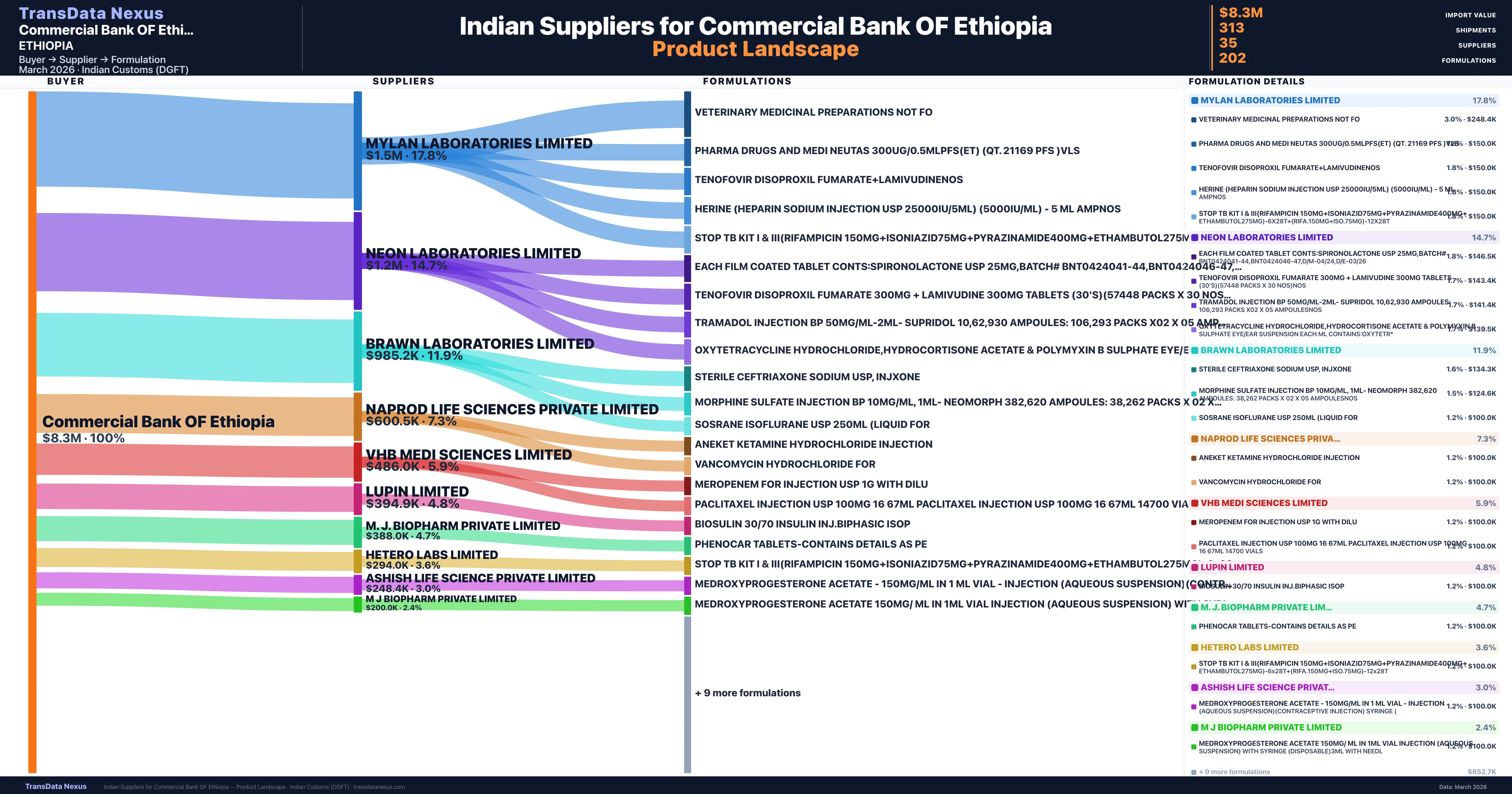
Who Are the Verified Indian Suppliers to Commercial Bank OF Ethiopia?
Customs-verified supplier relationships from Indian DGFT records
Commercial Bank OF Ethiopia sources from 35 verified Indian suppliers across 202 distinct formulations. The supply base is diversified across 35 suppliers, reducing single-source dependency risk.
What Formulations Does Commercial Bank OF Ethiopia Import?
| Formulation | Value | Ships |
|---|---|---|
| Veterinary medicinal preparations not | $248.4K | 9 |
| Pharma drugs and medi neutas 300ug/0.5mlpfs(et) (qt. 21169 pfs | $150.0K | 3 |
| Tenofovir disoproxil fumarate+lamivudinenos | $150.0K | 3 |
| Herine (heparin sodium injection USP 25000iu/5ML) (5000iu/ML) - 5 ML | $150.0K | 3 |
| Stop tb kit i & iii(rifampicin 150MG+isoniazid75mg+pyrazinamide400mg+ethambutol275mg)-6x28t+(rifa.150MG+iso.75MG | $150.0K | 3 |
| Each film coated tablet conts:spironolactone USP 25MG,batch# bnt0424041-44,bnt0424046-47,d/m-04/24 | $146.5K | 3 |
| Tenofovir disoproxil fumarate 300MG + lamivudine 300MG tablets (30's)(57448 packs x 30 nos | $143.4K | 3 |
| Tramadol injection BP 50MG/ML-2ML- supridol 10,62,930 ampoules: 106,293 packs x02 x 05 | $141.4K | 3 |
| Oxytetracycline hydrochloride,hydrocortisone acetate & polymyxin b sulphate eye/ear suspension Each ML | $139.5K | 3 |
| Sterile ceftriaxone sodium USP | $134.3K | 3 |
| Morphine sulfate injection BP 10MG/ML, 1ML- neomorph 382,620 ampoules: 38,262 packs x 02 x 05 | $124.6K | 3 |
| Sosrane isoflurane USP 250ML (liquid | $100.0K | 2 |
| Aneket ketamine hydrochloride | $100.0K | 2 |
| Vancomycin hydrochloride | $100.0K | 2 |
| Meropenem for injection USP 1g with | $100.0K | 2 |
Commercial Bank OF Ethiopia imports 202 distinct pharmaceutical formulations. Showing top 15 by value. For full formulation-level data, contact TransData Nexus.
What Products Does Commercial Bank OF Ethiopia Import?
Commercial Bank OF Ethiopia Therapeutic Categories — 7 Specializations
Commercial Bank OF Ethiopia imports across 7 therapeutic categories, with Diabetes & Endocrine (31.1%), Medical Devices & Diagnostics (31.1%), Antiviral & HIV Medications (11.9%) representing the largest segments. The portfolio is concentrated — top 5 products = 77% of total imports.
Diabetes & Endocrine
1 products · 31.1% · $650.0K
Medical Devices & Diagnostics
2 products · 31.1% · $650.0K
Antiviral & HIV Medications
2 products · 11.9% · $250.0K
Advanced Antibiotics
1 products · 7.2% · $150.0K
Antibiotics
1 products · 7.2% · $150.0K
Analgesics & Antipyretics
1 products · 6.0% · $124.6K
Advanced Oncology
2 products · 5.6% · $117.9K
Import Portfolio — Top 10 by Import Value
| # | Product | Category | Value | Ships | Share | Rk |
|---|---|---|---|---|---|---|
| 1 | Insulin | Diabetes & Endocrine | $650.0K | 13 | 0.9% | 5 |
| 2 | Kit | Medical Devices & Diagnostics | $450.0K | 9 | 0.1% | 9 |
| 3 | Syringe | Medical Devices & Diagnostics | $200.0K | 4 | 0.1% | 8 |
| 4 | Atazanavir | Antiviral & HIV Medications | $150.0K | 3 | 0.2% | 10 |
| 5 | Meropenem | Advanced Antibiotics | $150.0K | 3 | 0.1% | 15 |
| 6 | Tetracycline | Antibiotics | $150.0K | 3 | 0.9% | 11 |
| 7 | Morphine | Analgesics & Antipyretics | $124.6K | 3 | 0.7% | 2 |
| 8 | Darunavir | Antiviral & HIV Medications | $100.0K | 2 | 0.2% | 11 |
| 9 | Bleomycin | Advanced Oncology | $78.7K | 2 | 1.4% | 12 |
| 10 | Mercaptopurine | Advanced Oncology | $39.2K | 2 | 6.7% | 2 |
Commercial Bank OF Ethiopia imports 10 pharmaceutical products across 7 categories into Ethiopia totaling $2.1M.
Key Metrics
Top Categories
Indian Suppliers
Related Trade Data
Need Detailed Data?
Shipment-level records, supplier connections & pricing for Commercial Bank OF Ethiopia.
Request DemoCommercial Bank OF Ethiopia — Corporate Profile & Information
Company type, headquarters, distribution network, and industry role
1Company Overview
The Commercial Bank of Ethiopia (CBE) is a state-owned financial institution headquartered in Addis Ababa, Ethiopia. Established in 1963, CBE has grown to become the largest commercial bank in the country, offering a wide range of banking services, including savings and checking accounts, loans, and foreign exchange services. While primarily a financial entity, CBE has also engaged in the importation of pharmaceutical products, positioning itself as a significant player in Ethiopia's pharmaceutical supply chain. This involvement underscores the bank's diversified operations and its commitment to supporting the nation's healthcare sector.
2Distribution Network
CBE's distribution network for pharmaceutical imports is not publicly detailed. However, as a major financial institution, the bank likely leverages its extensive infrastructure, including branches and financial networks, to facilitate the importation and distribution of pharmaceutical products. This strategic approach enables efficient logistics and broad geographic coverage within Ethiopia, ensuring that imported medicines reach various regions effectively.
3Industry Role
In Ethiopia's pharmaceutical supply chain, CBE functions as an importer and distributor of finished pharmaceutical formulations. By sourcing medicines from international suppliers, particularly from India, the bank plays a crucial role in enhancing the availability of essential drugs in the Ethiopian market. This involvement supports the healthcare system by ensuring a steady supply of medications across the country.
Supplier Relationship Intelligence — Commercial Bank OF Ethiopia
Sourcing concentration, supply chain resilience, and strategic implications
1Sourcing Concentration Analysis
CBE's pharmaceutical imports from India total $2.1 million USD across 44 shipments, encompassing 10 products across 7 therapeutic categories. The top five products imported include insulin ($650K), kits ($450K), syringes ($200K), atazanavir ($150K), and meropenem ($150K). The bank's portfolio concentration is notable, with the top five products accounting for 76.5% of the total import value. This high concentration suggests a strategic focus on specific high-demand medications, potentially optimizing procurement and distribution processes. However, such concentration also indicates a dependency on a limited range of products, which could pose risks if market dynamics change or if there are disruptions in the supply chain.
2Supply Chain Resilience
CBE's supply chain resilience is influenced by its reliance on a select group of Indian suppliers. The top five suppliers—Mylan Laboratories Limited, Neon Laboratories Limited, Brawn Laboratories Limited, Naprod Life Sciences Private Limited, and VHB Medi Sciences Limited—collectively account for a significant portion of the import value. This concentrated supplier base may enhance negotiation leverage and streamline logistics. However, it also exposes the bank to potential risks associated with supplier disruptions, such as production delays or regulatory issues. To mitigate these risks, CBE may consider diversifying its supplier base and establishing relationships with additional manufacturers to ensure a more resilient supply chain.
3Strategic Implications
CBE's sourcing pattern, characterized by a focus on specific high-demand pharmaceutical products from a concentrated group of suppliers, positions the bank as a key player in meeting critical healthcare needs in Ethiopia. This strategy allows for efficient procurement and distribution, potentially leading to cost savings and improved market positioning. For Indian exporters, this presents an opportunity to strengthen partnerships with CBE by offering a broader range of products or by ensuring consistent quality and supply, thereby enhancing their presence in the Ethiopian market.
Importing Pharmaceuticals into Ethiopia — Regulatory Framework
Regulatory authority, GMP requirements, import licensing for Ethiopia
1Regulatory Authority & Framework
The Ethiopian Food and Drug Authority (EFDA) is the national regulatory body responsible for ensuring the safety, quality, and efficacy of medicines, medical devices, and other health-related products in Ethiopia. Established under Proclamation No. 1263/2021 and defined under Regulation No. 531/2023, EFDA's mandate includes the registration, licensing, and inspection of pharmaceutical products and establishments. EFDA's role is critical in safeguarding public health by regulating the importation and distribution of pharmaceutical products. (efda.gov.et)
2Import Licensing & GMP
Importers of pharmaceutical products into Ethiopia must obtain an import permit from EFDA. This process involves submitting an application through EFDA's electronic regulatory information system, i-Import, which streamlines the approval submission and review process. Additionally, EFDA requires that manufacturers provide a valid Good Manufacturing Practice (GMP) certificate or a waiver letter before issuing marketing authorization for imported medicines. The GMP certificate ensures that the manufacturing facilities adhere to internationally recognized quality standards. (efda.gov.et)
3Quality & Labeling
EFDA mandates that imported pharmaceutical products undergo batch testing to confirm their quality, safety, and efficacy. Stability studies are also required to ensure that products maintain their intended quality throughout their shelf life under Ethiopian storage conditions. Labeling requirements include providing information in the official language of Ethiopia, Amharic, and ensuring that labels meet EFDA's standards for clarity and accuracy. Serialization mandates are in place to enhance traceability and prevent counterfeit products from entering the market. (efda.gov.et)
4Recent Regulatory Changes
In May 2025, EFDA revised its directive on the inspection of pharmaceutical manufacturers, reducing the interval for Good Manufacturing Practice (GMP) re-inspection from five years to three years. This change aims to strengthen regulatory oversight and ensure that manufacturing facilities consistently meet quality standards. Additionally, fees paid for GMP inspections or waivers are now valid for only three years from the date of receipt by EFDA, emphasizing the need for timely compliance and ongoing quality assurance from manufacturers.
Commercial Bank OF Ethiopia — Procurement Pattern Analysis
Product strategy, sourcing profile, and market positioning
1Product Strategy
CBE's focus on importing specific high-demand pharmaceutical products, such as insulin, kits, syringes, atazanavir, and meropenem, aligns with the critical healthcare needs in Ethiopia. The bank's import strategy is driven by market demand for these essential medications, which are vital for managing chronic conditions like diabetes and for treating infections. By concentrating on these therapeutic areas, CBE aims to address significant health challenges in the country and ensure the availability of necessary treatments.
2Sourcing Profile
CBE's sourcing strategy emphasizes importing finished pharmaceutical formulations from India, a country known for its robust pharmaceutical manufacturing sector. The bank's focus on specific therapeutic categories suggests a targeted approach to procurement, ensuring that the imported products meet the therapeutic needs of the Ethiopian population. India's adherence to international quality standards and its competitive pricing make it a strategic partner for CBE in fulfilling Ethiopia's pharmaceutical requirements.
3Market Positioning
Through its importation of essential pharmaceutical products, CBE serves multiple segments of the Ethiopian market, including retail pharmacies, hospitals, and government health institutions. By ensuring the availability of critical medications, the bank supports the healthcare infrastructure and contributes to the overall health and well-being of the Ethiopian population.
Seller's Guide — How to Become a Supplier to Commercial Bank OF Ethiopia
Opportunity assessment, qualifications, and practical approach strategy
1Opportunity Assessment
There is a realistic opportunity for new Indian suppliers to engage with CBE, especially if they can offer a broader range of pharmaceutical products that complement the bank's existing imports. Identifying gaps in CBE's current sourcing, such as unmet therapeutic needs or emerging health challenges, presents avenues for new suppliers to introduce innovative solutions. Establishing partnerships with CBE could enhance market access and strengthen the presence of Indian pharmaceutical products in Ethiopia.
2Requirements & Qualifications
Indian exporters seeking to supply pharmaceutical products to CBE and the Ethiopian market must ensure that their products are registered with EFDA and comply with Ethiopian regulatory standards. This includes obtaining a valid GMP certificate or a waiver letter from EFDA, ensuring that products meet EFDA's quality and safety standards, and adhering to labeling requirements in Amharic. Additionally, exporters should be prepared to participate in EFDA's electronic regulatory information system, i-Import, for the import approval process. (efda.gov.et)
3How to Approach
To establish a relationship with CBE, Indian exporters should first ensure that their products are registered with EFDA and meet all regulatory requirements. Engaging with EFDA's i-Import system is essential for the import approval process. Building a relationship with CBE involves demonstrating the quality and reliability of products, understanding the bank's procurement processes, and aligning with its strategic focus on essential pharmaceutical products. Participating in tenders and responding to requests for proposals can provide opportunities to supply products to CBE. Understanding the regulatory filing strategy and adhering to EFDA's timelines for product registration and import approval are crucial steps in this process.
Frequently Asked Questions — Commercial Bank OF Ethiopia
What products does Commercial Bank OF Ethiopia import from India?
Commercial Bank OF Ethiopia imports 10 pharmaceutical products across 7 categories. Top imports: Insulin ($650.0K), Kit ($450.0K), Syringe ($200.0K), Atazanavir ($150.0K), Meropenem ($150.0K).
Who supplies pharmaceuticals to Commercial Bank OF Ethiopia from India?
Commercial Bank OF Ethiopia sources from 35 verified Indian suppliers. The primary supplier is Mylan Laboratories Limited (17.8% of imports, $1.5M).
What is Commercial Bank OF Ethiopia's total pharmaceutical import value?
Commercial Bank OF Ethiopia's total pharmaceutical import value from India is $2.1M, based on 44 verified shipments in Indian Customs (DGFT) data.
What therapeutic categories does Commercial Bank OF Ethiopia focus on?
Commercial Bank OF Ethiopia imports across 7 categories. The largest: Diabetes & Endocrine (31.1%), Medical Devices & Diagnostics (31.1%), Antiviral & HIV Medications (11.9%).
Get Full Commercial Bank OF Ethiopia Import Intelligence
Access shipment-level details, supplier connections, pricing data, and competitive analysis. TransData Nexus provides verified Indian Customs (DGFT) data trusted by pharmaceutical trade professionals worldwide.
Official References & Regulatory Resources
Verify import regulations and drug registration requirements with the agencies above.
Research Methodology & Data Transparency
Suresh Sormare
Verified AuthorPharmaceutical Export-Import Analyst & Trade Intelligence Expert
Suresh Sormare is a pharmaceutical export-import analyst with deep expertise in Indian Customs (DGFT) data, HS code classification, and global pharmaceutical supply chains. His analysis covers 10M+ shipment records across 150+ countries and is used by manufacturers, procurement agencies, and trade consultants worldwide. Suresh specializes in identifying verified suppliers and buyers from customs records, mapping bilateral pharmaceutical trade corridors, analyzing tariff structures and regulatory frameworks across 170+ destination markets, and benchmarking competitive positioning for finished pharmaceutical formulations. His methodology combines granular customs transaction data with regulatory intelligence from FDA, EMA, WHO, CDSCO, and 40+ national drug authorities to deliver actionable trade insights for the pharmaceutical formulations sector.
linkedin.com/in/sureshsormarePrimary Data Source
All trade data is sourced from Indian Customs (DGFT) official shipping bill records — the authoritative government database for India's pharmaceutical trade. Each verified record contains exporter name, consignee (buyer) name, detailed product description, quantity, declared FOB value (USD), port of loading, destination country, and shipment date.
Analysis Methodology
- 1.Buyer Matching: Commercial Bank OF Ethiopia identified across shipments using consignee name normalization, aggregating 2 name variants.
- 2.Statistical Normalization: Shipment values are statistically normalized to ensure accurate market share representation.
- 3.Market Share: Calculated per product as Commercial Bank OF Ethiopia's capped value divided by total Indian exports for that product.
- 4.Shipment Count: Based on 44 individual customs records matching Commercial Bank OF Ethiopia.
- 5.Supplier Verification: Commercial Bank OF Ethiopia sources from 35 verified Indian suppliers across 202 formulations, confirmed from customs records.
Government-Sourced Data
Official DGFT customs records
Transparent Methodology
Calculations fully disclosed above
10 Products Tracked
7 therapeutic categories
Expert-Reviewed
By pharmaceutical trade specialists
Data Source & Methodology
Trade data sourced from Indian Customs (DGFT) export shipment records. Values represent FOB export value in USD. Profile aggregates 2 company name variants from customs records. For current shipment-level data, contact TransData Nexus.