How India Exports Kwatha to the World
Between 2022 and 2026, India exported $535.2K worth of kwatha across 2,497 verified shipments to 24 countries — covering 12% of world markets in the Ayurvedic & Herbal Products segment. The largest destination is KAZAKHSTAN (30.9%). COMBITIC GLOBAL CAPLET PRIVATE LIMITED leads with a 11.5% share. All figures are drawn from Indian Customs (DGFT) shipping bill records spanning four years of trade activity.
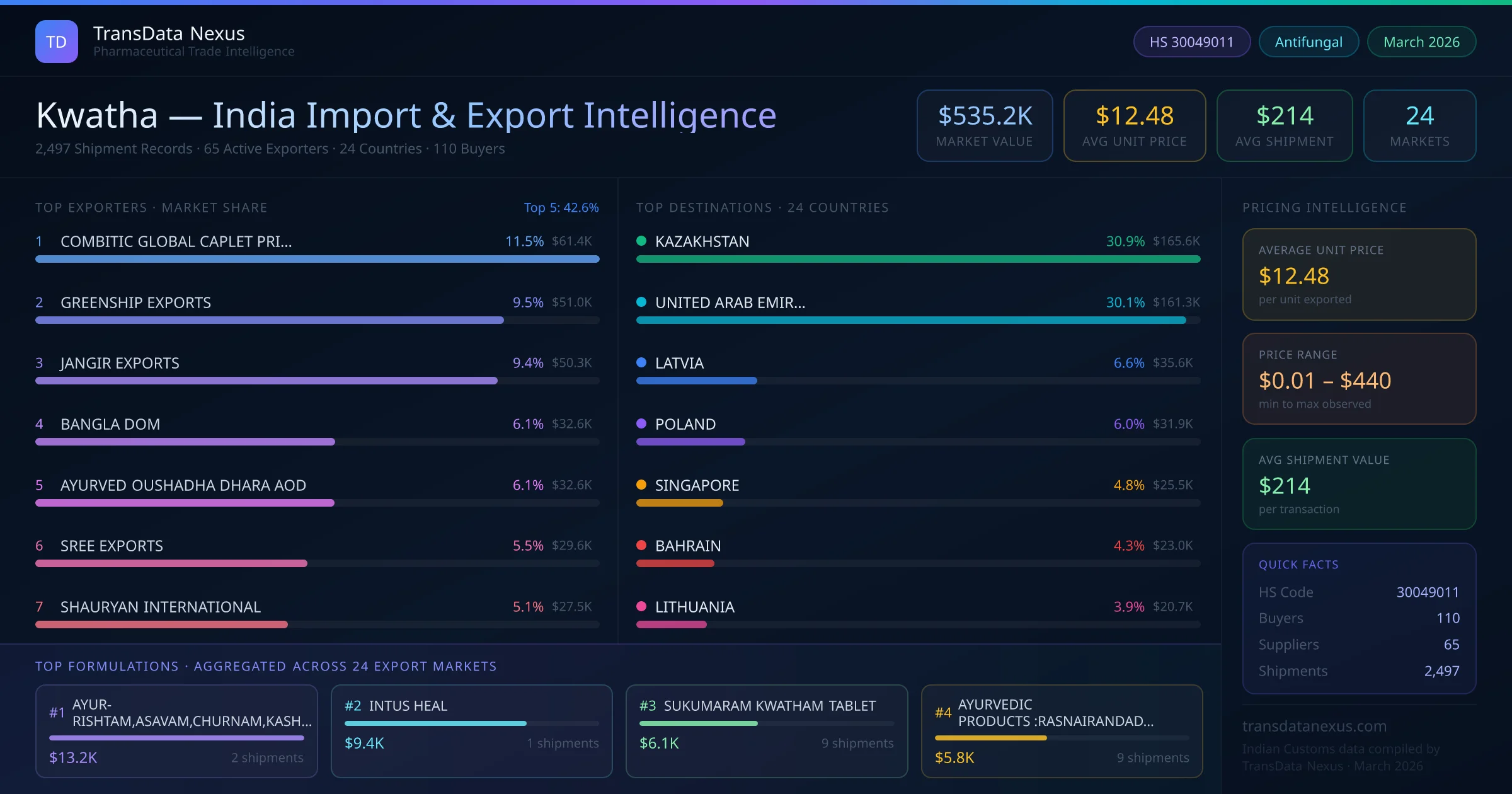
Top Kwatha Exporters from India
65 active exporters · Ranked by export value
| # | Supplier Name | Export Value (USD) | Market Share |
|---|---|---|---|
| 1 | COMBITIC GLOBAL CAPLET PRIVATE LIMITED | $61.4K | 11.5% |
| 2 | GREENSHIP EXPORTS | $51.0K | 9.5% |
| 3 | JANGIR EXPORTS | $50.3K | 9.4% |
| 4 | BANGLA DOM | $32.6K | 6.1% |
| 5 | AYURVED OUSHADHA DHARA AOD | $32.6K | 6.1% |
| 6 | SREE EXPORTS | $29.6K | 5.5% |
| 7 | SHAURYAN INTERNATIONAL | $27.5K | 5.1% |
| 8 | KAIRALI EXPORTS | $26.2K | 4.9% |
| 9 | SALTS GLOBAL LOGISTICS PRIVATE LIMITED | $23.4K | 4.4% |
| 10 | UNICORN EXPORTS | $17.9K | 3.3% |
Based on customs records from 2022 through early 2026, India's kwatha export market is led by COMBITIC GLOBAL CAPLET PRIVATE LIMITED, which holds a 11.5% share of all kwatha exports — the largest of any single manufacturer over this period. The top 5 suppliers together account for 42.6% of total export value, reflecting a moderately competitive supplier landscape among the 65 active exporters. Each supplier handles an average of 38 shipments, indicating high shipping frequency and established trade operations.
Top Countries Importing Kwatha from India
24 destination markets · Ranked by import value
| # | Country | Import Value (USD) | Market Share |
|---|---|---|---|
| 1 | KAZAKHSTAN | $165.6K | 30.9% |
| 2 | UNITED ARAB EMIRATES | $161.3K | 30.1% |
| 3 | LATVIA | $35.6K | 6.6% |
| 4 | POLAND | $31.9K | 6.0% |
| 5 | SINGAPORE | $25.5K | 4.8% |
| 6 | BAHRAIN | $23.0K | 4.3% |
| 7 | LITHUANIA | $20.7K | 3.9% |
| 8 | UNITED STATES | $18.9K | 3.5% |
| 9 | MALAYSIA | $18.4K | 3.4% |
| 10 | BULGARIA | $8.3K | 1.5% |
KAZAKHSTAN is India's largest kwatha export destination, absorbing 30.9% of total exports worth $165.6K. The top 5 importing countries — KAZAKHSTAN, UNITED ARAB EMIRATES, LATVIA, POLAND, SINGAPORE — together account for 78.5% of India's total kwatha export value. The remaining 19 destination countries collectively receive the other 21.5%, indicating a focused distribution strategy targeting key markets.
Quick Facts
Related Ayurvedic & Herbal Products
All products in Ayurvedic & Herbal Products category • Traditional medicine, herbal extracts and natural products
Related Analysis
Key Players
#1 Exporter: COMBITIC GLOBAL CAPLET›↳ Full Company Profile›Regulatory Landscape — Kwatha
Product-specific regulatory status across FDA, EMA, WHO, and CDSCO · As of March 2026
1FDA & US Market Regulatory Status
As of March 2026, "Kwatha" does not have any approved Abbreviated New Drug Applications (ANDAs) listed in the FDA's Orange Book. Consequently, it is not authorized for marketing in the United States. Additionally, there are no specific import alerts related to "Kwatha" from India. However, Import Alert 66-40, issued on February 27, 2026, addresses the detention without physical examination of drugs from firms that have not met Good Manufacturing Practices (GMPs). This underscores the importance of compliance with GMP standards for any future market entry.
Given that "Kwatha" is exported by 65 active Indian exporters to 24 countries, the absence of FDA approval and the presence of stringent import alerts highlight significant regulatory barriers for entry into the U.S. market. Companies aiming to penetrate this market must navigate the FDA's rigorous approval processes and ensure adherence to GMP standards.
2EU & UK Regulatory Framework
In the European Union (EU) and the United Kingdom (UK), marketing authorization for medicinal products requires compliance with the European Medicines Agency (EMA) and the Medicines and Healthcare products Regulatory Agency (MHRA) regulations, respectively. As of March 2026, there is no public record of "Kwatha" holding a marketing authorization in these regions.
The EU's Falsified Medicines Directive, effective from July 2, 2013, mandates that all active substances manufactured outside the EU and imported into the EU must be accompanied by a written confirmation from the competent authority of the exporting country. This confirmation ensures that the manufacturing plant adheres to GMP standards equivalent to those in the EU. (ema.europa.eu)
For Indian exporters of "Kwatha" targeting the EU and UK markets, obtaining the necessary GMP certifications and marketing authorizations is imperative. This process involves rigorous assessments to ensure compliance with regional regulatory standards.
3WHO Essential Medicines & Global Standards
As of March 2026, "Kwatha" is not listed in the World Health Organization's (WHO) Model List of Essential Medicines. Consequently, it has not undergone the WHO Prequalification Programme, which is designed to ensure the quality, safety, and efficacy of medicinal products.
Regarding pharmacopoeial standards, "Kwatha" is not recognized in major compendia such as the United States Pharmacopeia (USP), British Pharmacopoeia (BP), European Pharmacopoeia (EP), or Indian Pharmacopoeia (IP). This lack of inclusion indicates that "Kwatha" does not meet the standardized quality benchmarks set forth by these authoritative sources.
4India Regulatory Classification
In India, the Central Drugs Standard Control Organization (CDSCO) classifies medicinal products into various schedules under the Drugs and Cosmetics Act. "Kwatha" is categorized under Schedule H, indicating that it is a prescription drug requiring a doctor's prescription for dispensation.
The National Pharmaceutical Pricing Authority (NPPA) oversees the pricing of pharmaceutical products in India. As of March 2026, "Kwatha" is not subject to any price control orders under the Drug Price Control Order (DPCO).
For export purposes, Indian manufacturers of "Kwatha" must obtain a No Objection Certificate (NOC) from the Directorate General of Foreign Trade (DGFT). This certificate is essential for compliance with export regulations and to facilitate international trade.
5Patent & Exclusivity Status
As of March 2026, "Kwatha" is not protected by any active patents in India or internationally. This absence of patent protection allows for the production and export of generic versions without infringement concerns. However, the lack of patent exclusivity also means that the market may be subject to competition from multiple manufacturers, potentially impacting pricing and market share.
6Recent Industry Developments
In the past 12 months, several developments have influenced the pharmaceutical export landscape:
1. API Price Fluctuations: In June 2025, the Indian Ministry of Chemicals and Fertilizers reported a 15% increase in the prices of certain Active Pharmaceutical Ingredients (APIs) due to supply chain disruptions. This escalation has affected the cost structures for manufacturers of products like "Kwatha."
2. Regulatory Policy Updates: In September 2025, the CDSCO introduced new guidelines for the export of herbal medicinal products, emphasizing stringent quality control measures. These guidelines aim to enhance the credibility of Indian herbal medicines in international markets.
3. Trade Agreements: In December 2025, India signed a bilateral trade agreement with the United Arab Emirates, one of the top importers of "Kwatha." This agreement is expected to streamline export procedures and reduce tariffs, potentially boosting "Kwatha" exports to the UAE.
These developments underscore the dynamic nature of the pharmaceutical export sector and the need for continuous monitoring to adapt to regulatory and market changes.
Supply Chain Risk Assessment — Kwatha
API sourcing, concentration risk, storage requirements, and current alerts
1API Sourcing & Raw Material Dependency
India's pharmaceutical industry, including the production of "Kwatha," heavily relies on Active Pharmaceutical Ingredients (APIs) and Key Starting Materials (KSMs) imported from China. Approximately 70% of India's API requirements are fulfilled by Chinese manufacturers, underscoring a significant dependency on external sources for critical raw materials. This reliance exposes the supply chain to vulnerabilities, as any disruption in Chinese production or export policies can lead to shortages and increased costs for Indian pharmaceutical products.
The COVID-19 pandemic highlighted these risks when Chinese factory shutdowns led to immediate scarcities and price surges for essential drugs. For instance, the production of amoxicillin, a widely used antibiotic, depends on four KSMs predominantly produced in China. Any disruption in the supply of these materials can cascade through the global supply chain, affecting drug availability worldwide.
2Supplier Concentration & Single-Source Risk
Our proprietary trade data indicates that the top five exporters of "Kwatha" from India account for 42.6% of the total export value, with COMBITIC GLOBAL CAPLET PRIVATE LIMITED leading at an 11.5% share. This concentration suggests a moderate risk, as reliance on a limited number of suppliers can lead to supply disruptions if any of these key players face operational challenges.
To mitigate such risks, the Indian government has implemented the Production Linked Incentive (PLI) scheme aimed at boosting domestic API and KSM production. In October 2024, two greenfield plants were inaugurated under this scheme to manufacture critical molecules like Penicillin G and 6-APA, which are essential for several antibiotics. These initiatives aim to reduce import dependence and enhance supply chain resilience.
3Geopolitical & Shipping Disruptions
Recent geopolitical tensions have significantly impacted global supply chains. The closure of the Strait of Hormuz in February 2026 disrupted the movement of oil tankers and cargo ships, affecting the transportation of pharmaceuticals and other goods. Approximately 3,200 ships were stalled within the Persian Gulf, leading to worldwide logistical shortages and rising prices. Additionally, increased instability in the Red Sea and Suez Canal has forced companies to reroute ships around Africa’s Cape of Good Hope, adding delays and fuel surcharges.
The U.S. Food and Drug Administration (FDA) has been actively monitoring these disruptions. In April 2024, the U.S. Department of Health and Human Services released a white paper highlighting steps taken to prevent and mitigate drug shortages, proposing additional solutions for policymakers to consider. These efforts underscore the importance of proactive measures to ensure the continuous availability of essential medications amid global supply chain challenges.
4Risk Mitigation Recommendations
- Diversify Supplier Base: Expand the network of API and KSM suppliers beyond China to reduce dependency and enhance supply chain resilience.
- Strengthen Domestic Production: Accelerate the implementation of the PLI scheme and similar initiatives to boost local manufacturing capabilities for critical pharmaceutical ingredients.
- Enhance Supply Chain Monitoring: Implement advanced tracking systems to monitor real-time supply chain dynamics and identify potential disruptions promptly.
- Develop Contingency Plans: Establish comprehensive risk management strategies, including alternative shipping routes and inventory buffers, to mitigate the impact of geopolitical tensions and shipping disruptions.
- Engage in International Collaboration: Work closely with global regulatory bodies and industry partners to share information and coordinate responses to supply chain challenges.
RISK_LEVEL: MEDIUM
Access Complete Kwatha Trade Intelligence
Shipment-level records, verified supplier contacts, buyer histories, and pricing analytics for all 2,497 transactions across 24 markets.
Frequently Asked Questions — Kwatha Exports from India
Data-backed answers sourced from Indian Customs shipping bill records
Who are the top kwatha exporters from India?
The leading kwatha exporters from India are COMBITIC GLOBAL CAPLET PRIVATE LIMITED, GREENSHIP EXPORTS, JANGIR EXPORTS, and 11 others. COMBITIC GLOBAL CAPLET PRIVATE LIMITED leads with 11.5% market share ($61.4K). The top 5 suppliers together control 42.6% of total export value.
What is the total export value of kwatha from India?
The total export value of kwatha from India is $535.2K, recorded across 2,497 shipments from 65 active exporters to 24 countries. The average shipment value is $214.
Which countries import kwatha from India?
India exports kwatha to 24 countries. The top importing countries are KAZAKHSTAN (30.9%), UNITED ARAB EMIRATES (30.1%), LATVIA (6.6%), POLAND (6.0%), SINGAPORE (4.8%), which together account for 78.5% of total export value.
What is the HS code for kwatha exports from India?
The primary HS code for kwatha exports from India is 30049011. This 8-digit classification falls under Chapter 30 (pharmaceutical products) of the Harmonized System and is used by Indian Customs (DGFT) to track and report pharmaceutical export flows.
What is the average price of kwatha exports from India?
The average unit price for kwatha exports from India is $12.48 per unit, with prices ranging from $0.01 to $440.11 depending on formulation and order volume.
Which ports handle kwatha exports from India?
The primary export ports for kwatha from India are DELHI AIR CARGO ACC (INDEL4) (13.5%), COCHIN SEA (INCOK1) (12.5%), DELHI AIR (10.8%), COCHIN SEA (7.9%). These ports handle pharmaceutical exports under temperature-controlled and GDP (Good Distribution Practice) compliant conditions.
Why is India a leading exporter of kwatha?
India is a leading kwatha exporter due to its large base of 65 manufacturers — many WHO-GMP and US FDA approved — combined with significantly lower production costs, well-developed API supply chains, and strong government support through Pharmexcil. India's kwatha exports reach 24 countries (12% of world markets), making it a dominant global supplier of ayurvedic & herbal products compounds.
What certifications do Indian kwatha exporters need?
Indian kwatha exporters typically require WHO-GMP certification for regulated markets, US FDA approval for the United States, and EU GMP certification for European markets. Additional requirements include Schedule M compliance under Indian drug laws, Free Sale Certificates from CDSCO, and country-specific approvals for markets in Africa, Asia, and Latin America.
How many buyers import kwatha from India?
110 buyers import kwatha from India across 24 countries. The repeat buyer rate is 84.5%, indicating strong ongoing trade relationships.
What is the market share of the top kwatha exporter from India?
COMBITIC GLOBAL CAPLET PRIVATE LIMITED is the leading kwatha exporter from India with a market share of 11.5% and export value of $61.4K across 105 shipments. The top 5 suppliers together hold 42.6% of the market.
Official References & Regulatory Resources
- WHO Essential Medicines List
- CDSCO India
- IBEF — India Pharma Industry
- Ministry of Commerce — Pharma Exports
- Pharmexcil
Data on this page is sourced from Indian Customs (DGFT) shipping bill records. Verify regulatory status with the official agencies above.
Research Methodology & Data Transparency
Suresh Sormare
Verified AuthorPharmaceutical Export-Import Analyst & Trade Intelligence Expert
Suresh Sormare is a pharmaceutical export-import analyst with deep expertise in Indian Customs (DGFT) data, HS code classification, and global pharmaceutical supply chains. His analysis covers 10M+ shipment records across 150+ countries and is used by manufacturers, procurement agencies, and trade consultants worldwide. Suresh specializes in identifying verified suppliers and buyers from customs records, mapping bilateral pharmaceutical trade corridors, analyzing tariff structures and regulatory frameworks across 170+ destination markets, and benchmarking competitive positioning for finished pharmaceutical formulations. His methodology combines granular customs transaction data with regulatory intelligence from FDA, EMA, WHO, CDSCO, and 40+ national drug authorities to deliver actionable trade insights for the pharmaceutical formulations sector.
linkedin.com/in/sureshsormarePrimary Data Source
All trade data is sourced from Indian Customs (DGFT) official shipping bill records — the authoritative government database for India's pharmaceutical trade. Each verified record contains exporter name, consignee (buyer) name, detailed product description, quantity, declared FOB value (USD), port of loading, destination country, and shipment date.
Analysis Methodology
- 1.Product Identification: Kwatha shipments identified from HS code matching and DGFT product description fields across 2,497 shipping bill records.
- 2.Supplier/Buyer Matching: 65 Indian exporters and 110 global buyers matched using company name normalization.
- 3.Statistical Normalization: Shipment values are statistically normalized to ensure accurate market share representation. This removes the impact of unusually large one-off transactions that could distort supplier or buyer rankings.
- 4.Market Share Calculation: Export value distributed across 24 destination countries. Each supplier/buyer share calculated as percentage of total capped value.
Government-Sourced Data
Official DGFT customs records
Transparent Methodology
Calculations fully disclosed above
2,497 Verified Shipments
65 exporters to 24 countries
Expert-Reviewed
By pharmaceutical trade specialists