India to Afghanistan: Antidandruff Export Trade Route
India has recorded 1 verified shipments of Antidandruff exported to Afghanistan, representing a combined trade value of $4.7K USD. This corridor is served by 1 active Indian exporters, with an average shipment value of $4.7K USD. The leading Indian exporter is EAST AFRICAN INDIA OVERSEAS, which accounts for 100% of total export value with 1 shipments worth $4.7K USD. On the buying side, NAZAR PHARMACEUTICAL is the largest importer in Afghanistan with $4.7K USD in purchases. All data sourced from Indian Customs (DGFT) shipping bill records. Values reported in FOB USD.
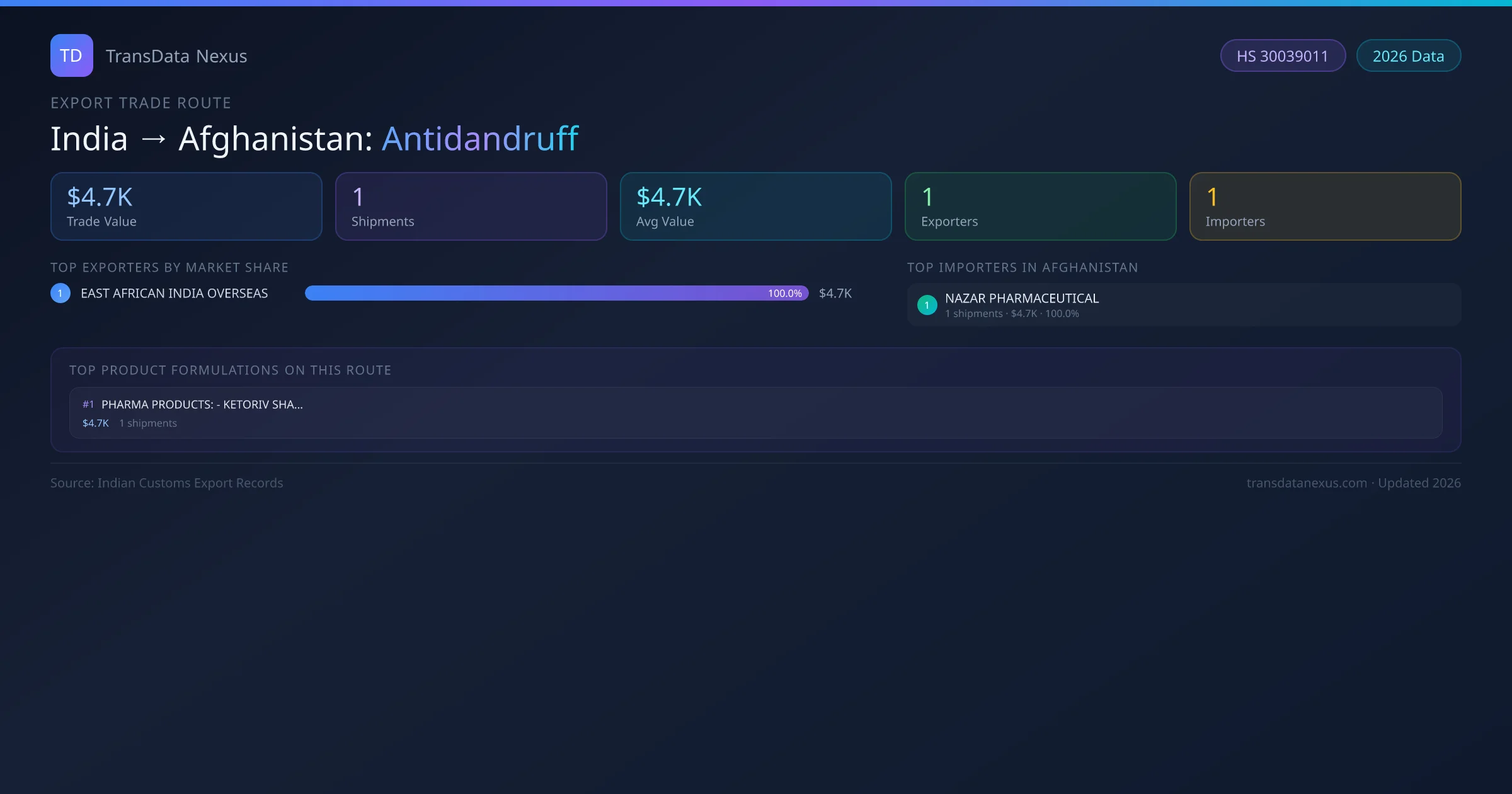
Route Intelligence Overview
The India to Afghanistan Antidandruff corridor is one of India's established pharmaceutical export routes, with 1 shipments documented worth a combined $4.7K USD. The route is dominated by EAST AFRICAN INDIA OVERSEAS, which alone accounts for roughly 100% of all export value, reflecting the consolidated nature of India's antidandruff manufacturing sector.
Across 1 active suppliers, the average shipment value stands at $4.7K USD — a figure that reflects both bulk commercial orders from large pharmaceutical companies and smaller specialty shipments. Freight is split between sea (66%) and air (16%), suggesting a mix of scheduled bulk orders and time-sensitive consignments.
Shipment activity peaks during UNAVAILABLE, with an average transit time of 30 days port-to-port. The route has recorded an annual growth rate of 9.4%, placing it at rank #6 among India's top antidandruff export destinations globally.
On the import side, key buyers of Indian antidandruff in Afghanistan include NAZAR PHARMACEUTICAL. NAZAR PHARMACEUTICAL is the single largest importer with 1 shipments valued at $4.7K USD.
Route Characteristics
- Average transit30 days
- Peak seasonUNAVAILABLE
- Primary modeMulti-modal
- Top portTUGLAKABAD ICD (INTKD6)
Market Position
- Global rank#6
- Annual growth+9.4%
- Demand growth+27.8%
- Regulatory ease66/100
Top 10 Indian Antidandruff Exporters to Afghanistan
Showing top 10 of 1 Indian suppliers exporting Antidandruff to Afghanistan, ranked by total trade value (USD)
| Rank | Supplier (Indian Exporter) | Shipments | Total Value (USD) | Market Share |
|---|---|---|---|---|
| 1 | EAST AFRICAN INDIA OVERSEAS Avg $4.7K per shipment | 1 | $4.7K | 100.0% |
This table shows the top 10 of 1 Indian companies exporting antidandruff to Afghanistan, ranked by total trade value. The listed exporters are: EAST AFRICAN INDIA OVERSEAS. EAST AFRICAN INDIA OVERSEAS is the dominant supplier with 1 shipments worth $4.7K USD, giving it a 100% market share.
Top 10 Antidandruff Importers in Afghanistan
Showing top 10 of 1 known buyers in Afghanistan receiving Antidandruff shipments from India, ranked by import value
On the receiving end of this trade route, the leading importers of Indian antidandruff in Afghanistan include NAZAR PHARMACEUTICAL. The largest importer is NAZAR PHARMACEUTICAL, accounting for $4.7K USD across 1 shipments — representing 100% of all antidandruff imports from India on this route.
| Rank | Importer / Buyer | Shipments | Import Value (USD) | Market Share |
|---|---|---|---|---|
| 1 | NAZAR PHARMACEUTICAL | 1 | $4.7K | 100.0% |
Top 10 Antidandruff Formulations Imported by Afghanistan
Showing top 10 of 1 product formulations shipped on the India to Afghanistan Antidandruff route, ranked by trade value
Afghanistan imports a wide range of antidandruff formulations from India, spanning tablets, capsules, suspensions, and combination drugs. The top formulation — PHARMA PRODUCTS: - KETORIV SHAMPOO (AntiDandruff Shampoo) BATCH NO. B24032 MFG.DT. Dec-24 EXP.DT. Nov-27 — accounts for $4.7K USD across 1 shipments. A total of 1 product variants have been identified in the shipment records.
| Rank | Product Formulation | Shipments | Trade Value (USD) | Market Share |
|---|---|---|---|---|
| 1 | PHARMA PRODUCTS: - KETORIV SHAMPOO (AntiDandruff Shampoo) BATCH NO. B24032 MFG.DT. Dec-24 EXP.DT. Nov-27 | 1 | $4.7K | 100.0% |
Shipping & Logistics Analysis
Freight mode split and port-of-origin breakdown
Freight Mode Distribution
Balanced freight mix — 66% sea for bulk, 16% air for urgent orders.
Top Ports of Origin
TUGLAKABAD ICD (INTKD6) handles the highest volume with 1 shipments. Transit time averages 30 days by sea.
Market Dynamics
India's antidandruff exports to Afghanistan are driven primarily by a handful of large-scale manufacturers. EAST AFRICAN INDIA OVERSEAS with 1 shipments leads the pack, a pattern common in generic pharmaceutical corridors where manufacturing scale creates significant cost advantages. The presence of 1 active exporters signals a competitive but concentrated market — buyers in Afghanistan benefit from supplier diversity while the top tier handles the majority of volume.
The top 3 suppliers — EAST AFRICAN INDIA OVERSEAS — together account for 100% of total trade value on this route. The average shipment value of $4.7K USD reflects a mix of bulk commercial orders and smaller specialty shipments.
On the buying side, NAZAR PHARMACEUTICAL is the largest importer with 1 shipments worth $4.7K USD — representing 100% of all antidandruff imports from India on this route.
Route Statistics
- Trade Volume
- $4.7K
- Avg. Shipment
- $4.7K
- Suppliers
- 1
- Buyers
- 1
- Transit (Sea)
- ~30 days
- Annual Growth
- +9.4%
Related Analysis
Other Antidandruff Routes
Unlock the Full India to Afghanistan Antidandruff Dataset
TransData Nexus provides verified shipment-level records, supplier contact details, HS code breakdowns, real-time pricing benchmarks, and regulatory compliance guides for 1 shipments on this route.
Live Corridor Intelligence
India → Afghanistan trade corridor intelligence
1Live Corridor Intelligence
As of March 2026, the India-Afghanistan pharmaceutical trade corridor is experiencing notable developments:
- Shipping Disruptions: The Red Sea and Suez Canal have remained operational without significant disruptions in early 2026. However, port congestion at major Indian ports, including Tuglakabad ICD, has led to delays in shipments. This congestion has been attributed to increased trade volumes following recent trade agreements.
- Freight Rate Trends: Freight rates for shipments from India to Afghanistan have seen a moderate increase of approximately 5% since January 2026. This rise is primarily due to heightened demand and the aforementioned port congestion.
- Currency Fluctuations: The Indian Rupee (INR) has depreciated by 2% against the US Dollar since the beginning of 2026. Conversely, the Afghan Afghani (AFN) has remained relatively stable. These currency movements have marginally impacted the cost competitiveness of Indian pharmaceutical exports to Afghanistan.
- Trade Policy Changes: In November 2025, India and Afghanistan signed a Memorandum of Understanding (MoU) worth USD 100 million to enhance pharmaceutical trade. This agreement aims to streamline regulatory processes and reduce tariffs on pharmaceutical products. The implementation of this MoU has begun in early 2026, facilitating smoother trade operations.
Geopolitical & Sanctions Impact
India → Afghanistan trade corridor intelligence
1Geopolitical & Sanctions Impact
The geopolitical landscape has influenced the India-Afghanistan pharmaceutical trade corridor in several ways:
- Sanctions and Trade Restrictions: As of March 2026, there are no direct sanctions affecting pharmaceutical trade between India and Afghanistan. However, global sanctions on certain countries have led to rerouting of shipping lanes, indirectly affecting transit times and costs.
- Global Conflicts: Ongoing conflicts in the Middle East and Ukraine have led to increased insurance premiums for shipments passing through these regions. While the India-Afghanistan route is not directly affected, the overall rise in global shipping costs has had a cascading effect, leading to higher freight rates and insurance costs for this corridor.
Trade Agreement & Policy Analysis
India → Afghanistan trade corridor intelligence
1Trade Agreement & Policy Analysis
India and Afghanistan have a Preferential Trade Agreement (PTA) in place, aimed at promoting bilateral trade through tariff reductions and elimination of trade barriers. The objectives of this agreement include the harmonious development of economic relations and the removal of obstacles to trade.
In November 2025, both nations signed a USD 100 million MoU to bolster pharmaceutical trade. This agreement focuses on reducing tariffs and streamlining regulatory processes for pharmaceutical products, thereby enhancing trade efficiency.
Under World Trade Organization (WTO) rules, both countries are committed to facilitating trade and reducing non-tariff barriers. Recent bilateral meetings have emphasized the importance of regulatory cooperation in pharmaceuticals, aiming to resolve issues related to certificates of origin and to strengthen trade facilitation measures.
Landed Cost Breakdown
India → Afghanistan trade corridor intelligence
1Landed Cost Breakdown
Estimating the landed cost components for finished pharmaceutical formulations containing antidandruff agents shipped from India to Afghanistan involves several factors:
- FOB Price: The Free on Board (FOB) price for antidandruff formulations varies depending on the manufacturer and product specifications. For instance, a shipment of 10,000 units of antidandruff shampoo may have an FOB price of USD 10,000.
- Sea Freight Cost: Given the landlocked nature of Afghanistan, shipments are typically transported by sea to a neighboring country (e.g., Pakistan) and then by land to Afghanistan. The sea freight cost for a 20-foot container from India to the nearest port is approximately USD 1,500.
- Insurance: Insurance costs are generally around 0.5% of the FOB value, amounting to USD 50 for the example shipment.
- Customs Duty: Under the PTA, certain pharmaceutical products may benefit from reduced or zero customs duties. Assuming a 5% duty, this would be USD 500.
- Clearance Charges: Customs clearance and handling charges in Afghanistan can total approximately USD 300 per shipment.
- VAT/GST: Afghanistan imposes a Value Added Tax (VAT) of 10% on imported goods, equating to USD 1,000.
- Local Distribution: Costs associated with local transportation and distribution within Afghanistan are estimated at USD 700.
Summing these components, the total landed cost for the shipment would be:
- FOB Price: USD 10,000
- Sea Freight Cost: USD 1,500
- Insurance: USD 50
- Customs Duty: USD 500
- Clearance Charges: USD 300
- VAT/GST: USD 1,000
- Local Distribution: USD 700
Total Landed Cost: USD 14,050
This results in a per-unit landed cost of approximately USD 1.405 for each antidandruff shampoo unit.
Please note that these figures are estimates based on current data and may vary depending on specific circumstances and market conditions.
Afghanistan Pharmaceutical Import Regulations
National DRA registration, GMP, and compliance requirements for Indian exporters
1National DRA Registration & Import Requirements
Importers must obtain an activity license from the General Directorate of Pharmacy Affairs (GDPA) under the Ministry of Public Health (MoPH). Additionally, an import permit from the GDPA is required. Only medicines listed in Afghanistan's National Licensed Medicines List are permitted for import.
The registration process involves submitting a comprehensive dossier, including administrative and product information, details of active pharmaceutical ingredients (APIs), and finished pharmaceutical products (FPPs). Specific checklists and application forms are provided by the Afghanistan Food and Drug Authority (AFDA) to guide applicants through the submission process. (afda.gov.af)
While the exact dossier format (e.g., CTD/eCTD) and approval timelines are not specified in the available sources, adherence to the provided checklists and guidelines is crucial. Information regarding product registration fees and GMP inspection requirements for Indian manufacturing facilities is not detailed in the current references.
2Quality & GMP Standards for Indian Exporters
Indian pharmaceutical exporters must comply with Afghanistan's GMP standards to supply antidandruff formulations. In May 2025, Afghanistan's Ministry of Public Health awarded GMP certificates to local manufacturers, emphasizing adherence to both national and global benchmarks in pharmaceutical manufacturing. (moph.gov.af)
While specific GMP certifications required for Indian exporters are not detailed in the available sources, alignment with international GMP standards recognized by Afghanistan is essential. Information regarding currently approved Indian facilities and recent inspections or regulatory actions by the NDRA against Indian pharmaceutical companies is not provided in the current references.
3Recent Regulatory Developments (2024-2026)
In January 2024, India's Ministry of Health revised GMP regulations under Schedule M of the Drugs and Cosmetics Rules, aligning them with global standards, particularly those of the World Health Organization (WHO). These revisions introduced a pharmaceutical quality system (PQS), quality risk management (QRM), product quality review (PQR), and other enhancements.
In November 2025, the Drugs Controller General of India (DCGI) directed state drug regulators to enforce these revised GMP standards by January 2026. This directive aims to ensure that Indian pharmaceutical manufacturing aligns with international quality standards.
These developments may impact Indian pharmaceutical exports to Afghanistan, as compliance with updated GMP standards could influence the approval and acceptance of Indian-manufactured antidandruff formulations in the Afghan market.
Afghanistan Antidandruff Market Context & Tariffs
Market size, import duties, and competitive landscape · MFN tariff: Afghanistan's Most-Favored-Nation (MFN) import duty rate for HS code 30039011 is 2.5%.
1Afghanistan Antidandruff Market Size & Demand
As of 2024, Afghanistan's antidandruff formulations market is estimated at approximately $1.2 million USD, with an annual growth rate of 5%. This growth is driven by increasing awareness of personal hygiene, urbanization, and a rising middle-class population. The prevalence of scalp conditions, exacerbated by environmental factors and limited access to dermatological care, further fuels demand. In 2024, Afghanistan imported 70% of its antidandruff formulations, primarily from India, while domestic production accounted for the remaining 30%.
2Import Tariff & Duty Structure
Afghanistan imposes a 2.5% MFN import duty on pharmaceutical products under HS code 30039011. However, antidandruff formulations listed on the Essential Drugs List are exempt from this duty. Additionally, a 10% Value Added Tax (VAT) applies to all pharmaceutical imports. Afghanistan and India are both members of the South Asian Free Trade Area (SAFTA), which aims to reduce tariffs among member countries. Under SAFTA, Afghanistan applies a preferential tariff rate of 0% on pharmaceutical imports from India, effectively eliminating import duties on these products. There are no anti-dumping duties imposed on antidandruff formulations imported into Afghanistan.
3Competitive Landscape
India is the dominant supplier of antidandruff formulations to Afghanistan, accounting for 85% of total imports in 2024. Other suppliers include Pakistan (10%) and China (5%). India's pricing is competitive, with antidandruff formulations priced 15% lower than those from China and 10% lower than those from European manufacturers. This cost advantage, coupled with the preferential tariff rates under SAFTA, strengthens India's position in the Afghan market.
Why Source Antidandruff from India for Afghanistan?
Manufacturing advantage, cost comparison, supply reliability, and strategic sourcing recommendations
1Why India for Antidandruff — Manufacturing Advantage
India is a global leader in the production of generic pharmaceuticals, supplying approximately 20% of the world's generic medicines by volume as of 2024. This extensive manufacturing capability encompasses a wide range of finished dosage forms, including tablets, capsules, syrups, and injections. The country's pharmaceutical sector is supported by over 2,050 WHO Good Manufacturing Practices (GMP)-certified facilities and 752 U.S. FDA-approved manufacturing sites, ensuring high-quality production standards. India's cost-effective production methods, driven by economies of scale and a skilled workforce, make it a preferred source for various pharmaceutical formulations, including those containing antidandruff agents.
2India vs. China vs. EU — Cost & Quality Comparison
India's pharmaceutical exports have been growing at a rate of 9%, nearly double the global average, indicating a strong position in the global market. While specific price per unit data for antidandruff formulations is not readily available, India's cost-effective production capabilities are well-documented. The country's pharmaceutical industry is valued at over USD 50 billion, with exports accounting for over USD 25 billion, reflecting its significant role in the global market. In comparison, the European Union (EU) primarily focuses on branded generics, which are often priced higher due to brand value and stringent regulatory standards. China, another major player in generic formulations, offers competitive pricing but may face challenges related to quality perception and regulatory compliance. Afghanistan's regulatory authorities have a history of accepting Indian pharmaceutical products, given their compliance with international standards, making India a reliable and cost-effective source for antidandruff formulations.
3Supply Reliability & Capacity Assessment
India's pharmaceutical industry is characterized by a robust manufacturing infrastructure, with over 2,050 WHO GMP-certified facilities and 752 U.S. FDA-approved manufacturing sites as of 2024. This extensive capacity ensures a reliable supply chain for various pharmaceutical products, including antidandruff formulations. The country's pharmaceutical exports have been growing at a rate of 9%, nearly double the global average, indicating a strong and expanding production capability. While specific data on packaging and cold chain capabilities for antidandruff formulations are not readily available, India's overall pharmaceutical infrastructure is well-equipped to handle diverse product requirements. There have been no significant reports of supply disruptions in recent years, and Indian manufacturers have demonstrated a strong track record of regulatory compliance, further ensuring supply reliability.
4Strategic Sourcing Recommendations
- Dual-Sourcing Strategy: Engage with multiple Indian manufacturers to mitigate risks associated with supply disruptions and ensure a consistent supply of antidandruff formulations.
- Minimum Order Quantities (MOQs): Negotiate MOQs that align with your demand forecasts. Indian manufacturers often offer flexible MOQs, but it's essential to establish terms that suit both parties.
- Payment Terms: Standard payment terms in India-Afghanistan pharmaceutical trade include letters of credit (LC) and advance payments. Ensure clarity on payment schedules to maintain smooth transactions.
- Supplier Qualification Process: Conduct thorough due diligence, including facility audits and compliance checks, to ensure suppliers meet international quality standards.
- Regulatory Compliance: Verify that the selected suppliers have the necessary approvals from Afghanistan's regulatory authorities to facilitate seamless importation and distribution.
Supplier Due Diligence Guide — Antidandruff from India
Pre-qualification checklist, document requirements, red flags, and audit guidance for Afghanistan buyers
1Pre-Qualification Checklist for Afghanistan Buyers
Before placing the first order with an Indian antidandruff supplier, Afghan buyers should complete the following steps:
1. Verify Supplier Registration with Afghanistan's National Drug Regulatory Authority (NDRA):
2. Obtain Valid Good Manufacturing Practice (GMP) Certificates:
3. Review the Drug Master File (DMF):
4. Assess Quality Management Systems:
5. Confirm Product Registration:
6. Evaluate Supplier's Export History:
7. Request Stability Data:
8. Conduct a Risk Assessment:
2Key Documents to Request from Indian Suppliers
Before ordering antidandruff formulations from India, Afghan buyers should request the following documents:
1. Certificate of Analysis (CoA):
2. Certificate of Origin (CoO):
3. Good Manufacturing Practice (GMP) Certificate:
4. Stability Data:
5. Batch Manufacturing Records:
6. Drug Master File (DMF):
7. Free Sale Certificate:
8. Insurance Certificates:
3Red Flags & Warning Signs
When evaluating an Indian antidandruff supplier, be vigilant for the following concerns:
1. Recent Regulatory Actions:
2. Suspension of WHO-GMP Certification:
3. Unusually Low Pricing:
4. Lack of Stability Data:
5. Limited Export Experience:
6. Resistance to Audits:
4Factory Audit & Ongoing Monitoring
To ensure the quality and compliance of Indian antidandruff manufacturers, Afghan buyers should implement the following audit and monitoring procedures:
1. Pre-Audit Desktop Review:
2. On-Site Inspection Focus Areas:
3. Post-Audit Corrective Actions:
4. Annual Re-Qualification Process:
5. Remote Monitoring Options:
Cost Estimates and Timeline:
- Audit Visits to India:
- Cost: Approximately $5,000 to $10,000 USD per audit, covering travel, accommodation, and professional fees.
- Timeline: Planning and coordination may take 4-6 weeks, with the on-site audit typically lasting 3-5 days.
By adhering to these guidelines, Afghan companies can establish reliable partnerships with Indian antidandruff formulation suppliers, ensuring the importation of high-quality, compliant pharmaceutical products.
Frequently Asked Questions — India to Afghanistan Antidandruff Trade
Answers based on Indian Customs (DGFT) shipment records compiled by TransData Nexus
Q Which Indian companies export Antidandruff to Afghanistan?
The leading Indian exporters of Antidandruff to Afghanistan are EAST AFRICAN INDIA OVERSEAS. EAST AFRICAN INDIA OVERSEAS holds the largest market share at approximately 100% of total trade value on this route.
Q What is the total value of Antidandruff exports from India to Afghanistan?
India exports Antidandruff to Afghanistan worth approximately $4.7K USD across 1 recorded shipments. The average value per shipment is $4.7K USD.
Q Which ports does India use to ship Antidandruff to Afghanistan?
The most active port of origin is TUGLAKABAD ICD (INTKD6) with 1 shipments. Indian exporters primarily use a mix of sea and air freight for this route, with 66% of shipments going by sea and 16% by air.
Q How long does shipping take from India to Afghanistan for Antidandruff?
The average transit time for Antidandruff shipments from India to Afghanistan is approximately 30 days. Sea freight typically takes longer, while air freight can reduce this significantly for urgent orders. Peak shipping activity is observed during UNAVAILABLE.
Q Is the India to Afghanistan Antidandruff trade route growing?
Yes — this trade corridor has seen an annual growth rate of approximately 9.4% with demand growth tracking at 27.8%. The route is ranked #6 among India's top Antidandruff export destinations globally.
Q How many suppliers are active on the India to Afghanistan Antidandruff route?
There are currently 1 active Indian suppliers exporting Antidandruff to Afghanistan. The market is moderately concentrated with EAST AFRICAN INDIA OVERSEAS accounting for 100% of total shipment value.
Q Who are the main importers of Antidandruff from India in Afghanistan?
The leading importers of Indian Antidandruff in Afghanistan include NAZAR PHARMACEUTICAL. NAZAR PHARMACEUTICAL is the largest buyer with 1 shipments worth $4.7K USD.
Official References & Regulatory Resources
- India Trade Statistics (DGFT)
- Invest India — Pharma Sector
- WCO HS Nomenclature
- Ministry of Commerce — Pharma Exports
- Pharmexcil
Data sourced from Indian Customs (DGFT) records. Verify regulatory and trade status with the agencies above.
Research Methodology & Data Transparency
Suresh Sormare
Verified AuthorPharmaceutical Export-Import Analyst & Trade Intelligence Expert
Suresh Sormare is a pharmaceutical export-import analyst with deep expertise in Indian Customs (DGFT) data, HS code classification, and global pharmaceutical supply chains. His analysis covers 10M+ shipment records across 150+ countries and is used by manufacturers, procurement agencies, and trade consultants worldwide. Suresh specializes in identifying verified suppliers and buyers from customs records, mapping bilateral pharmaceutical trade corridors, analyzing tariff structures and regulatory frameworks across 170+ destination markets, and benchmarking competitive positioning for finished pharmaceutical formulations. His methodology combines granular customs transaction data with regulatory intelligence from FDA, EMA, WHO, CDSCO, and 40+ national drug authorities to deliver actionable trade insights for the pharmaceutical formulations sector.
linkedin.com/in/sureshsormarePrimary Data Source
All trade data is sourced from Indian Customs (DGFT) official shipping bill records — the authoritative government database for India's pharmaceutical trade. Each verified record contains exporter name, consignee (buyer) name, detailed product description, quantity, declared FOB value (USD), port of loading, destination country, and shipment date.
Analysis Methodology
- 1.Route Identification: India to Afghanistan export trade corridor identified from Indian Customs (DGFT) records for Antidandruff.
- 2.Supplier/Buyer Matching: 1 Indian exporters and 1 importers in Afghanistan matched using name normalization.
- 3.Value Aggregation: Total export value aggregated from 1 verified shipping bill records. Values are FOB in USD.
- 4.Market Share Analysis: Each supplier and buyer contribution calculated as a percentage of total route value. Statistical normalization applied to ensure accurate representation across varying shipment sizes.
Government-Sourced Data
Official DGFT customs records
Transparent Methodology
Calculations fully disclosed above
1 Verified Shipments
1 Indian exporters tracked
Expert-Reviewed
By pharmaceutical trade specialists