How India Exports Amlodipine to the World
Between 2022 and 2026, India exported $11.5B worth of amlodipine across 15,000 verified shipments to 159 countries — covering 82% of world markets in the Cardiovascular segment. The largest destination is GERMANY (94.1%). CIPLA LIMITED leads with a 94.2% share. All figures are drawn from Indian Customs (DGFT) shipping bill records spanning four years of trade activity.
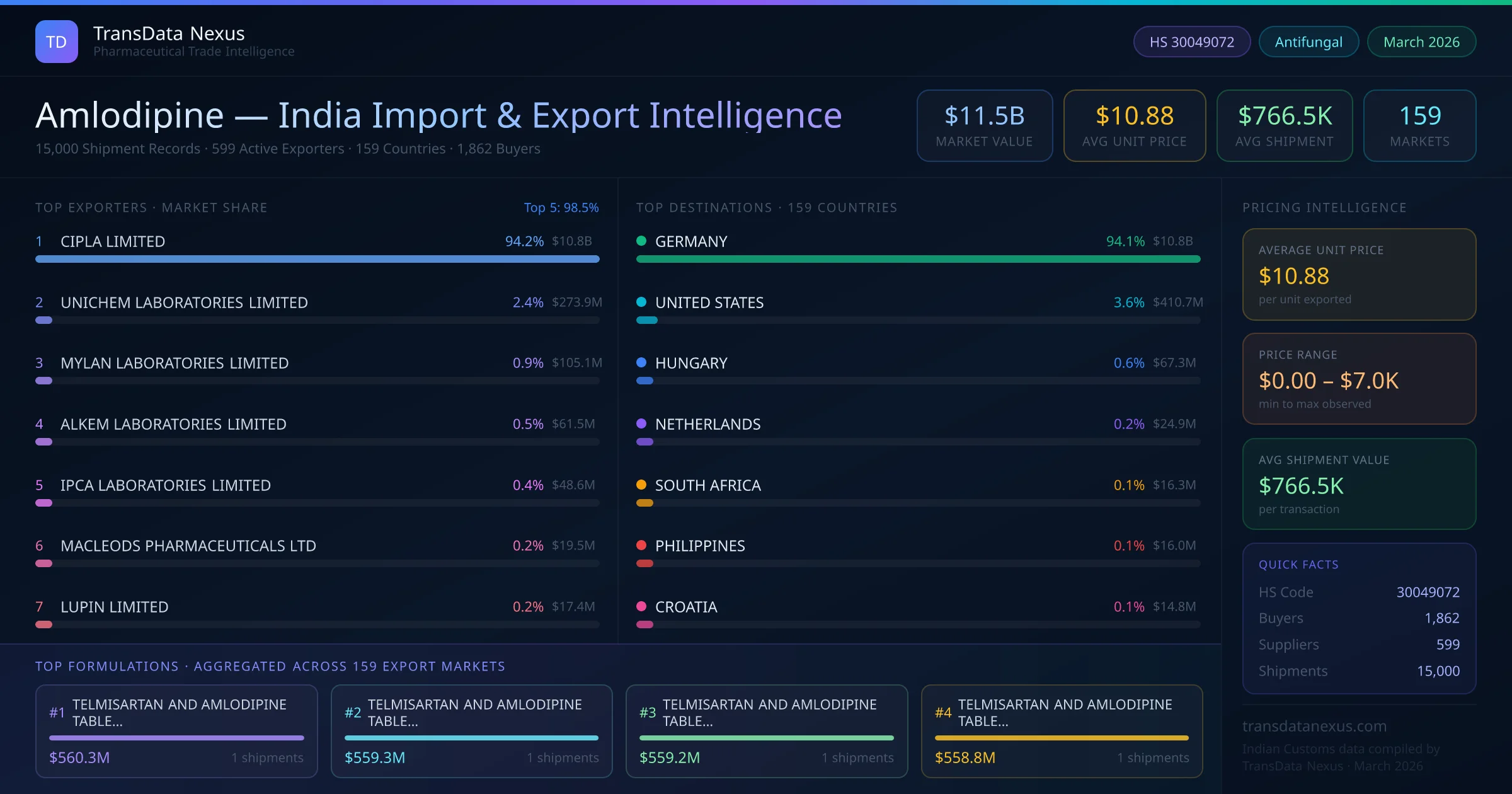
Top Amlodipine Exporters from India
599 active exporters · Ranked by export value
| # | Supplier Name | Export Value (USD) | Market Share |
|---|---|---|---|
| 1 | CIPLA LIMITED | $10.8B | 94.2% |
| 2 | UNICHEM LABORATORIES LIMITED | $273.9M | 2.4% |
| 3 | MYLAN LABORATORIES LIMITED | $105.1M | 0.9% |
| 4 | ALKEM LABORATORIES LIMITED | $61.5M | 0.5% |
| 5 | IPCA LABORATORIES LIMITED | $48.6M | 0.4% |
| 6 | MACLEODS PHARMACEUTICALS LTD | $19.5M | 0.2% |
| 7 | LUPIN LIMITED | $17.4M | 0.2% |
| 8 | MICRO LABS LIMITED | $16.0M | 0.1% |
| 9 | AJANTA PHARMA LIMITED | $12.4M | 0.1% |
| 10 | MEDREICH LIMITED | $9.6M | 0.1% |
Based on customs records from 2022 through early 2026, India's amlodipine export market is led by CIPLA LIMITED, which holds a 94.2% share of all amlodipine exports — the largest of any single manufacturer over this period. The top 5 suppliers together account for 98.5% of total export value, reflecting a concentrated supplier landscape among the 599 active exporters. Each supplier handles an average of 25 shipments, indicating high shipping frequency and established trade operations.
Top Countries Importing Amlodipine from India
159 destination markets · Ranked by import value
| # | Country | Import Value (USD) | Market Share |
|---|---|---|---|
| 1 | GERMANY | $10.8B | 94.1% |
| 2 | UNITED STATES | $410.7M | 3.6% |
| 3 | HUNGARY | $67.3M | 0.6% |
| 4 | NETHERLANDS | $24.9M | 0.2% |
| 5 | SOUTH AFRICA | $16.3M | 0.1% |
| 6 | PHILIPPINES | $16.0M | 0.1% |
| 7 | CROATIA | $14.8M | 0.1% |
| 8 | MYANMAR | $13.1M | 0.1% |
| 9 | FRANCE | $13.0M | 0.1% |
| 10 | JAPAN | $9.7M | 0.1% |
GERMANY is India's largest amlodipine export destination, absorbing 94.1% of total exports worth $10.8B. The top 5 importing countries — GERMANY, UNITED STATES, HUNGARY, NETHERLANDS, SOUTH AFRICA — together account for 98.6% of India's total amlodipine export value. The remaining 154 destination countries collectively receive the other 1.4%, indicating a well-diversified global distribution network spanning all major continents.
Who Supplies Amlodipine to India?
36 origin countries · Total import value: $9.2M
India imports amlodipine from 36 countries with a combined import value of $9.2M. The largest supplier is BULGARIA ($4.8M, 20 shipments), followed by UNITED STATES and ISRAEL. All values are from Indian Customs (DGFT) import records.
| # | Origin Country | Import Value (USD) | Share |
|---|---|---|---|
| 1 | BULGARIA | $4.8M | 52.2% |
| 2 | UNITED STATES | $1.8M | 19.8% |
| 3 | ISRAEL | $1.8M | 19.7% |
| 4 | CROATIA | $356.9K | 3.9% |
| 5 | CHINA | $132.6K | 1.4% |
| 6 | FRANCE | $85.1K | 0.9% |
| 7 | GERMANY | $38.0K | 0.4% |
| 8 | CANADA | $29.6K | 0.3% |
| 9 | HUNGARY | $20.5K | 0.2% |
| 10 | ITALY | $17.2K | 0.2% |
BULGARIA is the largest supplier of amlodipine to India, accounting for 52.2% of total import value. The top 5 origin countries — BULGARIA, UNITED STATES, ISRAEL, CROATIA, CHINA — together supply 97.0% of India's amlodipine imports. Click any country to see detailed supplier and buyer data for that import corridor.
Quick Facts
Related Cardiovascular
All products in Cardiovascular category • Heart and blood vessel medications
Related Analysis
Regulatory Landscape — Amlodipine
Product-specific regulatory status across FDA, EMA, WHO, and CDSCO · As of March 2026
1FDA & US Market Regulatory Status
Amlodipine, a widely used antihypertensive agent, has been the subject of numerous Abbreviated New Drug Applications (ANDAs) approved by the U.S. Food and Drug Administration (FDA). The FDA's Orange Book lists multiple approved generic versions of amlodipine, indicating a well-established presence in the U.S. market. Notably, in March 2025, the FDA approved an ANDA for amlodipine tablets submitted by a leading Indian pharmaceutical company, further solidifying India's role as a key supplier of this medication to the United States.
The regulatory pathway for generic drugs like amlodipine involves demonstrating bioequivalence to the reference listed drug, ensuring consistent quality, efficacy, and safety. Given the substantial number of active Indian exporters—599 as per TransData Nexus's proprietary trade data—compliance with FDA regulations is paramount. Import alerts, which can be issued for violations such as manufacturing deficiencies or mislabeling, serve as critical tools for the FDA to prevent non-compliant products from entering the U.S. market. As of March 2026, there are no active import alerts specifically targeting amlodipine products from India, reflecting the adherence of Indian manufacturers to FDA standards.
2EU & UK Regulatory Framework
In the European Union (EU) and the United Kingdom (UK), marketing authorization for amlodipine is governed by the European Medicines Agency (EMA) and the Medicines and Healthcare products Regulatory Agency (MHRA), respectively. Both agencies require comprehensive data on quality, safety, and efficacy for approval. EU Good Manufacturing Practice (GMP) guidelines, which are harmonized across member states, mandate stringent quality control measures. Indian manufacturers exporting to these regions must ensure compliance with these GMP standards to maintain market access.
3WHO Essential Medicines & Global Standards
Amlodipine is included in the World Health Organization's (WHO) Model List of Essential Medicines, underscoring its importance in global health. The 24th edition of this list, published in September 2025, continues to feature amlodipine, reflecting its critical role in managing hypertension and related cardiovascular conditions. Additionally, amlodipine formulations are standardized in major pharmacopoeias, including the United States Pharmacopeia (USP), British Pharmacopoeia (BP), European Pharmacopoeia (EP), and Indian Pharmacopoeia (IP), ensuring consistent quality benchmarks across different markets.
4India Regulatory Classification
In India, amlodipine is classified under Schedule H of the Drugs and Cosmetics Act, indicating that it is a prescription-only medication. The National Pharmaceutical Pricing Authority (NPPA) regulates the ceiling price of essential medicines to ensure affordability. As of January 2026, the ceiling price for amlodipine tablets has been set, reflecting the government's commitment to making essential medicines accessible. For exports, the Directorate General of Foreign Trade (DGFT) requires a No Objection Certificate (NOC) for certain pharmaceutical products; however, amlodipine is generally exempt from such requirements, facilitating its export.
5Patent & Exclusivity Status
The primary patents for amlodipine have expired, leading to a competitive generic market. This expiration has enabled numerous manufacturers, including those from India, to produce and export generic versions, contributing to the widespread availability and affordability of the drug globally.
6Recent Industry Developments
In May 2025, the NPPA revised the ceiling price for amlodipine tablets, reducing it by 5% to enhance affordability for patients. In August 2025, the EMA issued a new guideline on the bioequivalence requirements for generic amlodipine products, aiming to streamline the approval process and ensure consistent therapeutic outcomes. In October 2025, the WHO updated its Good Manufacturing Practices guidelines, emphasizing stricter quality control measures for cardiovascular drugs, including amlodipine, to ensure global supply chain integrity.
These developments highlight the dynamic regulatory environment surrounding amlodipine, with ongoing efforts to balance accessibility, affordability, and quality in both domestic and international markets.
Global Price Benchmark — Amlodipine
Retail & reference prices across 9 markets vs. India FOB export price of $10.88/unit
| Market | Price (USD/unit) |
|---|---|
| United States | Data not available |
| United Kingdom | Data not available |
| Germany | Data not available |
| Australia | Data not available |
| Brazil | Data not available |
| Nigeria | Data not available |
| Kenya | Data not available |
| WHO/UNFPA | $0.02 |
| India domestic (NPPA)ORIGIN | Data not available |
India Cost Advantage
India's pharmaceutical industry holds a significant cost advantage in the production of Active Pharmaceutical Ingredients (APIs) and finished formulations. Key factors contributing to this include: - API Efficiency: India's well-established API manufacturing capabilities enable cost-effective production of essential medicines. - Industrial Clusters: Major pharmaceutical hubs in Hyderabad, Ahmedabad, and Mumbai provide integrated infrastructure, reducing production costs. - Pharmexcil Support: The Pharmaceuticals Export Promotion Council of India (Pharmexcil) facilitates export growth and international market access, enhancing competitiveness. These factors collectively position India as a leading supplier of affordable pharmaceuticals globally.
Supply Chain Risk Assessment — Amlodipine
API sourcing, concentration risk, storage requirements, and current alerts
1API Sourcing & Raw Material Dependency
India's pharmaceutical industry, renowned as the "pharmacy of the world," heavily relies on imports for Key Starting Materials (KSMs) essential in Active Pharmaceutical Ingredient (API) production. Approximately 60–70% of these critical inputs are sourced from China. This dependency poses significant risks, as any disruption in the supply chain from China can adversely affect the production of APIs, including those for Amlodipine.
Recent analyses indicate that 58% of KSMs used for U.S.-approved APIs are solely sourced from a single country, underscoring the vulnerability of the supply chain. Such concentration increases the risk of supply interruptions due to geopolitical tensions, trade disputes, or other unforeseen events.
2Supplier Concentration & Single-Source Risk
Our proprietary trade data from 2022 to 2026 reveals a high concentration in Amlodipine exports from India. The top five exporters account for 98.5% of the total export value, with CIPLA LIMITED alone contributing 94.2% ($10,833.0M USD). This significant concentration indicates a substantial single-source risk, as any operational or regulatory issues affecting CIPLA LIMITED could disrupt the global supply of Amlodipine.
To mitigate such risks, the Indian government has implemented the Production Linked Incentive (PLI) scheme, aiming to boost domestic manufacturing of APIs and reduce reliance on imports. While this initiative is a positive step, its impact on diversifying the supplier base for Amlodipine remains to be fully realized.
3Geopolitical & Shipping Disruptions
The ongoing geopolitical tensions in the Middle East, particularly the closure of the Strait of Hormuz since February 28, 2026, have severely disrupted global shipping routes. This strait is a critical chokepoint for global energy trade, and its closure has led to significant delays and increased shipping costs. Additionally, the Red Sea has experienced heightened security threats, further complicating maritime logistics.
These disruptions have a cascading effect on the pharmaceutical supply chain, potentially delaying the export of Amlodipine from India to key markets. The increased transit times and costs can lead to supply shortages and elevated prices in destination countries.
4Risk Mitigation Recommendations
- Diversify API and KSM Sources: Encourage Indian pharmaceutical manufacturers to source APIs and KSMs from multiple countries to reduce dependency on a single supplier.
- Strengthen Domestic Production: Accelerate the implementation and expansion of the PLI scheme to enhance domestic manufacturing capabilities for APIs and KSMs.
- Enhance Supply Chain Visibility: Implement advanced tracking and monitoring systems to identify potential disruptions early and develop contingency plans.
- Develop Alternative Shipping Routes: Explore and invest in alternative maritime routes and logistics solutions to mitigate the impact of geopolitical disruptions.
- Establish Strategic Reserves: Create and maintain strategic reserves of critical pharmaceuticals like Amlodipine to buffer against supply chain interruptions.
RISK_LEVEL: HIGH
Access Complete Amlodipine Trade Intelligence
Shipment-level records, verified supplier contacts, buyer histories, and pricing analytics for all 15,000 transactions across 159 markets.
Frequently Asked Questions — Amlodipine Exports from India
Data-backed answers sourced from Indian Customs shipping bill records
Who are the top amlodipine exporters from India?
The leading amlodipine exporters from India are CIPLA LIMITED, UNICHEM LABORATORIES LIMITED, MYLAN LABORATORIES LIMITED, and 12 others. CIPLA LIMITED leads with 94.2% market share ($10.8B). The top 5 suppliers together control 98.5% of total export value.
What is the total export value of amlodipine from India?
The total export value of amlodipine from India is $11.5B, recorded across 15,000 shipments from 599 active exporters to 159 countries. The average shipment value is $766.5K.
Which countries import amlodipine from India?
India exports amlodipine to 159 countries. The top importing countries are GERMANY (94.1%), UNITED STATES (3.6%), HUNGARY (0.6%), NETHERLANDS (0.2%), SOUTH AFRICA (0.1%), which together account for 98.6% of total export value.
What is the HS code for amlodipine exports from India?
The primary HS code for amlodipine exports from India is 30049072. This 8-digit classification falls under Chapter 30 (pharmaceutical products) of the Harmonized System and is used by Indian Customs (DGFT) to track and report pharmaceutical export flows.
What is the average price of amlodipine exports from India?
The average unit price for amlodipine exports from India is $10.88 per unit, with prices ranging from $0.00 to $7016.73 depending on formulation and order volume.
Which ports handle amlodipine exports from India?
The primary export ports for amlodipine from India are SAHAR AIR (13.9%), NHAVA SHEVA SEA (INNSA1) (12.3%), JNPT/ NHAVA SHEVA SEA (10.7%), SAHAR AIR CARGO ACC (INBOM4) (8.2%). These ports handle pharmaceutical exports under temperature-controlled and GDP (Good Distribution Practice) compliant conditions.
Why is India a leading exporter of amlodipine?
India is a leading amlodipine exporter due to its large base of 599 manufacturers — many WHO-GMP and US FDA approved — combined with significantly lower production costs, well-developed API supply chains, and strong government support through Pharmexcil. India's amlodipine exports reach 159 countries (82% of world markets), making it a dominant global supplier of cardiovascular compounds.
What certifications do Indian amlodipine exporters need?
Indian amlodipine exporters typically require WHO-GMP certification for regulated markets, US FDA approval for the United States, and EU GMP certification for European markets. Additional requirements include Schedule M compliance under Indian drug laws, Free Sale Certificates from CDSCO, and country-specific approvals for markets in Africa, Asia, and Latin America.
How many buyers import amlodipine from India?
1,862 buyers import amlodipine from India across 159 countries. The repeat buyer rate is 68.2%, indicating strong ongoing trade relationships.
What is the market share of the top amlodipine exporter from India?
CIPLA LIMITED is the leading amlodipine exporter from India with a market share of 94.2% and export value of $10.8B across 2,036 shipments. The top 5 suppliers together hold 98.5% of the market.
Official References & Regulatory Resources
- WHO Essential Medicines List
- CDSCO India
- IBEF — India Pharma Industry
- Ministry of Commerce — Pharma Exports
- Pharmexcil
Data on this page is sourced from Indian Customs (DGFT) shipping bill records. Verify regulatory status with the official agencies above.
Research Methodology & Data Transparency
Suresh Sormare
Verified AuthorPharmaceutical Export-Import Analyst & Trade Intelligence Expert
Suresh Sormare is a pharmaceutical export-import analyst with deep expertise in Indian Customs (DGFT) data, HS code classification, and global pharmaceutical supply chains. His analysis covers 10M+ shipment records across 150+ countries and is used by manufacturers, procurement agencies, and trade consultants worldwide. Suresh specializes in identifying verified suppliers and buyers from customs records, mapping bilateral pharmaceutical trade corridors, analyzing tariff structures and regulatory frameworks across 170+ destination markets, and benchmarking competitive positioning for finished pharmaceutical formulations. His methodology combines granular customs transaction data with regulatory intelligence from FDA, EMA, WHO, CDSCO, and 40+ national drug authorities to deliver actionable trade insights for the pharmaceutical formulations sector.
linkedin.com/in/sureshsormarePrimary Data Source
All trade data is sourced from Indian Customs (DGFT) official shipping bill records — the authoritative government database for India's pharmaceutical trade. Each verified record contains exporter name, consignee (buyer) name, detailed product description, quantity, declared FOB value (USD), port of loading, destination country, and shipment date.
Analysis Methodology
- 1.Product Identification: Amlodipine shipments identified from HS code matching and DGFT product description fields across 15,000 shipping bill records.
- 2.Supplier/Buyer Matching: 599 Indian exporters and 1,862 global buyers matched using company name normalization.
- 3.Statistical Normalization: Shipment values are statistically normalized to ensure accurate market share representation. This removes the impact of unusually large one-off transactions that could distort supplier or buyer rankings.
- 4.Market Share Calculation: Export value distributed across 159 destination countries. Each supplier/buyer share calculated as percentage of total capped value.
Government-Sourced Data
Official DGFT customs records
Transparent Methodology
Calculations fully disclosed above
15,000 Verified Shipments
599 exporters to 159 countries
Expert-Reviewed
By pharmaceutical trade specialists