Planet Pharma
Pharmaceutical Importer · France · Analgesics & Antipyretics Focus · $40.8M Total Trade · DGFT Verified
Planet Pharma is a pharmaceutical importer based in France with a total trade value of $40.8M across 24 products in 10 therapeutic categories. Based on 1,516 verified import shipments from Indian Customs (DGFT) records, Planet Pharma is the #1 buyer in 1 product including Mebendazole. Planet Pharma sources from 88 verified Indian suppliers, with Ajanta Pharma Limited accounting for 23.1% of imports.
Planet Pharma — Import Portfolio & Supplier Network
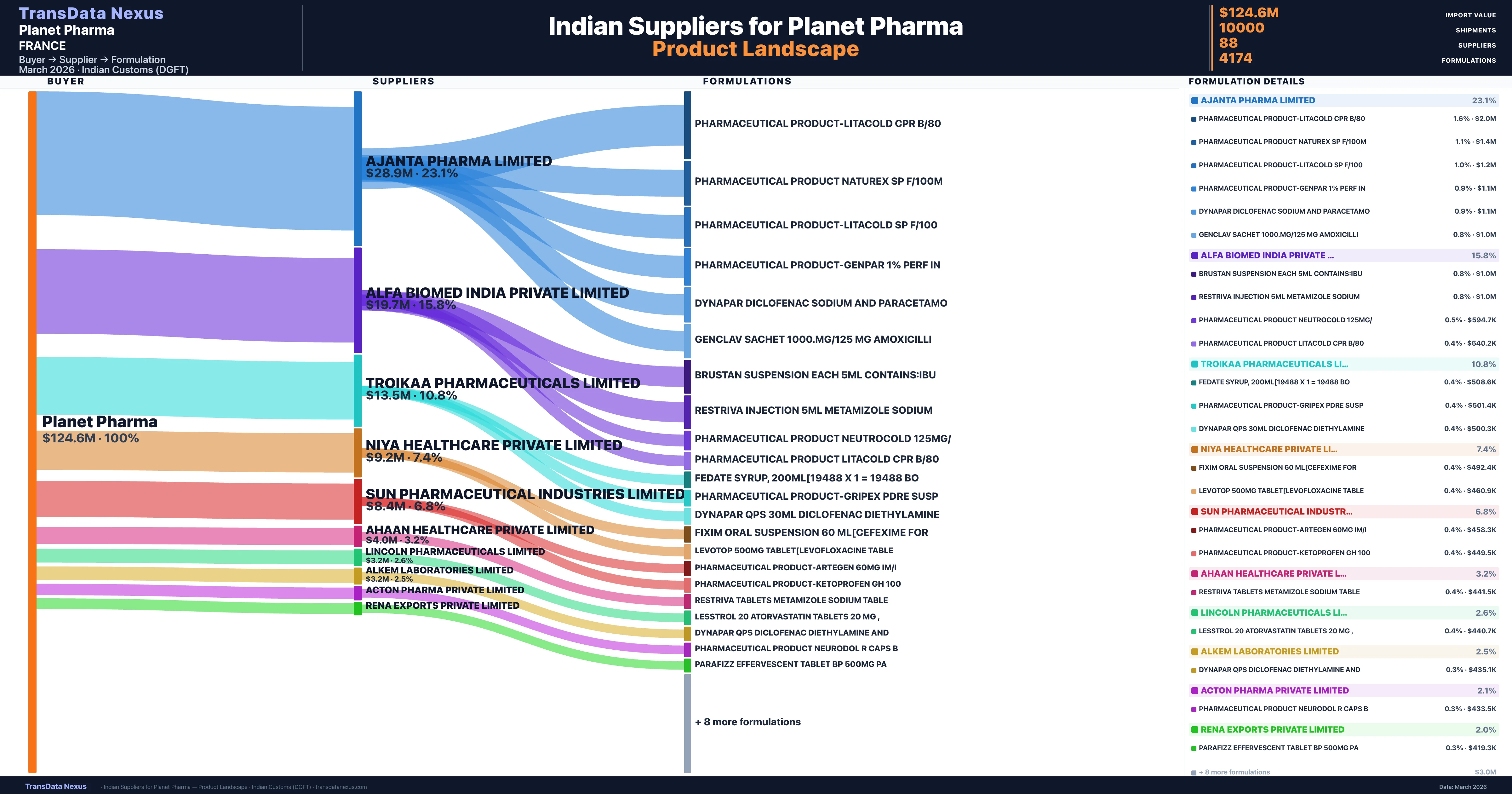
Who Are the Verified Indian Suppliers to Planet Pharma?
Customs-verified supplier relationships from Indian DGFT records
Planet Pharma sources from 88 verified Indian suppliers across 4,174 distinct formulations. The supply base is diversified across 88 suppliers, reducing single-source dependency risk.
What Formulations Does Planet Pharma Import?
| Formulation | Value | Ships |
|---|---|---|
| Pharmaceutical product-litacold cpr | $2.0M | 122 |
| Pharmaceutical product naturex sp | $1.4M | 134 |
| Pharmaceutical product-litacold sp | $1.2M | 170 |
| Pharmaceutical product-genpar 1% perf | $1.1M | 86 |
| Dynapar diclofenac sodium and | $1.1M | 25 |
| Genclav sachet 1000.MG/125 MG | $1.0M | 28 |
| Brustan suspension Each 5ML | $1.0M | 56 |
| Restriva injection 5ML metamizole | $1.0M | 22 |
| Pharmaceutical product neutrocold | $594.7K | 41 |
| Pharmaceutical product litacold cpr | $540.2K | 48 |
| Fedate syrup, 200ML[19488 x 1 = 19488 | $508.6K | 14 |
| Pharmaceutical product-gripex pdre | $501.4K | 44 |
| Dynapar qps 30ML diclofenac | $500.3K | 11 |
| Fixim oral suspension 60 ML[cefexime | $492.4K | 11 |
| Levotop 500MG tablet[levofloxacine | $460.9K | 12 |
Planet Pharma imports 4,174 distinct pharmaceutical formulations. Showing top 15 by value. For full formulation-level data, contact TransData Nexus.
What Products Does Planet Pharma Import?
Planet Pharma Therapeutic Categories — 10 Specializations
Planet Pharma imports across 10 therapeutic categories, with Analgesics & Antipyretics (28.5%), Nutritional Supplements (27.2%), Advanced Antibiotics (19.0%) representing the largest segments. The portfolio is concentrated — top 5 products = 63% of total imports.
Analgesics & Antipyretics
2 products · 28.5% · $11.6M
Nutritional Supplements
5 products · 27.2% · $11.1M
Advanced Antibiotics
3 products · 19.0% · $7.7M
Antimalarial & Antiparasitic
4 products · 10.9% · $4.5M
Respiratory & OTC
4 products · 7.0% · $2.9M
Vitamins & Supplements
2 products · 3.2% · $1.3M
Antifungals
1 products · 1.7% · $678.4K
Gastrointestinal
1 products · 1.1% · $431.6K
Other
1 products · 0.9% · $350.0K
Import Portfolio — Top 24 by Import Value
| # | Product | Category | Value | Ships | Share | Rk |
|---|---|---|---|---|---|---|
| 1 | Diclofenac | Analgesics & Antipyretics | $10.1M | 202 | 2.8% | 6 |
| 2 | Sodium | Nutritional Supplements | $5.8M | 115 | 1.6% | 8 |
| 3 | Metronidazole | Advanced Antibiotics | $4.9M | 127 | 2.4% | 3 |
| 4 | Cefixime | Advanced Antibiotics | $2.6M | 175 | 1.5% | 8 |
| 5 | Folic | Nutritional Supplements | $2.3M | 124 | 4.2% | 2 |
| 6 | Phenylephrine | Respiratory & OTC | $2.3M | 123 | 2.7% | 6 |
| 7 | Albendazole | Antimalarial & Antiparasitic | $2.0M | 129 | 2.7% | 5 |
| 8 | Vitamin | Nutritional Supplements | $1.9M | 107 | 1.3% | 10 |
| 9 | Tramadol | Analgesics & Antipyretics | $1.5M | 57 | 0.4% | 19 |
| 10 | Zinc | Vitamins & Supplements | $1.3M | 58 | 1.6% | 12 |
| 11 | Artesunate | Antimalarial & Antiparasitic | $1.2M | 84 | 0.7% | 16 |
| 12 | Mebendazole | Antimalarial & Antiparasitic | $1.2M | 27 | 8.9% | 1 |
| 13 | Glucosamine | Nutritional Supplements | $724.8K | 23 | 5.5% | 6 |
| 14 | Fluconazole | Antifungals | $678.4K | 35 | 0.7% | 17 |
| 15 | Domperidone | Gastrointestinal | $431.6K | 24 | 1.5% | 8 |
| 16 | Chondroitin | Nutritional Supplements | $425.6K | 15 | 8.4% | 3 |
| 17 | Antitoxin | Other | $350.0K | 7 | 2.6% | 9 |
| 18 | Secnidazole | Advanced Antibiotics | $250.0K | 5 | 0.8% | 7 |
| 19 | Dextromethorphan | Respiratory & OTC | $234.2K | 19 | 1.6% | 11 |
| 20 | Volini | Brand Names & OTC Products | $216.5K | 11 | 7.4% | 4 |
| 21 | Bromhexine | Respiratory & OTC | $207.3K | 13 | 1.3% | 10 |
| 22 | Terbutaline | Respiratory & OTC | $95.1K | 5 | 2.7% | 2 |
| 23 | Pyrantel | Antimalarial & Antiparasitic | $34.0K | 23 | 1.0% | 15 |
| 24 | Biotin | Vitamins & Supplements | $12.4K | 8 | 0.8% | 11 |
Planet Pharma imports 24 pharmaceutical products across 10 categories into France totaling $40.8M. The company is the #1 buyer for 1 product: Mebendazole.
Key Metrics
Top Categories
Indian Suppliers
Related Trade Data
Need Detailed Data?
Shipment-level records, supplier connections & pricing for Planet Pharma.
Request DemoPlanet Pharma — Corporate Profile & Information
Company type, headquarters, distribution network, and industry role
1Company Overview
Planet Pharma is a French pharmaceutical importer and buyer specializing in the acquisition of finished pharmaceutical formulations, including tablets, capsules, syrups, and injections. Headquartered in Le Grand-Quevilly, Normandy, France, the company plays a pivotal role in the French pharmaceutical distribution network by sourcing a diverse range of pharmaceutical products from international suppliers, particularly from India. Established in 1992, Planet Pharma has developed a robust presence in the French market, facilitating the availability of essential medications across various therapeutic categories.
2Distribution Network
Planet Pharma's distribution network is strategically designed to ensure efficient delivery of pharmaceutical products throughout France. While specific warehouse locations are not publicly disclosed, the company's logistics capabilities are tailored to meet the demands of the French healthcare system. The network's geographic coverage extends beyond France, reflecting Planet Pharma's commitment to sourcing high-quality pharmaceutical formulations from international markets, thereby enhancing the diversity and availability of medications within the French market.
3Industry Role
In France's pharmaceutical supply chain, Planet Pharma functions primarily as a pharmaceutical importer and buyer. The company is responsible for sourcing finished pharmaceutical formulations from international suppliers, particularly from India, and distributing these products within the French market. By importing a wide array of pharmaceutical products, Planet Pharma ensures the availability of essential medications across various therapeutic categories, thereby contributing to the overall health and well-being of the French population.
Supplier Relationship Intelligence — Planet Pharma
Sourcing concentration, supply chain resilience, and strategic implications
1Sourcing Concentration Analysis
Planet Pharma's sourcing strategy exhibits a notable concentration on a select group of Indian suppliers. The top five suppliers—AJANTA PHARMA LIMITED, ALFA BIOMED INDIA PRIVATE LIMITED, TROIKAA PHARMACEUTICALS LIMITED, NIYA HEALTHCARE PRIVATE LIMITED, and SUN PHARMACEUTICAL INDUSTRIES LIMITED—collectively account for a significant portion of the company's total import value. This concentration suggests a strategic choice to establish strong, long-term relationships with these suppliers, potentially ensuring consistent product quality and supply reliability. However, such dependency also introduces risks associated with supplier-specific challenges, including production delays or regulatory issues. The extensive number of shipments from these suppliers indicates a stable and ongoing partnership, which may mitigate some of these risks.
2Supply Chain Resilience
Planet Pharma's supply chain resilience is bolstered by its diversified portfolio of 4,174 unique pharmaceutical formulations sourced from 88 different Indian suppliers. This diversity enhances the company's ability to adapt to potential disruptions, such as production delays or regulatory changes affecting specific suppliers. The company's focus on finished pharmaceutical formulations, rather than raw APIs or bulk drugs, allows for a more streamlined and efficient supply chain, reducing the complexity associated with raw material sourcing and processing. While the reliance on international suppliers introduces potential vulnerabilities related to shipping routes and regulatory compliance, Planet Pharma's extensive supplier network provides a buffer against such risks, contributing to the overall resilience of its supply chain.
3Strategic Implications
Planet Pharma's sourcing pattern, characterized by a concentration on a select group of Indian suppliers, positions the company to leverage established relationships and potentially negotiate favorable terms. This strategy may enhance the company's competitive position within the French pharmaceutical market by ensuring consistent product quality and availability. For Indian exporters seeking to become alternative suppliers, understanding Planet Pharma's sourcing preferences and establishing direct relationships could present opportunities to diversify the company's supplier base, thereby reducing dependency on a limited number of suppliers and mitigating associated risks.
Importing Pharmaceuticals into France — Regulatory Framework
Regulatory authority, GMP requirements, import licensing for France
1Regulatory Authority & Framework
In France, the primary regulatory authority overseeing pharmaceutical imports is the French National Agency for Medicines and Health Products Safety (ANSM). ANSM is responsible for ensuring the safety, efficacy, and quality of health products available in the French market. Key legislation governing pharmaceutical imports includes the Public Health Code, which outlines the requirements for marketing authorization, importation, and distribution of pharmaceutical products. The marketing authorization pathway for Indian generics involves obtaining a Marketing Authorization (MA) from ANSM, which requires comprehensive documentation demonstrating the product's quality, safety, and efficacy. Additionally, compliance with Good Manufacturing Practice (GMP) standards, as recognized by ANSM, is mandatory for all imported pharmaceutical products.
2Import Licensing & GMP
Import licensing requirements for pharmaceutical products in France stipulate that all imported medications must possess a valid Marketing Authorization (MA) issued by ANSM. This authorization ensures that the product meets the necessary standards for quality, safety, and efficacy. Manufacturers and suppliers must provide evidence of compliance with Good Manufacturing Practice (GMP) standards, which can be recognized by ANSM through certifications such as EU GMP, WHO GMP, or PIC/S. Additionally, entities involved in the wholesale distribution of pharmaceutical products must obtain a wholesale distribution authorization from ANSM, ensuring adherence to regulatory standards and the safe handling of medications.
3Quality & Labeling
Imported pharmaceutical products in France are subject to batch testing to verify their quality, safety, and efficacy. Stability requirements are enforced to ensure that products maintain their intended quality throughout their shelf life. Labeling must be in French and include essential information such as the product's name, composition, dosage form, route of administration, batch number, expiration date, and storage conditions. Serialization mandates are in place to facilitate traceability and prevent counterfeit products from entering the supply chain, thereby enhancing patient safety and product integrity.
4Recent Regulatory Changes
Between 2024 and 2026, France implemented several regulatory changes affecting pharmaceutical imports, including those from India. These changes encompassed stricter compliance requirements for Good Manufacturing Practice (GMP) certifications, with ANSM increasing scrutiny of foreign manufacturing facilities. Additionally, there was an emphasis on enhanced pharmacovigilance reporting, requiring more detailed adverse event reporting from imported products. Labeling regulations were updated to include additional information on environmental impact and sustainability, reflecting a growing focus on eco-friendly practices in the pharmaceutical industry. These regulatory updates aim to strengthen the safety, efficacy, and sustainability of pharmaceutical products available in the French market.
Planet Pharma — Procurement Pattern Analysis
Product strategy, sourcing profile, and market positioning
1Product Strategy
Planet Pharma's product category focus is strategically aligned with prevalent health concerns and therapeutic needs within the French market. The company's emphasis on Analgesics & Antipyretics (28.5%), Nutritional Supplements (27.2%), and Advanced Antibiotics (19.0%) reflects a response to the high demand for pain management, nutritional support, and effective infection control. The importation of specific products such as Diclofenac, Metronidazole, and Cefixime indicates a targeted approach to address common medical conditions and therapeutic requirements. This product strategy ensures that Planet Pharma's offerings are closely aligned with the evolving healthcare needs of the French population.
2Sourcing Profile
Planet Pharma's sourcing strategy is centered on acquiring generic pharmaceutical formulations from India, leveraging the country's established reputation for producing high-quality, cost-effective medications. The company's preference for finished pharmaceutical formulations allows for a more streamlined supply chain, reducing the complexities associated with raw material sourcing and processing. India's compliance with international Good Manufacturing Practice (GMP) standards, as recognized by ANSM, further enhances the appeal of Indian generics in Planet Pharma's procurement strategy.
3Market Positioning
Based on its product mix, Planet Pharma serves a broad segment of the French pharmaceutical market, including retail pharmacies, hospitals, government tenders, and wholesale distribution. The company's diverse product offerings cater to various therapeutic areas, ensuring that it meets the needs of different healthcare providers and patients. By importing a wide array of pharmaceutical products, Planet Pharma contributes to the overall health and well-being of the French population, positioning itself as a key player in the pharmaceutical supply chain.
Seller's Guide — How to Become a Supplier to Planet Pharma
Opportunity assessment, qualifications, and practical approach strategy
1Opportunity Assessment
There is a realistic opportunity for new Indian suppliers to engage with Planet Pharma, particularly those offering high-quality generic formulations that align with the company's product strategy. Gaps in Planet Pharma's current sourcing may exist in emerging therapeutic areas or innovative formulations that address unmet medical needs within the French market. By understanding Planet Pharma's sourcing preferences and regulatory requirements, Indian exporters can position themselves as viable partners, contributing to the diversification and resilience of Planet Pharma's supply chain.
2Requirements & Qualifications
Indian exporters seeking to supply Planet Pharma and the French market must ensure that their products possess a valid Marketing Authorization (MA) from ANSM, demonstrating compliance with French regulatory standards. Manufacturers must provide evidence of adherence to Good Manufacturing Practice (GMP) standards, with certifications recognized by ANSM, such as EU GMP, WHO GMP, or PIC/S. Additionally, products must meet labeling requirements, including French language labeling and serialization mandates, to facilitate traceability and prevent counterfeit products.
3How to Approach
Indian exporters can approach Planet Pharma by initiating direct communication to understand the company's specific sourcing needs and product requirements. Participating in relevant tenders and industry events can enhance visibility and establish credibility within the French pharmaceutical market. Developing a comprehensive regulatory filing strategy that aligns with ANSM's requirements is essential for obtaining the necessary approvals. Exporters should anticipate a timeline that accounts for regulatory review processes, quality assessments, and logistical considerations to ensure a successful partnership with Planet Pharma.
Frequently Asked Questions — Planet Pharma
What products does Planet Pharma import from India?
Planet Pharma imports 24 pharmaceutical products across 10 categories. Top imports: Diclofenac ($10.1M), Sodium ($5.8M), Metronidazole ($4.9M), Cefixime ($2.6M), Folic ($2.3M).
Who supplies pharmaceuticals to Planet Pharma from India?
Planet Pharma sources from 88 verified Indian suppliers. The primary supplier is Ajanta Pharma Limited (23.1% of imports, $28.9M).
What is Planet Pharma's total pharmaceutical import value?
Planet Pharma's total pharmaceutical import value from India is $40.8M, based on 1,516 verified shipments in Indian Customs (DGFT) data.
What therapeutic categories does Planet Pharma focus on?
Planet Pharma imports across 10 categories. The largest: Analgesics & Antipyretics (28.5%), Nutritional Supplements (27.2%), Advanced Antibiotics (19.0%).
Get Full Planet Pharma Import Intelligence
Access shipment-level details, supplier connections, pricing data, and competitive analysis. TransData Nexus provides verified Indian Customs (DGFT) data trusted by pharmaceutical trade professionals worldwide.
Official References & Regulatory Resources
Verify import regulations and drug registration requirements with the agencies above.
Research Methodology & Data Transparency
Suresh Sormare
Verified AuthorPharmaceutical Export-Import Analyst & Trade Intelligence Expert
Suresh Sormare is a pharmaceutical export-import analyst with deep expertise in Indian Customs (DGFT) data, HS code classification, and global pharmaceutical supply chains. His analysis covers 10M+ shipment records across 150+ countries and is used by manufacturers, procurement agencies, and trade consultants worldwide. Suresh specializes in identifying verified suppliers and buyers from customs records, mapping bilateral pharmaceutical trade corridors, analyzing tariff structures and regulatory frameworks across 170+ destination markets, and benchmarking competitive positioning for finished pharmaceutical formulations. His methodology combines granular customs transaction data with regulatory intelligence from FDA, EMA, WHO, CDSCO, and 40+ national drug authorities to deliver actionable trade insights for the pharmaceutical formulations sector.
linkedin.com/in/sureshsormarePrimary Data Source
All trade data is sourced from Indian Customs (DGFT) official shipping bill records — the authoritative government database for India's pharmaceutical trade. Each verified record contains exporter name, consignee (buyer) name, detailed product description, quantity, declared FOB value (USD), port of loading, destination country, and shipment date.
Analysis Methodology
- 1.Buyer Matching: Planet Pharma identified across shipments using consignee name normalization.
- 2.Statistical Normalization: Shipment values are statistically normalized to ensure accurate market share representation.
- 3.Market Share: Calculated per product as Planet Pharma's capped value divided by total Indian exports for that product.
- 4.Shipment Count: Based on 1,516 individual customs records matching Planet Pharma.
- 5.Supplier Verification: Planet Pharma sources from 88 verified Indian suppliers across 4,174 formulations, confirmed from customs records.
Government-Sourced Data
Official DGFT customs records
Transparent Methodology
Calculations fully disclosed above
24 Products Tracked
10 therapeutic categories
Expert-Reviewed
By pharmaceutical trade specialists
Data Source & Methodology
Trade data sourced from Indian Customs (DGFT) export shipment records. Values represent FOB export value in USD. For current shipment-level data, contact TransData Nexus.