Pahang Pharmacy SDN BHD
Pharmaceutical Importer · Malaysia · Antivirals Focus · $3.9M Total Trade · DGFT Verified
Pahang Pharmacy SDN BHD is a pharmaceutical importer based in Malaysia with a total trade value of $3.9M across 3 products in 3 therapeutic categories. Based on 83 verified import shipments from Indian Customs (DGFT) records, the company actively imports across multiple product segments. Pahang Pharmacy SDN BHD sources from 13 verified Indian suppliers, with Mylan Laboratories Limited accounting for 44.7% of imports.
Pahang Pharmacy SDN BHD — Import Portfolio & Supplier Network
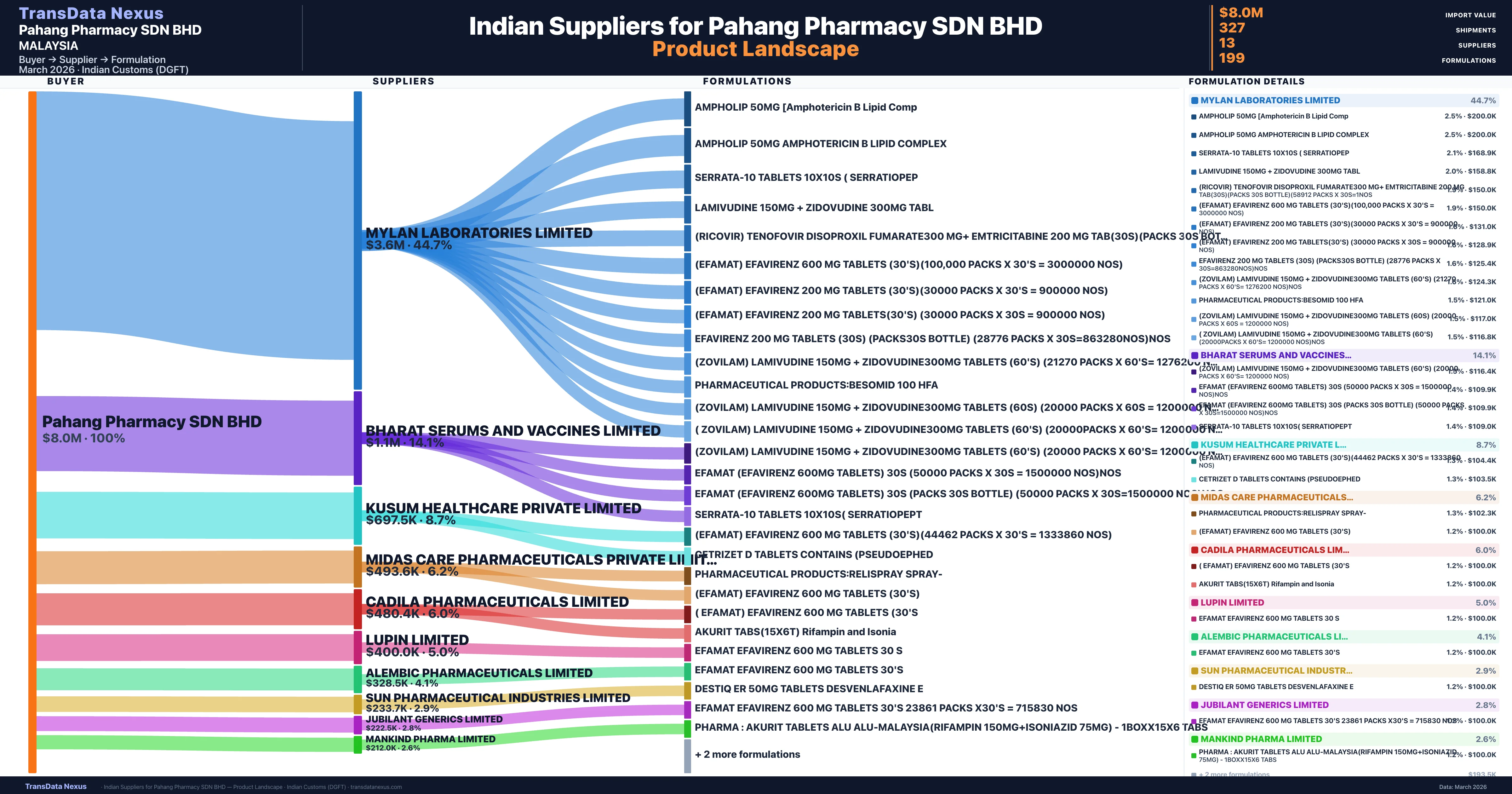
Who Are the Verified Indian Suppliers to Pahang Pharmacy SDN BHD?
Customs-verified supplier relationships from Indian DGFT records
| Supplier | Value | Shipments | Share |
|---|---|---|---|
| Mylan Laboratories Limited | $3.6M | 100 | 44.7% |
| Bharat Serums And Vaccines Limited | $1.1M | 31 | 14.1% |
| Kusum Healthcare Private Limited | $697.5K | 22 | 8.7% |
| Midas Care Pharmaceuticals Private Limited | $493.6K | 26 | 6.2% |
| Cadila Pharmaceuticals Limited | $480.4K | 52 | 6.0% |
| Lupin Limited | $400.0K | 8 | 5.0% |
| Alembic Pharmaceuticals Limited | $328.5K | 13 | 4.1% |
| Sun Pharmaceutical Industries Limited | $233.7K | 20 | 2.9% |
| Jubilant Generics Limited | $222.5K | 13 | 2.8% |
| Mankind Pharma Limited | $212.0K | 17 | 2.6% |
| Naprod Life Sciences Private Limited | $206.9K | 22 | 2.6% |
| Torrent Pharmaceuticals Limited | $23.6K | 1 | 0.3% |
| Adyant Healthcare Private Limited | $4.0K | 2 | 0.0% |
Pahang Pharmacy SDN BHD sources from 13 verified Indian suppliers across 199 distinct formulations. The supply base is diversified across 13 suppliers, reducing single-source dependency risk.
What Formulations Does Pahang Pharmacy SDN BHD Import?
| Formulation | Value | Ships |
|---|---|---|
| Ampholip 50MG [amphotericin b lipid | $200.0K | 4 |
| Ampholip 50MG amphotericin b lipid | $200.0K | 4 |
| Serrata-10 tablets 10x10s | $168.9K | 5 |
| Lamivudine 150MG + zidovudine 300MG | $158.8K | 4 |
| (ricovir) tenofovir disoproxil fumarate300 MG+ emtricitabine 200 MG TAB(30s)(packs 30s bottle)(58912 packs x | $150.0K | 3 |
| (efamat) efavirenz 600 MG tablets (30's)(100,000 packs x 30's = 3000000 nos) | $150.0K | 3 |
| (efamat) efavirenz 200 MG tablets (30's)(30000 packs x 30's = 900000 nos) | $131.0K | 3 |
| (efamat) efavirenz 200 MG tablets(30's) (30000 packs x 30s = 900000 nos) | $128.9K | 3 |
| Efavirenz 200 MG tablets (30s) (packs30s bottle) (28776 packs x 30s=863280nos | $125.4K | 3 |
| (zovilam) lamivudine 150MG + zidovudine300mg tablets (60's) (21270 packs x 60's= 1276200 nos | $124.3K | 3 |
| Pharmaceutical products:besomid 100 | $121.0K | 3 |
| (zovilam) lamivudine 150MG + zidovudine300mg tablets (60s) (20000 packs x 60s = 1200000 nos) | $117.0K | 3 |
| ( zovilam) lamivudine 150MG + zidovudine300mg tablets (60's) (20000packs x 60's= 1200000 nos | $116.8K | 3 |
| (zovilam) lamivudine 150MG + zidovudine300mg tablets (60's) (20000 packs x 60's= 1200000 nos) | $116.4K | 3 |
| Efamat (efavirenz 600MG tablets) 30s (50000 packs x 30s = 1500000 nos | $109.9K | 3 |
Pahang Pharmacy SDN BHD imports 199 distinct pharmaceutical formulations. Showing top 15 by value. For full formulation-level data, contact TransData Nexus.
What Products Does Pahang Pharmacy SDN BHD Import?
Top Products by Import Value
Pahang Pharmacy SDN BHD Therapeutic Categories — 3 Specializations
Pahang Pharmacy SDN BHD imports across 3 therapeutic categories, with Antivirals (71.7%), Antifungals (25.9%), Respiratory & OTC (2.4%) representing the largest segments. The portfolio is concentrated — top 5 products = 100% of total imports.
Antivirals
1 products · 71.7% · $2.8M
Antifungals
1 products · 25.9% · $1.0M
Respiratory & OTC
1 products · 2.4% · $92.3K
Import Portfolio — Top 3 by Import Value
| # | Product | Category | Value | Ships | Share | Rk |
|---|---|---|---|---|---|---|
| 1 | Efavirenz | Antivirals | $2.8M | 57 | 2.8% | 6 |
| 2 | Amphotericin | Antifungals | $1.0M | 20 | 1.1% | 20 |
| 3 | Pseudoephedrine | Respiratory & OTC | $92.3K | 6 | 0.8% | 13 |
Pahang Pharmacy SDN BHD imports 3 pharmaceutical products across 3 categories into Malaysia totaling $3.9M.
Key Metrics
Top Categories
Indian Suppliers
Related Trade Data
Need Detailed Data?
Shipment-level records, supplier connections & pricing for Pahang Pharmacy SDN BHD.
Request DemoPahang Pharmacy SDN BHD — Corporate Profile & Information
Company type, headquarters, distribution network, and industry role
1Company Overview
Pahang Pharmacy Sdn Bhd (PPSB), established in July 1971, is a prominent Malaysian company specializing in the marketing, distribution, and manufacturing of pharmaceutical and healthcare products. Headquartered in Klang, Selangor, PPSB has evolved from its initial role as a retail pharmacy into a comprehensive entity serving a diverse clientele, including clinics, pharmacies, and hospitals across Malaysia.
The company operates a Good Manufacturing Practice (GMP)-certified manufacturing facility, employing over 500 staff members. This facility supports an extensive distribution network, reaching more than 7,500 customers in the healthcare and medical sectors nationwide. PPSB's product portfolio encompasses generic ethical pharmaceuticals, health food supplements, and veterinary products, reflecting its commitment to advancing healthcare and improving quality of life.
2Distribution Network
PPSB's distribution network is robust and expansive, facilitated by four fully equipped warehouses strategically located across East and West Malaysia. This infrastructure enables the company to supply thousands of products daily, meeting the growing demands of its diverse customer base. The company's logistics capabilities are further enhanced by its GMP-certified manufacturing facility in Klang, Selangor, which supports its extensive distribution operations.
3Industry Role
PPSB plays a multifaceted role in Malaysia's pharmaceutical supply chain. As a primary wholesaler and distributor, it supplies a wide range of pharmaceutical and healthcare products to clinics, pharmacies, and hospitals nationwide. Additionally, PPSB engages in the manufacturing of health food supplements and veterinary products, further solidifying its position in the market.
Supplier Relationship Intelligence — Pahang Pharmacy SDN BHD
Sourcing concentration, supply chain resilience, and strategic implications
1Sourcing Concentration Analysis
PPSB's sourcing strategy exhibits a high degree of concentration, particularly in its imports from India. Between 2022 and 2026, the company imported finished pharmaceutical formulations totaling $3.9 million USD from India, comprising 83 shipments across three therapeutic categories. The top five products imported were Efavirenz ($2.8 million, 2.8% share), Amphotericin ($1.0 million, 1.1% share), and Pseudoephedrine ($92,000, 0.8% share). This concentration indicates a strategic choice to leverage India's competitive pricing and quality in these specific therapeutic areas.
The shipment data reveals a stable relationship with Indian suppliers, with 13 unique suppliers involved in the 83 shipments. The largest supplier, Mylan Laboratories Limited, accounted for 44.7% of the total import value, followed by Bharat Serums and Vaccines Limited at 14.1%. This distribution suggests a reliance on a select group of suppliers, which could pose risks if any supplier faces operational challenges.
2Supply Chain Resilience
PPSB's supply chain resilience is influenced by its concentrated sourcing from India. The company's reliance on a limited number of suppliers for key products may expose it to risks such as supply disruptions or regulatory changes affecting these suppliers. However, the diversity of formulations imported—199 unique formulations—indicates a level of diversification that can mitigate some risks. Additionally, PPSB's GMP-certified manufacturing facility in Malaysia provides a buffer against potential supply chain disruptions, allowing for localized production and distribution.
3Strategic Implications
PPSB's sourcing pattern positions it to benefit from India's established pharmaceutical manufacturing capabilities, ensuring access to a wide range of quality products at competitive prices. For Indian exporters, this presents an opportunity to strengthen partnerships with PPSB by offering a diverse portfolio of products that align with PPSB's therapeutic focus areas. Expanding the supplier base could also enhance supply chain resilience and reduce dependency on a few suppliers.
Importing Pharmaceuticals into Malaysia — Regulatory Framework
Regulatory authority, GMP requirements, import licensing for Malaysia
1Regulatory Authority & Framework
In Malaysia, the National Pharmaceutical Regulatory Agency (NPRA) under the Ministry of Health (MOH) is responsible for regulating pharmaceutical products. Key legislation governing pharmaceutical imports includes the Sale of Drugs Act 1952 and the Control of Drugs and Cosmetics Regulations 1984. These regulations ensure that imported pharmaceutical products meet safety, efficacy, and quality standards before they are marketed in Malaysia.
2Import Licensing & GMP
Importers like PPSB must obtain an import license from the NPRA to bring pharmaceutical products into Malaysia. The imported products must be accompanied by a valid Certificate of Pharmaceutical Product (CPP) from the country of origin, confirming compliance with Good Manufacturing Practice (GMP) standards. Recognized GMP certifications include those from the World Health Organization (WHO), the Pharmaceutical Inspection Co-operation Scheme (PIC/S), and the European Union (EU). PPSB's GMP-certified manufacturing facility in Klang, Selangor, underscores its commitment to maintaining high-quality standards in its operations.
3Quality & Labeling
Imported pharmaceutical products are subject to batch testing by the NPRA to ensure they meet the required quality standards. Stability studies are also conducted to determine the product's shelf life under Malaysian storage conditions. Labeling requirements include the use of the Malay language for product information, and labels must include details such as the product name, active ingredients, dosage form, batch number, manufacturing date, and expiry date. Serialization mandates may apply to facilitate traceability and prevent counterfeit products.
4Recent Regulatory Changes
Between 2024 and 2026, Malaysia has implemented several regulatory changes affecting pharmaceutical imports. These include stricter enforcement of GMP compliance for imported products, enhanced requirements for product labeling and packaging to improve consumer safety, and the introduction of electronic submission systems for import licenses to streamline the approval process. These changes aim to strengthen the regulatory framework and ensure the safety and efficacy of pharmaceutical products in the Malaysian market.
Pahang Pharmacy SDN BHD — Procurement Pattern Analysis
Product strategy, sourcing profile, and market positioning
1Product Strategy
PPSB's focus on importing products in the antiviral, antifungal, and respiratory therapeutic categories aligns with the company's strategic objective to address prevalent health concerns in Malaysia. The significant import value of Efavirenz and Amphotericin indicates a targeted approach to meet the needs of patients requiring treatments for HIV/AIDS and fungal infections, respectively. The inclusion of Pseudoephedrine reflects the company's commitment to providing over-the-counter solutions for respiratory issues.
2Sourcing Profile
PPSB's sourcing strategy emphasizes the procurement of generic pharmaceutical formulations, primarily from India, known for its robust pharmaceutical manufacturing sector. The company's focus on finished pharmaceutical formulations, rather than raw active pharmaceutical ingredients (APIs), suggests a preference for ready-to-market products that meet Malaysian regulatory standards. This approach allows PPSB to efficiently expand its product portfolio and address diverse therapeutic needs.
3Market Positioning
PPSB serves a broad segment of the Malaysian pharmaceutical market, including retail pharmacies, hospitals, and government tenders. Its extensive distribution network and diverse product offerings enable it to cater to both mass-market and niche segments, positioning the company as a key player in the Malaysian pharmaceutical supply chain.
Seller's Guide — How to Become a Supplier to Pahang Pharmacy SDN BHD
Opportunity assessment, qualifications, and practical approach strategy
1Opportunity Assessment
There is a realistic opportunity for new Indian suppliers to collaborate with PPSB, particularly in the antiviral and antifungal therapeutic categories, where PPSB has demonstrated significant import activity. Suppliers offering high-quality, GMP-compliant products that align with PPSB's therapeutic focus areas could establish mutually beneficial partnerships. Additionally, expanding the supplier base could enhance PPSB's supply chain resilience and reduce dependency on a limited number of suppliers.
2Requirements & Qualifications
Indian exporters seeking to supply PPSB must ensure their products are manufactured in facilities with recognized GMP certifications, such as those from WHO, PIC/S, or the EU. Products must comply with Malaysian regulatory standards, including obtaining a valid Certificate of Pharmaceutical Product (CPP) from the country of origin. Additionally, exporters should be prepared to meet Malaysia's labeling and packaging requirements, which include the use of the Malay language and adherence to specific information disclosure standards.
3How to Approach
To establish a relationship with PPSB, Indian exporters should initiate contact by providing detailed product information, including GMP certifications and compliance with Malaysian regulatory standards. Participating in tenders and responding to Requests for Proposals (RFPs) issued by PPSB can also be effective strategies. Understanding the regulatory filing process and preparing for the necessary documentation and approvals will facilitate a smoother entry into the Malaysian market. Given the regulatory complexities, a timeline of 6 to 12 months is advisable for establishing a partnership and ensuring full compliance with Malaysian regulations.
Frequently Asked Questions — Pahang Pharmacy SDN BHD
What products does Pahang Pharmacy SDN BHD import from India?
Pahang Pharmacy SDN BHD imports 3 pharmaceutical products across 3 categories. Top imports: Efavirenz ($2.8M), Amphotericin ($1.0M), Pseudoephedrine ($92.3K).
Who supplies pharmaceuticals to Pahang Pharmacy SDN BHD from India?
Pahang Pharmacy SDN BHD sources from 13 verified Indian suppliers. The primary supplier is Mylan Laboratories Limited (44.7% of imports, $3.6M).
What is Pahang Pharmacy SDN BHD's total pharmaceutical import value?
Pahang Pharmacy SDN BHD's total pharmaceutical import value from India is $3.9M, based on 83 verified shipments in Indian Customs (DGFT) data.
What therapeutic categories does Pahang Pharmacy SDN BHD focus on?
Pahang Pharmacy SDN BHD imports across 3 categories. The largest: Antivirals (71.7%), Antifungals (25.9%), Respiratory & OTC (2.4%).
Get Full Pahang Pharmacy SDN BHD Import Intelligence
Access shipment-level details, supplier connections, pricing data, and competitive analysis. TransData Nexus provides verified Indian Customs (DGFT) data trusted by pharmaceutical trade professionals worldwide.
Official References & Regulatory Resources
Verify import regulations and drug registration requirements with the agencies above.
Research Methodology & Data Transparency
Suresh Sormare
Verified AuthorPharmaceutical Export-Import Analyst & Trade Intelligence Expert
Suresh Sormare is a pharmaceutical export-import analyst with deep expertise in Indian Customs (DGFT) data, HS code classification, and global pharmaceutical supply chains. His analysis covers 10M+ shipment records across 150+ countries and is used by manufacturers, procurement agencies, and trade consultants worldwide. Suresh specializes in identifying verified suppliers and buyers from customs records, mapping bilateral pharmaceutical trade corridors, analyzing tariff structures and regulatory frameworks across 170+ destination markets, and benchmarking competitive positioning for finished pharmaceutical formulations. His methodology combines granular customs transaction data with regulatory intelligence from FDA, EMA, WHO, CDSCO, and 40+ national drug authorities to deliver actionable trade insights for the pharmaceutical formulations sector.
linkedin.com/in/sureshsormarePrimary Data Source
All trade data is sourced from Indian Customs (DGFT) official shipping bill records — the authoritative government database for India's pharmaceutical trade. Each verified record contains exporter name, consignee (buyer) name, detailed product description, quantity, declared FOB value (USD), port of loading, destination country, and shipment date.
Analysis Methodology
- 1.Buyer Matching: Pahang Pharmacy SDN BHD identified across shipments using consignee name normalization, aggregating 2 name variants.
- 2.Statistical Normalization: Shipment values are statistically normalized to ensure accurate market share representation.
- 3.Market Share: Calculated per product as Pahang Pharmacy SDN BHD's capped value divided by total Indian exports for that product.
- 4.Shipment Count: Based on 83 individual customs records matching Pahang Pharmacy SDN BHD.
- 5.Supplier Verification: Pahang Pharmacy SDN BHD sources from 13 verified Indian suppliers across 199 formulations, confirmed from customs records.
Government-Sourced Data
Official DGFT customs records
Transparent Methodology
Calculations fully disclosed above
3 Products Tracked
3 therapeutic categories
Expert-Reviewed
By pharmaceutical trade specialists
Data Source & Methodology
Trade data sourced from Indian Customs (DGFT) export shipment records. Values represent FOB export value in USD. Profile aggregates 2 company name variants from customs records. For current shipment-level data, contact TransData Nexus.