GDF Tilburg D102tc
Pharmaceutical Importer · Netherlands · Tuberculosis Medications Focus · $1.1M Total Trade · DGFT Verified
GDF Tilburg D102tc is a pharmaceutical importer based in Netherlands with a total trade value of $1.1M across 2 products in 2 therapeutic categories. Based on 22 verified import shipments from Indian Customs (DGFT) records, the company actively imports across multiple product segments. GDF Tilburg D102tc sources from 1 verified Indian supplier, with Lupin Limited accounting for 100.0% of imports.
GDF Tilburg D102tc — Import Portfolio & Supplier Network
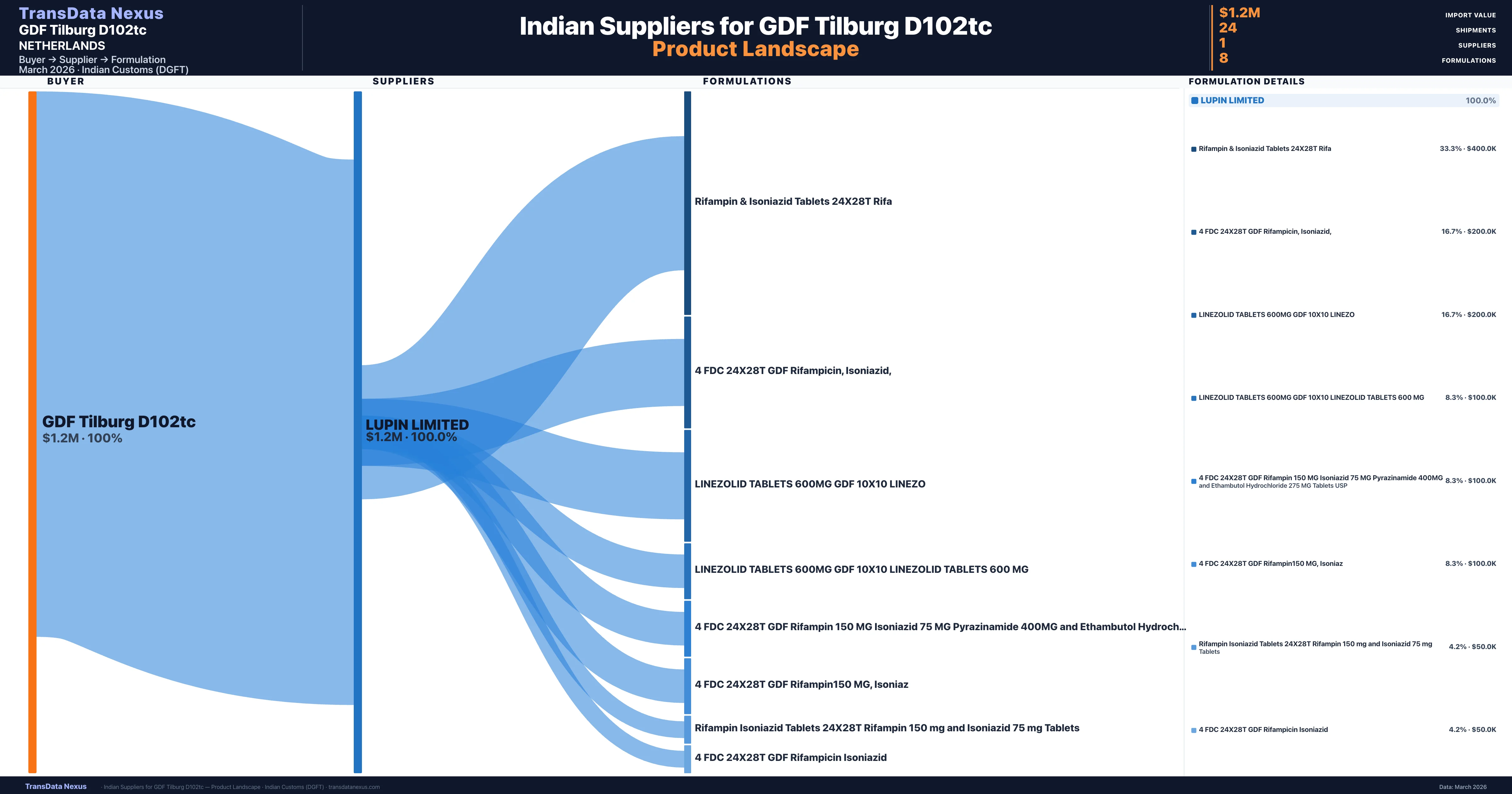
Who Are the Verified Indian Suppliers to GDF Tilburg D102tc?
Customs-verified supplier relationships from Indian DGFT records
| Supplier | Value | Shipments | Share |
|---|---|---|---|
| Lupin Limited | $1.2M | 24 | 100.0% |
GDF Tilburg D102tc sources from 1 verified Indian supplier across 8 distinct formulations. The sourcing is highly concentrated — Lupin Limited accounts for 100.0% of total imports, indicating a strategic single-source relationship.
What Formulations Does GDF Tilburg D102tc Import?
| Formulation | Value | Ships |
|---|---|---|
| Rifampin & isoniazid tablets 24x28t | $400.0K | 8 |
| 4 fdc 24x28t gdf rifampicin, isoniazid | $200.0K | 4 |
| Linezolid tablets 600MG gdf 10x10 | $200.0K | 4 |
| Linezolid tablets 600MG gdf 10x10 linezolid tablets 600 MG | $100.0K | 2 |
| 4 fdc 24x28t gdf rifampin 150 MG isoniazid 75 MG pyrazinamide 400MG and ethambutol hydrochloride 275 MG tablets | $100.0K | 2 |
| 4 fdc 24x28t gdf rifampin150 MG | $100.0K | 2 |
| Rifampin isoniazid tablets 24x28t rifampin 150 MG and isoniazid 75 MG | $50.0K | 1 |
| 4 fdc 24x28t gdf rifampicin | $50.0K | 1 |
GDF Tilburg D102tc imports 8 distinct pharmaceutical formulations. Showing top 8 by value. For full formulation-level data, contact TransData Nexus.
What Products Does GDF Tilburg D102tc Import?
Top Products by Import Value
GDF Tilburg D102tc Therapeutic Categories — 2 Specializations
GDF Tilburg D102tc imports across 2 therapeutic categories, with Tuberculosis Medications (72.7%), Advanced Antibiotics (27.3%), representing the largest segments. The portfolio is concentrated — top 5 products = 100% of total imports.
Tuberculosis Medications
1 products · 72.7% · $800.0K
Advanced Antibiotics
1 products · 27.3% · $300.0K
Import Portfolio — Top 2 by Import Value
| # | Product | Category | Value | Ships | Share | Rk |
|---|---|---|---|---|---|---|
| 1 | Isoniazid | Tuberculosis Medications | $800.0K | 16 | 0.0% | 18 |
| 2 | Linezolid | Advanced Antibiotics | $300.0K | 6 | 0.8% | 11 |
GDF Tilburg D102tc imports 2 pharmaceutical products across 2 categories into Netherlands totaling $1.1M.
Key Metrics
Top Categories
Indian Suppliers
Related Trade Data
Need Detailed Data?
Shipment-level records, supplier connections & pricing for GDF Tilburg D102tc.
Request DemoGDF Tilburg D102tc — Corporate Profile & Information
Company type, headquarters, distribution network, and industry role
1Company Overview
GDF Tilburg D102tc is a pharmaceutical importer and buyer based in the Netherlands, specializing in the acquisition of finished pharmaceutical formulations. The company operates as a wholesaler, sourcing medications from international suppliers to distribute within the Dutch market. While specific details about its parent company and exact headquarters location are not publicly disclosed, GDF Tilburg D102tc plays a significant role in the Netherlands' pharmaceutical distribution network by ensuring the availability of essential medications sourced from global suppliers.
2Distribution Network
GDF Tilburg D102tc's distribution network encompasses multiple warehouse locations across the Netherlands, strategically positioned to facilitate efficient logistics and timely delivery of pharmaceutical products. The company's logistics capabilities are robust, enabling it to manage a diverse portfolio of medications and meet the demands of various healthcare providers nationwide. While the primary focus is on the Dutch market, GDF Tilburg D102tc's operations may extend to neighboring countries, leveraging its strategic position within the European Union to optimize supply chain efficiency.
3Industry Role
Within the Netherlands' pharmaceutical supply chain, GDF Tilburg D102tc functions as a primary wholesaler. The company imports finished pharmaceutical formulations from international suppliers, including a notable partnership with LUPIN LIMITED, to distribute these products to various healthcare providers across the country. By sourcing medications from global manufacturers, GDF Tilburg D102tc ensures a steady supply of essential drugs, contributing to the overall stability and reliability of the Dutch pharmaceutical market.
Supplier Relationship Intelligence — GDF Tilburg D102tc
Sourcing concentration, supply chain resilience, and strategic implications
1Sourcing Concentration Analysis
GDF Tilburg D102tc exhibits a high degree of sourcing concentration, with a total import value of $1.1 million USD from India, comprising 22 shipments of two products across two therapeutic categories. The top five products imported include Isoniazid ($800K) and Linezolid ($300K), sourced exclusively from LUPIN LIMITED, indicating a single-source dependency. This concentrated sourcing strategy may present risks related to supply chain disruptions, such as production delays or quality issues. However, the consistent volume of shipments and the substantial financial commitment suggest a stable and strategic partnership between GDF Tilburg D102tc and LUPIN LIMITED, potentially mitigating some of these risks.
2Supply Chain Resilience
The resilience of GDF Tilburg D102tc's Indian supply chain is closely tied to its exclusive relationship with LUPIN LIMITED. The lack of backup suppliers for the imported products indicates a potential vulnerability to supply chain disruptions. The limited diversity in product formulations—eight unique formulations—further constrains the company's ability to adapt to sudden changes in supply or demand. Additionally, the reliance on specific shipping routes and the regulatory compliance of LUPIN LIMITED are critical factors influencing the overall resilience of the supply chain. Any disruptions in LUPIN LIMITED's operations or in the shipping routes could significantly impact GDF Tilburg D102tc's ability to meet market demands.
3Strategic Implications
GDF Tilburg D102tc's concentrated sourcing pattern positions it as a key player in the Dutch market for tuberculosis medications and advanced antibiotics. The exclusive importation of Isoniazid and Linezolid from LUPIN LIMITED allows the company to offer specialized products that may not be readily available from other suppliers. For Indian exporters, this presents an opportunity to establish partnerships with GDF Tilburg D102tc, particularly in the therapeutic areas of tuberculosis and advanced antibiotics. By diversifying their product offerings and ensuring compliance with Dutch regulatory standards, Indian exporters can position themselves as viable alternative suppliers to GDF Tilburg D102tc, potentially reducing the company's dependency on a single source and enhancing supply chain resilience.
Importing Pharmaceuticals into Netherlands — Regulatory Framework
Regulatory authority, GMP requirements, import licensing for Netherlands
1Regulatory Authority & Framework
In the Netherlands, the Medicines Evaluation Board (MEB) serves as the primary regulatory authority overseeing the safety, efficacy, and quality of medicinal products. The MEB is responsible for granting marketing authorizations for pharmaceutical products, ensuring that they meet the necessary standards before entering the Dutch market. Key legislation governing pharmaceutical imports includes the Medicines Act (Geneesmiddelenwet), which outlines the requirements for importing, manufacturing, and distributing medicinal products within the Netherlands. For Indian generics to be marketed in the Netherlands, they must undergo a marketing authorization process with the MEB, demonstrating compliance with Dutch and EU regulations. This process involves submitting comprehensive data on the product's quality, safety, and efficacy, as well as information on the manufacturing process and facilities.
2Import Licensing & GMP
Importers of medicinal products into the Netherlands are required to obtain a manufacturing authorization or a wholesale distribution authorization. A manufacturing authorization is necessary for the preparation, trading, import, and export of medicinal products and active substances. This authorization ensures that the importer complies with Good Manufacturing Practice (GMP) standards, which are essential for maintaining product quality and safety. GMP certificates recognized by the European Union, such as EU GMP, WHO GMP, and PIC/S, are acceptable for importation purposes. Additionally, importers must adhere to the European guidelines on Good Distribution Practice (GDP) of medicinal products for human use, ensuring that the distribution process maintains the quality and integrity of the products. Wholesale distribution authorization is required for activities such as procuring, holding, supplying, delivering, or exporting medicinal products or active substances prepared or imported by a third party. It's important to note that holders of wholesale distribution authorization, other than holders of marketing authorizations, are not authorized to import medicinal products from countries outside the European Economic Area (EEA).
3Quality & Labeling
Imported pharmaceutical products must undergo batch testing to ensure they meet the required quality standards. Stability requirements are also critical, as they determine the product's shelf life and ensure its efficacy and safety over time. Labeling must be in Dutch, providing clear and accurate information about the product's usage, dosage, and potential side effects. Serialization mandates are in place to enhance traceability and prevent counterfeit products from entering the market. These requirements are enforced by the MEB and other relevant authorities to maintain the integrity of the pharmaceutical supply chain and protect public health.
4Recent Regulatory Changes
As of 1 July 2024, significant changes have been implemented regarding the declaration of pharmaceutical products and active substances for import into the Netherlands. Importers are now required to include a fictitious document code in their declarations. For those with a marketing or manufacturing license for importing pharmaceutical products, the document code 1400 must be included. This change aims to streamline the import process and enhance regulatory oversight. Additionally, the Medicines Evaluation Board (MEB) has been actively involved in assessing parallel imports, ensuring that imported medicinal products are interchangeable with Dutch reference products and meet all necessary safety and efficacy standards. These regulatory updates reflect the MEB's commitment to maintaining high standards in the Dutch pharmaceutical market.
GDF Tilburg D102tc — Procurement Pattern Analysis
Product strategy, sourcing profile, and market positioning
1Product Strategy
GDF Tilburg D102tc's focus on importing tuberculosis medications and advanced antibiotics aligns with the ongoing demand for these critical therapeutic areas in the Netherlands. Tuberculosis remains a significant public health concern, necessitating a reliable supply of effective treatments. Advanced antibiotics are essential for combating resistant bacterial infections, a growing challenge in healthcare. The company's import strategy ensures that these vital medications are available to healthcare providers, supporting the treatment of complex infectious diseases. The partnership with LUPIN LIMITED, a reputable Indian pharmaceutical manufacturer, enables GDF Tilburg D102tc to source high-quality products that meet Dutch regulatory standards, thereby contributing to the overall health and well-being of the Dutch population.
2Sourcing Profile
GDF Tilburg D102tc's sourcing strategy is centered on importing generic drugs from India, focusing on finished pharmaceutical formulations. The company's preference for specific formulations, such as Isoniazid and Linezolid, indicates a targeted approach to meet the therapeutic needs of the Dutch market. India's well-established pharmaceutical industry, known for its adherence to international quality standards, makes it a suitable partner for sourcing these products. By importing from India, GDF Tilburg D102tc can offer cost-effective alternatives to branded medications, enhancing accessibility for patients while maintaining high-quality standards.
3Market Positioning
GDF Tilburg D102tc serves the wholesale distribution segment of the Netherlands pharmaceutical market. By importing and distributing essential medications, the company ensures that retail pharmacies, hospitals, and other healthcare providers have access to critical drugs necessary for patient care. The focus on tuberculosis medications and advanced antibiotics positions GDF Tilburg D102tc as a key supplier of specialized treatments, catering to the needs of healthcare providers dealing with complex infectious diseases. The company's strategic sourcing and distribution practices contribute to the overall efficiency and reliability of the Dutch pharmaceutical supply chain.
Seller's Guide — How to Become a Supplier to GDF Tilburg D102tc
Opportunity assessment, qualifications, and practical approach strategy
1Opportunity Assessment
There is a realistic opportunity for new Indian suppliers to collaborate with GDF Tilburg D102tc, particularly in the therapeutic areas of tuberculosis and advanced antibiotics. By offering high-quality generic formulations that meet Dutch regulatory standards, Indian exporters can position themselves as viable alternatives to existing suppliers. GDF Tilburg D102tc's concentrated sourcing pattern suggests a potential openness to diversifying its supplier base to enhance supply chain resilience and mitigate risks associated with single-source dependency. Establishing partnerships with GDF Tilburg D102tc could provide Indian exporters with a stable entry point into the Dutch market, leveraging the company's established distribution network and market knowledge.
2Requirements & Qualifications
Indian exporters seeking to supply GDF Tilburg D102tc and the Netherlands market must ensure
Frequently Asked Questions — GDF Tilburg D102tc
What products does GDF Tilburg D102tc import from India?
GDF Tilburg D102tc imports 2 pharmaceutical products across 2 categories. Top imports: Isoniazid ($800.0K), Linezolid ($300.0K).
Who supplies pharmaceuticals to GDF Tilburg D102tc from India?
GDF Tilburg D102tc sources from 1 verified Indian suppliers. The primary supplier is Lupin Limited (100.0% of imports, $1.2M).
What is GDF Tilburg D102tc's total pharmaceutical import value?
GDF Tilburg D102tc's total pharmaceutical import value from India is $1.1M, based on 22 verified shipments in Indian Customs (DGFT) data.
What therapeutic categories does GDF Tilburg D102tc focus on?
GDF Tilburg D102tc imports across 2 categories. The largest: Tuberculosis Medications (72.7%), Advanced Antibiotics (27.3%).
Get Full GDF Tilburg D102tc Import Intelligence
Access shipment-level details, supplier connections, pricing data, and competitive analysis. TransData Nexus provides verified Indian Customs (DGFT) data trusted by pharmaceutical trade professionals worldwide.
Official References & Regulatory Resources
Verify import regulations and drug registration requirements with the agencies above.
Research Methodology & Data Transparency
Suresh Sormare
Verified AuthorPharmaceutical Export-Import Analyst & Trade Intelligence Expert
Suresh Sormare is a pharmaceutical export-import analyst with deep expertise in Indian Customs (DGFT) data, HS code classification, and global pharmaceutical supply chains. His analysis covers 10M+ shipment records across 150+ countries and is used by manufacturers, procurement agencies, and trade consultants worldwide. Suresh specializes in identifying verified suppliers and buyers from customs records, mapping bilateral pharmaceutical trade corridors, analyzing tariff structures and regulatory frameworks across 170+ destination markets, and benchmarking competitive positioning for finished pharmaceutical formulations. His methodology combines granular customs transaction data with regulatory intelligence from FDA, EMA, WHO, CDSCO, and 40+ national drug authorities to deliver actionable trade insights for the pharmaceutical formulations sector.
linkedin.com/in/sureshsormarePrimary Data Source
All trade data is sourced from Indian Customs (DGFT) official shipping bill records — the authoritative government database for India's pharmaceutical trade. Each verified record contains exporter name, consignee (buyer) name, detailed product description, quantity, declared FOB value (USD), port of loading, destination country, and shipment date.
Analysis Methodology
- 1.Buyer Matching: GDF Tilburg D102tc identified across shipments using consignee name normalization.
- 2.Statistical Normalization: Shipment values are statistically normalized to ensure accurate market share representation.
- 3.Market Share: Calculated per product as GDF Tilburg D102tc's capped value divided by total Indian exports for that product.
- 4.Shipment Count: Based on 22 individual customs records matching GDF Tilburg D102tc.
- 5.Supplier Verification: GDF Tilburg D102tc sources from 1 verified Indian suppliers across 8 formulations, confirmed from customs records.
Government-Sourced Data
Official DGFT customs records
Transparent Methodology
Calculations fully disclosed above
2 Products Tracked
2 therapeutic categories
Expert-Reviewed
By pharmaceutical trade specialists
Data Source & Methodology
Trade data sourced from Indian Customs (DGFT) export shipment records. Values represent FOB export value in USD. For current shipment-level data, contact TransData Nexus.