E.p.dis
Pharmaceutical Importer · France · Advanced Antibiotics Focus · $5.0M Total Trade · DGFT Verified
E.p.dis is a pharmaceutical importer based in France with a total trade value of $5.0M across 5 products in 5 therapeutic categories. Based on 189 verified import shipments from Indian Customs (DGFT) records, the company actively imports across multiple product segments. E.p.dis sources from 9 verified Indian suppliers, with Micro Labs Limited accounting for 82.0% of imports.
E.p.dis — Import Portfolio & Supplier Network
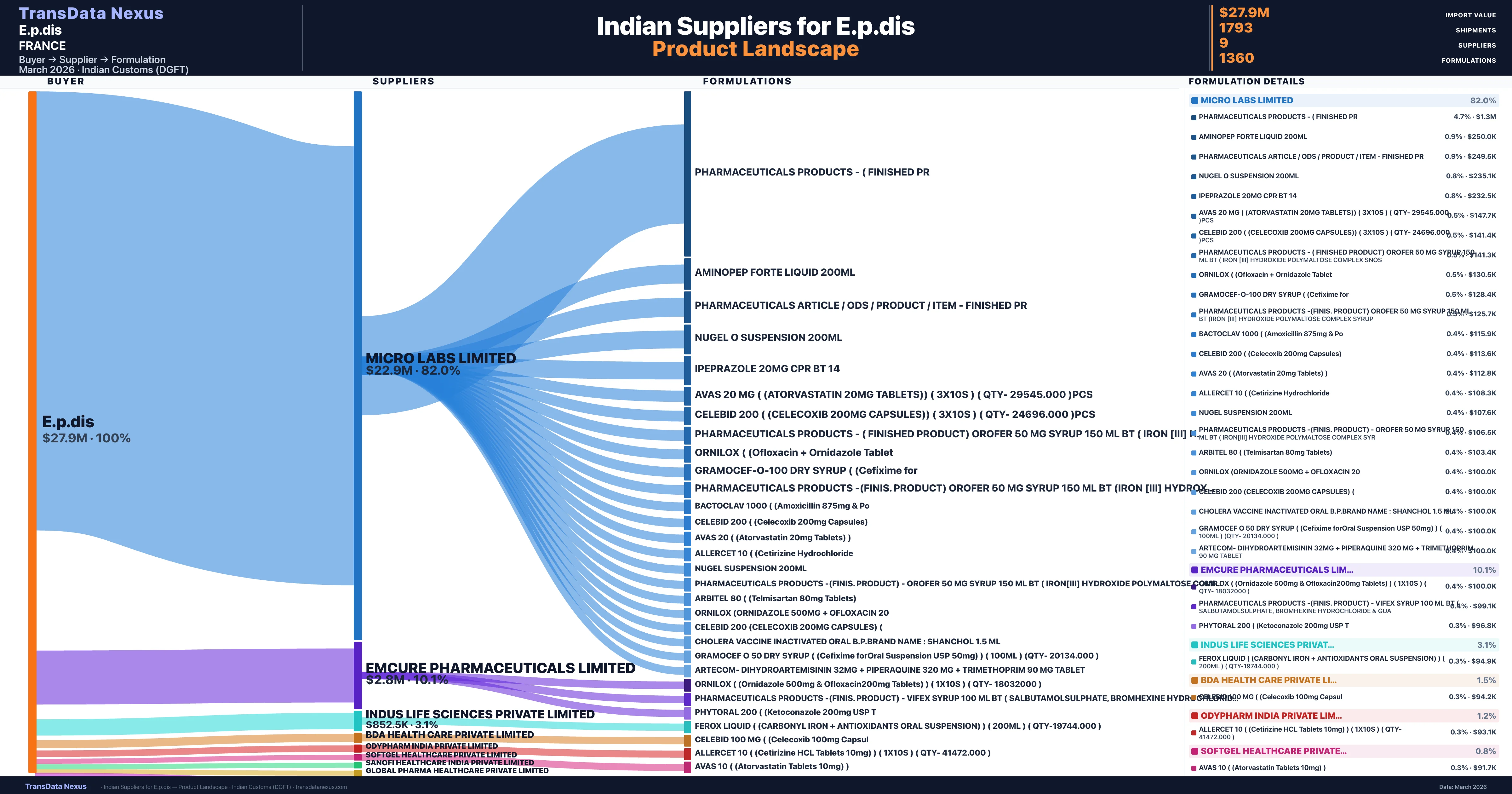
Who Are the Verified Indian Suppliers to E.p.dis?
Customs-verified supplier relationships from Indian DGFT records
| Supplier | Value | Shipments | Share |
|---|---|---|---|
| Micro Labs Limited | $22.9M | 1,451 | 82.0% |
| Emcure Pharmaceuticals Limited | $2.8M | 229 | 10.1% |
| Indus Life Sciences Private Limited | $852.5K | 65 | 3.1% |
| Bda Health Care Private Limited | $425.0K | 12 | 1.5% |
| Odypharm India Private Limited | $339.4K | 17 | 1.2% |
| Softgel Healthcare Private Limited | $229.4K | 6 | 0.8% |
| Sanofi Healthcare India Private Limited | $200.0K | 4 | 0.7% |
| Global Pharma Healthcare Private Limited | $144.4K | 7 | 0.5% |
| Bliss Gvs Pharma Limited | $19.8K | 2 | 0.1% |
E.p.dis sources from 9 verified Indian suppliers across 1,360 distinct formulations. The sourcing is highly concentrated — Micro Labs Limited accounts for 82.0% of total imports, indicating a strategic single-source relationship.
What Formulations Does E.p.dis Import?
| Formulation | Value | Ships |
|---|---|---|
| Pharmaceuticals products - ( finished | $1.3M | 95 |
| Aminopep forte liquid 200ML | $250.0K | 5 |
| Pharmaceuticals article / ods / product / item - finished | $249.5K | 20 |
| Nugel o suspension 200ML | $235.1K | 8 |
| Ipeprazole 20MG cpr bt | $232.5K | 6 |
| Avas 20 MG ( (atorvastatin 20MG tablets)) ( 3x10s ) ( qty- 29545.000 | $147.7K | 3 |
| Celebid 200 ( (celecoxib 200MG capsules)) ( 3x10s ) ( qty- 24696.000 | $141.4K | 3 |
| Pharmaceuticals products - ( finished product) orofer 50 MG syrup 150 ML bt ( iron [iii] hydroxide polymaltose complex | $141.3K | 12 |
| Ornilox ( (ofloxacin + ornidazole | $130.5K | 3 |
| Gramocef-o-100 dry syrup ( (cefixime | $128.4K | 4 |
| Pharmaceuticals products -(finis. product) orofer 50 MG syrup 150 ML bt (iron [iii] hydroxide polymaltose complex | $125.7K | 3 |
| Bactoclav 1000 ( (amoxicillin 875MG & | $115.9K | 3 |
| Celebid 200 ( (celecoxib 200MG capsules) | $113.6K | 4 |
| Avas 20 ( (atorvastatin 20MG tablets) ) | $112.8K | 3 |
| Allercet 10 ( (cetirizine | $108.3K | 3 |
E.p.dis imports 1,360 distinct pharmaceutical formulations. Showing top 15 by value. For full formulation-level data, contact TransData Nexus.
What Products Does E.p.dis Import?
Top Products by Import Value
E.p.dis Therapeutic Categories — 5 Specializations
E.p.dis imports across 5 therapeutic categories, with Advanced Antibiotics (37.9%), Analgesics & Antipyretics (31.6%), Antifungals (13.6%) representing the largest segments. The portfolio is concentrated — top 5 products = 100% of total imports.
Advanced Antibiotics
1 products · 37.9% · $1.9M
Analgesics & Antipyretics
1 products · 31.6% · $1.6M
Antifungals
1 products · 13.6% · $686.8K
Antibiotics
1 products · 12.0% · $602.2K
Diuretics
1 products · 4.9% · $247.5K
Import Portfolio — Top 5 by Import Value
| # | Product | Category | Value | Ships | Share | Rk |
|---|---|---|---|---|---|---|
| 1 | Ornidazole | Advanced Antibiotics | $1.9M | 52 | 7.4% | 2 |
| 2 | Celecoxib | Analgesics & Antipyretics | $1.6M | 36 | 1.2% | 11 |
| 3 | Ketoconazole | Antifungals | $686.8K | 29 | 1.7% | 12 |
| 4 | Levofloxacin | Antibiotics | $602.2K | 44 | 0.8% | 17 |
| 5 | Torsemide | Diuretics | $247.5K | 28 | 0.8% | 13 |
E.p.dis imports 5 pharmaceutical products across 5 categories into France totaling $5.0M.
Key Metrics
Top Categories
Indian Suppliers
Related Trade Data
E.p.dis — Corporate Profile & Information
Company type, headquarters, distribution network, and industry role
1Company Overview
E.p.dis is a French pharmaceutical company specializing in the wholesale distribution of pharmaceutical products. Established on March 8, 2000, and headquartered at 8 Avenue Paul Delorme, 76120 Le Grand-Quevilly, France, E.p.dis operates as a Société Anonyme (SA), a common corporate structure in France. (entreprises.lefigaro.fr) The company employs approximately three individuals at this location. (allbiz.fr)
E.p.dis functions as a pre-wholesale export distributor, primarily managing exports to around 50 destinations in Sub-Saharan Africa for pharmaceutical companies. This role involves overseeing the logistics and distribution of pharmaceutical products, ensuring compliance with regulatory standards, and maintaining the integrity of the supply chain. The company's operations are duly registered with the Agence Nationale de Sécurité des Médicaments (ANSM), the French regulatory body responsible for the safety of health products.
2Distribution Network
E.p.dis operates a 24,000 m² logistics hub located in Val de Reuil, France. This facility serves as the central point for managing exports to approximately 50 destinations in Sub-Saharan Africa. The company's distribution network is designed to ensure the efficient and secure delivery of pharmaceutical products, adhering to the highest standards of pharmaceutical logistics, including the maintenance of the cold chain to preserve product efficacy.
3Industry Role
In France's pharmaceutical supply chain, E.p.dis operates as a pre-wholesale export distributor. This role involves importing pharmaceutical products from international manufacturers and managing their distribution to various markets, particularly in Sub-Saharan Africa. By handling the logistics and regulatory compliance aspects, E.p.dis facilitates the entry of pharmaceutical products into these markets, ensuring that they meet the necessary standards and reach the intended destinations efficiently.
Supplier Relationship Intelligence — E.p.dis
Sourcing concentration, supply chain resilience, and strategic implications
1Sourcing Concentration Analysis
E.p.dis's sourcing strategy exhibits a high degree of concentration, with a significant portion of its imports originating from a single supplier, MICRO LABS LIMITED. This supplier accounts for 82% of the total import value, indicating a strong dependency on this source. Such concentration can pose risks, including potential supply chain disruptions if issues arise with the primary supplier. However, the stability of the relationship, as evidenced by the consistent volume of shipments, suggests a strategic choice to leverage the supplier's capabilities and reliability. The remaining 18% of imports are distributed among eight other suppliers, indicating a diversified sourcing approach to mitigate potential risks.
2Supply Chain Resilience
E.p.dis's supply chain resilience is bolstered by its diversified supplier base, despite the predominant reliance on MICRO LABS LIMITED. The company imports a total of 1,360 unique pharmaceutical formulations, reflecting a broad product portfolio that can help mitigate risks associated with supply chain disruptions. Additionally, E.p.dis's logistics hub in Val de Reuil is equipped to handle complex distribution requirements, including the maintenance of the cold chain, which is crucial for the stability and efficacy of pharmaceutical products. The company's registration with the ANSM underscores its commitment to regulatory compliance, further enhancing the resilience of its supply chain.
3Strategic Implications
E.p.dis's concentrated sourcing strategy, particularly its reliance on MICRO LABS LIMITED, positions the company to benefit from strong supplier relationships and potentially favorable terms. However, this dependency also exposes E.p.dis to risks associated with supply chain disruptions or changes in supplier dynamics. For Indian pharmaceutical exporters, this presents an opportunity to diversify E.p.dis's supplier base by offering competitive products and establishing reliable partnerships. By providing high-quality formulations and ensuring consistent supply, Indian exporters can position themselves as viable alternatives to existing suppliers, potentially capturing a share of E.p.dis's import volume.
Importing Pharmaceuticals into France — Regulatory Framework
Regulatory authority, GMP requirements, import licensing for France
1Regulatory Authority & Framework
In France, the Agence Nationale de Sécurité des Médicaments (ANSM) is the primary regulatory authority overseeing the safety and efficacy of health products, including pharmaceuticals. The ANSM is responsible for granting marketing authorizations, monitoring the safety of medicines, and ensuring compliance with European Union regulations. For Indian pharmaceutical companies seeking to export to France, obtaining a marketing authorization from the ANSM is a critical step. This process involves submitting comprehensive documentation, including clinical trial data, manufacturing details, and quality control measures, to demonstrate that the product meets the required standards. The ANSM evaluates these submissions to ensure that imported pharmaceuticals are safe for the French market.
2Import Licensing & GMP
Import licensing requirements in France are stringent, necessitating that pharmaceutical products comply with Good Manufacturing Practice (GMP) standards recognized by the European Union. Indian pharmaceutical manufacturers must ensure that their facilities are certified by an authority whose GMP standards are accepted by the EU, such as the World Health Organization (WHO) or the Pharmaceutical Inspection Co-operation Scheme (PIC/S). Additionally, Indian exporters must obtain a wholesale distribution authorization to legally distribute pharmaceutical products within France. This authorization requires adherence to specific storage, handling, and distribution protocols to maintain product integrity and comply with French regulations.
3Quality & Labeling
Pharmaceutical products imported into France must undergo batch testing to verify their quality and compliance with regulatory standards. Stability studies are also required to ensure that products maintain their efficacy and safety throughout their shelf life. Labeling requirements include providing information in French, detailing the product's composition, dosage instructions, storage conditions, and expiration date. Serialization mandates are in place to track and trace pharmaceutical products throughout the supply chain, enhancing transparency and preventing counterfeit products from entering the market. These measures are designed to protect public health and ensure that consumers receive safe and effective medications.
4Recent Regulatory Changes
Between 2024 and 2026, France implemented several regulatory changes affecting the importation of pharmaceutical products, particularly generics from India. These changes include stricter compliance requirements for GMP certifications, enhanced scrutiny of marketing authorization applications, and more rigorous post-market surveillance to monitor the safety and efficacy of imported drugs. Additionally, France has updated its labeling and serialization requirements to align with EU directives, necessitating that imported pharmaceuticals meet these new standards. Indian pharmaceutical exporters must stay informed about these regulatory updates to ensure continued access to the French market.
E.p.dis — Procurement Pattern Analysis
Product strategy, sourcing profile, and market positioning
1Product Strategy
E.p.dis's product strategy focuses on importing pharmaceutical formulations across five therapeutic categories, with a significant emphasis on Advanced Antibiotics (37.9%), Analgesics & Antipyretics (31.6%), and Antifungals (13.6%). This focus aligns with the therapeutic needs of the Sub-Saharan African markets, where infectious diseases and pain management are prevalent concerns. The top five imported products—Ornidazole, Celecoxib, Ketoconazole, Levofloxacin, and Torsemide—are indicative of the company's strategic alignment with these therapeutic areas. By concentrating on these categories, E.p.dis aims to address critical health challenges in the regions it serves.
2Sourcing Profile
E.p.dis's sourcing strategy is heavily reliant on Indian pharmaceutical manufacturers, with MICRO LABS LIMITED being the predominant supplier. This reliance suggests that E.p.dis values the cost-effectiveness and quality of Indian generics. The company's import portfolio includes a diverse range of formulations, indicating a preference for suppliers capable of providing a broad spectrum of products. For Indian exporters, this presents an opportunity to strengthen partnerships with E.p.dis by offering a wide array of high-quality pharmaceutical formulations that meet the company's standards and regulatory requirements.
3Market Positioning
E.p.dis serves the wholesale distribution segment of the French pharmaceutical market, focusing on exporting pharmaceutical products to Sub-Saharan Africa. By acting as a pre-wholesale export distributor, E.p.dis plays a crucial role in ensuring that pharmaceutical products reach various markets efficiently and in compliance with regulatory standards. The company's strategic focus on specific therapeutic areas reflects its commitment to addressing the health needs of the regions it serves.
Seller's Guide — How to Become a Supplier to E.p.dis
Opportunity assessment, qualifications, and practical approach strategy
1Opportunity Assessment
There is a realistic opportunity for new Indian suppliers to enter E.p.dis's supply chain. The company's diversified sourcing approach, as evidenced by its engagement with multiple suppliers, indicates openness to establishing new partnerships. Indian exporters can capitalize on this by offering high-quality pharmaceutical formulations that meet E.p.dis's standards and regulatory requirements. By demonstrating reliability, compliance, and the ability to meet specific therapeutic needs, Indian suppliers can position themselves as valuable partners to E.p.dis.
2Requirements & Qualifications
Indian pharmaceutical exporters seeking to supply E.p.dis must ensure that their products comply with EU-recognized GMP standards, such as those set by the WHO or PIC/S. Obtaining a marketing authorization from the ANSM is essential, which involves submitting comprehensive documentation to demonstrate product safety and efficacy. Additionally, exporters must adhere to French labeling requirements, including providing information in French and meeting serialization mandates. Ensuring compliance with these standards is crucial for gaining access to the French market through E.p.dis.
Frequently Asked Questions — E.p.dis
What products does E.p.dis import from India?
E.p.dis imports 5 pharmaceutical products across 5 categories. Top imports: Ornidazole ($1.9M), Celecoxib ($1.6M), Ketoconazole ($686.8K), Levofloxacin ($602.2K), Torsemide ($247.5K).
Who supplies pharmaceuticals to E.p.dis from India?
E.p.dis sources from 9 verified Indian suppliers. The primary supplier is Micro Labs Limited (82.0% of imports, $22.9M).
What is E.p.dis's total pharmaceutical import value?
E.p.dis's total pharmaceutical import value from India is $5.0M, based on 189 verified shipments in Indian Customs (DGFT) data.
What therapeutic categories does E.p.dis focus on?
E.p.dis imports across 5 categories. The largest: Advanced Antibiotics (37.9%), Analgesics & Antipyretics (31.6%), Antifungals (13.6%).
Get Full E.p.dis Import Intelligence
Access shipment-level details, supplier connections, pricing data, and competitive analysis. TransData Nexus provides verified Indian Customs (DGFT) data trusted by pharmaceutical trade professionals worldwide.
Official References & Regulatory Resources
Verify import regulations and drug registration requirements with the agencies above.
Research Methodology & Data Transparency
Suresh Sormare
Verified AuthorPharmaceutical Export-Import Analyst & Trade Intelligence Expert
Suresh Sormare is a pharmaceutical export-import analyst with deep expertise in Indian Customs (DGFT) data, HS code classification, and global pharmaceutical supply chains. His analysis covers 10M+ shipment records across 150+ countries and is used by manufacturers, procurement agencies, and trade consultants worldwide. Suresh specializes in identifying verified suppliers and buyers from customs records, mapping bilateral pharmaceutical trade corridors, analyzing tariff structures and regulatory frameworks across 170+ destination markets, and benchmarking competitive positioning for finished pharmaceutical formulations. His methodology combines granular customs transaction data with regulatory intelligence from FDA, EMA, WHO, CDSCO, and 40+ national drug authorities to deliver actionable trade insights for the pharmaceutical formulations sector.
linkedin.com/in/sureshsormarePrimary Data Source
All trade data is sourced from Indian Customs (DGFT) official shipping bill records — the authoritative government database for India's pharmaceutical trade. Each verified record contains exporter name, consignee (buyer) name, detailed product description, quantity, declared FOB value (USD), port of loading, destination country, and shipment date.
Analysis Methodology
- 1.Buyer Matching: E.p.dis identified across shipments using consignee name normalization, aggregating 3 name variants.
- 2.Statistical Normalization: Shipment values are statistically normalized to ensure accurate market share representation.
- 3.Market Share: Calculated per product as E.p.dis's capped value divided by total Indian exports for that product.
- 4.Shipment Count: Based on 189 individual customs records matching E.p.dis.
- 5.Supplier Verification: E.p.dis sources from 9 verified Indian suppliers across 1,360 formulations, confirmed from customs records.
Government-Sourced Data
Official DGFT customs records
Transparent Methodology
Calculations fully disclosed above
5 Products Tracked
5 therapeutic categories
Expert-Reviewed
By pharmaceutical trade specialists
Data Source & Methodology
Trade data sourced from Indian Customs (DGFT) export shipment records. Values represent FOB export value in USD. Profile aggregates 3 company name variants from customs records. For current shipment-level data, contact TransData Nexus.