Director, Mbdc, Dghs
Pharmaceutical Importer · Bangladesh · Tuberculosis Medications Focus · $1.9M Total Trade · DGFT Verified
Director, Mbdc, Dghs is a pharmaceutical importer based in Bangladesh with a total trade value of $1.9M across 2 products in 2 therapeutic categories. Based on 39 verified import shipments from Indian Customs (DGFT) records, the company actively imports across multiple product segments. Director, Mbdc, Dghs sources from 2 verified Indian suppliers, with Lupin Limited accounting for 87.5% of imports.
Director, Mbdc, Dghs — Import Portfolio & Supplier Network
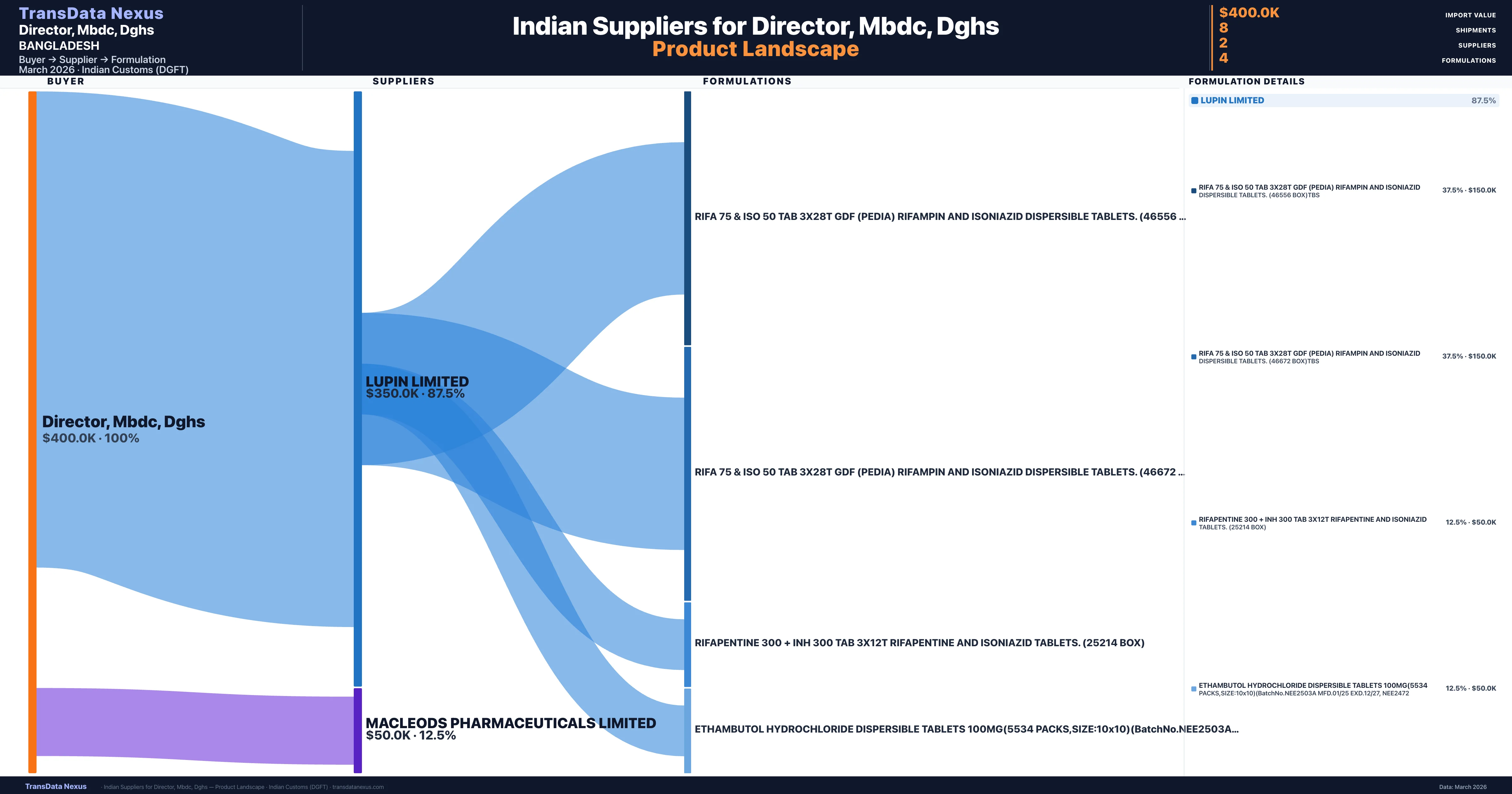
Who Are the Verified Indian Suppliers to Director, Mbdc, Dghs?
Customs-verified supplier relationships from Indian DGFT records
| Supplier | Value | Shipments | Share |
|---|---|---|---|
| Lupin Limited | $350.0K | 7 | 87.5% |
| Macleods Pharmaceuticals Limited | $50.0K | 1 | 12.5% |
Director, Mbdc, Dghs sources from 2 verified Indian suppliers across 4 distinct formulations. The sourcing is highly concentrated — Lupin Limited accounts for 87.5% of total imports, indicating a strategic single-source relationship.
What Formulations Does Director, Mbdc, Dghs Import?
| Formulation | Value | Ships |
|---|---|---|
| Rifa 75 & iso 50 TAB 3x28t gdf (pedia) rifampin and isoniazid dispersible tablets. (46556 Box | $150.0K | 3 |
| Rifa 75 & iso 50 TAB 3x28t gdf (pedia) rifampin and isoniazid dispersible tablets. (46672 Box | $150.0K | 3 |
| Rifapentine 300 + inh 300 TAB 3x12t rifapentine and isoniazid tablets. (25214 Box) | $50.0K | 1 |
| Ethambutol hydrochloride dispersible tablets 100MG(5534 packs,size:10x10)(batchno.nee2503a mfd.01/25 exd.12/27 | $50.0K | 1 |
Director, Mbdc, Dghs imports 4 distinct pharmaceutical formulations. Showing top 4 by value. For full formulation-level data, contact TransData Nexus.
What Products Does Director, Mbdc, Dghs Import?
Top Products by Import Value
Director, Mbdc, Dghs Therapeutic Categories — 2 Specializations
Director, Mbdc, Dghs imports across 2 therapeutic categories, with Tuberculosis Medications (56.4%), Advanced Antibiotics (43.6%), representing the largest segments. The portfolio is concentrated — top 5 products = 100% of total imports.
Tuberculosis Medications
1 products · 56.4% · $1.1M
Advanced Antibiotics
1 products · 43.6% · $850.0K
Import Portfolio — Top 2 by Import Value
| # | Product | Category | Value | Ships | Share | Rk |
|---|---|---|---|---|---|---|
| 1 | Isoniazid | Tuberculosis Medications | $1.1M | 22 | 0.0% | 5 |
| 2 | Rifampicin | Advanced Antibiotics | $850.0K | 17 | 0.1% | 4 |
Director, Mbdc, Dghs imports 2 pharmaceutical products across 2 categories into Bangladesh totaling $1.9M.
Key Metrics
Top Categories
Indian Suppliers
Related Trade Data
Need Detailed Data?
Shipment-level records, supplier connections & pricing for Director, Mbdc, Dghs.
Request DemoDirector, Mbdc, Dghs — Corporate Profile & Information
Company type, headquarters, distribution network, and industry role
1Company Overview
Director, MBDC, DGHS is a governmental entity operating under the Directorate General of Health Services (DGHS) in Bangladesh. The DGHS is the principal authority responsible for the planning, development, and management of the country's health services. The MBDC (Medical Supplies and Drug Control) division within DGHS oversees the procurement and distribution of medical supplies and pharmaceuticals to ensure the availability of essential medicines across Bangladesh. Headquartered at the Leprosy Hospital Compound, TB Gate, Mohakhali, Dhaka-1212, Bangladesh, the MBDC plays a pivotal role in the national healthcare supply chain. (csc.dghs.gov.bd)
As a government procurement agency, Director, MBDC, DGHS is tasked with sourcing and importing pharmaceutical products to meet the country's medical needs. This includes managing the importation of finished pharmaceutical formulations, such as tablets, capsules, syrups, and injections, from various international suppliers. The agency's operations are integral to maintaining a steady supply of essential medicines, thereby supporting the overall healthcare infrastructure in Bangladesh.
2Distribution Network
While specific details about the distribution network of Director, MBDC, DGHS are not publicly disclosed, it is understood that the agency's operations are centralized at its headquarters in Dhaka. The DGHS, under which MBDC operates, is responsible for the nationwide distribution of medical supplies and pharmaceuticals. This centralized approach ensures that medical products are efficiently distributed to various healthcare facilities across Bangladesh, including hospitals, clinics, and health centers. The logistics capabilities of the DGHS are designed to support the timely delivery of medical supplies to meet the country's healthcare demands.
3Industry Role
Director, MBDC, DGHS functions as a government procurement agency within Bangladesh's pharmaceutical supply chain. Its primary role is to source and import finished pharmaceutical formulations to ensure the availability of essential medicines nationwide. By managing the procurement process, MBDC plays a critical role in maintaining the stability and reliability of the country's pharmaceutical supply, directly impacting the quality and accessibility of healthcare services.
Supplier Relationship Intelligence — Director, Mbdc, Dghs
Sourcing concentration, supply chain resilience, and strategic implications
1Sourcing Concentration Analysis
The sourcing data indicates that Director, MBDC, DGHS imports a limited range of pharmaceutical products, specifically focusing on two therapeutic categories: Tuberculosis Medications and Advanced Antibiotics. This concentration suggests a strategic approach to procurement, aligning with the national health priorities of combating tuberculosis and addressing antibiotic resistance. The agency's reliance on a small number of suppliers, notably LUPIN LIMITED and MACLEODS PHARMACEUTICALS LIMITED, indicates a preference for established partnerships to ensure consistent quality and supply. However, this limited supplier base may pose risks related to supply chain disruptions or changes in supplier dynamics.
The shipment data reveals that LUPIN LIMITED has been the primary supplier, accounting for 87.5% of the shipments, while MACLEODS PHARMACEUTICALS LIMITED contributed 12.5%. This distribution reflects a strong reliance on LUPIN LIMITED, which could be advantageous in terms of negotiating favorable terms and ensuring product consistency. However, such dependency also underscores the importance of maintaining a robust relationship with these suppliers and having contingency plans in place to mitigate potential risks.
2Supply Chain Resilience
The supply chain resilience of Director, MBDC, DGHS appears to be moderately robust, given its reliance on two primary suppliers for a limited range of products. The agency's focus on finished pharmaceutical formulations from India, particularly from suppliers like LUPIN LIMITED and MACLEODS PHARMACEUTICALS LIMITED, suggests a streamlined procurement process. However, the limited number of suppliers may expose the supply chain to risks such as supply disruptions, geopolitical issues, or changes in supplier policies. To enhance resilience, it would be prudent for MBDC to diversify its supplier base and establish contingency plans to ensure a continuous supply of essential medicines.
3Strategic Implications
The current sourcing pattern of Director, MBDC, DGHS indicates a strategic focus on essential tuberculosis medications and advanced antibiotics, aligning with national health priorities. The agency's reliance on a limited number of suppliers, particularly LUPIN LIMITED, suggests a preference for established partnerships to ensure consistent quality and supply. For Indian exporters, this presents an opportunity to strengthen relationships with MBDC by offering high-quality products that meet the agency's specific needs. However, potential suppliers should be prepared to navigate the competitive landscape and adhere to the regulatory standards set by the Bangladesh Directorate General of Drug Administration (DGDA).
Importing Pharmaceuticals into Bangladesh — Regulatory Framework
Regulatory authority, GMP requirements, import licensing for Bangladesh
1Regulatory Authority & Framework
In Bangladesh, the Directorate General of Drug Administration (DGDA) is the primary regulatory authority overseeing the pharmaceutical sector. The DGDA is responsible for ensuring the safety, efficacy, and quality of drugs and pharmaceutical products within the country. Key legislation governing pharmaceutical imports includes the Drugs Act, 1940, and the Drugs (Control) Ordinance, 1982, which provide the legal framework for drug regulation and control. The DGDA's role encompasses the registration of pharmaceutical products, monitoring of manufacturing practices, and enforcement of standards to safeguard public health.
For Indian pharmaceutical exporters, understanding the regulatory framework is crucial. The DGDA requires that all imported pharmaceutical products be registered and approved before they can be marketed in Bangladesh. This process involves submitting detailed documentation, including product dossiers, manufacturing licenses, and certificates of analysis. Compliance with Good Manufacturing Practice (GMP) standards, as recognized by the World Health Organization (WHO) or the Pharmaceutical Inspection Co-operation Scheme (PIC/S), is mandatory for all imported pharmaceutical products. Adhering to these regulations ensures that products meet the safety and quality standards required for the Bangladeshi market.
2Import Licensing & GMP
Import licensing in Bangladesh is governed by the DGDA, which mandates that all pharmaceutical products, including finished formulations, be registered prior to importation. The registration process requires submission of comprehensive documentation, including product dossiers, manufacturing licenses, and certificates of analysis. Additionally, compliance with Good Manufacturing Practice (GMP) standards is essential. The DGDA recognizes GMP certifications from reputable organizations such as the World Health Organization (WHO) and the Pharmaceutical Inspection Co-operation Scheme (PIC/S). For Indian exporters, obtaining GMP certification from these recognized bodies is a prerequisite for exporting pharmaceutical products to Bangladesh. Furthermore, wholesale distribution authorization is required for entities involved in the distribution of pharmaceutical products within Bangladesh.
3Quality & Labeling
Pharmaceutical products imported into Bangladesh must undergo batch testing to ensure they meet the safety, efficacy, and quality standards set by the DGDA. Stability studies are also required to confirm that products maintain their quality throughout their shelf life. Labeling requirements stipulate that product labels be in Bengali, the official language of Bangladesh, to ensure clear communication with consumers. Serialization mandates are in place to prevent counterfeit products and ensure traceability within the supply chain. Compliance with these quality and labeling standards is essential for the successful importation and marketing of pharmaceutical products in Bangladesh.
4Recent Regulatory Changes
Between 2024 and 2026, Bangladesh has implemented several regulatory changes affecting pharmaceutical imports. The DGDA has introduced stricter guidelines for the registration of imported pharmaceutical products, emphasizing the need for comprehensive documentation and adherence to international quality standards. Additionally, there has been an increased focus on enforcing GMP compliance, with more rigorous inspections and audits of manufacturing facilities. These changes aim to enhance the safety and efficacy of pharmaceutical products available in the Bangladeshi market. For Indian pharmaceutical exporters, staying informed about these regulatory updates is crucial to ensure continued access to the Bangladeshi market.
Director, Mbdc, Dghs — Procurement Pattern Analysis
Product strategy, sourcing profile, and market positioning
1Product Strategy
Director, MBDC, DGHS's focus on importing tuberculosis medications and advanced antibiotics aligns with Bangladesh's national health priorities. Tuberculosis remains a significant public health concern in the country, necessitating a steady supply of effective medications. Advanced antibiotics are essential for treating complex infections and combating antibiotic resistance. The market demand for these products is driven by the prevalence of infectious diseases and the need for effective treatment options. By concentrating on these therapeutic areas, MBDC ensures that critical medical needs are met, thereby supporting the overall healthcare infrastructure in Bangladesh.
2Sourcing Profile
Director, MBDC, DGHS's sourcing strategy involves importing generic drugs, particularly those used in the treatment of tuberculosis and complex infections. The agency's preference for finished pharmaceutical formulations indicates a focus on ready-to-use products that can be immediately distributed within the healthcare system. India's pharmaceutical industry, with its robust manufacturing capabilities and adherence to international quality standards, fits well into MBDC's procurement strategy. For Indian exporters, understanding MBDC's focus on these therapeutic areas and product types is essential for aligning their offerings with the agency's requirements.
3Market Positioning
Based on its product mix, Director, MBDC, DGHS serves the public healthcare sector in Bangladesh, supplying essential medicines to government hospitals, clinics, and health centers. The agency's focus on critical therapeutic areas positions it as a key player in ensuring the availability of life-saving medications within the country's healthcare system. By importing and distributing these products, MBDC plays a vital role in maintaining the health and well-being of the Bangladeshi population.
Frequently Asked Questions — Director, Mbdc, Dghs
What products does Director, Mbdc, Dghs import from India?
Director, Mbdc, Dghs imports 2 pharmaceutical products across 2 categories. Top imports: Isoniazid ($1.1M), Rifampicin ($850.0K).
Who supplies pharmaceuticals to Director, Mbdc, Dghs from India?
Director, Mbdc, Dghs sources from 2 verified Indian suppliers. The primary supplier is Lupin Limited (87.5% of imports, $350.0K).
What is Director, Mbdc, Dghs's total pharmaceutical import value?
Director, Mbdc, Dghs's total pharmaceutical import value from India is $1.9M, based on 39 verified shipments in Indian Customs (DGFT) data.
What therapeutic categories does Director, Mbdc, Dghs focus on?
Director, Mbdc, Dghs imports across 2 categories. The largest: Tuberculosis Medications (56.4%), Advanced Antibiotics (43.6%).
Get Full Director, Mbdc, Dghs Import Intelligence
Access shipment-level details, supplier connections, pricing data, and competitive analysis. TransData Nexus provides verified Indian Customs (DGFT) data trusted by pharmaceutical trade professionals worldwide.
Official References & Regulatory Resources
Verify import regulations and drug registration requirements with the agencies above.
Research Methodology & Data Transparency
Suresh Sormare
Verified AuthorPharmaceutical Export-Import Analyst & Trade Intelligence Expert
Suresh Sormare is a pharmaceutical export-import analyst with deep expertise in Indian Customs (DGFT) data, HS code classification, and global pharmaceutical supply chains. His analysis covers 10M+ shipment records across 150+ countries and is used by manufacturers, procurement agencies, and trade consultants worldwide. Suresh specializes in identifying verified suppliers and buyers from customs records, mapping bilateral pharmaceutical trade corridors, analyzing tariff structures and regulatory frameworks across 170+ destination markets, and benchmarking competitive positioning for finished pharmaceutical formulations. His methodology combines granular customs transaction data with regulatory intelligence from FDA, EMA, WHO, CDSCO, and 40+ national drug authorities to deliver actionable trade insights for the pharmaceutical formulations sector.
linkedin.com/in/sureshsormarePrimary Data Source
All trade data is sourced from Indian Customs (DGFT) official shipping bill records — the authoritative government database for India's pharmaceutical trade. Each verified record contains exporter name, consignee (buyer) name, detailed product description, quantity, declared FOB value (USD), port of loading, destination country, and shipment date.
Analysis Methodology
- 1.Buyer Matching: Director, Mbdc, Dghs identified across shipments using consignee name normalization, aggregating 2 name variants.
- 2.Statistical Normalization: Shipment values are statistically normalized to ensure accurate market share representation.
- 3.Market Share: Calculated per product as Director, Mbdc, Dghs's capped value divided by total Indian exports for that product.
- 4.Shipment Count: Based on 39 individual customs records matching Director, Mbdc, Dghs.
- 5.Supplier Verification: Director, Mbdc, Dghs sources from 2 verified Indian suppliers across 4 formulations, confirmed from customs records.
Government-Sourced Data
Official DGFT customs records
Transparent Methodology
Calculations fully disclosed above
2 Products Tracked
2 therapeutic categories
Expert-Reviewed
By pharmaceutical trade specialists
Data Source & Methodology
Trade data sourced from Indian Customs (DGFT) export shipment records. Values represent FOB export value in USD. Profile aggregates 2 company name variants from customs records. For current shipment-level data, contact TransData Nexus.