Cardinal Health
Pharmaceutical Importer · United States · Antibiotics Focus · $10.0M Total Trade · DGFT Verified
Cardinal Health is a pharmaceutical importer based in United States with a total trade value of $10.0M across 5 products in 4 therapeutic categories. Based on 210 verified import shipments from Indian Customs (DGFT) records, Cardinal Health is the #1 buyer in 2 products including Clindamycin, Exemestane. Cardinal Health sources from 19 verified Indian suppliers, with Encube Ethicals Private Limited accounting for 33.8% of imports.
Cardinal Health — Import Portfolio & Supplier Network
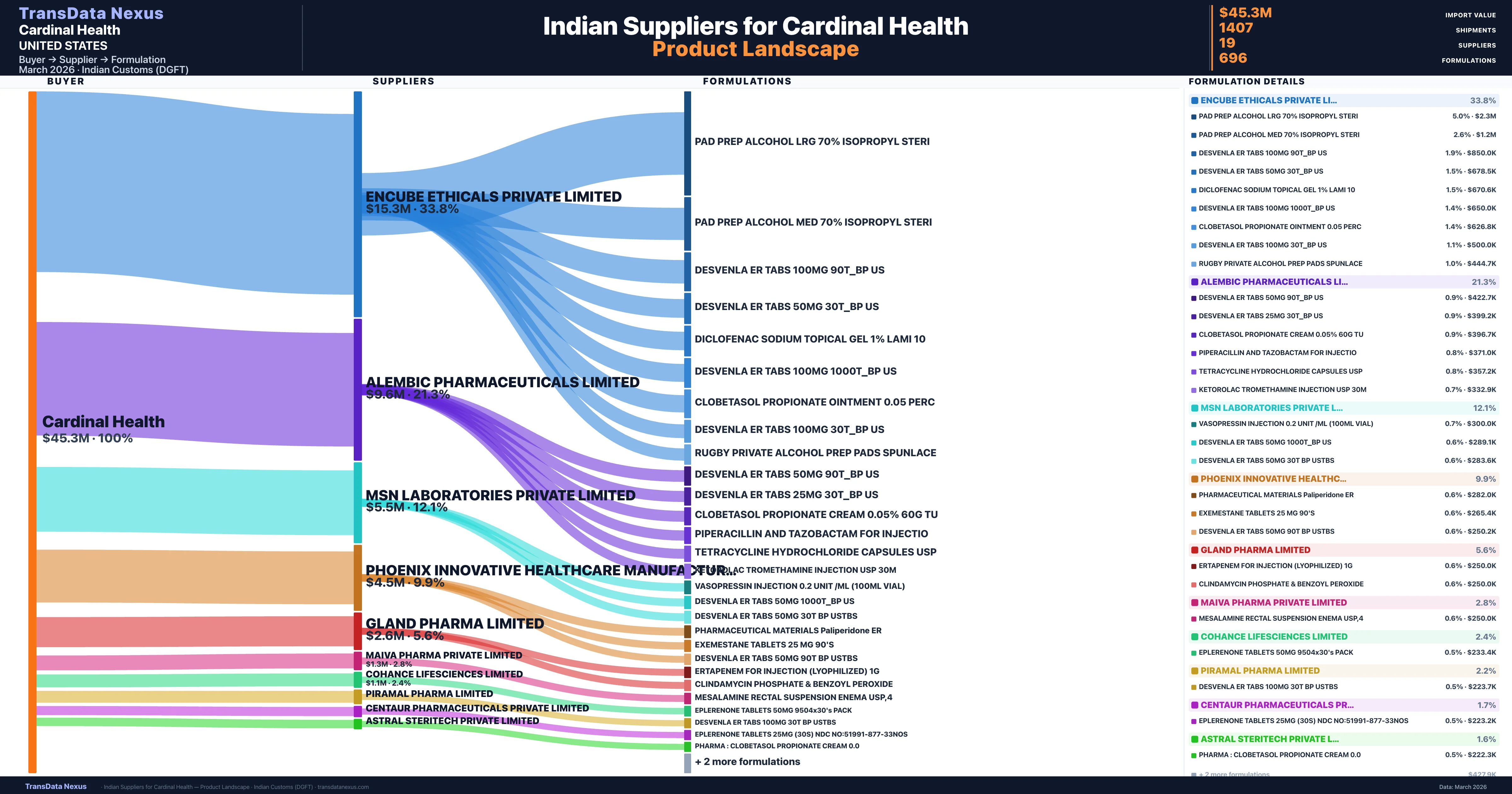
Who Are the Verified Indian Suppliers to Cardinal Health?
Customs-verified supplier relationships from Indian DGFT records
| Supplier | Value | Shipments | Share |
|---|---|---|---|
| Encube Ethicals Private Limited | $15.3M | 583 | 33.8% |
| Alembic Pharmaceuticals Limited | $9.6M | 258 | 21.3% |
| Msn Laboratories Private Limited | $5.5M | 171 | 12.1% |
| Phoenix Innovative Healthcare Manufacturers Privat | $4.5M | 98 | 9.9% |
| Gland Pharma Limited | $2.6M | 57 | 5.6% |
| Maiva Pharma Private Limited | $1.3M | 28 | 2.8% |
| Cohance Lifesciences Limited | $1.1M | 42 | 2.4% |
| Piramal Pharma Limited | $1.0M | 30 | 2.2% |
| Centaur Pharmaceuticals Private Limited | $772.6K | 25 | 1.7% |
| Astral Steritech Private Limited | $712.5K | 16 | 1.6% |
| Cipla Limited | $700.0K | 39 | 1.5% |
| Steril-gene Life Sciences Private Limited | $700.0K | 14 | 1.5% |
| Inventia Healthcare Limited | $670.7K | 21 | 1.5% |
| Ra Chem Pharma Limited | $221.8K | 6 | 0.5% |
| Optimus Pharma Private Limited | $196.1K | 8 | 0.4% |
| Ritsa Pharma Private Limited | $173.1K | 4 | 0.4% |
| Zenara Pharma Private Limited | $150.0K | 3 | 0.3% |
| Steril Gene Life Sciences Private Limited | $150.0K | 3 | 0.3% |
| Hibrow Healthcare Private Limited | $14.9K | 1 | 0.0% |
Cardinal Health sources from 19 verified Indian suppliers across 696 distinct formulations. The supply base is diversified across 19 suppliers, reducing single-source dependency risk.
What Formulations Does Cardinal Health Import?
| Formulation | Value | Ships |
|---|---|---|
| Pad prep alcohol lrg 70% isopropyl | $2.3M | 46 |
| Pad prep alcohol med 70% isopropyl | $1.2M | 25 |
| Desvenla er tabs 100MG 90t_bp | $850.0K | 17 |
| Desvenla er tabs 50MG 30t_bp | $678.5K | 14 |
| Diclofenac sodium topical gel 1% lami | $670.6K | 20 |
| Desvenla er tabs 100MG 1000t_bp | $650.0K | 13 |
| Clobetasol propionate ointment 0.05 | $626.8K | 20 |
| Desvenla er tabs 100MG 30t_bp | $500.0K | 10 |
| Rugby private alcohol prep pads | $444.7K | 9 |
| Desvenla er tabs 50MG 90t_bp | $422.7K | 9 |
| Desvenla er tabs 25MG 30t_bp | $399.2K | 12 |
| Clobetasol propionate cream 0.05% 60g | $396.7K | 10 |
| Piperacillin and tazobactam for | $371.0K | 8 |
| Tetracycline hydrochloride capsules | $357.2K | 9 |
| Ketorolac tromethamine injection USP | $332.9K | 7 |
Cardinal Health imports 696 distinct pharmaceutical formulations. Showing top 15 by value. For full formulation-level data, contact TransData Nexus.
What Products Does Cardinal Health Import?
Top Products by Import Value
Cardinal Health Therapeutic Categories — 4 Specializations
Cardinal Health imports across 4 therapeutic categories, with Antibiotics (62.6%), Analgesics & Antipyretics (25.1%), Advanced Oncology (8.0%) representing the largest segments. The portfolio is concentrated — top 5 products = 100% of total imports.
Antibiotics
2 products · 62.6% · $6.2M
Analgesics & Antipyretics
1 products · 25.1% · $2.5M
Advanced Oncology
1 products · 8.0% · $800.0K
CNS & Psychiatric
1 products · 4.2% · $423.3K
Import Portfolio — Top 5 by Import Value
| # | Product | Category | Value | Ships | Share | Rk |
|---|---|---|---|---|---|---|
| 1 | Clindamycin | Antibiotics | $4.7M | 94 | 5.2% | 1 |
| 2 | Diclofenac | Analgesics & Antipyretics | $2.5M | 50 | 0.7% | 15 |
| 3 | Tetracycline | Antibiotics | $1.5M | 39 | 9.1% | 3 |
| 4 | Exemestane | Advanced Oncology | $800.0K | 16 | 5.5% | 1 |
| 5 | Alprazolam | CNS & Psychiatric | $423.3K | 11 | 2.6% | 9 |
Cardinal Health imports 5 pharmaceutical products across 4 categories into United States totaling $10.0M. The company is the #1 buyer for 2 products: Clindamycin, Exemestane.
Key Metrics
Top Categories
Indian Suppliers
Related Trade Data
Need Detailed Data?
Shipment-level records, supplier connections & pricing for Cardinal Health.
Request DemoCardinal Health — Corporate Profile & Information
Company type, headquarters, distribution network, and industry role
1Company Overview
Cardinal Health, Inc., headquartered in Dublin, Ohio, is a leading American multinational healthcare services and products company. Established in 1971 as Cardinal Foods, it transitioned to healthcare distribution in 1979, adopting its current name. The company operates primarily in two segments: Pharmaceutical and Specialty Solutions, and Global Medical Products and Distribution. It offers a comprehensive range of services, including the distribution of branded and generic pharmaceuticals, specialty pharmaceuticals, and over-the-counter healthcare products. Additionally, Cardinal Health provides medical products such as surgical gloves, needles, syringes, and wound care supplies. Serving over 100,000 locations, the company plays a pivotal role in the U.S. pharmaceutical supply chain, delivering essential products to hospitals, pharmacies, and other healthcare providers.
2Distribution Network
Cardinal Health's distribution network is extensive, encompassing numerous warehouses and logistics centers across the United States. This infrastructure enables the company to efficiently manage and deliver a vast array of pharmaceutical and medical products nationwide. While specific warehouse locations are not publicly disclosed, the company's operations are designed to ensure timely and reliable distribution to meet the needs of healthcare providers and patients. Internationally, Cardinal Health extends its reach to over 30 countries, providing customized solutions for hospitals, healthcare systems, pharmacies, and other healthcare entities.
3Industry Role
In the United States pharmaceutical supply chain, Cardinal Health functions as a primary wholesaler and distributor. The company sources a wide range of pharmaceutical products from various manufacturers, including those in India, and supplies them to hospitals, pharmacies, and other healthcare providers. By acting as an intermediary between manufacturers and end-users, Cardinal Health ensures the efficient and timely delivery of essential medications and medical supplies, thereby supporting the overall healthcare infrastructure.
Supplier Relationship Intelligence — Cardinal Health
Sourcing concentration, supply chain resilience, and strategic implications
1Sourcing Concentration Analysis
Cardinal Health's sourcing strategy from India reveals a significant concentration among a select group of suppliers. The top five Indian suppliers account for 83.8% of the total import value, with ENCUBE ETHICALS PRIVATE LIMITED leading at 33.8%. This concentration indicates a strategic choice to establish strong, reliable partnerships with key manufacturers. The high volume of shipments from these suppliers suggests stable and ongoing relationships, which are crucial for maintaining a consistent supply chain. However, such dependency also presents a risk; any disruption with these primary suppliers could impact Cardinal Health's ability to meet market demand. Diversifying the supplier base could mitigate this risk and enhance supply chain resilience.
2Supply Chain Resilience
Cardinal Health's supply chain resilience concerning Indian imports is influenced by its reliance on a limited number of suppliers. While the existing partnerships with top suppliers like ENCUBE ETHICALS PRIVATE LIMITED and ALEMBIC PHARMACEUTICALS LIMITED provide stability, the lack of backup suppliers could pose challenges in the event of disruptions. The diversity of formulations imported—spanning antibiotics, analgesics, and oncology products—offers some flexibility. However, the concentration of imports in a few therapeutic categories may limit the company's ability to quickly adapt to changes in market demand or supply chain disruptions. Ensuring that key suppliers adhere to international quality standards and maintaining alternative sourcing options are essential steps to bolster supply chain resilience.
3Strategic Implications
Cardinal Health's sourcing pattern, characterized by a concentrated supplier base from India, positions the company to leverage strong relationships and potentially negotiate favorable terms. This strategy can lead to cost efficiencies and streamlined operations. However, the heavy reliance on a few suppliers also exposes Cardinal Health to risks associated with supply chain disruptions, quality control issues, or geopolitical factors affecting trade. For Indian exporters, this presents an opportunity to become alternative suppliers by meeting Cardinal Health's quality standards and demonstrating reliability. Diversifying the supplier base could enhance Cardinal Health's supply chain stability and provide Indian exporters with a foothold in the U.S. market.
Importing Pharmaceuticals into United States — Regulatory Framework
Regulatory authority, GMP requirements, import licensing for United States
1Regulatory Authority & Framework
In the United States, the Food and Drug Administration (FDA) is the primary regulatory authority overseeing the importation and distribution of pharmaceutical products. The FDA enforces regulations to ensure that imported drugs meet safety, efficacy, and quality standards. Key legislation governing pharmaceutical imports includes the Federal Food, Drug, and Cosmetic Act, which outlines requirements for drug approval, labeling, and manufacturing practices. For Indian generics to enter the U.S. market, they must undergo the FDA's Abbreviated New Drug Application (ANDA) process, demonstrating bioequivalence to the reference listed drug. This pathway ensures that generic drugs are therapeutically equivalent to their brand-name counterparts.
2Import Licensing & GMP
Import licensing requirements for pharmaceutical products entering the U.S. include obtaining an FDA registration for the manufacturing facility and ensuring that the products comply with FDA regulations. Good Manufacturing Practice (GMP) certification is crucial; the FDA recognizes GMP certifications from reputable authorities such as the European Union (EU), World Health Organization (WHO), and Pharmaceutical Inspection Co-operation Scheme (PIC/S). Indian exporters seeking to supply Cardinal Health must ensure that their manufacturing facilities are GMP-compliant and that their products meet FDA standards. Additionally, wholesale distribution authorization is required to distribute pharmaceutical products within the U.S., ensuring that distributors adhere to regulatory requirements and maintain product integrity.
3Quality & Labeling
Pharmaceutical products imported into the U.S. must undergo batch testing to verify their quality, potency, and purity. Stability studies are also required to ensure that products maintain their efficacy and safety throughout their shelf life. Labeling requirements include providing information in English, detailing the drug's active ingredients, dosage instructions, storage conditions, and any necessary warnings or precautions. Serialization mandates, such as the Drug Supply Chain Security Act (DSCSA), require that each package of prescription drugs be assigned a unique serial number to enhance traceability and prevent counterfeit products from entering the supply chain.
4Recent Regulatory Changes
Between 2024 and 2026, several regulatory changes have impacted the importation of pharmaceutical products from India to the U.S. The FDA has implemented stricter guidelines for GMP compliance, requiring foreign manufacturers to undergo more rigorous inspections and certifications. Additionally, the DSCSA has introduced enhanced serialization requirements, necessitating that all pharmaceutical products have unique identifiers to improve traceability and security. These changes aim to bolster the integrity of the pharmaceutical supply chain and ensure patient safety.
Cardinal Health — Procurement Pattern Analysis
Product strategy, sourcing profile, and market positioning
1Product Strategy
Cardinal Health's focus on importing specific therapeutic categories—antibiotics, analgesics, and oncology products—aligns with market demand for essential medications in these areas. The high import value of clindamycin and tetracycline indicates a strong market need for antibiotics, while the inclusion of exemestane reflects the demand for oncology treatments. This strategic selection ensures that Cardinal Health meets critical healthcare needs and maintains a competitive edge in supplying high-demand pharmaceuticals.
2Sourcing Profile
Cardinal Health's sourcing strategy emphasizes generic drugs, particularly those manufactured in India, due to their cost-effectiveness and quality. The company's preference for finished pharmaceutical formulations, such as tablets, capsules, syrups, and injections, allows for efficient distribution and immediate availability to healthcare providers. India's robust pharmaceutical manufacturing sector, with its adherence to international quality standards, makes it a preferred sourcing destination for Cardinal Health.
3Market Positioning
Based on its product mix, Cardinal Health serves a broad segment of the U.S. healthcare market, including retail pharmacies, hospitals, government tenders, and wholesale distribution. The company's diverse product offerings enable it to meet the needs of various healthcare providers, ensuring that essential medications and medical supplies are accessible across different settings.
Seller's Guide — How to Become a Supplier to Cardinal Health
Opportunity assessment, qualifications, and practical approach strategy
1Opportunity Assessment
There is a realistic opportunity for new Indian suppliers to enter Cardinal Health's sourcing network. By meeting FDA regulatory requirements, obtaining necessary certifications, and demonstrating consistent product quality, Indian exporters can position themselves as viable alternatives to existing suppliers. Identifying and addressing any gaps in Cardinal Health's current sourcing, such as specific product formulations or therapeutic areas, can further enhance the attractiveness of new suppliers.
2Requirements & Qualifications
Indian exporters aiming to supply Cardinal Health and the U.S. market must ensure that their manufacturing facilities are FDA-registered and comply with GMP standards recognized by the FDA. Products must undergo the FDA's ANDA process to demonstrate bioequivalence to reference drugs. Additionally, exporters must adhere to labeling requirements, including providing information in English and meeting serialization mandates under the DSCSA.
3How to Approach
To build a relationship with Cardinal Health, Indian exporters should initiate contact through formal channels, presenting their company profile, product portfolio, and compliance with FDA regulations. Participating in industry trade shows and conferences can also facilitate networking opportunities. Developing a comprehensive regulatory filing strategy, including obtaining necessary certifications and approvals, is essential. Setting realistic timelines for product registration and market entry, considering FDA review processes, will aid in effective planning and execution.
Frequently Asked Questions — Cardinal Health
What products does Cardinal Health import from India?
Cardinal Health imports 5 pharmaceutical products across 4 categories. Top imports: Clindamycin ($4.7M), Diclofenac ($2.5M), Tetracycline ($1.5M), Exemestane ($800.0K), Alprazolam ($423.3K).
Who supplies pharmaceuticals to Cardinal Health from India?
Cardinal Health sources from 19 verified Indian suppliers. The primary supplier is Encube Ethicals Private Limited (33.8% of imports, $15.3M).
What is Cardinal Health's total pharmaceutical import value?
Cardinal Health's total pharmaceutical import value from India is $10.0M, based on 210 verified shipments in Indian Customs (DGFT) data.
What therapeutic categories does Cardinal Health focus on?
Cardinal Health imports across 4 categories. The largest: Antibiotics (62.6%), Analgesics & Antipyretics (25.1%), Advanced Oncology (8.0%).
Get Full Cardinal Health Import Intelligence
Access shipment-level details, supplier connections, pricing data, and competitive analysis. TransData Nexus provides verified Indian Customs (DGFT) data trusted by pharmaceutical trade professionals worldwide.
Official References & Regulatory Resources
Verify import regulations and drug registration requirements with the agencies above.
Research Methodology & Data Transparency
Suresh Sormare
Verified AuthorPharmaceutical Export-Import Analyst & Trade Intelligence Expert
Suresh Sormare is a pharmaceutical export-import analyst with deep expertise in Indian Customs (DGFT) data, HS code classification, and global pharmaceutical supply chains. His analysis covers 10M+ shipment records across 150+ countries and is used by manufacturers, procurement agencies, and trade consultants worldwide. Suresh specializes in identifying verified suppliers and buyers from customs records, mapping bilateral pharmaceutical trade corridors, analyzing tariff structures and regulatory frameworks across 170+ destination markets, and benchmarking competitive positioning for finished pharmaceutical formulations. His methodology combines granular customs transaction data with regulatory intelligence from FDA, EMA, WHO, CDSCO, and 40+ national drug authorities to deliver actionable trade insights for the pharmaceutical formulations sector.
linkedin.com/in/sureshsormarePrimary Data Source
All trade data is sourced from Indian Customs (DGFT) official shipping bill records — the authoritative government database for India's pharmaceutical trade. Each verified record contains exporter name, consignee (buyer) name, detailed product description, quantity, declared FOB value (USD), port of loading, destination country, and shipment date.
Analysis Methodology
- 1.Buyer Matching: Cardinal Health identified across shipments using consignee name normalization.
- 2.Statistical Normalization: Shipment values are statistically normalized to ensure accurate market share representation.
- 3.Market Share: Calculated per product as Cardinal Health's capped value divided by total Indian exports for that product.
- 4.Shipment Count: Based on 210 individual customs records matching Cardinal Health.
- 5.Supplier Verification: Cardinal Health sources from 19 verified Indian suppliers across 696 formulations, confirmed from customs records.
Government-Sourced Data
Official DGFT customs records
Transparent Methodology
Calculations fully disclosed above
5 Products Tracked
4 therapeutic categories
Expert-Reviewed
By pharmaceutical trade specialists
Data Source & Methodology
Trade data sourced from Indian Customs (DGFT) export shipment records. Values represent FOB export value in USD. For current shipment-level data, contact TransData Nexus.