Atlas Trading Company
Pharmaceutical Importer · Iraq · Advanced Oncology Focus · $93.1K Total Trade · DGFT Verified
Atlas Trading Company is a pharmaceutical importer based in Iraq with a total trade value of $93.1K across 4 products in 2 therapeutic categories. Based on 44 verified import shipments from Indian Customs (DGFT) records, Atlas Trading Company is the #1 buyer in 1 product including Axitinib. Atlas Trading Company sources from 3 verified Indian suppliers, with Seatrack International Tradex Private Limited accounting for 71.9% of imports.
Atlas Trading Company — Import Portfolio & Supplier Network
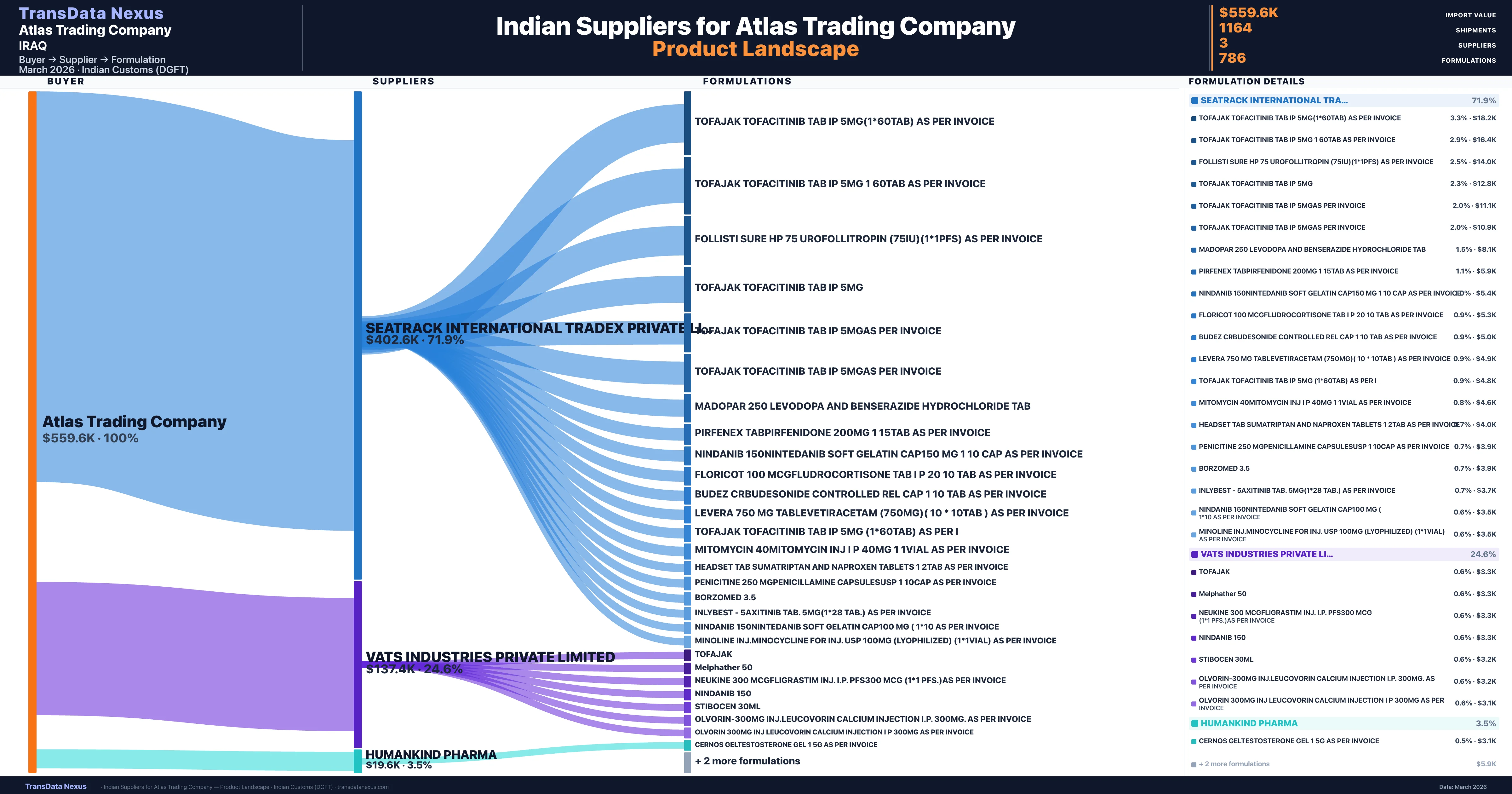
Who Are the Verified Indian Suppliers to Atlas Trading Company?
Customs-verified supplier relationships from Indian DGFT records
| Supplier | Value | Shipments | Share |
|---|---|---|---|
| Seatrack International Tradex Private Limited | $402.6K | 739 | 71.9% |
| Vats Industries Private Limited | $137.4K | 342 | 24.6% |
| Humankind Pharma | $19.6K | 83 | 3.5% |
Atlas Trading Company sources from 3 verified Indian suppliers across 786 distinct formulations. Total import value: $559.6K across 1,164 shipments.
What Formulations Does Atlas Trading Company Import?
| Formulation | Value | Ships |
|---|---|---|
| Tofajak tofacitinib TAB IP 5MG(1*60tab) as per | $18.2K | 5 |
| Tofajak tofacitinib TAB IP 5MG 1 60tab as per | $16.4K | 2 |
| Follisti sure hp 75 urofollitropin (75iu)(1*1pfs) as per | $14.0K | 2 |
| Tofajak tofacitinib TAB IP 5MG | $12.8K | 2 |
| Tofajak tofacitinib TAB IP 5mgas per | $11.1K | 1 |
| Tofajak tofacitinib TAB IP 5mgas per | $10.9K | 1 |
| Madopar 250 levodopa and benserazide hydrochloride TAB | $8.1K | 5 |
| Pirfenex tabpirfenidone 200MG 1 15tab as per | $5.9K | 2 |
| Nindanib 150nintedanib soft gelatin cap150 MG 1 10 cap as per | $5.4K | 2 |
| Floricot 100 mcgfludrocortisone TAB i p 20 10 TAB as per | $5.3K | 3 |
| Budez crbudesonide controlled rel cap 1 10 TAB as per | $5.0K | 2 |
| Levera 750 MG tablevetiracetam (750MG)( 10 * 10tab ) as per | $4.9K | 2 |
| Tofajak tofacitinib TAB IP 5MG (1*60tab) as per | $4.8K | 1 |
| Mitomycin 40mitomycin INJ i p 40MG 1 1vial as per | $4.6K | 2 |
| Headset TAB sumatriptan and naproxen tablets 1 2tab as per | $4.0K | 2 |
Atlas Trading Company imports 786 distinct pharmaceutical formulations. Showing top 15 by value. For full formulation-level data, contact TransData Nexus.
What Products Does Atlas Trading Company Import?
Top Products by Import Value
Atlas Trading Company Therapeutic Categories — 2 Specializations
Atlas Trading Company imports across 2 therapeutic categories, with Advanced Oncology (98.7%), Antibiotics (1.3%), representing the largest segments. The portfolio is concentrated — top 5 products = 100% of total imports.
Advanced Oncology
3 products · 98.7% · $92.0K
Antibiotics
1 products · 1.3% · $1.2K
Import Portfolio — Top 4 by Import Value
| # | Product | Category | Value | Ships | Share | Rk |
|---|---|---|---|---|---|---|
| 1 | Tofacitinib | Advanced Oncology | $81.5K | 25 | 2.1% | 6 |
| 2 | Axitinib | Advanced Oncology | $8.5K | 11 | 9.1% | 1 |
| 3 | Cabozantinib | Advanced Oncology | $1.9K | 5 | 1.5% | 8 |
| 4 | Streptomycin | Antibiotics | $1.2K | 3 | 0.2% | 10 |
Atlas Trading Company imports 4 pharmaceutical products across 2 categories into Iraq totaling $93.1K. The company is the #1 buyer for 1 product: Axitinib.
Key Metrics
Top Categories
Indian Suppliers
Related Trade Data
Need Detailed Data?
Shipment-level records, supplier connections & pricing for Atlas Trading Company.
Request DemoAtlas Trading Company — Corporate Profile & Information
Company type, headquarters, distribution network, and industry role
1Company Overview
Atlas Trading Company is a pharmaceutical importer and buyer based in Sulaymaniyah, Iraq. The company specializes in sourcing finished pharmaceutical formulations, including tablets, capsules, syrups, and injections, primarily from India. With a total import value of $93,000 USD over 44 shipments from 2022 to 2026, Atlas Trading Company plays a significant role in Iraq's pharmaceutical distribution network. The company's portfolio is heavily concentrated, with the top five products accounting for 100% of its imports. This indicates a strategic focus on specific high-demand medications, particularly in the oncology and antibiotics therapeutic categories.
2Distribution Network
While specific details about Atlas Trading Company's warehouse locations and logistics capabilities are not publicly available, the company's consistent import activity suggests a well-established distribution network within Iraq. The strategic location in Sulaymaniyah likely facilitates efficient access to both domestic and international markets, enabling timely delivery of pharmaceutical products across the country. The company's reliance on Indian suppliers further indicates a streamlined logistics operation, leveraging established shipping routes and partnerships to maintain a steady supply chain.
3Industry Role
Atlas Trading Company functions primarily as a pharmaceutical importer and wholesaler within Iraq's supply chain. By sourcing finished pharmaceutical formulations from Indian manufacturers, the company acts as an intermediary between international producers and the Iraqi market. This role is crucial in ensuring the availability of essential medications, particularly in specialized therapeutic areas such as oncology and antibiotics, thereby supporting the healthcare infrastructure in Iraq.
Supplier Relationship Intelligence — Atlas Trading Company
Sourcing concentration, supply chain resilience, and strategic implications
1Sourcing Concentration Analysis
Atlas Trading Company's sourcing strategy exhibits a high degree of concentration, with the top five products accounting for 100% of its imports. This approach suggests a strategic focus on specific high-demand medications, particularly in the oncology and antibiotics therapeutic categories. The company's reliance on a limited number of suppliers—three Indian companies—indicates a preference for established partnerships to ensure product quality and reliability. However, this concentration also presents potential risks, such as supply chain disruptions or price fluctuations. The stability of these relationships is crucial for maintaining a consistent supply of essential medications to the Iraqi market.
2Supply Chain Resilience
The resilience of Atlas Trading Company's supply chain is closely tied to the stability and reliability of its Indian suppliers. The company's limited supplier base may pose risks in terms of supply chain disruptions or price fluctuations. However, the established nature of these partnerships suggests a level of trust and reliability that can mitigate potential challenges. The company's focus on finished pharmaceutical formulations, rather than raw APIs or bulk drugs, indicates a preference for ready-to-market products, which can streamline operations and reduce lead times. Nonetheless, the company's exposure to specific shipping routes and reliance on a single source country for imports may impact its ability to adapt to global supply chain disruptions.
3Strategic Implications
Atlas Trading Company's concentrated sourcing strategy positions it as a key player in the supply of specific high-demand medications within Iraq. This focus allows the company to leverage its expertise and established relationships with Indian suppliers to maintain a competitive edge in the market. For Indian exporters, Atlas Trading Company's preference for finished pharmaceutical formulations presents an opportunity to expand their market reach by partnering with a reliable importer in Iraq. However, potential suppliers should be prepared to meet the stringent quality standards and regulatory requirements set by both Iraqi authorities and Atlas Trading Company.
Importing Pharmaceuticals into Iraq — Regulatory Framework
Regulatory authority, GMP requirements, import licensing for Iraq
1Regulatory Authority & Framework
In Iraq, the Ministry of Health (MOH) oversees the regulation of pharmaceutical products through the Iraq Drug Regulatory Authority (IDRA). The IDRA is responsible for marketing authorization, pricing oversight, pharmacovigilance, inspections, import permissions, and promotion rules. All medicines, including biologics and biosimilars, medical devices, and most over-the-counter products, require IDRA approval based on safety, efficacy, and quality, with evidence of Good Manufacturing Practice (GMP) compliance. Marketing authorizations are typically time-limited, commonly for five years, and are renewable with updated data. Generics follow an abbreviated, bioequivalence-driven route, while biologics and biosimilars require comparability packages. Promotion is tightly controlled, with strict rules on healthcare professional interactions.
2Import Licensing & GMP
Import licensing in Iraq requires pharmaceutical companies to register their products with the Technical Affairs Directorate of the Ministry of Health. Registration is mandatory for all pharmaceutical products, including both domestically produced and imported items. The registration process involves submitting documentation that demonstrates the safety, efficacy, quality, and origin of the products. Good Manufacturing Practice (GMP) certification is a critical component of the registration process, ensuring that imported pharmaceuticals meet international quality standards. The Ministry of Health mandates the right to carry out inspections to ensure GMP compliance if deemed necessary.
3Quality & Labeling
Pharmaceutical products imported into Iraq must comply with the country's labeling requirements, which include displaying essential drug information in writing. The National Drug System in Iraq requires comprehensive registration of all pharmaceutical products and manufacturers within its centralized digital platform. Each pharmaceutical product must display a specially designed electronic label featuring essential drug information, official pricing, and a unique QR code for instant verification. This labeling system provides immediate access to critical product data, including drug names, expiry dates, manufacturer details, active ingredients, side effects, warnings, and precautions.
4Recent Regulatory Changes
In January 2023, the Iraqi government issued a decision to reduce the import of 23 types of medicines that are produced locally and fulfill the need. This decision aims to encourage domestic production and reduce reliance on imported pharmaceuticals. The move is part of a broader strategy to strengthen the national pharmaceutical industry and ensure the availability of essential medicines within the country. (ina.iq)
Atlas Trading Company — Procurement Pattern Analysis
Product strategy, sourcing profile, and market positioning
1Product Strategy
Atlas Trading Company's product strategy focuses on importing specific high-demand medications, particularly in the oncology and antibiotics therapeutic categories. The company's portfolio is heavily concentrated, with the top five products accounting for 100% of its imports. This strategic focus allows Atlas Trading Company to leverage its expertise and established relationships with Indian suppliers to maintain a competitive edge in the market. The demand for these specific medications in Iraq is driven by the prevalence of related health conditions and the need for effective treatments.
2Sourcing Profile
Atlas Trading Company's sourcing strategy is centered on importing finished pharmaceutical formulations from India. The company's portfolio is heavily concentrated, with the top five products accounting for 100% of its imports. This approach suggests a strategic focus on specific high-demand medications, particularly in the oncology and antibiotics therapeutic categories. The company's reliance on a limited number of suppliers—three Indian companies—indicates a preference for established partnerships to ensure product quality and reliability. This sourcing strategy allows Atlas Trading Company to maintain a streamlined supply chain and focus on delivering essential medications to the Iraqi market.
3Market Positioning
Based on its product mix, Atlas Trading Company serves the wholesale distribution segment of the Iraqi pharmaceutical market. By importing specific high-demand medications, particularly in the oncology and antibiotics therapeutic categories, the company plays a crucial role in ensuring the availability of essential treatments across Iraq. The company's strategic focus on a concentrated portfolio allows it to maintain a competitive edge in the market and meet the needs of healthcare providers and patients.
Seller's Guide — How to Become a Supplier to Atlas Trading Company
Opportunity assessment, qualifications, and practical approach strategy
1Opportunity Assessment
There is a realistic opportunity for new Indian suppliers to partner with Atlas Trading Company, given the company's focus on importing specific high-demand medications. However, potential suppliers should be prepared to meet the stringent quality standards and regulatory requirements set by both Iraqi authorities and Atlas Trading Company. The recent decision by the Iraqi government to reduce the import of certain locally produced medicines may also influence the demand for imported pharmaceuticals, presenting both challenges and opportunities for new suppliers. (ina.iq)
2Requirements & Qualifications
Indian exporters seeking to supply Atlas Trading Company and the Iraqi market must ensure that their products are registered with the Technical Affairs Directorate of the Ministry of Health in Iraq. This registration process requires documentation demonstrating the safety, efficacy, quality, and origin of the products. Good Manufacturing Practice (GMP) certification is a critical component of the registration process, ensuring that imported pharmaceuticals meet international quality standards. Additionally, products must comply with Iraq's labeling requirements, which include displaying essential drug information in writing and incorporating a unique QR code for instant verification.
3How to Approach
To establish a partnership with Atlas Trading Company, Indian exporters should initiate contact to discuss potential collaboration opportunities. Engaging in tenders and participating in the registration process with the Ministry of Health in Iraq are essential steps. Developing a comprehensive regulatory filing strategy that addresses the specific requirements of the Iraqi market, including GMP certification and labeling standards, is crucial. Given the complexities of the regulatory environment, it is advisable to allocate sufficient time for the registration process and to ensure compliance with all necessary regulations.
Frequently Asked Questions — Atlas Trading Company
What products does Atlas Trading Company import from India?
Atlas Trading Company imports 4 pharmaceutical products across 2 categories. Top imports: Tofacitinib ($81.5K), Axitinib ($8.5K), Cabozantinib ($1.9K), Streptomycin ($1.2K).
Who supplies pharmaceuticals to Atlas Trading Company from India?
Atlas Trading Company sources from 3 verified Indian suppliers. The primary supplier is Seatrack International Tradex Private Limited (71.9% of imports, $402.6K).
What is Atlas Trading Company's total pharmaceutical import value?
Atlas Trading Company's total pharmaceutical import value from India is $93.1K, based on 44 verified shipments in Indian Customs (DGFT) data.
What therapeutic categories does Atlas Trading Company focus on?
Atlas Trading Company imports across 2 categories. The largest: Advanced Oncology (98.7%), Antibiotics (1.3%).
Get Full Atlas Trading Company Import Intelligence
Access shipment-level details, supplier connections, pricing data, and competitive analysis. TransData Nexus provides verified Indian Customs (DGFT) data trusted by pharmaceutical trade professionals worldwide.
Official References & Regulatory Resources
Verify import regulations and drug registration requirements with the agencies above.
Research Methodology & Data Transparency
Suresh Sormare
Verified AuthorPharmaceutical Export-Import Analyst & Trade Intelligence Expert
Suresh Sormare is a pharmaceutical export-import analyst with deep expertise in Indian Customs (DGFT) data, HS code classification, and global pharmaceutical supply chains. His analysis covers 10M+ shipment records across 150+ countries and is used by manufacturers, procurement agencies, and trade consultants worldwide. Suresh specializes in identifying verified suppliers and buyers from customs records, mapping bilateral pharmaceutical trade corridors, analyzing tariff structures and regulatory frameworks across 170+ destination markets, and benchmarking competitive positioning for finished pharmaceutical formulations. His methodology combines granular customs transaction data with regulatory intelligence from FDA, EMA, WHO, CDSCO, and 40+ national drug authorities to deliver actionable trade insights for the pharmaceutical formulations sector.
linkedin.com/in/sureshsormarePrimary Data Source
All trade data is sourced from Indian Customs (DGFT) official shipping bill records — the authoritative government database for India's pharmaceutical trade. Each verified record contains exporter name, consignee (buyer) name, detailed product description, quantity, declared FOB value (USD), port of loading, destination country, and shipment date.
Analysis Methodology
- 1.Buyer Matching: Atlas Trading Company identified across shipments using consignee name normalization.
- 2.Statistical Normalization: Shipment values are statistically normalized to ensure accurate market share representation.
- 3.Market Share: Calculated per product as Atlas Trading Company's capped value divided by total Indian exports for that product.
- 4.Shipment Count: Based on 44 individual customs records matching Atlas Trading Company.
- 5.Supplier Verification: Atlas Trading Company sources from 3 verified Indian suppliers across 786 formulations, confirmed from customs records.
Government-Sourced Data
Official DGFT customs records
Transparent Methodology
Calculations fully disclosed above
4 Products Tracked
2 therapeutic categories
Expert-Reviewed
By pharmaceutical trade specialists
Data Source & Methodology
Trade data sourced from Indian Customs (DGFT) export shipment records. Values represent FOB export value in USD. For current shipment-level data, contact TransData Nexus.