Who Buys Syringe from India — 751 Importers Behind a $179.9M Market
India's syringe import market is served by 751 active buyers who collectively imported $179.9M across 3,522 shipments. FRESENIUS KABI USA, LLC (UNITED STATES) leads with a 19.8% market share, followed by YUSEN LOGISTICS BENELUX BELGIUM and BOSTON ONCOLOGY ARABIA. The top 5 buyers together control 54.2% of total import value, reflecting a moderately competitive buyer landscape.
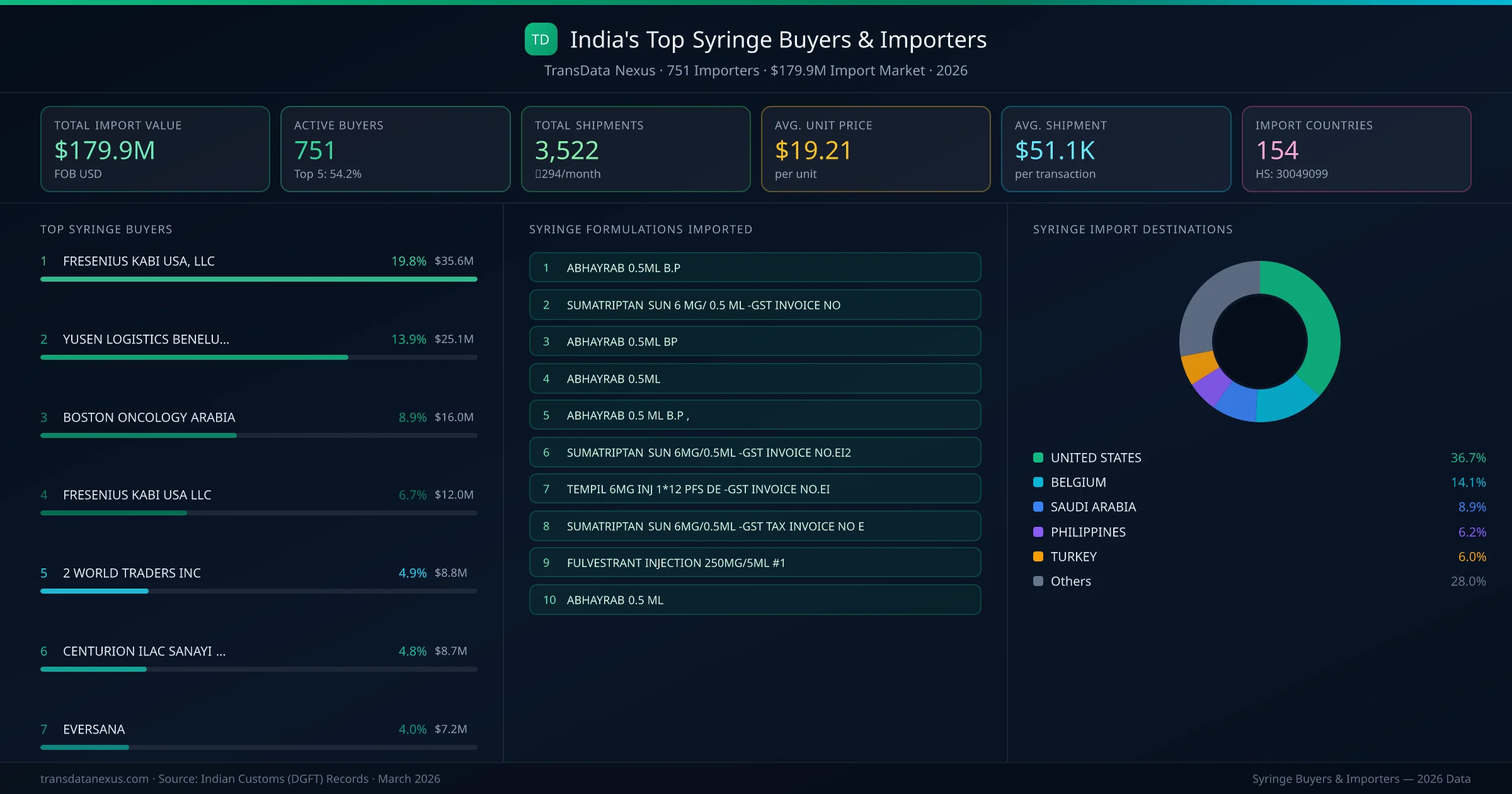
Top Syringe Importers — Ranked by Import Value
FRESENIUS KABI USA, LLC (UNITED STATES) is the leading syringe importer from India, holding a 19.8% share of the $179.9M market across 3,522 shipments from 751 buyers. The top 5 buyers — FRESENIUS KABI USA, LLC (UNITED STATES), YUSEN LOGISTICS BENELUX BELGIUM (BELGIUM), BOSTON ONCOLOGY ARABIA (SAUDI ARABIA), FRESENIUS KABI USA LLC (UNITED STATES), 2 WORLD TRADERS INC (PHILIPPINES) — collectively control 54.2% of total import value.
Top Syringe Buyers & Importers
Ranked by import value · 751 active buyers · Indian Customs (DGFT) data
| # | Buyer & Formulations | Value | Suppliers | Share |
|---|---|---|---|---|
| 1 | FRESENIUS KABI USA, LLCUNITED STATES ENOXAPARIN SODIUM INJECTION USP, 40MG PRE-FILLEDSYRINGES | $35.6M | 5 | 19.8% |
| 2 | YUSEN LOGISTICS BENELUX BELGIUMBELGIUM SUMATRIPTAN SUN 6 MG/ 0.5 ML -GST INVOICE NOSUMATRIPTAN SUN 6MG/0.5ML -GST INVOICE NO.EI2TEMPIL 6MG INJ 1*12 PFS DE -GST INVOICE NO.EI | $25.1M | 5 | 13.9% |
| 3 | BOSTON ONCOLOGY ARABIASAUDI ARABIA | $16.0M | 5 | 8.9% |
| 4 | FRESENIUS KABI USA LLCUNITED STATES ENOXAPARIN SODIUM INJECTION USP, 40MG PRE-FILLEDSYRINGES | $12.0M | 5 | 6.7% |
| 5 | 2 WORLD TRADERS INCPHILIPPINES ABHAYRAB 0.5ML BPABHAYRAB 0.5ML B.P | $8.8M | 5 | 4.9% |
| 6 | CENTURION ILAC SANAYI VE TICARET ANTURKEY ABHAYRAB 0.5ML B.PABHAYRAB 0.5 ML B.P , | $8.7M | 5 | 4.8% |
| 7 | EVERSANAUNITED STATES ENOXAPARIN SODIUM INJECTION USP, 40MG PRE-FILLEDSYRINGES | $7.2M | 5 | 4.0% |
| 8 | COMMERCIAL BANK OF ETHIOPIA,DJIBOUTI DENTAL GOODS :- LIGHT CURE COMPOSITE SYRINGE - KRIS N CERAMDENTAL GOODS :- FLOWABLE COMPOSITE SYRINGE - KRIS N FLOW | $4.8M | 5 | 2.7% |
| 9 | EVERSANA LIFE SCIENCE SERVICES LLCUNITED STATES ENOXAPARIN SODIUM INJECTION USP, 40MG PRE-FILLEDSYRINGES | $4.8M | 5 | 2.7% |
| 10 | DUC MINH MEDICAL JOINT STOCK COMPANVIETNAM ABHAYRAB 0.5MLABHAYRAB 0 5ML HUMAN RABIES VACCINE WITHDILUENT AND SYRINGEABHAYRAB 0.5MLHUMAN RABIES VACCINE WITHDILUENT AND SYRINGE | $4.4M | 5 | 2.4% |
| 11 | EVERSANA EVERSANAUNITED STATES ENOXAPARIN SODIUM INJECTION USP, 40MG PRE-FILLEDSYRINGES | $3.6M | 5 | 2.0% |
| 12 | STATE PHARMACEUTICALS CORPORATIONSRI LANKA FULVESTRANT INJECTION 250MG/5ML PRE-FILLED SYRINGE NOSENOXAPARIN INJECTION 60MG IN 0.6ML PREFILLED SYRINGE | $2.0M | 5 | 1.1% |
| 13 | OOOJODAS EXPOIMRUSSIA FULVESTRANT INJECTION 250MG/5ML #1 | $2.0M | 5 | 1.1% |
| 14 | CENTURION ILAC SANAYI VE TICARETTURKEY ABHAYRAB 0.5ML B.PABHAYRAB 0.5 ML B.P , | $1.9M | 5 | 1.0% |
| 15 | PHARMACEUTICAL TECHNOLOGYDOMINICAN REPUBLIC ABHAYRAB 0.5MLABHAYRAB 0 5ML HUMAN RABIES VACCINE WITHDILUENT AND SYRINGEABHAYRAB 0.5MLHUMAN RABIES VACCINE WITHDILUENT AND SYRINGE | $1.7M | 5 | 0.9% |
Related Analysis
Market Analysis: Top Importing Countries & Importers
Comprehensive geographic market intelligence dashboard
Which companies are buying Syringe — and from which countries?
Flow of Syringe exports from India: each country's share and the named importers behind the numbers
Syringe — Buyer Countries to Key Importers
Trade flow: top importing countries → named buyer companies
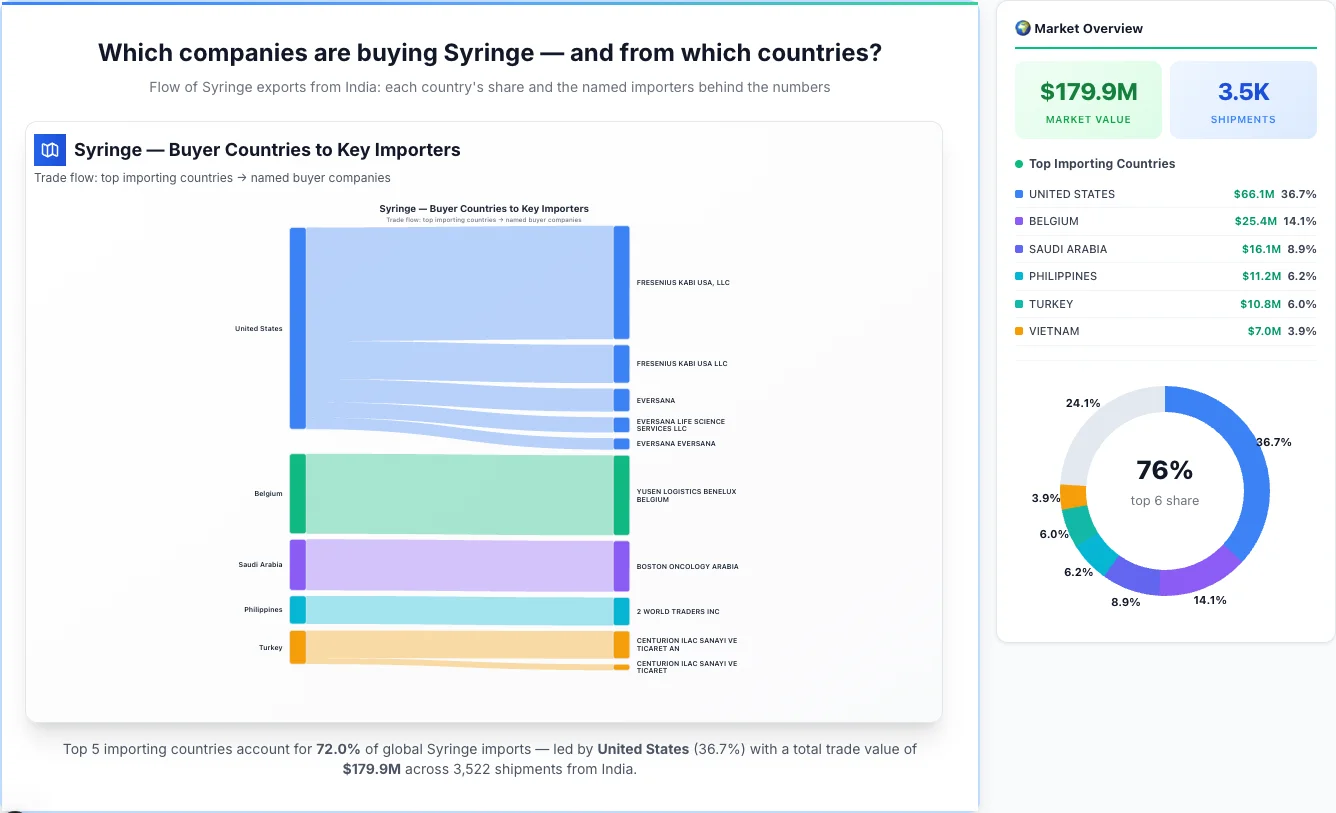
Market Analysis: Top Importing Countries & Their Importers
1United States
United States emerges as the first largest importing country, achieving a total trade value of $66.1M through 530 shipments. This represents a market share of 36.7% of the total market activity, demonstrating their significant presence in the industry.
Top Importers: United States has a diverse importer base, with their top importers including:
• FRESENIUS KABI USA, LLC - $35.6M (53.8% of country's total business)
• FRESENIUS KABI USA LLC - $12.0M (18.1% of country's total business)
• EVERSANA - $7.2M (10.9% of country's total business)
• EVERSANA LIFE SCIENCE SERVICES LLC - $4.8M (7.3% of country's total business)
• EVERSANA EVERSANA - $3.6M (5.5% of country's total business)
• Rest of United States's importers - $2.9M (4.4% of country's total business)
Key Insight: United States demonstrates strong market positioning with an average shipment value of $124.7K, indicating premium pricing strategy compared to the market average of $51.1K.
United States is a key market for Syringe imports, representing 36.7% of total trade value.
2Belgium
Belgium emerges as the second largest importing country, achieving a total trade value of $25.4M through 95 shipments. This represents a market share of 14.1% of the total market activity, demonstrating their significant presence in the industry.
Top Importers: Belgium has a diverse importer base, with their top importers including:
• YUSEN LOGISTICS BENELUX BELGIUM - $25.1M (98.8% of country's total business)
Key Insight: Belgium demonstrates strong market positioning with an average shipment value of $267.3K, indicating premium pricing strategy compared to the market average of $51.1K.
Belgium is a key market for Syringe imports, representing 14.1% of total trade value.
3Saudi Arabia
Saudi Arabia emerges as the third largest importing country, achieving a total trade value of $16.1M through 95 shipments. This represents a market share of 8.9% of the total market activity, demonstrating their significant presence in the industry.
Top Importers: Saudi Arabia has a diverse importer base, with their top importers including:
• BOSTON ONCOLOGY ARABIA - $16.0M (99.6% of country's total business)
Key Insight: Saudi Arabia demonstrates strong market positioning with an average shipment value of $169.0K, indicating premium pricing strategy compared to the market average of $51.1K.
Saudi Arabia is a key market for Syringe imports, representing 8.9% of total trade value.
4Philippines
Philippines emerges as the fourth largest importing country, achieving a total trade value of $11.2M through 24 shipments. This represents a market share of 6.2% of the total market activity, demonstrating their significant presence in the industry.
Top Importers: Philippines has a diverse importer base, with their top importers including:
• 2 WORLD TRADERS INC - $8.8M (78.3% of country's total business)
Key Insight: Philippines demonstrates strong market positioning with an average shipment value of $468.0K, indicating premium pricing strategy compared to the market average of $51.1K.
Philippines is a key market for Syringe imports, representing 6.2% of total trade value.
5Turkey
Turkey emerges as the fifth largest importing country, achieving a total trade value of $10.8M through 38 shipments. This represents a market share of 6.0% of the total market activity, demonstrating their significant presence in the industry.
Top Importers: Turkey has a diverse importer base, with their top importers including:
• CENTURION ILAC SANAYI VE TICARET AN - $8.7M (80.6% of country's total business)
• CENTURION ILAC SANAYI VE TICARET - $1.9M (17.4% of country's total business)
Key Insight: Turkey demonstrates strong market positioning with an average shipment value of $283.0K, indicating premium pricing strategy compared to the market average of $51.1K.
Turkey is a key market for Syringe imports, representing 6.0% of total trade value.
Buyer Segment Analysis
TransData Nexus Syringe buyer market intelligence
1Buyer Segment Analysis
The importation of syringes from India involves various buyer segments, each with distinct purchasing behaviors and order patterns.
Distributors: Entities like Yusen Logistics Benelux Belgium and 2 World Traders Inc (Philippines) function as intermediaries, procuring large volumes of syringes to supply hospitals, clinics, and pharmacies. Their purchasing patterns are characterized by bulk orders to meet the demands of multiple clients, ensuring a steady supply chain.
Hospital Groups: Organizations such as Fresenius Kabi USA, LLC (United States) and Boston Oncology Arabia (Saudi Arabia) represent hospital networks that import syringes directly for in-house use. Their procurement is driven by patient care needs, leading to consistent and sizable orders to maintain adequate inventory levels.
Government Procurement: Entities like the Commercial Bank of Ethiopia (Djibouti) engage in government-led procurement, often through national tenders or collaborations with international organizations. Their purchasing behavior is influenced by public health initiatives, resulting in large-scale, periodic orders aligned with healthcare programs.
Re-exporters: Companies such as Centurion Ilac Sanayi ve Ticaret An (Turkey) may act as re-exporters, importing syringes from India to distribute them to neighboring regions. Their order patterns are influenced by regional demand fluctuations and trade agreements, leading to variable order sizes and frequencies.
Contract Manufacturers: Firms like Eversana Life Science Services LLC (United States) may serve as contract manufacturers, importing syringes to incorporate into medical kits or devices. Their procurement is project-based, with order volumes and frequencies dictated by contractual obligations and production schedules.
Country-Specific Import Regulations
TransData Nexus Syringe buyer market intelligence
1Country-Specific Import Regulations
United States:
1. Drug Regulatory Authority: U.S. Food and Drug Administration (FDA).
2. Import Registration Process for Syringes: Syringes are classified as medical devices and require FDA clearance or approval. Importers must ensure compliance with FDA regulations, including establishment registration, device listing, and adherence to Quality System Regulations.
3. Estimated Timeline for Registration: The registration process can take several months, depending on the complexity of the device and the completeness of the submission.
4. Import Tariff/Duty for HS 30049099: The Harmonized Tariff Schedule of the United States (HTSUS) should be consulted for the specific duty rate applicable to syringes under this code.
Belgium:
1. Drug Regulatory Authority: Federal Agency for Medicines and Health Products (FAMHP).
2. Import Registration Process for Syringes: Syringes must comply with the European Union's Medical Device Regulation (MDR). Importers are required to ensure that products have CE marking, indicating conformity with EU standards.
3. Estimated Timeline for Registration: The CE marking process can take several months to over a year, depending on the device classification and the notified body's assessment.
4. Import Tariff/Duty for HS 30049099: As an EU member, Belgium applies the EU's Common External Tariff. The specific duty rate for syringes under this code should be verified in the EU's TARIC database.
Saudi Arabia:
1. Drug Regulatory Authority: Saudi Food and Drug Authority (SFDA).
2. Import Registration Process for Syringes: Importers must register medical devices with the SFDA, ensuring compliance with the Medical Devices Interim Regulation. This includes obtaining a Medical Device Marketing Authorization (MDMA).
3. Estimated Timeline for Registration: The registration process typically takes several months, contingent on the device's risk classification and the completeness of the application.
4. Import Tariff/Duty for HS 30049099: Saudi Arabia, as a member of the Gulf Cooperation Council (GCC), applies a common external tariff. The specific duty rate for syringes should be confirmed with the Saudi Customs Authority.
Philippines:
1. Drug Regulatory Authority: Food and Drug Administration Philippines (FDA Philippines).
2. Import Registration Process for Syringes: Syringes are classified as medical devices and require registration with the FDA Philippines. Importers must submit a Certificate of Product Registration (CPR) application, including technical documentation and proof of compliance with safety standards.
3. Estimated Timeline for Registration: The registration process can take several months, depending on the device classification and the completeness of the submission.
4. Import Tariff/Duty for HS 30049099: The Philippines' Bureau of Customs applies specific tariffs to imported goods. The exact duty rate for syringes under this code should be verified with the Bureau of Customs.
Turkey:
1. Drug Regulatory Authority: Turkish Medicines and Medical Devices Agency (TMMDA).
2. Import Registration Process for Syringes: Syringes must comply with Turkey's medical device regulations, which align with the EU's MDR. Importers are required to ensure that products have CE marking and are registered in the National Data Bank of Medical Devices (TITUBB).
3. Estimated Timeline for Registration: The registration process can take several months, depending on the device classification and the notified body's assessment.
4. Import Tariff/Duty for HS 30049099: Turkey applies specific tariffs to imported goods. The exact duty rate for syringes under this code should be confirmed with the Turkish Customs Authority.
Demand Drivers & Market Opportunity
TransData Nexus Syringe buyer market intelligence
1Demand Drivers & Market Opportunity
The global demand for syringes is driven by several factors:
1. Disease Prevalence: The management of chronic diseases, such as diabetes, necessitates regular insulin administration via syringes. The World Health Organization (WHO) emphasizes the importance of essential medicines and medical devices in managing such conditions. (who.int)
2. Government Healthcare Programs: Many countries have implemented national health programs that include the provision of essential medical devices like syringes. For instance, WHO supports countries in developing and updating national essential medicines lists to guide procurement and supply. (who.int)
3. Universal Health Coverage (UHC) Expansion: The global push towards UHC aims to ensure that all individuals have access to necessary health services, including medical devices. WHO's efforts in strengthening access to essential medicines and health technologies are integral to this initiative. (emro.who.int)
4. WHO Essential Medicines List Procurement: Syringes are often included in national essential medicines lists, aligning with WHO's Model List of Essential Medicines. This inclusion facilitates their procurement and distribution through public health systems. (who.int)
5. Tender-Based Purchasing: Many governments and international organizations procure medical devices through competitive tenders to ensure cost-effectiveness and quality. WHO emphasizes the role of public procurement in promoting equitable access to health technologies. (who.int)
With 751 buyers across 154 countries, the market for Indian-manufactured syringes is extensive. The combination of disease prevalence, governmental health initiatives, and international procurement strategies underscores a robust and growing demand for syringes globally.
Common Questions — Syringe Buyers & Importers
Answers based on Indian Customs (DGFT) shipment records compiled by TransData Nexus
QWho is the largest syringe buyer importing from India?
Based on import volume and value, FRESENIUS KABI USA, LLC (UNITED STATES) leads with $35.6M in imports and a 19.8% market share — the highest of any single syringe importer. YUSEN LOGISTICS BENELUX BELGIUM (BELGIUM) and BOSTON ONCOLOGY ARABIA (SAUDI ARABIA) are the next largest buyers.
QHow many companies buy syringe from India?
There are 751 active syringe buyers importing from India, with a combined market of $179.9M across 3,522 shipments to 154 countries. The top 5 buyers hold 54.2% of total import value, while the remaining 746 buyers handle the other 45.8%.
QWhich countries import the most syringe from India?
The top importing countries for syringe from India are United States (36.7%), Belgium (14.1%), Saudi Arabia (8.9%), Philippines (6.2%), Turkey (6.0%). These markets represent the largest demand centres for Indian pharmaceutical exports of syringe, with buyers ranging from government procurement agencies to private pharmaceutical distributors.
QWhat is the average import order value for syringe from India?
The average import transaction value for syringe from India is $51.1K, with an average unit price of $19.21 per unit. Order sizes vary significantly based on buyer type — government tenders tend to be larger while private distributors place more frequent smaller orders.
Buyer Segment Analysis
TransData Nexus Syringe buyer market intelligence
1Buyer Segment Analysis
The importation of syringes from India involves various buyer segments, each with distinct purchasing behaviors and order patterns.
Distributors: Entities like Yusen Logistics Benelux Belgium and 2 World Traders Inc (Philippines) function as intermediaries, procuring large volumes of syringes to supply hospitals, clinics, and pharmacies. Their purchasing patterns are characterized by bulk orders to meet the demands of multiple clients, ensuring a steady supply chain.
Hospital Groups: Organizations such as Fresenius Kabi USA, LLC (United States) and Boston Oncology Arabia (Saudi Arabia) represent hospital networks that import syringes directly for in-house use. Their procurement is driven by patient care needs, leading to consistent and sizable orders to maintain adequate inventory levels.
Government Procurement: Entities like the Commercial Bank of Ethiopia (Djibouti) engage in government-led procurement, often through national tenders or collaborations with international organizations. Their purchasing behavior is influenced by public health initiatives, resulting in large-scale, periodic orders aligned with healthcare programs.
Re-exporters: Companies such as Centurion Ilac Sanayi ve Ticaret An (Turkey) may act as re-exporters, importing syringes from India to distribute them to neighboring regions. Their order patterns are influenced by regional demand fluctuations and trade agreements, leading to variable order sizes and frequencies.
Contract Manufacturers: Firms like Eversana Life Science Services LLC (United States) may serve as contract manufacturers, importing syringes to incorporate into medical kits or devices. Their procurement is project-based, with order volumes and frequencies dictated by contractual obligations and production schedules.
Country-Specific Import Regulations
TransData Nexus Syringe buyer market intelligence
1Country-Specific Import Regulations
United States:
1. Drug Regulatory Authority: U.S. Food and Drug Administration (FDA).
2. Import Registration Process for Syringes: Syringes are classified as medical devices and require FDA clearance or approval. Importers must ensure compliance with FDA regulations, including establishment registration, device listing, and adherence to Quality System Regulations.
3. Estimated Timeline for Registration: The registration process can take several months, depending on the complexity of the device and the completeness of the submission.
4. Import Tariff/Duty for HS 30049099: The Harmonized Tariff Schedule of the United States (HTSUS) should be consulted for the specific duty rate applicable to syringes under this code.
Belgium:
1. Drug Regulatory Authority: Federal Agency for Medicines and Health Products (FAMHP).
2. Import Registration Process for Syringes: Syringes must comply with the European Union's Medical Device Regulation (MDR). Importers are required to ensure that products have CE marking, indicating conformity with EU standards.
3. Estimated Timeline for Registration: The CE marking process can take several months to over a year, depending on the device classification and the notified body's assessment.
4. Import Tariff/Duty for HS 30049099: As an EU member, Belgium applies the EU's Common External Tariff. The specific duty rate for syringes under this code should be verified in the EU's TARIC database.
Saudi Arabia:
1. Drug Regulatory Authority: Saudi Food and Drug Authority (SFDA).
2. Import Registration Process for Syringes: Importers must register medical devices with the SFDA, ensuring compliance with the Medical Devices Interim Regulation. This includes obtaining a Medical Device Marketing Authorization (MDMA).
3. Estimated Timeline for Registration: The registration process typically takes several months, contingent on the device's risk classification and the completeness of the application.
4. Import Tariff/Duty for HS 30049099: Saudi Arabia, as a member of the Gulf Cooperation Council (GCC), applies a common external tariff. The specific duty rate for syringes should be confirmed with the Saudi Customs Authority.
Philippines:
1. Drug Regulatory Authority: Food and Drug Administration Philippines (FDA Philippines).
2. Import Registration Process for Syringes: Syringes are classified as medical devices and require registration with the FDA Philippines. Importers must submit a Certificate of Product Registration (CPR) application, including technical documentation and proof of compliance with safety standards.
3. Estimated Timeline for Registration: The registration process can take several months, depending on the device classification and the completeness of the submission.
4. Import Tariff/Duty for HS 30049099: The Philippines' Bureau of Customs applies specific tariffs to imported goods. The exact duty rate for syringes under this code should be verified with the Bureau of Customs.
Turkey:
1. Drug Regulatory Authority: Turkish Medicines and Medical Devices Agency (TMMDA).
2. Import Registration Process for Syringes: Syringes must comply with Turkey's medical device regulations, which align with the EU's MDR. Importers are required to ensure that products have CE marking and are registered in the National Data Bank of Medical Devices (TITUBB).
3. Estimated Timeline for Registration: The registration process can take several months, depending on the device classification and the notified body's assessment.
4. Import Tariff/Duty for HS 30049099: Turkey applies specific tariffs to imported goods. The exact duty rate for syringes under this code should be confirmed with the Turkish Customs Authority.
Demand Drivers & Market Opportunity
TransData Nexus Syringe buyer market intelligence
1Demand Drivers & Market Opportunity
The global demand for syringes is driven by several factors:
1. Disease Prevalence: The management of chronic diseases, such as diabetes, necessitates regular insulin administration via syringes. The World Health Organization (WHO) emphasizes the importance of essential medicines and medical devices in managing such conditions. (who.int)
2. Government Healthcare Programs: Many countries have implemented national health programs that include the provision of essential medical devices like syringes. For instance, WHO supports countries in developing and updating national essential medicines lists to guide procurement and supply. (who.int)
3. Universal Health Coverage (UHC) Expansion: The global push towards UHC aims to ensure that all individuals have access to necessary health services, including medical devices. WHO's efforts in strengthening access to essential medicines and health technologies are integral to this initiative. (emro.who.int)
4. WHO Essential Medicines List Procurement: Syringes are often included in national essential medicines lists, aligning with WHO's Model List of Essential Medicines. This inclusion facilitates their procurement and distribution through public health systems. (who.int)
5. Tender-Based Purchasing: Many governments and international organizations procure medical devices through competitive tenders to ensure cost-effectiveness and quality. WHO emphasizes the role of public procurement in promoting equitable access to health technologies. (who.int)
With 751 buyers across 154 countries, the market for Indian-manufactured syringes is extensive. The combination of disease prevalence, governmental health initiatives, and international procurement strategies underscores a robust and growing demand for syringes globally.
Official References & Regulatory Resources
- European Medicines Agency
- WHO Essential Medicines
- Invest India — Pharma Sector
- India Trade Statistics (DGFT)
Verify import regulations and drug registration requirements with the official agencies above.
Research Methodology & Data Transparency
Suresh Sormare
Verified AuthorPharmaceutical Export-Import Analyst & Trade Intelligence Expert
Suresh Sormare is a pharmaceutical export-import analyst with deep expertise in Indian Customs (DGFT) data, HS code classification, and global pharmaceutical supply chains. His analysis covers 10M+ shipment records across 150+ countries and is used by manufacturers, procurement agencies, and trade consultants worldwide. Suresh specializes in identifying verified suppliers and buyers from customs records, mapping bilateral pharmaceutical trade corridors, analyzing tariff structures and regulatory frameworks across 170+ destination markets, and benchmarking competitive positioning for finished pharmaceutical formulations. His methodology combines granular customs transaction data with regulatory intelligence from FDA, EMA, WHO, CDSCO, and 40+ national drug authorities to deliver actionable trade insights for the pharmaceutical formulations sector.
linkedin.com/in/sureshsormarePrimary Data Source
All trade data is sourced from Indian Customs (DGFT) official shipping bill records — the authoritative government database for India's pharmaceutical trade. Each verified record contains exporter name, consignee (buyer) name, detailed product description, quantity, declared FOB value (USD), port of loading, destination country, and shipment date.
Analysis Methodology
- 1.Buyer Identification: 751 global importers of Syringe identified from consignee fields in DGFT shipping bill records.
- 2.Import Value Analysis: Total import value aggregated from 3,522 individual shipping bill records. Values are FOB in USD.
- 3.Statistical Normalization: Shipment values are statistically normalized to ensure accurate market share representation.
- 4.Geographic Distribution: Buyer imports distributed across 154 destination countries with market share per buyer calculated from capped values.
Government-Sourced Data
Official DGFT customs records
Transparent Methodology
Calculations fully disclosed above
3,522 Verified Shipments
751 buyers tracked
Expert-Reviewed
By pharmaceutical trade specialists