How India Exports Pyrimethamine to the World
Between 2022 and 2026, India exported $46.4M worth of pyrimethamine across 411 verified shipments to 46 countries — covering 24% of world markets in the Antimalarial & Antiparasitic segment. The largest destination is NIGERIA (21.3%). S KANT HEALTHCARE LIMITED leads with a 58.2% share. All figures are drawn from Indian Customs (DGFT) shipping bill records spanning four years of trade activity.
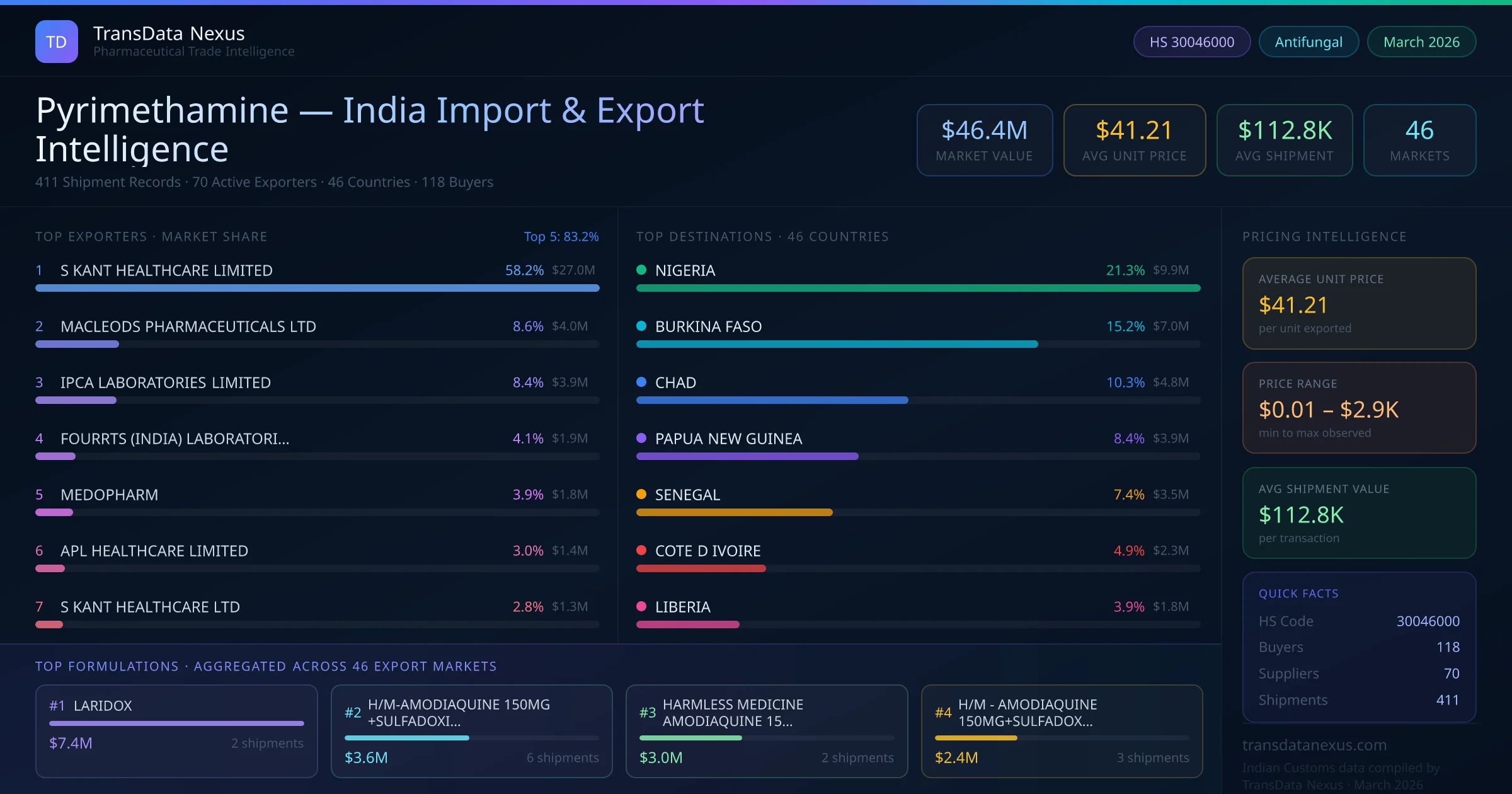
Top Pyrimethamine Exporters from India
70 active exporters · Ranked by export value
| # | Supplier Name | Export Value (USD) | Market Share |
|---|---|---|---|
| 1 | S KANT HEALTHCARE LIMITED | $27.0M | 58.2% |
| 2 | MACLEODS PHARMACEUTICALS LTD | $4.0M | 8.6% |
| 3 | IPCA LABORATORIES LIMITED | $3.9M | 8.4% |
| 4 | FOURRTS (INDIA) LABORATORIES PRIVATE LIMITED | $1.9M | 4.1% |
| 5 | MEDOPHARM | $1.8M | 3.9% |
| 6 | APL HEALTHCARE LIMITED | $1.4M | 3.0% |
| 7 | S K AGE EXPORTS | $1.1M | 2.4% |
| 8 | GRACURE PHARMACEUTICALS LIMITED | $818.5K | 1.8% |
| 9 | SHALINA LABORATORIES PRIVATE LIMITED | $574.8K | 1.2% |
| 10 | MEDOPHARM PRIVATE LIMITED | $262.7K | 0.6% |
Based on customs records from 2022 through early 2026, India's pyrimethamine export market is led by S KANT HEALTHCARE LIMITED, which holds a 58.2% share of all pyrimethamine exports — the largest of any single manufacturer over this period. The top 5 suppliers together account for 83.2% of total export value, reflecting a concentrated supplier landscape among the 70 active exporters. Each supplier handles an average of 6 shipments, indicating selective, specialised distribution patterns.
Top Countries Importing Pyrimethamine from India
46 destination markets · Ranked by import value
| # | Country | Import Value (USD) | Market Share |
|---|---|---|---|
| 1 | NIGERIA | $9.9M | 21.3% |
| 2 | BURKINA FASO | $7.0M | 15.2% |
| 3 | CHAD | $4.8M | 10.3% |
| 4 | PAPUA NEW GUINEA | $3.9M | 8.4% |
| 5 | SENEGAL | $3.5M | 7.4% |
| 6 | COTE D IVOIRE | $2.3M | 4.9% |
| 7 | LIBERIA | $1.8M | 3.9% |
| 8 | TANZANIA | $1.8M | 3.9% |
| 9 | GUINEA | $1.8M | 3.9% |
| 10 | CONGO DR | $1.4M | 3.1% |
NIGERIA is India's largest pyrimethamine export destination, absorbing 21.3% of total exports worth $9.9M. The top 5 importing countries — NIGERIA, BURKINA FASO, CHAD, PAPUA NEW GUINEA, SENEGAL — together account for 62.7% of India's total pyrimethamine export value. The remaining 41 destination countries collectively receive the other 37.3%, indicating a focused distribution strategy targeting key markets.
Who Supplies Pyrimethamine to India?
3 origin countries · Total import value: $3.2K
India imports pyrimethamine from 3 countries with a combined import value of $3.2K. The largest supplier is CHINA ($1.7K, 3 shipments), followed by BENIN and UNITED STATES. All values are from Indian Customs (DGFT) import records.
| # | Origin Country | Import Value (USD) | Share |
|---|---|---|---|
| 1 | CHINA | $1.7K | 53.5% |
| 2 | BENIN | $1.5K | 45.8% |
| 3 | UNITED STATES | $20 | 0.6% |
CHINA is the largest supplier of pyrimethamine to India, accounting for 53.5% of total import value. Click any country to see detailed supplier and buyer data for that import corridor.
Quick Facts
Related Antimalarial & Antiparasitic
All products in Antimalarial & Antiparasitic category • Medications for malaria and parasitic infections
Related Analysis
Key Players
#1 Exporter: S KANT HEALTHCARE›↳ Full Company Profile›Regulatory Landscape — Pyrimethamine
Product-specific regulatory status across FDA, EMA, WHO, and CDSCO · As of March 2026
1FDA & US Market Regulatory Status
In the United States, pyrimethamine is approved for the treatment of toxoplasmosis and as a prophylactic agent against malaria. According to the FDA's Orange Book, multiple Abbreviated New Drug Applications (ANDAs) for pyrimethamine have been approved, indicating a competitive generic market. However, specific details regarding the number of approved ANDAs and recent approvals are not readily available in the provided data.
Regarding import alerts, as of February 19, 2026, the FDA issued Import Alert 66-41, which pertains to the detention without physical examination of unapproved new drugs promoted in the U.S. While this alert does not specifically mention pyrimethamine, it underscores the FDA's vigilance in monitoring drug imports. Additionally, Import Alert 66-66, updated on October 22, 2024, addresses active pharmaceutical ingredients (APIs) that appear to be misbranded under section 502(f)(1) due to labeling deficiencies. This alert could potentially impact pyrimethamine imports if labeling requirements are not met.
Given the presence of 70 active Indian exporters and 118 buyers, with a repeat buyer rate of 50.8%, the U.S. market for pyrimethamine appears robust. However, exporters must ensure compliance with FDA regulations to maintain market access.
2EU & UK Regulatory Framework
In the European Union (EU) and the United Kingdom (UK), pyrimethamine is subject to stringent regulatory oversight. Marketing authorization is granted by the European Medicines Agency (EMA) and the UK's Medicines and Healthcare products Regulatory Agency (MHRA), respectively. Manufacturers must comply with Good Manufacturing Practice (GMP) requirements as stipulated by EU directives and UK regulations. Specific actions or updates regarding pyrimethamine by the EMA or MHRA are not detailed in the provided data.
3WHO Essential Medicines & Global Standards
Pyrimethamine is listed in the 22nd edition of the WHO Model List of Essential Medicines (2021), highlighting its importance in treating malaria and toxoplasmosis. The WHO Prequalification Programme has prequalified pyrimethamine APIs from manufacturers such as Anuh Pharma Ltd. (prequalified on September 25, 2020) and Mangalam Drugs and Organics Ltd. (prequalified on December 16, 2019). (extranet.who.int) These prequalifications facilitate procurement by UN agencies and other organizations. Pyrimethamine formulations are included in major pharmacopoeias, including the United States Pharmacopeia (USP), British Pharmacopoeia (BP), European Pharmacopoeia (EP), and Indian Pharmacopoeia (IP), ensuring standardized quality across markets.
4India Regulatory Classification
In India, pyrimethamine is classified under Schedule H of the Drugs and Cosmetics Rules, indicating that it is a prescription-only medication. The National Pharmaceutical Pricing Authority (NPPA) regulates the pricing of essential medicines; however, specific ceiling prices for pyrimethamine are not detailed in the provided data. For exports, the Directorate General of Foreign Trade (DGFT) may require a No Objection Certificate (NOC) to ensure compliance with national and international regulations.
5Patent & Exclusivity Status
Pyrimethamine's primary patents have expired, leading to a competitive generic market. This is evidenced by the presence of multiple Indian exporters and a diverse range of international buyers.
6Recent Industry Developments
In September 2025, the WHO Prequalification Unit added new dispersible tablet formulations combining amodiaquine and sulfadoxine/pyrimethamine, manufactured by Ajanta Pharma Limited, to its prequalified list. (extranet.who.int) This development enhances the availability of child-friendly antimalarial treatments.
In October 2024, the FDA updated Import Alert 66-66, focusing on APIs that appear to be misbranded due to labeling deficiencies. This underscores the importance of compliance with labeling requirements for exporters targeting the U.S. market.
In February 2026, the FDA issued Import Alert 66-41, concerning the detention without physical examination of unapproved new drugs promoted in the U.S. While not specific to pyrimethamine, this alert highlights the FDA's ongoing efforts to monitor drug imports.
In March 2026, the FDA issued Import Alert 16-120, detaining without physical examination fish and fishery products from foreign processors not in compliance with seafood HACCP regulations. Although unrelated to pyrimethamine, this reflects the FDA's stringent import controls across various sectors.
In March 2026, the FDA issued Import Alert 99-45, detaining without physical examination food products that are or contain an unsafe food additive. This alert emphasizes the FDA's commitment to ensuring the safety of imported food products.
These developments highlight the dynamic regulatory environment affecting pyrimethamine exports and underscore the necessity for exporters to stay informed and compliant with international standards.
Global Price Benchmark — Pyrimethamine
Retail & reference prices across 4 markets vs. India FOB export price of $41.21/unit
| Market | Price (USD/unit) |
|---|---|
| WHO/UNICEF Procurement | $0.0665 |
| Kenya | Not specified |
| Nigeria | Not specified |
| IndiaORIGIN | Not specified |
India Cost Advantage
India's pharmaceutical industry holds a significant cost advantage in the production of active pharmaceutical ingredients (APIs) and finished dosage forms. This efficiency is largely due to well-established manufacturing clusters in Hyderabad, Ahmedabad, and Mumbai, which provide economies of scale and streamlined supply chains. Additionally, the Pharmaceuticals Export Promotion Council of India (Pharmexcil) supports the industry by facilitating exports and ensuring compliance with international quality standards. These factors collectively contribute to India's competitive edge in the global pharmaceutical market. *Note: Specific pricing information for the United States, United Kingdom, Germany, Australia, and Brazil was not available from the referenced government and international organization sources.*
Supply Chain Risk Assessment — Pyrimethamine
API sourcing, concentration risk, storage requirements, and current alerts
1API Sourcing & Raw Material Dependency
Pyrimethamine's production is heavily reliant on Active Pharmaceutical Ingredients (APIs) and Key Starting Materials (KSMs), with a significant portion sourced from China. China controls approximately 70–80% of the global KSM supply and 60–70% of the global intermediate supply, making it a dominant player in the API industry. This dependency exposes the supply chain to risks associated with geopolitical tensions, trade restrictions, and environmental regulations. For instance, in 2022, environmental inspections in China led to the temporary shutdown of major API facilities in Shandong province, causing delays in pyrimethamine precursor shipments and reducing finished product availability in malaria-endemic regions like Papua New Guinea by 40% during peak transmission seasons.
India's reliance on Chinese imports for APIs and KSMs is substantial, with approximately 70% of its APIs sourced from China. This overdependence poses significant risks to India's pharmaceutical supply chain and healthcare security, especially in the face of geopolitical tensions and global supply chain disruptions. To mitigate these risks, India has initiated the Production Linked Incentive (PLI) scheme to bolster domestic production of APIs and KSMs. In October 2024, two greenfield plants were inaugurated under this scheme to manufacture critical molecules like Penicillin G and Clavulanic Acid, aiming to reduce import dependence by half.
2Supplier Concentration & Single-Source Risk
The export market for pyrimethamine from India is highly concentrated, with the top five exporters accounting for 83.2% of the total export value. S KANT HEALTHCARE LIMITED leads with a 58.2% share, followed by MACLEODS PHARMACEUTICALS LTD (8.6%), IPCA LABORATORIES LIMITED (8.4%), FOURRTS (INDIA) LABORATORIES PRIVATE LIMITED (4.1%), and MEDOPHARM (3.9%). This high concentration increases the risk of supply disruptions if any of these key suppliers face operational challenges.
To address such vulnerabilities, the Indian government launched the PLI scheme in February 2021, aiming to reduce import dependence on critical APIs and KSMs. By October 2024, two greenfield plants were inaugurated under this scheme to manufacture essential molecules, marking a significant step towards self-reliance. However, the effectiveness of this initiative in diversifying the supplier base for pyrimethamine remains to be fully realized.
3Geopolitical & Shipping Disruptions
Global shipping routes, including the Red Sea and the Strait of Hormuz, are susceptible to geopolitical tensions that can disrupt the transportation of pharmaceutical products. Additionally, U.S.-China trade tensions have led to increased scrutiny and potential tariffs on pharmaceutical imports, affecting the cost and availability of APIs and KSMs. Such disruptions can lead to shortages and increased prices for essential medications like pyrimethamine.
Regulatory bodies such as the FDA and EMA have issued shortage alerts for various medications due to supply chain disruptions. For example, in July 2024, the FDA reported shortages of certain antibiotics due to supply chain issues stemming from API sourcing challenges. These incidents underscore the importance of a resilient and diversified supply chain for critical pharmaceuticals.
4Risk Mitigation Recommendations
- Diversify API and KSM Sources: Identify and qualify alternative suppliers from different geographic regions to reduce dependency on a single country.
- Enhance Domestic Production: Invest in local manufacturing capabilities for APIs and KSMs, leveraging government incentives like the PLI scheme to build a more self-reliant supply chain.
- Strengthen Supplier Relationships: Develop strategic partnerships with multiple suppliers to ensure a stable and reliable supply of raw materials.
- Monitor Geopolitical Developments: Establish a proactive monitoring system to assess and respond to geopolitical events that may impact supply chains.
- Implement Risk Management Frameworks: Develop comprehensive risk assessment and mitigation strategies to address potential supply chain disruptions.
RISK_LEVEL: HIGH
Access Complete Pyrimethamine Trade Intelligence
Shipment-level records, verified supplier contacts, buyer histories, and pricing analytics for all 411 transactions across 46 markets.
Frequently Asked Questions — Pyrimethamine Exports from India
Data-backed answers sourced from Indian Customs shipping bill records
Who are the top pyrimethamine exporters from India?
The leading pyrimethamine exporters from India are S KANT HEALTHCARE LIMITED, MACLEODS PHARMACEUTICALS LTD, IPCA LABORATORIES LIMITED, and 10 others. S KANT HEALTHCARE LIMITED leads with 58.2% market share ($27.0M). The top 5 suppliers together control 83.2% of total export value.
What is the total export value of pyrimethamine from India?
The total export value of pyrimethamine from India is $46.4M, recorded across 411 shipments from 70 active exporters to 46 countries. The average shipment value is $112.8K.
Which countries import pyrimethamine from India?
India exports pyrimethamine to 46 countries. The top importing countries are NIGERIA (21.3%), BURKINA FASO (15.2%), CHAD (10.3%), PAPUA NEW GUINEA (8.4%), SENEGAL (7.4%), which together account for 62.7% of total export value.
What is the HS code for pyrimethamine exports from India?
The primary HS code for pyrimethamine exports from India is 30046000. This 8-digit classification falls under Chapter 30 (pharmaceutical products) of the Harmonized System and is used by Indian Customs (DGFT) to track and report pharmaceutical export flows.
What is the average price of pyrimethamine exports from India?
The average unit price for pyrimethamine exports from India is $41.21 per unit, with prices ranging from $0.01 to $2941.61 depending on formulation and order volume.
Which ports handle pyrimethamine exports from India?
The primary export ports for pyrimethamine from India are JNPT/ NHAVA SHEVA SEA (13.9%), SAHAR AIR (12.2%), NHAVA SHEVA SEA (INNSA1) (11.9%), JNPT (10.0%). These ports handle pharmaceutical exports under temperature-controlled and GDP (Good Distribution Practice) compliant conditions.
Why is India a leading exporter of pyrimethamine?
India is a leading pyrimethamine exporter due to its large base of 70 manufacturers — many WHO-GMP and US FDA approved — combined with significantly lower production costs, well-developed API supply chains, and strong government support through Pharmexcil. India's pyrimethamine exports reach 46 countries (24% of world markets), making it a dominant global supplier of antimalarial & antiparasitic compounds.
What certifications do Indian pyrimethamine exporters need?
Indian pyrimethamine exporters typically require WHO-GMP certification for regulated markets, US FDA approval for the United States, and EU GMP certification for European markets. Additional requirements include Schedule M compliance under Indian drug laws, Free Sale Certificates from CDSCO, and country-specific approvals for markets in Africa, Asia, and Latin America.
How many buyers import pyrimethamine from India?
118 buyers import pyrimethamine from India across 46 countries. The repeat buyer rate is 50.8%, indicating strong ongoing trade relationships.
What is the market share of the top pyrimethamine exporter from India?
S KANT HEALTHCARE LIMITED is the leading pyrimethamine exporter from India with a market share of 58.2% and export value of $27.0M across 85 shipments. The top 5 suppliers together hold 83.2% of the market.
Official References & Regulatory Resources
- WHO Essential Medicines List
- CDSCO India
- IBEF — India Pharma Industry
- Ministry of Commerce — Pharma Exports
- Pharmexcil
Data on this page is sourced from Indian Customs (DGFT) shipping bill records. Verify regulatory status with the official agencies above.
Research Methodology & Data Transparency
Suresh Sormare
Verified AuthorPharmaceutical Export-Import Analyst & Trade Intelligence Expert
Suresh Sormare is a pharmaceutical export-import analyst with deep expertise in Indian Customs (DGFT) data, HS code classification, and global pharmaceutical supply chains. His analysis covers 10M+ shipment records across 150+ countries and is used by manufacturers, procurement agencies, and trade consultants worldwide. Suresh specializes in identifying verified suppliers and buyers from customs records, mapping bilateral pharmaceutical trade corridors, analyzing tariff structures and regulatory frameworks across 170+ destination markets, and benchmarking competitive positioning for finished pharmaceutical formulations. His methodology combines granular customs transaction data with regulatory intelligence from FDA, EMA, WHO, CDSCO, and 40+ national drug authorities to deliver actionable trade insights for the pharmaceutical formulations sector.
linkedin.com/in/sureshsormarePrimary Data Source
All trade data is sourced from Indian Customs (DGFT) official shipping bill records — the authoritative government database for India's pharmaceutical trade. Each verified record contains exporter name, consignee (buyer) name, detailed product description, quantity, declared FOB value (USD), port of loading, destination country, and shipment date.
Analysis Methodology
- 1.Product Identification: Pyrimethamine shipments identified from HS code matching and DGFT product description fields across 411 shipping bill records.
- 2.Supplier/Buyer Matching: 70 Indian exporters and 118 global buyers matched using company name normalization.
- 3.Statistical Normalization: Shipment values are statistically normalized to ensure accurate market share representation. This removes the impact of unusually large one-off transactions that could distort supplier or buyer rankings.
- 4.Market Share Calculation: Export value distributed across 46 destination countries. Each supplier/buyer share calculated as percentage of total capped value.
Government-Sourced Data
Official DGFT customs records
Transparent Methodology
Calculations fully disclosed above
411 Verified Shipments
70 exporters to 46 countries
Expert-Reviewed
By pharmaceutical trade specialists