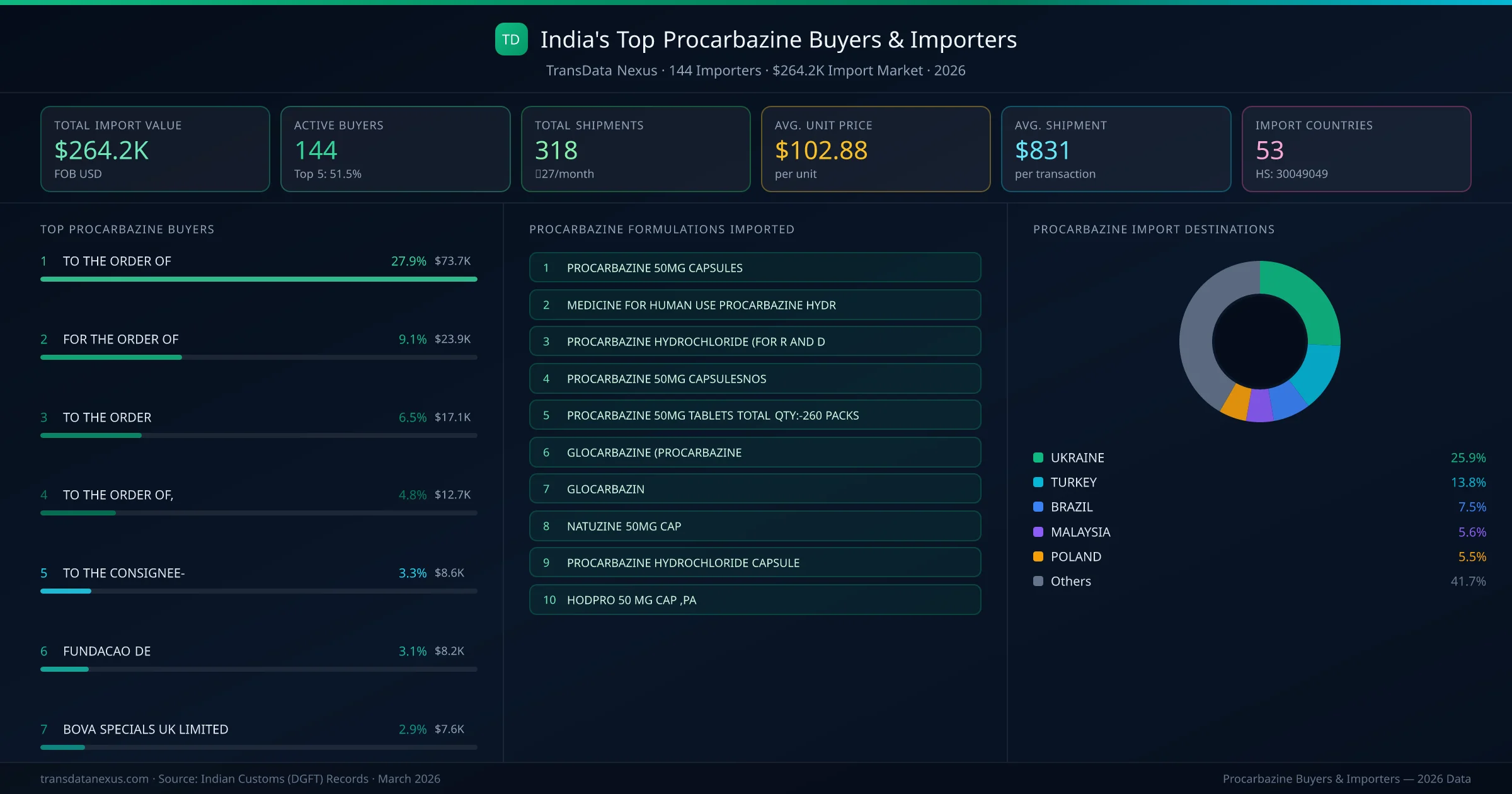
Who Buys Procarbazine from India — 144 Importers Behind a $264.2K Market
India's procarbazine import market is served by 144 active buyers who collectively imported $264.2K across 318 shipments. TO THE CONSIGNEE- (POLAND) leads with a 3.3% market share, followed by FUNDACAO DE and LISMEDFARM S.R.L.,. The top 5 buyers together control 11.6% of total import value, reflecting a moderately competitive buyer landscape.
Procarbazine buyer data — 144 importers · $264.2K market · 318 shipmentsTransData Nexus · Indian Customs Data
Top Procarbazine Importers — Ranked by Import Value
TO THE CONSIGNEE- (POLAND) is the leading procarbazine importer from India, holding a 3.3% share of the $264.2K market across 318 shipments from 144 buyers. The top 5 buyers — TO THE CONSIGNEE- (POLAND), FUNDACAO DE (BRAZIL), LISMEDFARM S.R.L., (MOLDOVA), COMERCIAL FARMACEUTICA LEISA S.A. (COSTA RICA), SKIN LINE LOGISTIC (IRAQ) — collectively control 11.6% of total import value.
Top Procarbazine Buyers & Importers
Ranked by import value · 144 active buyers · Indian Customs (DGFT) data
Apr 2026
Top Procarbazine Buyers & Importers — Ranked by Import Value. 144 active buyers with import value, shipments, country and supplier data compiled from Indian Customs records by TransData Nexus.
#
Buyer & Formulations
Value
Orders
Suppliers
Share
1
TO THE CONSIGNEE-POLAND
Updated
·HS 30049049
PROCARBAZINE 50MG CAPSULESMEDICINE FOR HUMAN USE PROCARBAZINE HYDRPROCARBAZINE 50MG CAPSULESNOS
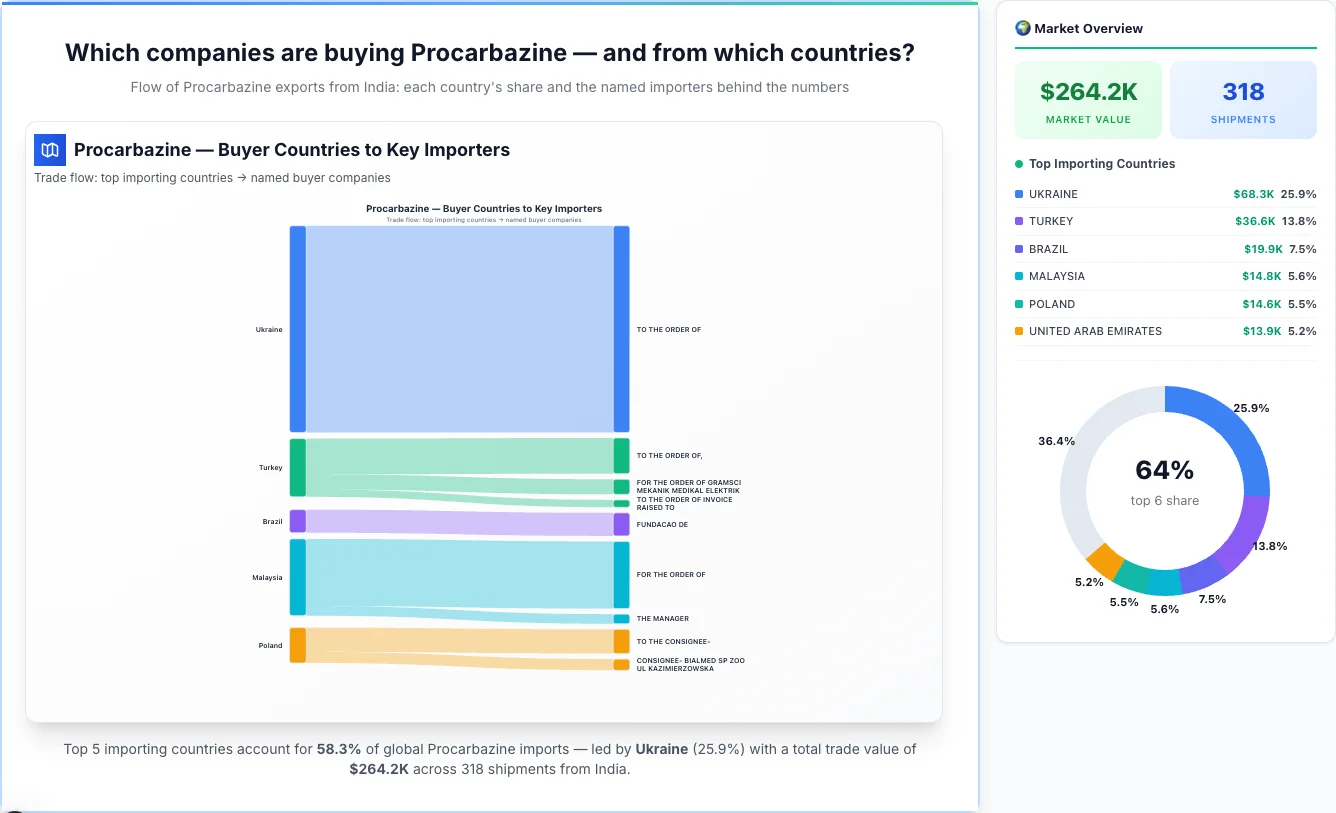
Which companies are buying Procarbazine — and from which countries?
Flow of Procarbazine exports from India: each country's share and the named importers behind the numbers
Procarbazine — Buyer Countries to Key Importers
Trade flow: top importing countries → named buyer companies
Top 5 importing countries account for 58.3% of global Procarbazine imports — led by Ukraine (25.9%) with a total trade value of $264.2K across 318 shipments from India.
Market Analysis: Top Importing Countries & Their Importers
1Ukraine
Ukraine emerges as the first largest importing country, achieving a total trade value of $68.3K through 0 shipments. This represents a market share of 25.9% of the total market activity, demonstrating their significant presence in the industry.
Key Insight: Ukraine demonstrates strong market positioning with an average shipment value of $68.3K, indicating premium pricing strategy compared to the market average of $831.
Ukraine is a key market for Procarbazine imports, representing 25.9% of total trade value.
Primary Market
Secondary Market
2Turkey
Turkey emerges as the second largest importing country, achieving a total trade value of $36.6K through 0 shipments. This represents a market share of 13.8% of the total market activity, demonstrating their significant presence in the industry.
Key Insight: Turkey demonstrates strong market positioning with an average shipment value of $36.6K, indicating premium pricing strategy compared to the market average of $831.
Turkey is a key market for Procarbazine imports, representing 13.8% of total trade value.
The importation of Procarbazine from India involves various buyer segments, each with distinct purchasing behaviors:
Distributors: Entities like LISMEDFARM S.R.L. in Moldova and COMERCIAL FARMACEUTICA LEISA S.A. in Costa Rica function as intermediaries, procuring Procarbazine in bulk to supply to healthcare providers and pharmacies. Their purchasing patterns are characterized by large, periodic orders to maintain inventory levels and meet market demand.
Hospital Groups: Organizations such as FUNDACAO DE in Brazil represent hospital networks that import Procarbazine directly for patient treatment. Their procurement is typically based on patient needs and treatment protocols, leading to consistent, scheduled orders to ensure uninterrupted therapy.
Government Procurement Agencies: While not explicitly listed among the top buyers, government bodies often engage in tender-based purchasing to supply public healthcare facilities. Their procurement processes are structured, involving competitive bidding and adherence to regulatory standards, resulting in large-volume purchases at negotiated prices.
Re-exporters: Companies like SKIN LINE LOGISTIC in Iraq may act as re-exporters, importing Procarbazine for distribution to neighboring regions. Their buying behavior is influenced by regional demand fluctuations, leading to variable order sizes and frequencies.
Importing Procarbazine into the top five importing countries involves navigating specific regulatory frameworks:
Ukraine:
Regulatory Authority: State Service of Ukraine on Medicines and Drugs Control (SMDC).
Import Registration Process: Requires submission of a registration dossier, including quality, safety, and efficacy data.
Estimated Timeline: Approximately 6-12 months, depending on dossier completeness and regulatory workload.
Import Tariff/Duty: Pharmaceutical products under HS Code 30049049 are typically subject to a 0% import duty, aligning with Ukraine's commitment to facilitate access to essential medicines.
Turkey:
Regulatory Authority: Turkish Medicines and Medical Devices Agency (TMMDA).
The demand for Procarbazine in importing countries is driven by several key factors:
Disease Prevalence: Procarbazine is primarily used in the treatment of Hodgkin's lymphoma and certain brain cancers. The incidence of these cancers influences demand, with higher prevalence leading to increased need for the medication.
Government Healthcare Programs: Many countries have national health programs that subsidize or provide cancer treatments, including Procarbazine, to ensure patient access.
Universal Health Coverage Expansion: Efforts to expand health coverage increase the number of patients eligible for treatment, thereby boosting demand for essential medicines like Procarbazine.
WHO Essential Medicines List Procurement: Inclusion of Procarbazine in the WHO Essential Medicines List encourages countries to procure it for their healthcare systems, recognizing its importance in cancer treatment.
Tender-Based Purchasing: Government and institutional tenders for pharmaceuticals create structured demand, with suppliers competing to fulfill large orders, often leading to more stable and predictable procurement patterns.
Common Questions — Procarbazine Buyers & Importers
Answers based on Indian Customs (DGFT) shipment records compiled by TransData Nexus
QWho is the largest procarbazine buyer importing from India?
Based on import volume and value, TO THE CONSIGNEE- (POLAND) leads with $8.6K in imports and a 3.3% market share — the highest of any single procarbazine importer. FUNDACAO DE (BRAZIL) and LISMEDFARM S.R.L., (MOLDOVA) are the next largest buyers.
QHow many companies buy procarbazine from India?
There are 144 active procarbazine buyers importing from India, with a combined market of $264.2K across 318 shipments to 53 countries. The top 5 buyers hold 11.6% of total import value, while the remaining 139 buyers handle the other 88.4%.
QWhich countries import the most procarbazine from India?
The top importing countries for procarbazine from India are Ukraine (25.9%), Turkey (13.8%), Brazil (7.5%), Malaysia (5.6%), Poland (5.5%). These markets represent the largest demand centres for Indian pharmaceutical exports of procarbazine, with buyers ranging from government procurement agencies to private pharmaceutical distributors.
The importation of Procarbazine from India involves various buyer segments, each with distinct purchasing behaviors:
Distributors: Entities like LISMEDFARM S.R.L. in Moldova and COMERCIAL FARMACEUTICA LEISA S.A. in Costa Rica function as intermediaries, procuring Procarbazine in bulk to supply to healthcare providers and pharmacies. Their purchasing patterns are characterized by large, periodic orders to maintain inventory levels and meet market demand.
Hospital Groups: Organizations such as FUNDACAO DE in Brazil represent hospital networks that import Procarbazine directly for patient treatment. Their procurement is typically based on patient needs and treatment protocols, leading to consistent, scheduled orders to ensure uninterrupted therapy.
Government Procurement Agencies: While not explicitly listed among the top buyers, government bodies often engage in tender-based purchasing to supply public healthcare facilities. Their procurement processes are structured, involving competitive bidding and adherence to regulatory standards, resulting in large-volume purchases at negotiated prices.
Re-exporters: Companies like SKIN LINE LOGISTIC in Iraq may act as re-exporters, importing Procarbazine for distribution to neighboring regions. Their buying behavior is influenced by regional demand fluctuations, leading to variable order sizes and frequencies.
Importing Procarbazine into the top five importing countries involves navigating specific regulatory frameworks:
Ukraine:
Regulatory Authority: State Service of Ukraine on Medicines and Drugs Control (SMDC).
Import Registration Process: Requires submission of a registration dossier, including quality, safety, and efficacy data.
Estimated Timeline: Approximately 6-12 months, depending on dossier completeness and regulatory workload.
Import Tariff/Duty: Pharmaceutical products under HS Code 30049049 are typically subject to a 0% import duty, aligning with Ukraine's commitment to facilitate access to essential medicines.
Turkey:
Regulatory Authority: Turkish Medicines and Medical Devices Agency (TMMDA).
The demand for Procarbazine in importing countries is driven by several key factors:
Disease Prevalence: Procarbazine is primarily used in the treatment of Hodgkin's lymphoma and certain brain cancers. The incidence of these cancers influences demand, with higher prevalence leading to increased need for the medication.
Government Healthcare Programs: Many countries have national health programs that subsidize or provide cancer treatments, including Procarbazine, to ensure patient access.
Universal Health Coverage Expansion: Efforts to expand health coverage increase the number of patients eligible for treatment, thereby boosting demand for essential medicines like Procarbazine.
WHO Essential Medicines List Procurement: Inclusion of Procarbazine in the WHO Essential Medicines List encourages countries to procure it for their healthcare systems, recognizing its importance in cancer treatment.
Tender-Based Purchasing: Government and institutional tenders for pharmaceuticals create structured demand, with suppliers competing to fulfill large orders, often leading to more stable and predictable procurement patterns.
Suresh Sormare is a pharmaceutical export-import analyst with deep expertise in Indian Customs (DGFT) data, HS code classification, and global pharmaceutical supply chains. His analysis covers 10M+ shipment records across 150+ countries and is used by manufacturers, procurement agencies, and trade consultants worldwide. Suresh specializes in identifying verified suppliers and buyers from customs records, mapping bilateral pharmaceutical trade corridors, analyzing tariff structures and regulatory frameworks across 170+ destination markets, and benchmarking competitive positioning for finished pharmaceutical formulations. His methodology combines granular customs transaction data with regulatory intelligence from FDA, EMA, WHO, CDSCO, and 40+ national drug authorities to deliver actionable trade insights for the pharmaceutical formulations sector.
All trade data is sourced from Indian Customs (DGFT) official shipping bill records — the authoritative government database for India's pharmaceutical trade. Each verified record contains exporter name, consignee (buyer) name, detailed product description, quantity, declared FOB value (USD), port of loading, destination country, and shipment date.
Primary Market
Secondary Market
3Brazil
Brazil emerges as the third largest importing country, achieving a total trade value of $19.9K through 3 shipments. This represents a market share of 7.5% of the total market activity, demonstrating their significant presence in the industry.
Top Importers: Brazil has a diverse importer base, with their top importers including:
• FUNDACAO DE - $8.2K (41.4% of country's total business)
Key Insight: Brazil demonstrates strong market positioning with an average shipment value of $6.6K, indicating premium pricing strategy compared to the market average of $831.
Brazil is a key market for Procarbazine imports, representing 7.5% of total trade value.
Primary Market
Secondary Market
4Malaysia
Malaysia emerges as the fourth largest importing country, achieving a total trade value of $14.8K through 0 shipments. This represents a market share of 5.6% of the total market activity, demonstrating their significant presence in the industry.
Key Insight: Malaysia demonstrates strong market positioning with an average shipment value of $14.8K, indicating premium pricing strategy compared to the market average of $831.
Malaysia is a key market for Procarbazine imports, representing 5.6% of total trade value.
Primary Market
Secondary Market
5Poland
Poland emerges as the fifth largest importing country, achieving a total trade value of $14.6K through 7 shipments. This represents a market share of 5.5% of the total market activity, demonstrating their significant presence in the industry.
Top Importers: Poland has a diverse importer base, with their top importers including:
• TO THE CONSIGNEE- - $8.6K (59.1% of country's total business)
Key Insight: Poland demonstrates strong market positioning with an average shipment value of $2.1K, indicating premium pricing strategy compared to the market average of $831.
Poland is a key market for Procarbazine imports, representing 5.5% of total trade value.
Primary Market
Secondary Market
Contract Manufacturers: Some buyers may be contract manufacturers who import Procarbazine as an active pharmaceutical ingredient (API) for formulation into finished products. Their procurement is aligned with production schedules and client requirements, resulting in bulk purchases timed with manufacturing cycles.
Understanding these segments is crucial for tailoring marketing strategies and supply chain logistics to meet the specific needs and behaviors of each buyer type.
TransData Nexus Research · Government and regulatory sourcesMar 2026
Import Registration Process: Involves obtaining a product license through submission of comprehensive documentation and compliance with Good Manufacturing Practices (GMP).
Estimated Timeline: Generally 8-14 months, contingent upon the evaluation process and any additional information requests.
Import Tariff/Duty: Pharmaceuticals under HS Code 30049049 are usually exempt from import duties, promoting the availability of essential drugs.
Brazil:
Regulatory Authority: National Health Surveillance Agency (ANVISA).
Import Registration Process: Necessitates registration with ANVISA, including submission of technical dossiers and adherence to local labeling requirements.
Estimated Timeline: Approximately 10-15 months, influenced by regulatory review periods and potential site inspections.
Import Tariff/Duty: Pharmaceutical products under HS Code 30049049 are subject to an import duty of 8%, with potential reductions under specific trade agreements.
Malaysia:
Regulatory Authority: National Pharmaceutical Regulatory Agency (NPRA).
Import Registration Process: Requires product registration through the Quest system, including submission of quality, safety, and efficacy data.
Estimated Timeline: Typically 12-18 months, depending on the complexity of the application and regulatory assessments.
Import Tariff/Duty: Pharmaceuticals under HS Code 30049049 are generally exempt from import duties, facilitating access to essential medicines.
Poland:
Regulatory Authority: Office for Registration of Medicinal Products, Medical Devices and Biocidal Products (URPL).
Import Registration Process: Involves obtaining marketing authorization through submission of a registration dossier and compliance with EU regulations.
Estimated Timeline: Approximately 7-12 months, subject to the evaluation process and any additional information requests.
Import Tariff/Duty: As an EU member state, Poland applies a 0% import duty on pharmaceutical products under HS Code 30049049, in line with EU policies to ensure medicine accessibility.
Navigating these regulatory landscapes requires thorough preparation and adherence to each country's specific requirements to ensure successful market entry.
TransData Nexus Research · Government and regulatory sourcesMar 2026
With 144 buyers across 53 countries, the global landscape for Procarbazine presents significant market opportunities, particularly in regions with rising cancer incidence and expanding healthcare access.
TransData Nexus Research · Government and regulatory sourcesMar 2026
QWhat is the average import order value for procarbazine from India?
The average import transaction value for procarbazine from India is $831, with an average unit price of $102.88 per unit. Order sizes vary significantly based on buyer type — government tenders tend to be larger while private distributors place more frequent smaller orders.
Contract Manufacturers: Some buyers may be contract manufacturers who import Procarbazine as an active pharmaceutical ingredient (API) for formulation into finished products. Their procurement is aligned with production schedules and client requirements, resulting in bulk purchases timed with manufacturing cycles.
Understanding these segments is crucial for tailoring marketing strategies and supply chain logistics to meet the specific needs and behaviors of each buyer type.
TransData Nexus Research · Government and regulatory sourcesMar 2026
Import Registration Process: Involves obtaining a product license through submission of comprehensive documentation and compliance with Good Manufacturing Practices (GMP).
Estimated Timeline: Generally 8-14 months, contingent upon the evaluation process and any additional information requests.
Import Tariff/Duty: Pharmaceuticals under HS Code 30049049 are usually exempt from import duties, promoting the availability of essential drugs.
Brazil:
Regulatory Authority: National Health Surveillance Agency (ANVISA).
Import Registration Process: Necessitates registration with ANVISA, including submission of technical dossiers and adherence to local labeling requirements.
Estimated Timeline: Approximately 10-15 months, influenced by regulatory review periods and potential site inspections.
Import Tariff/Duty: Pharmaceutical products under HS Code 30049049 are subject to an import duty of 8%, with potential reductions under specific trade agreements.
Malaysia:
Regulatory Authority: National Pharmaceutical Regulatory Agency (NPRA).
Import Registration Process: Requires product registration through the Quest system, including submission of quality, safety, and efficacy data.
Estimated Timeline: Typically 12-18 months, depending on the complexity of the application and regulatory assessments.
Import Tariff/Duty: Pharmaceuticals under HS Code 30049049 are generally exempt from import duties, facilitating access to essential medicines.
Poland:
Regulatory Authority: Office for Registration of Medicinal Products, Medical Devices and Biocidal Products (URPL).
Import Registration Process: Involves obtaining marketing authorization through submission of a registration dossier and compliance with EU regulations.
Estimated Timeline: Approximately 7-12 months, subject to the evaluation process and any additional information requests.
Import Tariff/Duty: As an EU member state, Poland applies a 0% import duty on pharmaceutical products under HS Code 30049049, in line with EU policies to ensure medicine accessibility.
Navigating these regulatory landscapes requires thorough preparation and adherence to each country's specific requirements to ensure successful market entry.
TransData Nexus Research · Government and regulatory sourcesMar 2026
With 144 buyers across 53 countries, the global landscape for Procarbazine presents significant market opportunities, particularly in regions with rising cancer incidence and expanding healthcare access.
TransData Nexus Research · Government and regulatory sourcesMar 2026
Analysis Methodology
1.Buyer Identification: 144 global importers of Procarbazine identified from consignee fields in DGFT shipping bill records.
2.Import Value Analysis: Total import value aggregated from 318 individual shipping bill records. Values are FOB in USD.
3.Statistical Normalization: Shipment values are statistically normalized to ensure accurate market share representation.
4.Geographic Distribution: Buyer imports distributed across 53 destination countries with market share per buyer calculated from capped values.