Loading...
Loading...
India's plasma imports from ALGERIA total $213 across 1 shipments from 1 foreign suppliers. GROUP INDUSTRIEL SAIDAL SPA leads with $213 in import value; the top 5 suppliers together control 100.0% of this origin. Leading Indian buyers include INDIGLOBAL LABS PRIVATE LIMITED. This corridor reflects India's pharmaceutical import demand for plasma โ a concentrated sourcing relationship with select suppliers from ALGERIA.
GROUP INDUSTRIEL SAIDAL SPA is the leading Plasma supplier from ALGERIA to India, with import value of $213 across 1 shipments. The top 5 suppliers โ GROUP INDUSTRIEL SAIDAL SPA โ collectively account for 100.0% of total import value from this origin.
Ranked by import value (USD) ยท Indian Customs (DGFT) data
| # | Supplier | Value (USD) | Shipments | Share |
|---|---|---|---|---|
| 1 | GROUP INDUSTRIEL SAIDAL SPA | $213 | 1 | 100.0% |
Ranked by import value (USD)
| # | Buyer | Value (USD) | Shipments | Share |
|---|---|---|---|---|
| 1 | INDIGLOBAL LABS PRIVATE LIMITED | $213 | 1 | 100.0% |
ALGERIA โ India trade corridor intelligence
The Algeria to India trade corridor for pharmaceutical imports is currently stable. Port congestion at major Indian ports such as Jawaharlal Nehru Port Trust (JNPT), Chennai, and Mundra is minimal, facilitating timely deliveries. Freight rates are competitive, and the exchange rate between the Indian Rupee (INR) and Algerian Dinar remains favorable for trade. No significant disruptions have been reported in the 2025-2026 period.
The Indian government's Production Linked Incentive (PLI) scheme aims to boost domestic manufacturing, potentially reducing the dependency on imports of finished pharmaceutical formulations. However, for specialized products like plasma formulations, the import substitution policies may not fully eliminate the need for imports, as domestic production capabilities are still developing.
India and Algeria have explored enhancing bilateral trade relations, including discussions on Free Trade Agreements (FTAs) and mutual recognition of Good Manufacturing Practices (GMP). These efforts aim to streamline pharmaceutical trade, reduce regulatory barriers, and promote mutual economic benefits. Specific agreements are under negotiation, with progress varying by sector.
The landed cost for importing finished pharmaceutical formulations containing plasma from Algeria to India includes the following components:
Per-unit estimates depend on the specific product and shipment details.
CDSCO registration, import licensing, and quality testing requirements
To import finished pharmaceutical formulations containing plasma into India, the foreign manufacturer must obtain an Import License from the Directorate General of Foreign Trade (DGFT). The importer in India must register the product with the Central Drugs Standard Control Organisation (CDSCO) by submitting Form 40 or 41, depending on the product's classification. The registration process includes providing a Certificate of Pharmaceutical Product (CoPP), Good Manufacturing Practice (GMP) certificate, and stability data. The timeline for import drug registration varies but typically ranges from several months to a year, depending on the complexity of the product and the completeness of the submitted documentation. For formulations under HS Code 30029010, specific requirements include detailed product information, manufacturing details, and compliance with Indian pharmacopoeia standards.
Imported finished pharmaceutical formulations containing plasma must undergo quality testing at CDSCO-approved laboratories in India. Each batch requires a Certificate of Analysis (CoA) confirming compliance with Indian Pharmacopoeia standards. Stability data, particularly for ICH Zone IV conditions, must be provided to demonstrate the product's shelf-life under Indian climatic conditions. Port inspection by customs drug inspectors is mandatory to verify the authenticity and quality of the imported products. Failure to meet these requirements can result in delays, rejections, or destruction of the consignment.
Between 2024 and 2026, the CDSCO has implemented several regulatory updates affecting the import of finished pharmaceutical formulations. The introduction of the Production Linked Incentive (PLI) scheme has incentivized domestic manufacturing, potentially impacting the volume of imports. Bilateral agreements with Algeria have been explored to facilitate smoother trade relations, including mutual recognition of GMP standards and streamlined import procedures. These developments aim to balance the promotion of domestic industry with the need for high-quality imported formulations.
Market demand, customs duty structure, and competitive landscape ยท Import duty: 10%
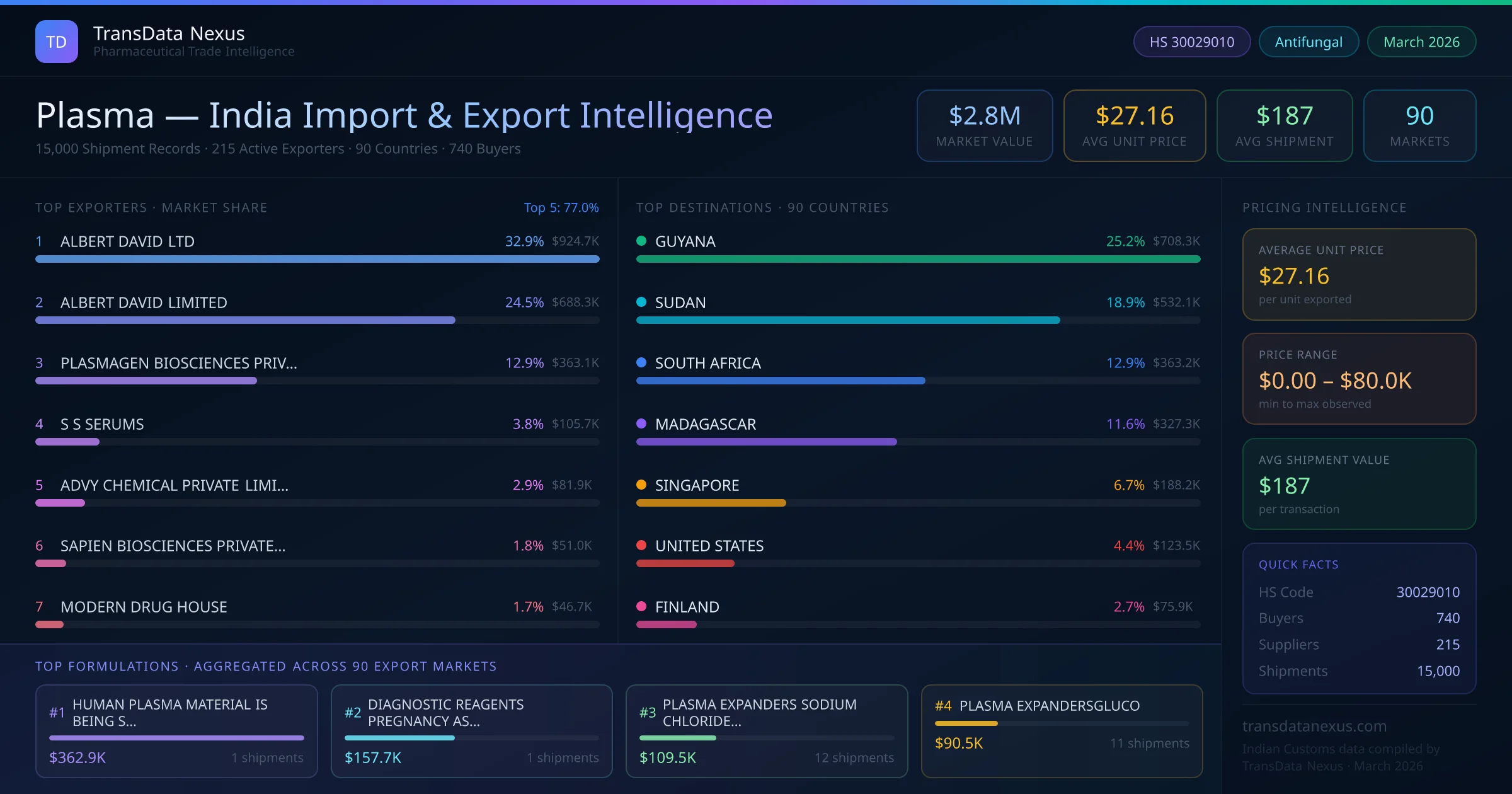
India imports finished pharmaceutical formulations containing plasma to meet the demand for specialized treatments not fully addressed by domestic production. This includes patented or branded formulations, specific dosage forms, and products requiring advanced manufacturing technologies. The market size for such imports is significant, with India's total plasma formulation export market valued at $2.8 million across 215 exporters to 90 countries. The reliance on imports is due to the limited domestic capacity to produce certain complex plasma-based formulations.
The Basic Customs Duty for HS Code 30029010 is 10%. An additional 3% Education Cess is applied, totaling 10.3%. The Integrated Goods and Services Tax (IGST) is 0% for this category. There are no additional duties such as Anti-Dumping Duty or National Calamity Contingent Duty (NCCD) applicable. Exemption notifications may apply under specific trade agreements or for products meeting certain criteria. The total landed duty percentage is 10.3%.
India sources finished pharmaceutical formulations containing plasma from Algeria due to Algeria's competitive advantages, including the availability of patented formulations, specialized dosage forms, and high-quality manufacturing practices. Algeria's share in India's plasma formulation imports is notable, though specific figures are not disclosed. Other suppliers include China, Germany, and the United States, each offering different advantages in terms of price, quality, and regulatory compliance.
Import rationale, competitive comparison, supply chain risk, and procurement strategy
India imports finished pharmaceutical formulations containing plasma from Algeria due to Algeria's ability to supply patented formulations, specialized dosage forms, and products manufactured under stringent quality controls. These products may not be available domestically, necessitating imports to meet patient needs.
Compared to other origins like China, the European Union, and the United States, Algeria offers competitive pricing and high-quality products. Algeria's regulatory compliance and reliability in supply chains make it an attractive source for India.
Potential risks include single-source dependency, currency fluctuations, regulatory changes in Algeria, quality incidents, and shipping disruptions. Past shortages have been minimal, but importers should maintain contingency plans.
Import license checklist, document requirements, quality testing, and compliance
Answers based on Indian Customs (DGFT) import records compiled by TransData Nexus
The top Plasma suppliers from ALGERIA to India include GROUP INDUSTRIEL SAIDAL SPA. The leading supplier is GROUP INDUSTRIEL SAIDAL SPA with import value of $213 USD across 1 shipments. India imported Plasma worth $213 USD from ALGERIA in total across 1 shipments.
India imported Plasma worth $213 USD from ALGERIA across 1 shipments. Data is from Indian Customs (DGFT) records. Values are in USD.
The main Indian buyers of Plasma sourced from ALGERIA include INDIGLOBAL LABS PRIVATE LIMITED. The largest buyer is INDIGLOBAL LABS PRIVATE LIMITED with $213 in imports across 1 shipments.
The total value of Plasma imports from ALGERIA to India is $213 USD, across 1 shipments and 1 foreign suppliers. Data source: Indian Customs (DGFT).
Data sourced from Indian Customs (DGFT) records. Verify regulatory and trade status with the agencies above.
Pharmaceutical Export-Import Analyst & Trade Intelligence Expert
Suresh Sormare is a pharmaceutical export-import analyst with deep expertise in Indian Customs (DGFT) data, HS code classification, and global pharmaceutical supply chains. His analysis covers 10M+ shipment records across 150+ countries and is used by manufacturers, procurement agencies, and trade consultants worldwide. Suresh specializes in identifying verified suppliers and buyers from customs records, mapping bilateral pharmaceutical trade corridors, analyzing tariff structures and regulatory frameworks across 170+ destination markets, and benchmarking competitive positioning for finished pharmaceutical formulations. His methodology combines granular customs transaction data with regulatory intelligence from FDA, EMA, WHO, CDSCO, and 40+ national drug authorities to deliver actionable trade insights for the pharmaceutical formulations sector.
linkedin.com/in/sureshsormareAll trade data is sourced from Indian Customs (DGFT) official shipping bill records โ the authoritative government database for India's pharmaceutical trade. Each verified record contains exporter name, consignee (buyer) name, detailed product description, quantity, declared FOB value (USD), port of loading, destination country, and shipment date.
Government-Sourced Data
Official DGFT customs records
Transparent Methodology
Calculations fully disclosed above
1 Verified Shipments
1 suppliers, 1 buyers tracked
Expert-Reviewed
By pharmaceutical trade specialists