Who Buys Paracetamol from India — 2197 Importers Behind a $357.3M Market
India's paracetamol import market is served by 2197 active buyers who collectively imported $357.3M across 15,000 shipments. ADCOCK INGRAM LIMITED. (SOUTH AFRICA) leads with a 5.7% market share, followed by ALLOGA UK AP7 and CENTRAFARM SERVICES B.V.(I). The top 5 buyers together control 13.7% of total import value, reflecting a moderately competitive buyer landscape.
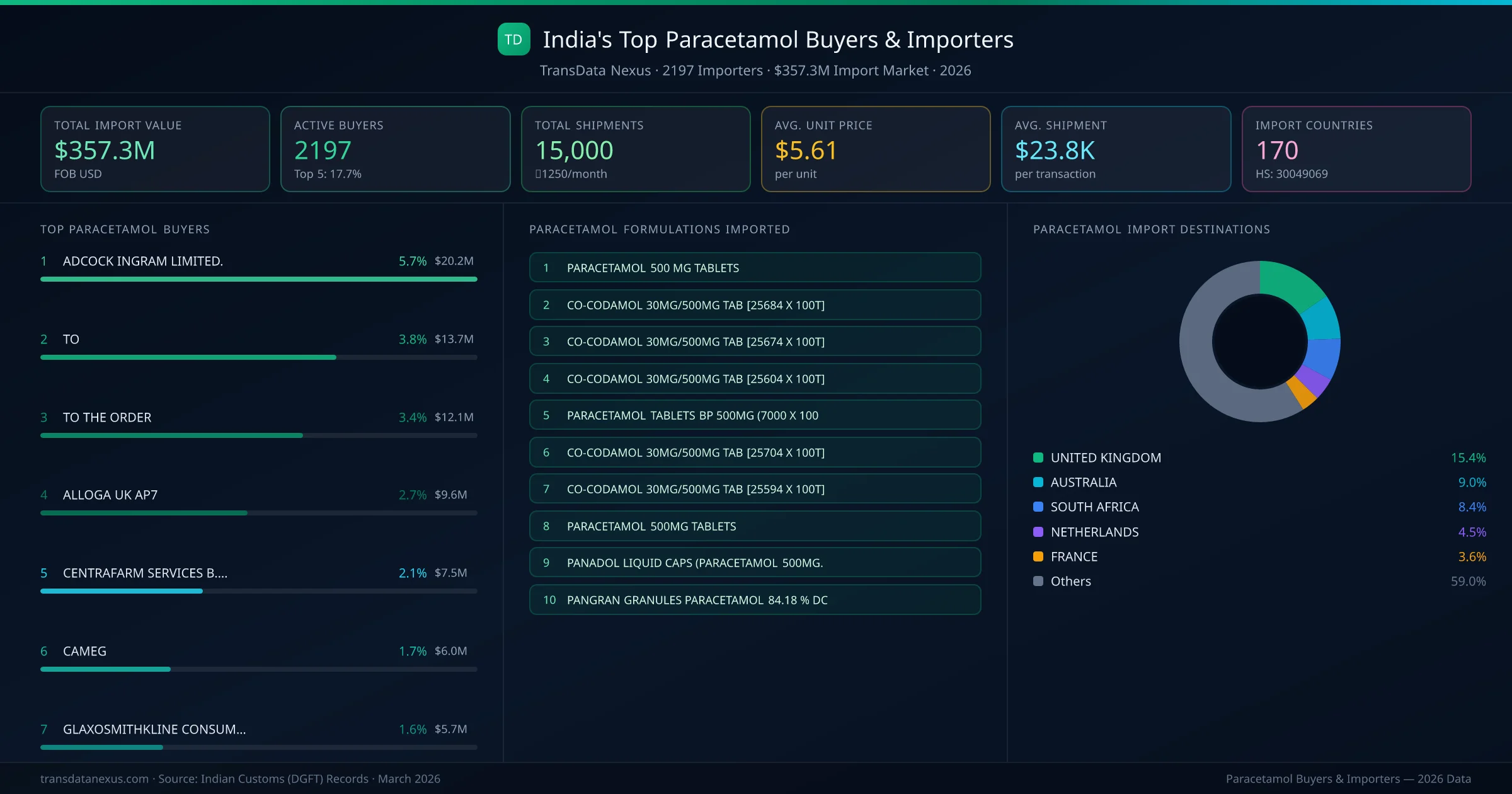
Top Paracetamol Importers — Ranked by Import Value
ADCOCK INGRAM LIMITED. (SOUTH AFRICA) is the leading paracetamol importer from India, holding a 5.7% share of the $357.3M market across 15,000 shipments from 2197 buyers. The top 5 buyers — ADCOCK INGRAM LIMITED. (SOUTH AFRICA), ALLOGA UK AP7 (UNITED KINGDOM), CENTRAFARM SERVICES B.V.(I) (NETHERLANDS), CAMEG (BURKINA FASO), GLAXOSMITHKLINE CONSUMER HEALTHCARE (AUSTRALIA) — collectively control 13.7% of total import value.
Top Paracetamol Buyers & Importers
Ranked by import value · 2197 active buyers · Indian Customs (DGFT) data
| # | Buyer & Formulations | Value | Suppliers | Share |
|---|---|---|---|---|
| 1 | ADCOCK INGRAM LIMITED.SOUTH AFRICA ADCODOL TABLETS (PARACETAMOL 450MG+CODEIACURATE TABLETS (PARACETAMOL 450MG+DOXYLSYNALEVE CAPSULES (PARACETAMOL 400MG+COD | $20.2M | 5 | 5.7% |
| 2 | ALLOGA UK AP7UNITED KINGDOM PARACETAMOL 500 MG TABLETSCO-CODAMOL 30MG/500MG TAB [25684 X 100T]PARACETAMOL TABLETS BP 500MG (7000 X 100 | $9.6M | 5 | 2.7% |
| 3 | CENTRAFARM SERVICES B.V.(I)NETHERLANDS PARACETAMOL TABLETS BP 500MG (7000 X 100PARACETAMOL TABLETS 500MGKRUIDVAT PARACETAMOL 500MG TABLETTEN(465 | $7.5M | 5 | 2.1% |
| 4 | CAMEGBURKINA FASO PARACETAMOL TABLETS BP 500MG QTY: 23400XPARACETAMOL TABLETS BP 500 MGPARACETAMOL TABLETS BP 500 MG QTY: 23540 | $6.0M | 5 | 1.7% |
| 5 | GLAXOSMITHKLINE CONSUMER HEALTHCAREAUSTRALIA | $5.7M | 5 | 1.6% |
| 6 | SMITHKLINE BEECHAM PVT LTDSRI LANKA PANGRAN GRANULES PARACETAMOL 84.18 % DCPANGRAN GRANULES - PARACETAMOL 84.18% DCGRANULESPANGRAN GRANULES PARACETAMOL 84.18 % DCGRANULES | $4.3M | 5 | 1.2% |
| 7 | IPCA LABORATORIES UK LIMITEDUNITED KINGDOM PARACETAMOL 500 MG TABLETSCO-CODAMOL 30MG/500MG TAB [25684 X 100T] | $4.1M | 5 | 1.2% |
| 8 | EMBASSY PHARMACEUTICAL ANDNIGERIA | $4.0M | 5 | 1.1% |
| 9 | ADCOCK INGRAM LIMITEDSOUTH AFRICA ADCODOL TABLETS (PARACETAMOL 450MG+CODEIACURATE TABLETS (PARACETAMOL 450MG+DOXYLSYNALEVE CAPSULES (PARACETAMOL 400MG+COD | $3.6M | 5 | 1.0% |
| 10 | BELLS HEALTHCAREUNITED KINGDOM PARACETAMOL 500 MG TABLETSCO-CODAMOL 30MG/500MG TAB [25684 X 100T] | $3.4M | 5 | 0.9% |
| 11 | CICI SARLMALI PHARMACEUTICAL PRODUCTS, PARACETAMOL 500HARMLESS MEDICINES PARACETAMOL B.P.325 MSUDREK TABLETS( PARACETAMOL BP 325MG + C | $3.3M | 5 | 0.9% |
| 12 | NOVA PHARMACEUTICALSAUSTRALIA PARACETAMOL 500 MG TABLETSCO-CODAMOL 30MG/500MG TAB [25684 X 100T]PARACETAMOL TABLETS BP 500MG (7000 X 100 | $3.1M | 5 | 0.9% |
| 13 | PERRIGOUNITED KINGDOM PARACETAMOL 500 MG TABLETSCO-CODAMOL 30MG/500MG TAB [25684 X 100T] | $3.1M | 5 | 0.9% |
| 14 | AO RANBAXYRUSSIA PARACETAMOL TABLETS BP 500MG QTY: 23400XPARACETAMOL, DICLOFENAC SODIUM AND MAGNEDICLOFENAC SODIUM, PARACETAMOL, CHLORPHE | $3.0M | 5 | 0.8% |
| 15 | EVOLAN PHARMA ABSWEDEN | $2.8M | 5 | 0.8% |
Related Analysis
Market Analysis: Top Importing Countries & Importers
Comprehensive geographic market intelligence dashboard
Which companies are buying Paracetamol — and from which countries?
Flow of Paracetamol exports from India: each country's share and the named importers behind the numbers
Paracetamol — Buyer Countries to Key Importers
Trade flow: top importing countries → named buyer companies
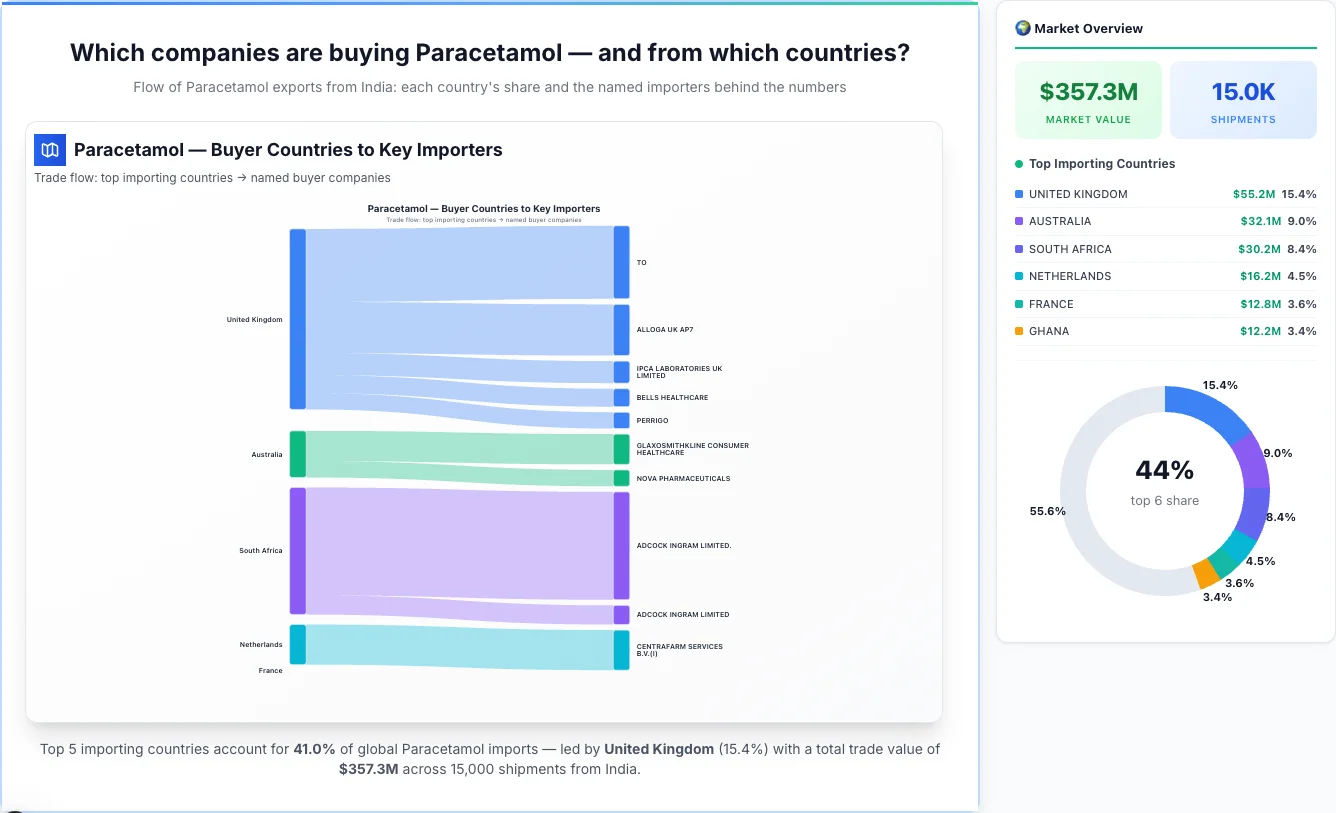
Market Analysis: Top Importing Countries & Their Importers
1United Kingdom
United Kingdom emerges as the first largest importing country, achieving a total trade value of $55.2M through 467 shipments. This represents a market share of 15.4% of the total market activity, demonstrating their significant presence in the industry.
Top Importers: United Kingdom has a diverse importer base, with their top importers including:
• ALLOGA UK AP7 - $9.6M (17.4% of country's total business)
• IPCA LABORATORIES UK LIMITED - $4.1M (7.5% of country's total business)
• BELLS HEALTHCARE - $3.4M (6.1% of country's total business)
• PERRIGO - $3.1M (5.5% of country's total business)
Key Insight: United Kingdom demonstrates strong market positioning with an average shipment value of $118.2K, indicating premium pricing strategy compared to the market average of $23.8K.
United Kingdom is a key market for Paracetamol imports, representing 15.4% of total trade value.
2Australia
Australia emerges as the second largest importing country, achieving a total trade value of $32.1M through 152 shipments. This represents a market share of 9.0% of the total market activity, demonstrating their significant presence in the industry.
Top Importers: Australia has a diverse importer base, with their top importers including:
• GLAXOSMITHKLINE CONSUMER HEALTHCARE - $5.7M (17.7% of country's total business)
• NOVA PHARMACEUTICALS - $3.1M (9.6% of country's total business)
Key Insight: Australia demonstrates strong market positioning with an average shipment value of $211.0K, indicating premium pricing strategy compared to the market average of $23.8K.
Australia is a key market for Paracetamol imports, representing 9.0% of total trade value.
3South Africa
South Africa emerges as the third largest importing country, achieving a total trade value of $30.2M through 1,040 shipments. This represents a market share of 8.4% of the total market activity, demonstrating their significant presence in the industry.
Top Importers: South Africa has a diverse importer base, with their top importers including:
• ADCOCK INGRAM LIMITED. - $20.2M (67.0% of country's total business)
• ADCOCK INGRAM LIMITED - $3.6M (11.9% of country's total business)
Key Insight: South Africa demonstrates strong market positioning with an average shipment value of $29.0K, indicating premium pricing strategy compared to the market average of $23.8K.
South Africa is a key market for Paracetamol imports, representing 8.4% of total trade value.
4Netherlands
Netherlands emerges as the fourth largest importing country, achieving a total trade value of $16.2M through 151 shipments. This represents a market share of 4.5% of the total market activity, demonstrating their significant presence in the industry.
Top Importers: Netherlands has a diverse importer base, with their top importers including:
• CENTRAFARM SERVICES B.V.(I) - $7.5M (46.4% of country's total business)
Key Insight: Netherlands demonstrates strong market positioning with an average shipment value of $107.3K, indicating premium pricing strategy compared to the market average of $23.8K.
Netherlands is a key market for Paracetamol imports, representing 4.5% of total trade value.
5France
France emerges as the fifth largest importing country, achieving a total trade value of $12.8M through 0 shipments. This represents a market share of 3.6% of the total market activity, demonstrating their significant presence in the industry.
Key Insight: France demonstrates strong market positioning with an average shipment value of $12.8M, indicating premium pricing strategy compared to the market average of $23.8K.
France is a key market for Paracetamol imports, representing 3.6% of total trade value.
Buyer Segment Analysis
TransData Nexus Paracetamol buyer market intelligence
1Buyer Segment Analysis
The importers of Paracetamol from India can be categorized into several key segments:
1. Distributors: These entities purchase large quantities of Paracetamol to supply to various retailers, pharmacies, and healthcare providers. Their buying behavior is characterized by bulk purchasing to leverage economies of scale, ensuring a steady supply chain to meet market demand.
2. Hospital Groups: Hospitals and healthcare institutions procure Paracetamol directly for patient care. Their purchasing decisions are driven by the need for consistent quality, compliance with regulatory standards, and cost-effectiveness to manage healthcare budgets efficiently.
3. Retail Chains: Pharmacy and supermarket chains import Paracetamol to stock their shelves for consumer purchase. They focus on product availability, brand reputation, and competitive pricing to attract and retain customers.
4. Government Procurement Agencies: Organizations like UNICEF and the Global Fund procure Paracetamol for public health initiatives. Their buying behavior emphasizes large-scale purchases, stringent quality control, and adherence to international health standards to support healthcare programs in various regions.
5. Re-exporters: These buyers import Paracetamol with the intention of exporting it to other markets. They seek cost-effective sourcing to maximize profit margins while ensuring compliance with the regulatory requirements of both the importing and destination countries.
6. Contract Manufacturers: Companies that manufacture pharmaceutical products on behalf of other brands may import Paracetamol as an active pharmaceutical ingredient (API). Their purchasing decisions are influenced by the need for high-quality raw materials, reliable supply chains, and cost considerations to fulfill contractual obligations efficiently.
Country-Specific Import Regulations
TransData Nexus Paracetamol buyer market intelligence
1Country-Specific Import Regulations
United Kingdom
1. Drug Regulatory Authority: Medicines and Healthcare products Regulatory Agency (MHRA).
2. Import Registration Process: Importers must hold a Wholesale Dealer's License (WDA(H)) issued by the MHRA. The application involves demonstrating compliance with Good Distribution Practice (GDP) standards and providing details about the premises and personnel involved.
3. Estimated Timeline: The processing time for a WDA(H) application is approximately 90 days, subject to the completeness of the application and any required inspections.
4. Import Tariff for HS 3004: As of March 2026, the United Kingdom applies a 0% import tariff on pharmaceutical products classified under HS code 3004, aligning with its commitment to facilitate access to essential medicines.
Australia
1. Drug Regulatory Authority: Therapeutic Goods Administration (TGA).
2. Import Registration Process: Importers must register the product in the Australian Register of Therapeutic Goods (ARTG). This process includes submitting comprehensive data on product quality, safety, and efficacy, as well as compliance with Good Manufacturing Practice (GMP) standards.
3. Estimated Timeline: The registration process can take between 6 to 12 months, depending on the complexity of the application and the need for additional information or clarification.
4. Import Tariff for HS 3004: Australia imposes a 5% import tariff on pharmaceutical products under HS code 3004; however, certain products may be eligible for tariff concessions or exemptions under specific trade agreements.
South Africa
1. Drug Regulatory Authority: South African Health Products Regulatory Authority (SAHPRA).
2. Import Registration Process: Importers are required to obtain a license from SAHPRA, which involves submitting detailed product dossiers, evidence of GMP compliance, and adherence to labeling and packaging regulations.
3. Estimated Timeline: The licensing process typically takes 12 to 18 months, influenced by the completeness of the application and the scheduling of necessary inspections.
4. Import Tariff for HS 3004: South Africa applies a 0% import tariff on pharmaceutical products under HS code 3004, facilitating the importation of essential medicines.
Netherlands
1. Drug Regulatory Authority: Medicines Evaluation Board (MEB).
2. Import Registration Process: Importers must obtain a Marketing Authorization from the MEB, which requires submission of comprehensive data on product quality, safety, and efficacy, as well as compliance with European Union GMP standards.
3. Estimated Timeline: The authorization process can take approximately 210 days, subject to the completeness of the application and any additional information requests.
4. Import Tariff for HS 3004: As a member of the European Union, the Netherlands applies a 0% import tariff on pharmaceutical products under HS code 3004, in line with EU regulations.
France
1. Drug Regulatory Authority: French National Agency for Medicines and Health Products Safety (ANSM).
2. Import Registration Process: Importers are required to obtain a Marketing Authorization from ANSM, involving the submission of detailed product information, clinical data, and evidence of GMP compliance.
3. Estimated Timeline: The authorization process typically takes 180 to 210 days, depending on the complexity of the application and any additional information required.
4. Import Tariff for HS 3004: France, as part of the European Union, applies a 0% import tariff on pharmaceutical products under HS code 3004, facilitating the importation of essential medicines.
Demand Drivers & Market Opportunity
TransData Nexus Paracetamol buyer market intelligence
1Demand Drivers & Market Opportunity
The demand for Paracetamol in importing countries is driven by several key factors:
1. Disease Prevalence: Paracetamol is widely used for the treatment of pain and fever associated with various illnesses, including influenza, common colds, and other viral infections. Seasonal outbreaks and the prevalence of such conditions significantly increase the demand for Paracetamol.
2. Government Healthcare Programs: Many countries have implemented healthcare programs that provide essential medicines to the population. Paracetamol, being a cost-effective and widely accepted analgesic and antipyretic, is often included in these programs, leading to substantial procurement by government agencies.
3. Universal Health Coverage Expansion: The global push towards universal health coverage has led to increased access to essential medicines. Countries expanding their healthcare coverage ensure that medications like Paracetamol are readily available to their populations, thereby driving import volumes.
4. Tender Procurement: Public and private healthcare institutions often procure medicines through tender processes to ensure cost-effectiveness and supply reliability. Paracetamol, due to its essential status, is frequently included in such tenders, leading to bulk purchasing and increased importation.
Recent data indicates a steady growth in the global demand for Paracetamol, with emerging markets showing significant increases due to improved healthcare infrastructure and access. Additionally, the ongoing efforts to manage and treat common illnesses effectively continue to position Paracetamol as a critical component in healthcare systems worldwide.
Common Questions — Paracetamol Buyers & Importers
Answers based on Indian Customs (DGFT) shipment records compiled by TransData Nexus
QWho is the largest paracetamol buyer importing from India?
Based on import volume and value, ADCOCK INGRAM LIMITED. (SOUTH AFRICA) leads with $20.2M in imports and a 5.7% market share — the highest of any single paracetamol importer. ALLOGA UK AP7 (UNITED KINGDOM) and CENTRAFARM SERVICES B.V.(I) (NETHERLANDS) are the next largest buyers.
QHow many companies buy paracetamol from India?
There are 2197 active paracetamol buyers importing from India, with a combined market of $357.3M across 15,000 shipments to 170 countries. The top 5 buyers hold 13.7% of total import value, while the remaining 2192 buyers handle the other 86.3%.
QWhich countries import the most paracetamol from India?
The top importing countries for paracetamol from India are United Kingdom (15.4%), Australia (9.0%), South Africa (8.4%), Netherlands (4.5%), France (3.6%). These markets represent the largest demand centres for Indian pharmaceutical exports of paracetamol, with buyers ranging from government procurement agencies to private pharmaceutical distributors.
QWhat is the average import order value for paracetamol from India?
The average import transaction value for paracetamol from India is $23.8K, with an average unit price of $5.61 per unit. Order sizes vary significantly based on buyer type — government tenders tend to be larger while private distributors place more frequent smaller orders.
Buyer Segment Analysis
TransData Nexus Paracetamol buyer market intelligence
1Buyer Segment Analysis
The importers of Paracetamol from India can be categorized into several key segments:
1. Distributors: These entities purchase large quantities of Paracetamol to supply to various retailers, pharmacies, and healthcare providers. Their buying behavior is characterized by bulk purchasing to leverage economies of scale, ensuring a steady supply chain to meet market demand.
2. Hospital Groups: Hospitals and healthcare institutions procure Paracetamol directly for patient care. Their purchasing decisions are driven by the need for consistent quality, compliance with regulatory standards, and cost-effectiveness to manage healthcare budgets efficiently.
3. Retail Chains: Pharmacy and supermarket chains import Paracetamol to stock their shelves for consumer purchase. They focus on product availability, brand reputation, and competitive pricing to attract and retain customers.
4. Government Procurement Agencies: Organizations like UNICEF and the Global Fund procure Paracetamol for public health initiatives. Their buying behavior emphasizes large-scale purchases, stringent quality control, and adherence to international health standards to support healthcare programs in various regions.
5. Re-exporters: These buyers import Paracetamol with the intention of exporting it to other markets. They seek cost-effective sourcing to maximize profit margins while ensuring compliance with the regulatory requirements of both the importing and destination countries.
6. Contract Manufacturers: Companies that manufacture pharmaceutical products on behalf of other brands may import Paracetamol as an active pharmaceutical ingredient (API). Their purchasing decisions are influenced by the need for high-quality raw materials, reliable supply chains, and cost considerations to fulfill contractual obligations efficiently.
Country-Specific Import Regulations
TransData Nexus Paracetamol buyer market intelligence
1Country-Specific Import Regulations
United Kingdom
1. Drug Regulatory Authority: Medicines and Healthcare products Regulatory Agency (MHRA).
2. Import Registration Process: Importers must hold a Wholesale Dealer's License (WDA(H)) issued by the MHRA. The application involves demonstrating compliance with Good Distribution Practice (GDP) standards and providing details about the premises and personnel involved.
3. Estimated Timeline: The processing time for a WDA(H) application is approximately 90 days, subject to the completeness of the application and any required inspections.
4. Import Tariff for HS 3004: As of March 2026, the United Kingdom applies a 0% import tariff on pharmaceutical products classified under HS code 3004, aligning with its commitment to facilitate access to essential medicines.
Australia
1. Drug Regulatory Authority: Therapeutic Goods Administration (TGA).
2. Import Registration Process: Importers must register the product in the Australian Register of Therapeutic Goods (ARTG). This process includes submitting comprehensive data on product quality, safety, and efficacy, as well as compliance with Good Manufacturing Practice (GMP) standards.
3. Estimated Timeline: The registration process can take between 6 to 12 months, depending on the complexity of the application and the need for additional information or clarification.
4. Import Tariff for HS 3004: Australia imposes a 5% import tariff on pharmaceutical products under HS code 3004; however, certain products may be eligible for tariff concessions or exemptions under specific trade agreements.
South Africa
1. Drug Regulatory Authority: South African Health Products Regulatory Authority (SAHPRA).
2. Import Registration Process: Importers are required to obtain a license from SAHPRA, which involves submitting detailed product dossiers, evidence of GMP compliance, and adherence to labeling and packaging regulations.
3. Estimated Timeline: The licensing process typically takes 12 to 18 months, influenced by the completeness of the application and the scheduling of necessary inspections.
4. Import Tariff for HS 3004: South Africa applies a 0% import tariff on pharmaceutical products under HS code 3004, facilitating the importation of essential medicines.
Netherlands
1. Drug Regulatory Authority: Medicines Evaluation Board (MEB).
2. Import Registration Process: Importers must obtain a Marketing Authorization from the MEB, which requires submission of comprehensive data on product quality, safety, and efficacy, as well as compliance with European Union GMP standards.
3. Estimated Timeline: The authorization process can take approximately 210 days, subject to the completeness of the application and any additional information requests.
4. Import Tariff for HS 3004: As a member of the European Union, the Netherlands applies a 0% import tariff on pharmaceutical products under HS code 3004, in line with EU regulations.
France
1. Drug Regulatory Authority: French National Agency for Medicines and Health Products Safety (ANSM).
2. Import Registration Process: Importers are required to obtain a Marketing Authorization from ANSM, involving the submission of detailed product information, clinical data, and evidence of GMP compliance.
3. Estimated Timeline: The authorization process typically takes 180 to 210 days, depending on the complexity of the application and any additional information required.
4. Import Tariff for HS 3004: France, as part of the European Union, applies a 0% import tariff on pharmaceutical products under HS code 3004, facilitating the importation of essential medicines.
Demand Drivers & Market Opportunity
TransData Nexus Paracetamol buyer market intelligence
1Demand Drivers & Market Opportunity
The demand for Paracetamol in importing countries is driven by several key factors:
1. Disease Prevalence: Paracetamol is widely used for the treatment of pain and fever associated with various illnesses, including influenza, common colds, and other viral infections. Seasonal outbreaks and the prevalence of such conditions significantly increase the demand for Paracetamol.
2. Government Healthcare Programs: Many countries have implemented healthcare programs that provide essential medicines to the population. Paracetamol, being a cost-effective and widely accepted analgesic and antipyretic, is often included in these programs, leading to substantial procurement by government agencies.
3. Universal Health Coverage Expansion: The global push towards universal health coverage has led to increased access to essential medicines. Countries expanding their healthcare coverage ensure that medications like Paracetamol are readily available to their populations, thereby driving import volumes.
4. Tender Procurement: Public and private healthcare institutions often procure medicines through tender processes to ensure cost-effectiveness and supply reliability. Paracetamol, due to its essential status, is frequently included in such tenders, leading to bulk purchasing and increased importation.
Recent data indicates a steady growth in the global demand for Paracetamol, with emerging markets showing significant increases due to improved healthcare infrastructure and access. Additionally, the ongoing efforts to manage and treat common illnesses effectively continue to position Paracetamol as a critical component in healthcare systems worldwide.
Official References & Regulatory Resources
- European Medicines Agency
- WHO Essential Medicines
- Invest India — Pharma Sector
- India Trade Statistics (DGFT)
Verify import regulations and drug registration requirements with the official agencies above.
Research Methodology & Data Transparency
Suresh Sormare
Verified AuthorPharmaceutical Export-Import Analyst & Trade Intelligence Expert
Suresh Sormare is a pharmaceutical export-import analyst with deep expertise in Indian Customs (DGFT) data, HS code classification, and global pharmaceutical supply chains. His analysis covers 10M+ shipment records across 150+ countries and is used by manufacturers, procurement agencies, and trade consultants worldwide. Suresh specializes in identifying verified suppliers and buyers from customs records, mapping bilateral pharmaceutical trade corridors, analyzing tariff structures and regulatory frameworks across 170+ destination markets, and benchmarking competitive positioning for finished pharmaceutical formulations. His methodology combines granular customs transaction data with regulatory intelligence from FDA, EMA, WHO, CDSCO, and 40+ national drug authorities to deliver actionable trade insights for the pharmaceutical formulations sector.
linkedin.com/in/sureshsormarePrimary Data Source
All trade data is sourced from Indian Customs (DGFT) official shipping bill records — the authoritative government database for India's pharmaceutical trade. Each verified record contains exporter name, consignee (buyer) name, detailed product description, quantity, declared FOB value (USD), port of loading, destination country, and shipment date.
Analysis Methodology
- 1.Buyer Identification: 2197 global importers of Paracetamol identified from consignee fields in DGFT shipping bill records.
- 2.Import Value Analysis: Total import value aggregated from 15,000 individual shipping bill records. Values are FOB in USD.
- 3.Statistical Normalization: Shipment values are statistically normalized to ensure accurate market share representation.
- 4.Geographic Distribution: Buyer imports distributed across 170 destination countries with market share per buyer calculated from capped values.
Government-Sourced Data
Official DGFT customs records
Transparent Methodology
Calculations fully disclosed above
15,000 Verified Shipments
2197 buyers tracked
Expert-Reviewed
By pharmaceutical trade specialists