India to South Africa Pharmaceutical Export
Bilateral Trade Intelligence · $749.1M Total Trade · 350 Exporters · 892 Buyers · DGFT Verified · Updated March 2026
India exported $749.1M worth of pharmaceutical formulations to South Africa across 23,527 verified shipments, sourced from 350 Indian exporters supplying 892 South Africa buyers. The top exporters are CIPLA LIMITED ($132.9M) and MACLEODS PHARMACEUTICALS LTD ($67.1M). The leading products are Tenofovir ($13.2M) and Amoxicillin ($12.1M). Average shipment value: $31.8K.
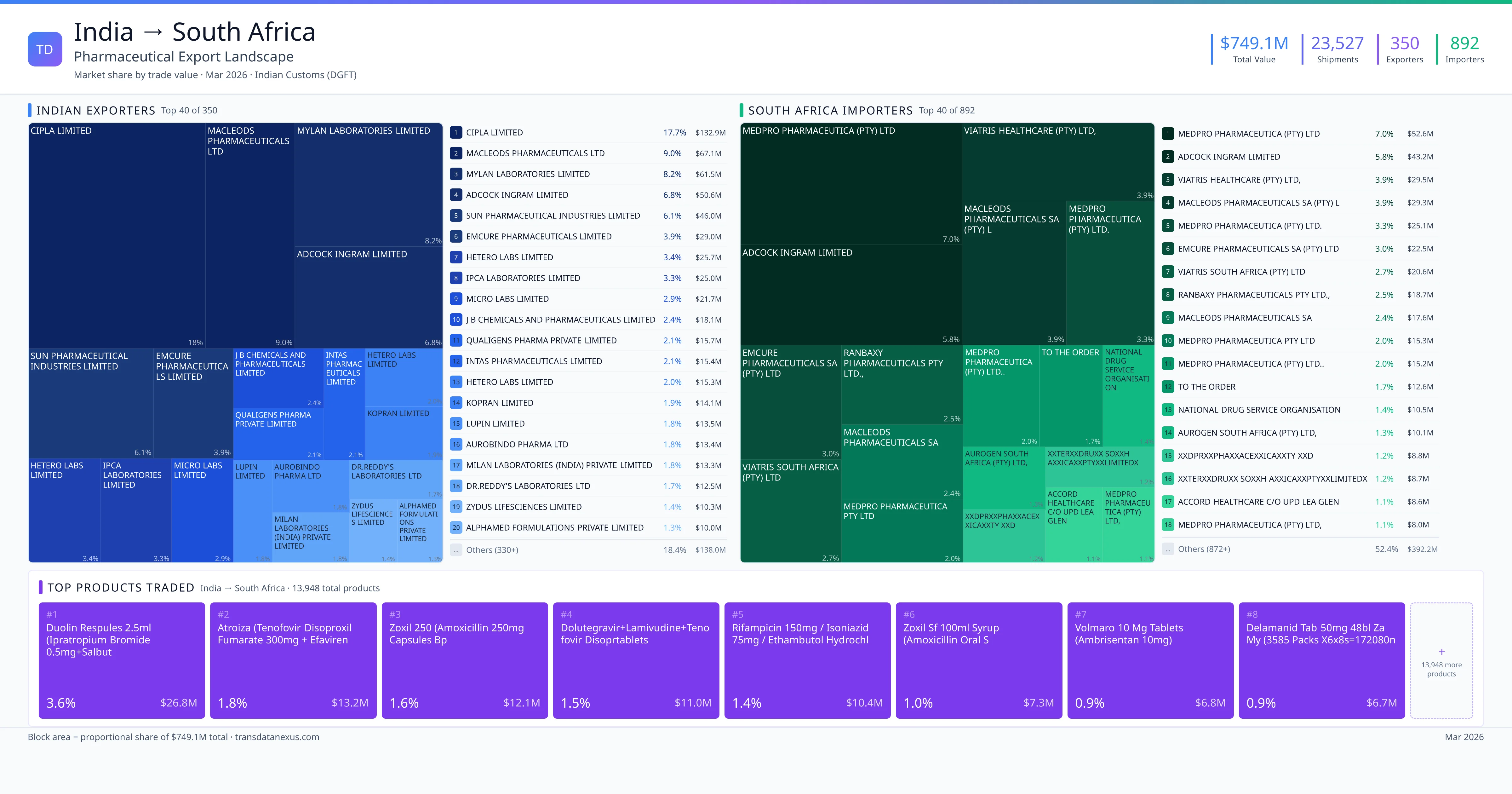
Top Pharmaceutical Formulations — India to South Africa
| # | Formulation | Value | Share |
|---|---|---|---|
| 1 | Duolin Respules 2.5ml (ipratropium Bromide 0.5mg+salbutamol Sulphate 2.5mg (per… | $26.8M | 3.6% |
| 2 | Atroiza (tenofovir Disoproxil Fumarate 300mg + Efavirenz 600mg + Emtricitabine… | $13.2M | 1.8% |
| 3 | Zoxil 250 (amoxicillin 250mg Capsules BP | $12.1M | 1.6% |
| 4 | Dolutegravir+lamivudine+tenofovir Disoprtablets | $11.0M | 1.5% |
| 5 | Rifampicin 150mg / Isoniazid 75mg / Ethambutol Hydrochloride 275mg Tablets Bno:… | $10.4M | 1.4% |
| 6 | Zoxil Sf 100ml Syrup (amoxicillin Oral S | $7.3M | 1.0% |
| 7 | Volmaro 10 MG Tablets (ambrisentan 10mg) | $6.8M | 0.9% |
| 8 | Delamanid Tablets 50mg 48bl Za My (3585 Packs X6x8s=172080nos) | $6.7M | 0.9% |
| 9 | Pneumococcal Polysaccharide | $6.5M | 0.9% |
| 10 | Dumiva (abacavir Sulfate 600mg + Lamivudine 300mg Tablets) (28s) (41295 Packs X… | $5.7M | 0.8% |
| 11 | Triolar Tablets Bno:beb92310a Md.10/23 Ed.09/25 Ps: 1x30s | $5.3M | 0.7% |
| 12 | Triolar Tablets Bno:beb92309a Md.09/23 Ed.08/25 Ps: 1x30s | $4.8M | 0.6% |
| 13 | Flat Pouches 61mm X 131 Mm ( 60gsm Pape | $4.8M | 0.6% |
| 14 | Coricib 90mg Tablets Each Tablets Contains Etoricoxib 90mg Pack: 4x7s | $4.7M | 0.6% |
| 15 | Syromak 1x30s (78874 Pac) | $4.5M | 0.6% |
India exports 18+ pharmaceutical formulations to South Africa with a combined trade value of $749.1M. Key products include Tenofovir ($13.2M), Amoxicillin ($12.1M), Dolutegravir ($11.0M), Rifampicin ($10.4M), Efavirenz ($5.3M). These are finished dosage forms — tablets, capsules, injectables, and combination drugs — shipped from Indian manufacturing facilities with FDA, WHO-GMP, and EU GMP certifications. Data from 23,527 verified Indian Customs (DGFT) shipment records.
Top Pharmaceutical Products — India to South Africa Trade Routes
These are the top pharmaceutical products exported from India to South Africa, each with a dedicated trade route analysis page. Click any product to see detailed export data including Indian suppliers, South Africa buyers, regulatory requirements, and logistics for that specific product corridor. Products include Tenofovir ($13.2M), Amoxicillin ($12.1M), Dolutegravir ($11.0M), Rifampicin ($10.4M), Efavirenz ($5.3M) — all finished pharmaceutical formulations verified from Indian Customs (DGFT) records.
Top Indian Exporters to South Africa
350 Indian pharmaceutical companies export finished formulations to South Africa. Leading exporters include Cipla Limited, Macleods Pharmaceuticals Ltd, Mylan Laboratories Limited, Adcock Ingram Limited. The top exporter accounts for 17.7% of total India–South Africa pharma exports. Source: Indian Customs (DGFT).
Top South Africa Buyers from India
892 companies in South Africa import pharmaceutical formulations from India. Top buyers include Medpro Pharmaceutica (pty) Ltd, Adcock Ingram Limited, Viatris Healthcare (pty) Ltd,, Macleods Pharmaceuticals Sa (pty) L. The largest buyer accounts for 7.0% of India–South Africa pharma imports. Source: Indian Customs (DGFT).
Port Analysis — India to South Africa Pharmaceutical Shipments
Indian Export Ports
South Africa Import Ports
Trade Statistics
Other Destinations
Product Routes
India–South Africa Pharmaceutical Trade Corridor Analysis
Historical evolution, India's market position, and recent developments
1Trade Corridor Evolution
The pharmaceutical trade between India and South Africa has experienced significant growth over the past decade. In 2024, India exported pharmaceutical products valued at approximately $668.99 million to South Africa, marking a substantial increase from previous years. This upward trajectory underscores the strengthening bilateral trade relations and India's expanding footprint in the South African pharmaceutical market.
Key milestones in this evolution include the establishment of robust distribution networks and the alignment of Indian pharmaceutical standards with South African regulatory requirements. The presence of major Indian pharmaceutical companies in South Africa has facilitated the introduction of a diverse range of products, catering to the country's healthcare needs. This growth is also attributed to India's competitive pricing and the high quality of its pharmaceutical offerings.
2India's Market Position
India holds a dominant position in South Africa's pharmaceutical import landscape. In 2024, India was one of the main trade partners of South Africa concerning pharmaceutical imports, with a share of just over 50 percent. This substantial market share highlights India's strategic importance as a supplier of high-quality, cost-effective pharmaceutical products.
The Indian pharmaceutical sector's adherence to international quality standards and its ability to offer a wide array of generic medicines have bolstered its standing in the South African market. This competitive edge is further enhanced by India's compliance with Good Manufacturing Practices (GMP), ensuring the safety and efficacy of its products.
3Recent Developments
Between 2024 and 2026, several developments have influenced the India-South Africa pharmaceutical trade. In June 2025, the South African Health Products Regulatory Authority (SAHPRA) updated its guidelines for the importation and exportation of medicines, aiming to streamline regulatory processes and enhance product safety. (sahpra.org.za) These revisions have facilitated smoother market entry for Indian pharmaceutical companies.
Additionally, in August 2025, SAHPRA published the "Guideline for the Importation and Exportation of Medicines," providing comprehensive directives for stakeholders involved in the pharmaceutical trade. (sahpra.org.za) This guideline has been instrumental in clarifying regulatory expectations and ensuring compliance among Indian exporters.
South Africa Regulatory Landscape for Indian Pharmaceutical Exports
Registration process, GMP requirements, import documentation
1Registration Process
Indian pharmaceutical companies seeking to register products in South Africa must navigate SAHPRA's structured application process. The process involves submitting a Health Product Application (HPA) through SAHPRA's Engagement Portal, accompanied by comprehensive documentation, including a Certificate of Pharmaceutical Product (CPP), Certificate of Analysis (CoA), and evidence of Good Manufacturing Practice (GMP) compliance. (sahpra.org.za)
The registration dossier should adhere to the Common Technical Document (CTD) format, encompassing modules on administrative information, quality data, non-clinical and clinical study reports, and labeling. SAHPRA evaluates the safety, efficacy, and quality of the product based on this dossier. The review timeline varies depending on the application type and data completeness but typically ranges from several months to over a year.
2GMP & Facility Requirements
SAHPRA mandates that manufacturing facilities comply with GMP standards to ensure product quality and safety. Indian manufacturers must undergo inspections by SAHPRA or recognized regulatory authorities to verify adherence to these standards. The inspection process assesses various aspects, including facility design, equipment, personnel qualifications, and quality control measures. Mutual recognition agreements between SAHPRA and other regulatory bodies can expedite this process for manufacturers with existing certifications.
3Import Documentation
To import pharmaceutical products into South Africa, Indian exporters must provide several key documents:
- Certificate of Pharmaceutical Product (CPP): Confirms the product's registration and compliance with manufacturing standards in the country of origin.
- Certificate of Analysis (CoA): Details the product's composition and quality control results.
- Good Manufacturing Practice (GMP) Certificate: Demonstrates that the manufacturing facility adheres to recognized GMP standards.
These documents facilitate customs clearance and ensure that imported medicines meet South Africa's regulatory requirements. Additionally, compliance with SAHPRA's guidelines for the importation and exportation of medicines is essential to prevent delays and ensure market access. (sahpra.org.za)
Product Categories & Therapeutic Trends — India to South Africa
Dominant categories, emerging opportunities, and demand drivers
1Dominant Categories
India's pharmaceutical exports to South Africa are predominantly in the form of finished pharmaceutical formulations, including tablets, capsules, syrups, and injections. These products align with South Africa's healthcare needs, particularly in the treatment of infectious diseases, respiratory conditions, and chronic illnesses. The therapeutic areas that dominate include antiretrovirals, antibiotics, and respiratory medications, reflecting the high disease burden in these categories within South Africa.
2Emerging Opportunities
The expiration of patents for several high-demand medications presents opportunities for Indian pharmaceutical companies to introduce generic versions into the South African market. Additionally, the growing demand for biosimilars offers a promising avenue for Indian exporters, given their expertise in biosimilar development. Exploring new therapeutic areas, such as oncology and immunology, could further diversify India's export portfolio to South Africa.
3Demand Drivers
South Africa's high disease burden, including a significant prevalence of HIV/AIDS, tuberculosis, and non-communicable diseases, drives the demand for pharmaceutical imports. The aging population and increasing healthcare spending further contribute to this demand, creating a sustained market for imported medicines. Indian pharmaceutical products, known for their affordability and quality, are well-positioned to meet these needs.
Trade Policy & Tariff Intelligence — India and South Africa
Tariff structure, trade agreements, IP and patent landscape
1Tariff & Duty Structure
South Africa applies the Most Favored Nation (MFN) tariff rates to pharmaceutical imports, with specific duties and exemptions outlined in the Customs and Excise Act. Certain pharmaceutical products may qualify for preferential rates or duty exemptions under trade agreements or specific conditions. Importers should consult the South African Revenue Service (SARS) and SAHPRA for the most current information on applicable tariffs and duties.
2Trade Agreements
South Africa is a member of the Southern African Customs Union (SACU) and the Southern African Development Community (SADC), which have established trade agreements affecting pharmaceutical imports. While there is no specific Free Trade Agreement (FTA) between India and South Africa, the existing agreements within these regional bodies may influence trade dynamics. Ongoing negotiations and policy developments could further impact the pharmaceutical trade between the two nations.
3IP & Patent Landscape
South Africa's patent laws, governed by the Patents Act, provide protection for pharmaceutical inventions. However, the country has provisions for compulsory licensing under specific circumstances, such as public health emergencies, which can affect the entry of generic medicines. Indian pharmaceutical companies must navigate these intellectual property regulations to ensure compliance and protect their products in the South African market.
Supply Chain & Logistics — India to South Africa Pharma Shipments
Shipping routes, port infrastructure, cold chain compliance
1Shipping Routes & Transit
Major sea routes from Indian ports, such as Nhava Sheva (Jawaharlal Nehru Port), to South African ports like Durban and Cape Town are commonly used for pharmaceutical exports. Air freight is also utilized, particularly for time-sensitive shipments, with transit times varying based on the specific route and logistics arrangements. Potential disruptions, such as geopolitical tensions or natural disasters, can impact these routes, necessitating contingency planning by exporters.
2Port Infrastructure
Key export ports in India include Nhava Sheva Sea (INNSA1), which accounts for 16.4% of pharmaceutical exports, and Sahar Air, handling 12.5% of shipments. In South Africa, major import ports are Durban, receiving 25.5% of pharmaceutical imports, and Johannesburg, handling 16.1%. These ports are equipped to handle pharmaceutical products, ensuring compliance with international shipping standards and facilitating efficient customs clearance.
3Cold Chain & Compliance
Maintaining the integrity of pharmaceutical products during transit is critical, especially for temperature-sensitive items. Exporters must adhere to Good Distribution Practice (GDP) guidelines, ensuring appropriate packaging, labeling, and documentation. Compliance with SAHPRA's guidelines for the importation and exportation of medicines is essential to prevent delays and ensure market access. (sahpra.org.za)
Market Opportunity Assessment — South Africa for Indian Pharma
Market size, healthcare system, growth outlook
1Market Size & Growth
South Africa's pharmaceutical market is substantial, with a total import value of approximately $8.11 billion in 2025. The market is characterized by a growing demand for both branded and generic medicines, driven by the country's healthcare needs and economic development. India's pharmaceutical exports to South Africa have been increasing, indicating a positive growth trend and a favorable market environment.
2Healthcare System
South Africa's healthcare system comprises both public and private sectors, with the public sector serving the majority of the population. Government healthcare programs, such as the National Health Insurance (NHI
FAQ — India to South Africa Pharmaceutical Trade
What is the total value of India's pharmaceutical export to South Africa?
India exported pharmaceuticals worth $749.1M to South Africa across 23,527 verified shipments.
Who are the top Indian pharmaceutical exporters to South Africa?
1. CIPLA LIMITED — $132.9M. 2. MACLEODS PHARMACEUTICALS LTD — $67.1M. 3. MYLAN LABORATORIES LIMITED — $61.5M. Total: 350 suppliers.
Which companies in South Africa import pharmaceuticals from India?
1. MEDPRO PHARMACEUTICA (PTY) LTD — $52.6M. 2. ADCOCK INGRAM LIMITED — $43.2M. 3. VIATRIS HEALTHCARE (PTY) LTD, — $29.5M. 892 buyers total.
What pharmaceutical products does India export most to South Africa?
1. Duolin Respules 2.5ml (ipratropium Bromide 0.5mg+salbutamol Sulphate 2.5mg (per… ($26.8M, 3.6%); 2. Atroiza (tenofovir Disoproxil Fumarate 300mg + Efavirenz 600mg + Emtricitabine… ($13.2M, 1.8%); 3. Zoxil 250 (amoxicillin 250mg Capsules BP ($12.1M, 1.6%); 4. Dolutegravir+lamivudine+tenofovir Disoprtablets ($11.0M, 1.5%); 5. Rifampicin 150mg / Isoniazid 75mg / Ethambutol Hydrochloride 275mg Tablets Bno:… ($10.4M, 1.4%)
Which ports handle pharmaceutical shipments from India to South Africa?
Export: NHAVA SHEVA SEA (INNSA1), NHAVA SHEVA SEA, SAHAR AIR, JNPT/ NHAVA SHEVA SEA, JNPT. Import: Durban, DURBAN, JOHANNESBURG - JOHAN, CAPE TOWN, Cape Town.
Why does South Africa import pharmaceuticals from India?
India's cost-competitive generic drug manufacturing, WHO-GMP certified facilities, and broad product portfolio. This $749.1M corridor reflects quality compliance and pricing advantages.
What certifications do Indian pharmaceutical exporters need to supply South Africa?
WHO-GMP certification, EU GMP approval (for EU markets), product dossier registration (CTD format), and ICH guideline compliance.
What is the average shipment value for India to South Africa pharmaceutical trade?
$31.8K per consignment across 23,527 shipments.
How many Indian pharmaceutical companies export to South Africa?
350 Indian companies. Largest: CIPLA LIMITED with $132.9M.
How can I find verified Indian pharmaceutical suppliers for South Africa?
TransData Nexus covers 350 active exporters with shipment history and trade values at transdatanexus.com.
Unlock the Full India to South Africa Pharmaceutical Export Dataset
Access complete shipment records, supplier intelligence, buyer histories, and price analytics for all 23,527 shipments.
Official References & Regulatory Resources
- WHO Essential Medicines List
- CDSCO India
- IBEF — India Pharma Industry
- Ministry of Commerce — Pharma Exports
- Pharmexcil
Data sourced from Indian Customs (DGFT) records. Verify regulatory status with the agencies above.
Research Methodology & Data Transparency
Suresh Sormare
Verified AuthorPharmaceutical Export-Import Analyst & Trade Intelligence Expert
Suresh Sormare is a pharmaceutical export-import analyst with deep expertise in Indian Customs (DGFT) data, HS code classification, and global pharmaceutical supply chains. His analysis covers 10M+ shipment records across 150+ countries and is used by manufacturers, procurement agencies, and trade consultants worldwide. Suresh specializes in identifying verified suppliers and buyers from customs records, mapping bilateral pharmaceutical trade corridors, analyzing tariff structures and regulatory frameworks across 170+ destination markets, and benchmarking competitive positioning for finished pharmaceutical formulations. His methodology combines granular customs transaction data with regulatory intelligence from FDA, EMA, WHO, CDSCO, and 40+ national drug authorities to deliver actionable trade insights for the pharmaceutical formulations sector.
linkedin.com/in/sureshsormarePrimary Data Source
All trade data is sourced from Indian Customs (DGFT) official shipping bill records — the authoritative government database for India's pharmaceutical trade. Each verified record contains exporter name, consignee (buyer) name, detailed product description, quantity, declared FOB value (USD), port of loading, destination country, and shipment date.
Analysis Methodology
- 1.Data Source: Indian Customs (DGFT) export shipping bill records covering all pharmaceutical shipments from India.
- 2.Country Matching: Shipments to South Africa identified using destination country codes from customs declarations.
- 3.Statistical Normalization: Values are statistically normalized to remove outlier transactions and ensure accurate market share representation.
- 4.Coverage: 23,527 verified shipments from 350 Indian exporters to 892 South Africa buyers.
Government-Sourced Data
Official DGFT customs records
Transparent Methodology
Calculations fully disclosed above
350 Exporters
892 buyers tracked
Expert-Reviewed
By pharmaceutical trade specialists