India to Kenya Pharmaceutical Export
Bilateral Trade Intelligence · $588.0M Total Trade · 687 Exporters · 1144 Buyers · DGFT Verified · Updated March 2026
India exported $588.0M worth of pharmaceutical formulations to Kenya across 38,476 verified shipments, sourced from 687 Indian exporters supplying 1144 Kenya buyers. The top exporters are MYLAN LABORATORIES LIMITED ($70.9M) and INNOVA CAPTAB LIMITED ($57.0M). The leading products are Ceftriaxone ($28.1M) and Artemether ($20.7M). Average shipment value: $15.3K.
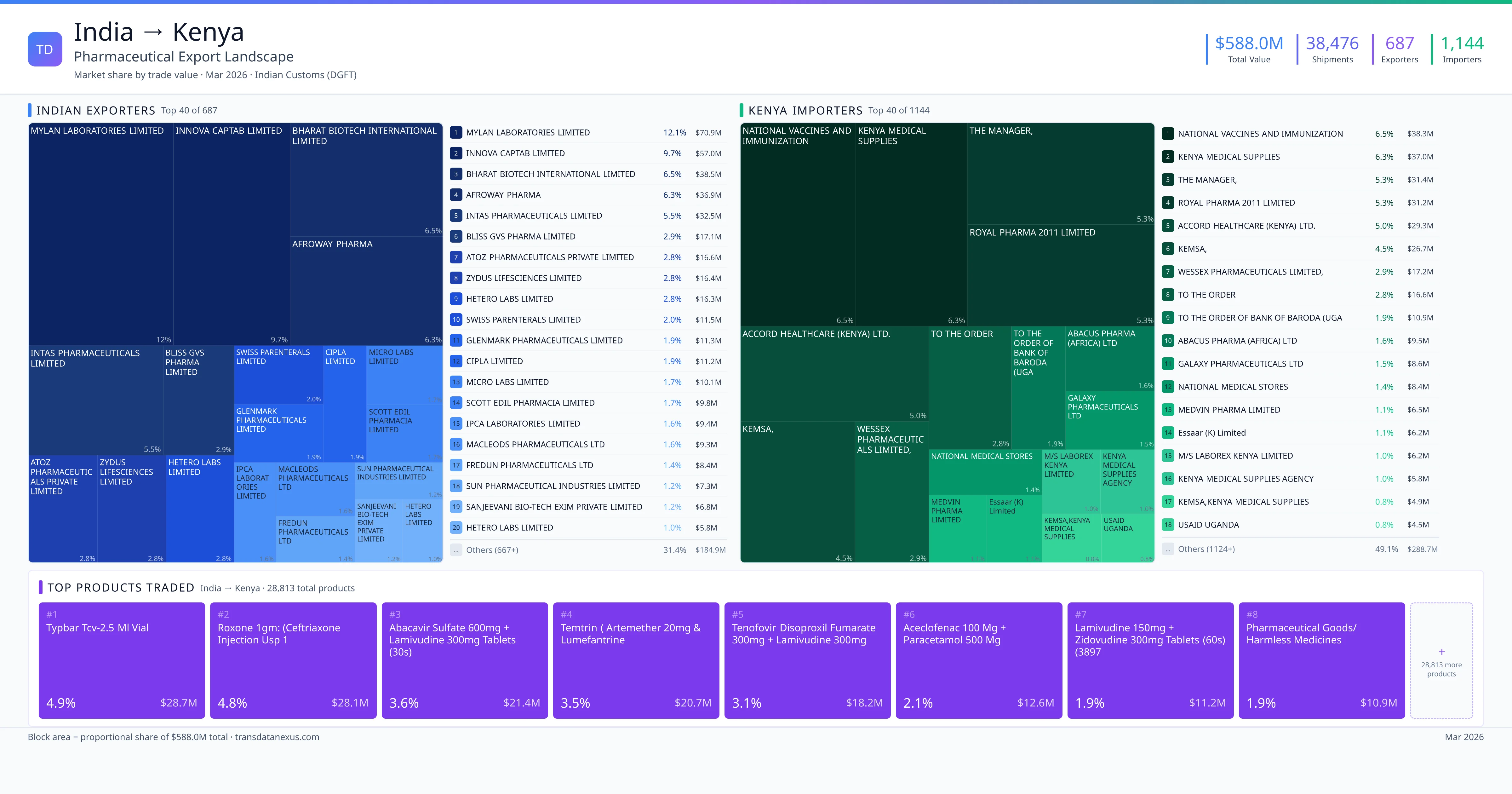
Top Pharmaceutical Formulations — India to Kenya
| # | Formulation | Value | Share |
|---|---|---|---|
| 1 | Typbar Tcv-2.5 ML Vial | $28.7M | 4.9% |
| 2 | Roxone 1gm: (ceftriaxone Injection USP 1 | $28.1M | 4.8% |
| 3 | Temtrin ( Artemether 20mg & Lumefantrine | $20.7M | 3.5% |
| 4 | Aceclofenac 100 MG + Paracetamol 500 MG | $12.6M | 2.1% |
| 5 | Lamivudine 150mg + Zidovudine 300mg Tablets (60s) (38974 Pakc X 60s = 2338440no… | $11.2M | 1.9% |
| 6 | Pharmaceutical Goods/harmless Medicines | $10.9M | 1.9% |
| 7 | Abacavir Sulfate 600mg + Lamivudine 300mg Tablets (30s) (39524 Pack X 30s = 118… | $7.9M | 1.4% |
| 8 | Abacavir Sulfate 600mg + Lamivudine 300mg Tablets (30s) (38635 Packs X 30s=1159… | $7.8M | 1.3% |
| 9 | Pharma Drugs and Medi Losartas-ht As Per | $7.2M | 1.2% |
| 10 | Kuartem Tablets 20/120 Artemether 20mg & | $6.8M | 1.2% |
| 11 | Flonart 120 MG Artesunate for Injection | $6.3M | 1.1% |
| 12 | Esgame 20/120 Tablet (artemether 20mg + | $6.2M | 1.1% |
| 13 | Abacavir Sulfate 600mg + Lamivudine 300mg Tablets (30s) (28116 Pack X 30s = 843… | $5.7M | 1.0% |
| 14 | Tenofovir Disoproxil Fumarate 300mg + Lamivudine 300mg Tablets (30s) (67322 Pac… | $5.3M | 0.9% |
| 15 | Kuartem Tablets 80/480 Artemether & Lume | $4.9M | 0.8% |
India exports 20+ pharmaceutical formulations to Kenya with a combined trade value of $588.0M. Key products include Ceftriaxone ($28.1M), Artemether ($20.7M), Paracetamol ($12.6M), Artesunate ($6.3M), Tenofovir ($5.3M). These are finished dosage forms — tablets, capsules, injectables, and combination drugs — shipped from Indian manufacturing facilities with FDA, WHO-GMP, and EU GMP certifications. Data from 38,476 verified Indian Customs (DGFT) shipment records.
Top Pharmaceutical Products — India to Kenya Trade Routes
These are the top pharmaceutical products exported from India to Kenya, each with a dedicated trade route analysis page. Click any product to see detailed export data including Indian suppliers, Kenya buyers, regulatory requirements, and logistics for that specific product corridor. Products include Ceftriaxone ($28.1M), Artemether ($20.7M), Paracetamol ($12.6M), Artesunate ($6.3M), Tenofovir ($5.3M) — all finished pharmaceutical formulations verified from Indian Customs (DGFT) records.
Top Indian Exporters to Kenya
687 Indian pharmaceutical companies export finished formulations to Kenya. Leading exporters include Mylan Laboratories Limited, Innova Captab Limited, Bharat Biotech International Limited, Afroway Pharma. The top exporter accounts for 12.1% of total India–Kenya pharma exports. Source: Indian Customs (DGFT).
Top Kenya Buyers from India
1144 companies in Kenya import pharmaceutical formulations from India. Top buyers include National Vaccines And Immunization, Kenya Medical Supplies, The Manager,, Royal Pharma 2011 Limited. The largest buyer accounts for 6.5% of India–Kenya pharma imports. Source: Indian Customs (DGFT).
Port Analysis — India to Kenya Pharmaceutical Shipments
Indian Export Ports
Kenya Import Ports
Trade Statistics
Other Destinations
Product Routes
India–Kenya Pharmaceutical Trade Corridor Analysis
Historical evolution, India's market position, and recent developments
1Trade Corridor Evolution
The India-Kenya pharmaceutical trade corridor has experienced significant growth over the past decade. Between 2022 and 2026, India exported pharmaceutical products valued at $588 million USD to Kenya, encompassing 38,476 shipments from 687 Indian exporters to 1,144 Kenyan buyers. This surge underscores the strengthening trade relations and India's pivotal role in supplying essential medicines to the East African market.
Key milestones include the establishment of robust distribution networks and the introduction of diverse pharmaceutical formulations tailored to Kenya's healthcare needs. The trade's expansion reflects India's strategic focus on African markets and Kenya's growing demand for quality pharmaceuticals.
2India's Market Position
India holds a dominant position in Kenya's pharmaceutical imports, supplying a substantial portion of the market's needs. This dominance is attributed to India's competitive pricing, adherence to international quality standards, and a comprehensive product portfolio. The strategic importance of this relationship is evident in India's sustained export growth and Kenya's reliance on Indian pharmaceuticals to meet its healthcare demands.
3Recent Developments
Between 2024 and 2026, several developments have influenced the India-Kenya pharmaceutical trade. In January 2025, the Pharmacy and Poisons Board (PPB) of Kenya issued directives halting the import and use of drugs referencing the Indian Pharmacopoeia, citing non-compliance with Kenyan registration requirements. This move underscores the need for Indian exporters to align with Kenya's regulatory standards to maintain market access. (kenyans.co.ke)
Additionally, in June 2022, Kenya introduced stringent regulations requiring imported pharmaceutical products to undergo intellectual property rights checks through the Anti-Counterfeit Authority (ACA). This initiative aims to combat counterfeit goods and emphasizes the importance of compliance with local regulations for Indian exporters.
Kenya Regulatory Landscape for Indian Pharmaceutical Exports
Registration process, GMP requirements, import documentation
1Registration Process
Indian pharmaceutical companies seeking to register products in Kenya must adhere to the Pharmacy and Poisons Board (PPB) requirements. The registration process involves submitting a comprehensive dossier, including product details, manufacturing information, and quality control data. The Common Technical Document (CTD) format is typically utilized, and bioequivalence studies may be required for certain products. The timeline for registration varies but generally spans several months, depending on the product's complexity and the completeness of the submission.
2GMP & Facility Requirements
Kenya mandates that Indian manufacturing sites comply with Good Manufacturing Practices (GMP) standards. The PPB conducts inspections to ensure adherence to these standards, and mutual recognition agreements may facilitate the process. Manufacturers must demonstrate consistent product quality and safety to maintain registration and market access.
3Import Documentation
Importers in Kenya are required to obtain an import license and provide certificates such as the Certificate of Pharmaceutical Product (CPP), Certificate of Analysis (CoA), and proof of GMP compliance. Customs procedures involve clearance through the Kenya National TradeNet System (KESWS), ensuring that all documentation is accurate and complete to facilitate smooth importation. (infotradekenya.go.ke)
Product Categories & Therapeutic Trends — India to Kenya
Dominant categories, emerging opportunities, and demand drivers
1Dominant Categories
India's pharmaceutical exports to Kenya are predominantly in the form of finished pharmaceutical formulations, including tablets, capsules, syrups, and injections. These products align with Kenya's healthcare needs, addressing prevalent diseases such as typhoid, malaria, and HIV/AIDS. The therapeutic areas of vaccines, antibiotics, and antimalarials are particularly significant, reflecting the demand for essential medicines in the region.
2Emerging Opportunities
The expiration of patents for certain drugs presents opportunities for Indian exporters to introduce generics and biosimilars to the Kenyan market. Additionally, the increasing prevalence of non-communicable diseases in Kenya opens avenues for Indian companies to supply specialized treatments. Staying attuned to these trends can enhance market penetration and growth.
3Demand Drivers
Kenya's disease burden, including high rates of infectious diseases, drives the demand for affordable and effective pharmaceuticals. The aging population and rising healthcare spending further contribute to the growing need for diverse medical treatments. These factors collectively create a robust market for Indian pharmaceutical exports.
Trade Policy & Tariff Intelligence — India and Kenya
Tariff structure, trade agreements, IP and patent landscape
1Tariff & Duty Structure
Kenya's Most Favored Nation (MFN) tariff rates and preferential rates for pharmaceutical formulations are subject to change. Import duties and taxes, including the Value Added Tax (VAT), apply to imported pharmaceuticals. Indian exporters should consult the latest tariff schedules and engage with Kenyan authorities to understand applicable duties and potential exemptions.
2Trade Agreements
Kenya is a member of the East African Community (EAC), which has established a Common External Tariff (CET). While there is no specific Free Trade Agreement (FTA) between India and Kenya, the EAC's CET may influence trade dynamics. Ongoing negotiations and regional agreements could impact pharmaceutical trade policies and tariffs.
3IP & Patent Landscape
Kenya's intellectual property laws, including provisions on patents and data exclusivity, affect the entry of Indian generics and biosimilars. Understanding these regulations is crucial for Indian exporters to navigate the market effectively and ensure compliance with local IP laws.
Supply Chain & Logistics — India to Kenya Pharma Shipments
Shipping routes, port infrastructure, cold chain compliance
1Shipping Routes & Transit
Major sea routes from Indian ports to Kenya include the Arabian Sea, with transit times varying based on the specific ports of departure and arrival. Air freight options are also available, offering faster delivery times. Exporters should monitor geopolitical developments, such as potential disruptions in the Red Sea, which could impact shipping routes and times.
2Port Infrastructure
In India, key export ports include Ahmedabad ICD (3.7%), Nhava Sheva Sea (INNSA1) (12.3%), and Ludhiana ICD (0.7%). In Kenya, major import ports are Mombasa (13.6%), Nairobi (48.4%), and Mombasa (19.3%). These ports are integral to the pharmaceutical supply chain, and their operational efficiency is vital for timely deliveries.
3Cold Chain & Compliance
Maintaining the cold chain is essential for certain pharmaceutical products. Compliance with Good Distribution Practices (GDP) and packaging standards ensures product integrity during transit. Exporters must coordinate with logistics providers to adhere to temperature-controlled logistics requirements and meet both Indian and Kenyan regulatory standards.
Market Opportunity Assessment — Kenya for Indian Pharma
Market size, healthcare system, growth outlook
1Market Size & Growth
Kenya's pharmaceutical market is substantial, with a significant portion of products imported to meet domestic demand. The market is characterized by a growing preference for generic medicines, offering opportunities for Indian exporters to supply cost-effective alternatives. The market's growth is driven by increasing healthcare needs and economic development.
2Healthcare System
Kenya's government healthcare programs and insurance coverage are expanding, aiming to improve access to medicines. The Kenya Medical Supplies Authority (KEMSA) plays a central role in drug procurement, presenting opportunities for Indian exporters to participate in public tenders and supply agreements. (the-star.co.ke)
3Opportunity for Indian Exporters
Indian exporters can capitalize on opportunities in supplying essential medicines, generics, and specialized treatments to Kenya. Engaging with local distributors and understanding the regulatory landscape will enhance market penetration and growth prospects.
Competitive Landscape — India vs Other Pharmaceutical Suppliers to Kenya
Competing origins, India's edge, challenges and threats
1Competing Origins
Other pharmaceutical suppliers to Kenya include China, the European Union, and domestic manufacturers. While India holds a significant market share, competition is intensifying, particularly from Chinese and European suppliers offering competitive pricing and diverse product ranges.
2India's Competitive Edge
India's advantages include cost-effective manufacturing, adherence to WHO-GMP standards, and a broad portfolio of generic medicines. These factors position Indian exporters favorably in the Kenyan market, provided they navigate regulatory challenges effectively.
3Challenges & Threats
Key challenges include regulatory tightening, such as the PPB's directives on Indian Pharmacopoeia references, and competition from other suppliers. Maintaining product quality and compliance with Kenyan standards is essential to mitigate these threats and sustain market presence.
FAQ — India to Kenya Pharmaceutical Trade
What is the total value of India's pharmaceutical export to Kenya?
India exported pharmaceuticals worth $588.0M to Kenya across 38,476 verified shipments.
Who are the top Indian pharmaceutical exporters to Kenya?
1. MYLAN LABORATORIES LIMITED — $70.9M. 2. INNOVA CAPTAB LIMITED — $57.0M. 3. BHARAT BIOTECH INTERNATIONAL LIMITED — $38.5M. Total: 687 suppliers.
Which companies in Kenya import pharmaceuticals from India?
1. NATIONAL VACCINES AND IMMUNIZATION — $38.3M. 2. KENYA MEDICAL SUPPLIES — $37.0M. 3. THE MANAGER, — $31.4M. 1144 buyers total.
What pharmaceutical products does India export most to Kenya?
1. Typbar Tcv-2.5 ML Vial ($28.7M, 4.9%); 2. Roxone 1gm: (ceftriaxone Injection USP 1 ($28.1M, 4.8%); 3. Temtrin ( Artemether 20mg & Lumefantrine ($20.7M, 3.5%); 4. Aceclofenac 100 MG + Paracetamol 500 MG ($12.6M, 2.1%); 5. Lamivudine 150mg + Zidovudine 300mg Tablets (60s) (38974 Pakc X 60s = 2338440no… ($11.2M, 1.9%)
Which ports handle pharmaceutical shipments from India to Kenya?
Export: AHEMDABAD ICD, NHAVA SHEVA SEA (INNSA1), GRFL SAHNEWAL LUDHIANA ICD, HYDERABAD ACC (INHYD4), JNPT/ NHAVA SHEVA SEA. Import: Mombasa, NAIROBI, MOMBASA, Nairobi, Kampala.
Why does Kenya import pharmaceuticals from India?
India's cost-competitive generic drug manufacturing, WHO-GMP certified facilities, and broad product portfolio. This $588.0M corridor reflects quality compliance and pricing advantages.
What certifications do Indian pharmaceutical exporters need to supply Kenya?
WHO-GMP certification, EU GMP approval (for EU markets), product dossier registration (CTD format), and ICH guideline compliance.
What is the average shipment value for India to Kenya pharmaceutical trade?
$15.3K per consignment across 38,476 shipments.
How many Indian pharmaceutical companies export to Kenya?
687 Indian companies. Largest: MYLAN LABORATORIES LIMITED with $70.9M.
How can I find verified Indian pharmaceutical suppliers for Kenya?
TransData Nexus covers 687 active exporters with shipment history and trade values at transdatanexus.com.
Unlock the Full India to Kenya Pharmaceutical Export Dataset
Access complete shipment records, supplier intelligence, buyer histories, and price analytics for all 38,476 shipments.
Official References & Regulatory Resources
- WHO Essential Medicines List
- CDSCO India
- IBEF — India Pharma Industry
- Ministry of Commerce — Pharma Exports
- Pharmexcil
Data sourced from Indian Customs (DGFT) records. Verify regulatory status with the agencies above.
Research Methodology & Data Transparency
Suresh Sormare
Verified AuthorPharmaceutical Export-Import Analyst & Trade Intelligence Expert
Suresh Sormare is a pharmaceutical export-import analyst with deep expertise in Indian Customs (DGFT) data, HS code classification, and global pharmaceutical supply chains. His analysis covers 10M+ shipment records across 150+ countries and is used by manufacturers, procurement agencies, and trade consultants worldwide. Suresh specializes in identifying verified suppliers and buyers from customs records, mapping bilateral pharmaceutical trade corridors, analyzing tariff structures and regulatory frameworks across 170+ destination markets, and benchmarking competitive positioning for finished pharmaceutical formulations. His methodology combines granular customs transaction data with regulatory intelligence from FDA, EMA, WHO, CDSCO, and 40+ national drug authorities to deliver actionable trade insights for the pharmaceutical formulations sector.
linkedin.com/in/sureshsormarePrimary Data Source
All trade data is sourced from Indian Customs (DGFT) official shipping bill records — the authoritative government database for India's pharmaceutical trade. Each verified record contains exporter name, consignee (buyer) name, detailed product description, quantity, declared FOB value (USD), port of loading, destination country, and shipment date.
Analysis Methodology
- 1.Data Source: Indian Customs (DGFT) export shipping bill records covering all pharmaceutical shipments from India.
- 2.Country Matching: Shipments to Kenya identified using destination country codes from customs declarations.
- 3.Statistical Normalization: Values are statistically normalized to remove outlier transactions and ensure accurate market share representation.
- 4.Coverage: 38,476 verified shipments from 687 Indian exporters to 1144 Kenya buyers.
Government-Sourced Data
Official DGFT customs records
Transparent Methodology
Calculations fully disclosed above
687 Exporters
1144 buyers tracked
Expert-Reviewed
By pharmaceutical trade specialists