Loading...
Loading...
India's collagen imports from SINGAPORE total $22 across 1 shipments from 1 foreign suppliers. LIFE TECHNOLOGIES HOLDING PTE LIMITED leads with $22 in import value; the top 5 suppliers together control 100.0% of this origin. Leading Indian buyers include Syngene International Limited Unit IV BLOCK S 12. This corridor reflects India's pharmaceutical import demand for collagen โ a concentrated sourcing relationship with select suppliers from SINGAPORE.
LIFE TECHNOLOGIES HOLDING PTE LIMITED is the leading Collagen supplier from SINGAPORE to India, with import value of $22 across 1 shipments. The top 5 suppliers โ LIFE TECHNOLOGIES HOLDING PTE LIMITED โ collectively account for 100.0% of total import value from this origin.
Ranked by import value (USD) ยท Indian Customs (DGFT) data
| # | Supplier | Value (USD) | Shipments | Share |
|---|---|---|---|---|
| 1 | LIFE TECHNOLOGIES HOLDING PTE LIMITED | $22 | 1 | 100.0% |
Ranked by import value (USD)
| # | Buyer | Value (USD) | Shipments | Share |
|---|---|---|---|---|
| 1 | Syngene International Limited Unit IV BLOCK S 12 | $22 | 1 | 100.0% |
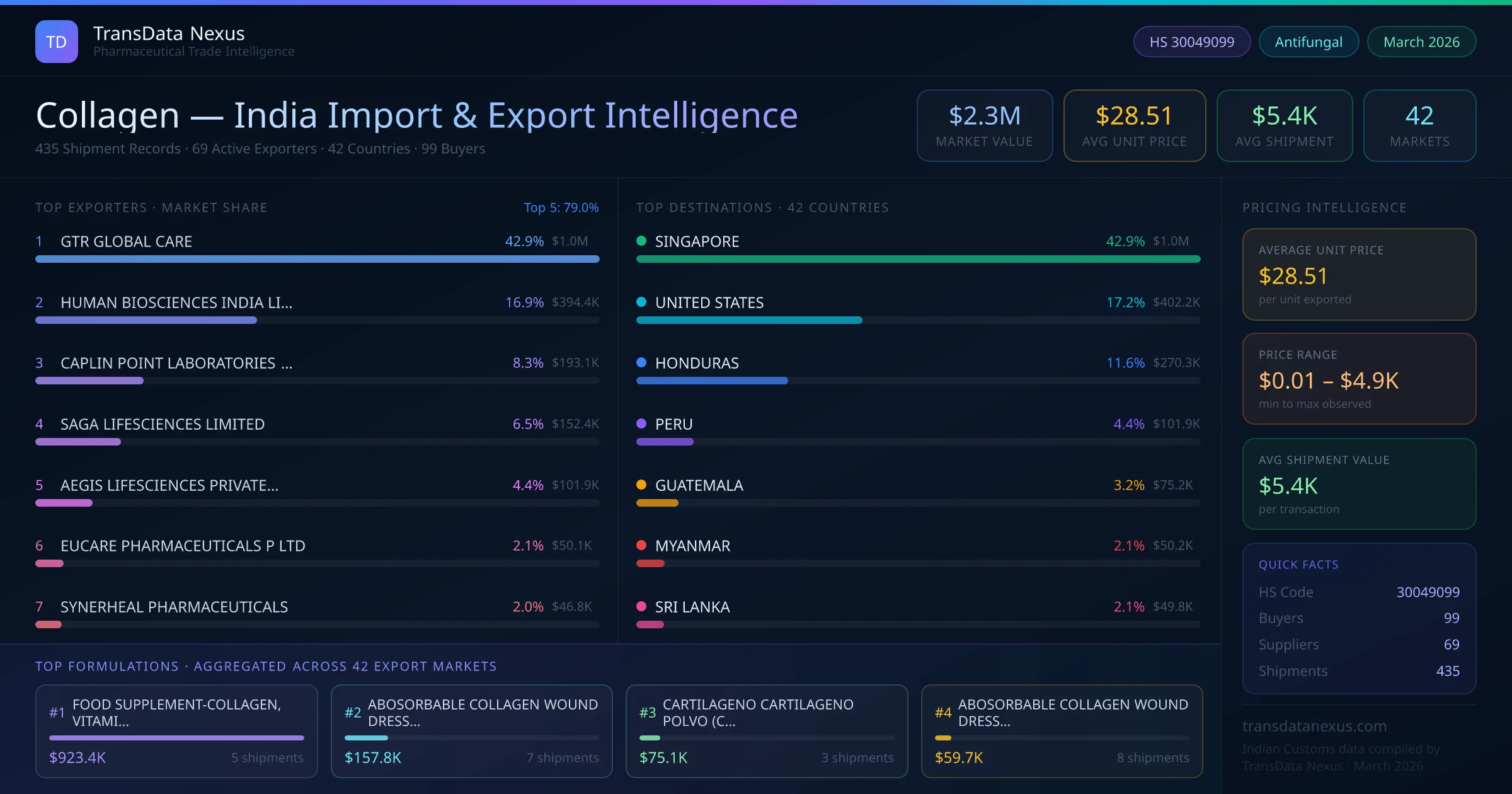
Visual overview of India's collagen SINGAPORE to India import corridor โ top suppliers, destinations, pricing, and trade routes
SINGAPORE โ India trade corridor intelligence
As of April 2026, the Singapore to India trade corridor for pharmaceutical imports is operating efficiently. Major ports such as Jawaharlal Nehru Port Trust (JNPT), Chennai, and Mundra are handling increased volumes of pharmaceutical shipments. Sea freight transit times range from 7 to 10 days, while air freight takes approximately 3 to 5 days. Port congestion is minimal, and freight rates remain stable. The Indian Rupee (INR) has shown relative stability against the Singapore Dollar, facilitating predictable cost structures for importers.
India's Production-Linked Incentive (PLI) scheme aims to boost domestic manufacturing and reduce import dependency. While the scheme primarily targets the production of bulk drugs and active pharmaceutical ingredients, it also encourages the development of finished formulations. However, the current domestic capacity for producing specialized collagen formulations remains limited, necessitating continued imports from countries like Singapore to meet market demand.
India and Singapore share a strong trade relationship, underpinned by the Comprehensive Economic Cooperation Agreement (CECA) signed in 2005. This agreement facilitates trade and investment between the two nations, including the pharmaceutical sector. Ongoing discussions aim to enhance mutual recognition of Good Manufacturing Practices (GMP) and streamline regulatory processes, further promoting pharmaceutical trade.
For a shipment of finished collagen formulations under HS Code 30049099 from Singapore to India, the estimated landed cost per unit is calculated as follows:
Total Landed Cost: $29.06 per unit
This estimate provides a comprehensive view of the costs involved in importing finished collagen formulations from Singapore to India.
CDSCO registration, import licensing, and quality testing requirements
To import finished pharmaceutical formulations containing collagen into India, the foreign manufacturer must obtain an Import Registration Certificate and an Import License from the Central Drugs Standard Control Organization (CDSCO). The registration process involves submitting an application to the Drugs Controller General of India (DCGI), along with necessary documents such as the Free Sale Certificate, Good Manufacturing Practice (GMP) certificate, and manufacturing license. The registration certificate is valid for three years from the date of issue. The import license is also valid for three years and is required for each consignment. The application process typically takes several months, depending on the completeness of the submitted documents and the inspection schedule. For formulations under HS Code 30049099, specific requirements include stability data (preferably ICH Zone IV), and compliance with the Indian Pharmacopoeia standards.
Imported finished pharmaceutical formulations containing collagen must undergo quality testing at CDSCO-approved laboratories in India. Each batch requires a Certificate of Analysis (CoA) confirming compliance with Indian Pharmacopoeia standards. Stability data, preferably from ICH Zone IV studies, must be provided to demonstrate the product's shelf-life under Indian climatic conditions. Port inspection by customs drug inspectors is mandatory to verify the authenticity and quality of the imported products. The testing process can take several weeks, and if a batch fails to meet the required standards, it may be rejected or require reprocessing.
In April 2025, the CDSCO introduced new regulations mandating import registration and licenses for all imported drugs, including finished formulations containing collagen. This measure aims to prevent the sale of unapproved or illegal medicines in the Indian market. The regulations also stipulate that drugs manufactured in Special Economic Zones (SEZs) for export purposes are not permitted for transfer to the Domestic Tariff Area (DTA) for sale and distribution. These changes are part of India's ongoing efforts to streamline drug import procedures and ensure the quality, safety, and efficacy of pharmaceutical products available domestically.
Market demand, customs duty structure, and competitive landscape ยท Import duty: 10%
India imports finished collagen formulations to meet the demand for specialized dosage forms and patented or branded products not manufactured domestically. The domestic capacity for producing collagen-based formulations is limited, leading to a reliance on imports to fulfill market needs. The market size for collagen formulations in India is growing, driven by increasing awareness of their therapeutic benefits and applications in various medical fields.
The Basic Customs Duty (BCD) for finished pharmaceutical formulations under HS Code 30049099 is 10%. An additional Social Welfare Surcharge (SWS) of 10% on the BCD is applicable. The Integrated Goods and Services Tax (IGST) is 12%. Considering these components, the total landed duty for importing such formulations into India is approximately 23.536%.
Singapore is a preferred source for importing finished collagen formulations into India due to its advanced manufacturing capabilities, adherence to international quality standards, and the availability of specialized dosage forms. Singapore's pharmaceutical industry is known for its innovation and compliance with Good Manufacturing Practices (GMP), making it a reliable supplier. Other potential suppliers include China, Germany, and the United States; however, Singapore's strategic location, robust regulatory framework, and established trade relations with India provide it with a competitive advantage in this market segment.
Import rationale, competitive comparison, supply chain risk, and procurement strategy
India imports collagen formulations from Singapore due to the latter's advanced manufacturing capabilities, adherence to international quality standards, and the availability of specialized dosage forms not produced domestically. Singapore's pharmaceutical industry is known for its innovation and compliance with Good Manufacturing Practices (GMP), making it a reliable supplier for India's growing demand for collagen-based products.
Compared to other potential suppliers like China, Germany, and the United States, Singapore offers a competitive advantage in terms of quality, regulatory compliance, and reliability. While China may offer lower prices, concerns about quality and regulatory standards can be a drawback. Germany and the United States provide high-quality products but may have higher costs and longer lead times. Singapore's strategic location, robust regulatory framework, and established trade relations with India make it a preferred source for collagen formulations.
Indian importers face several supply chain risks when sourcing collagen formulations from Singapore, including single-source dependency, currency fluctuations, regulatory changes, quality incidents, and shipping disruptions. To mitigate these risks, importers should consider diversifying their supplier base, closely monitoring currency exchange rates, staying updated on regulatory changes, implementing stringent quality control measures, and maintaining buffer stocks to manage potential shipping delays.
Implementing these strategies can enhance the reliability and efficiency of the procurement process for collagen formulations from Singapore.
Import license checklist, document requirements, quality testing, and compliance
1. DGFT Importer Exporter Code (IEC): Obtain an IEC from the Directorate General of Foreign Trade.
Answers based on Indian Customs (DGFT) import records compiled by TransData Nexus
The top Collagen suppliers from SINGAPORE to India include LIFE TECHNOLOGIES HOLDING PTE LIMITED. The leading supplier is LIFE TECHNOLOGIES HOLDING PTE LIMITED with import value of $22 USD across 1 shipments. India imported Collagen worth $22 USD from SINGAPORE in total across 1 shipments.
India imported Collagen worth $22 USD from SINGAPORE across 1 shipments. Data is from Indian Customs (DGFT) records. Values are in USD.
The main Indian buyers of Collagen sourced from SINGAPORE include Syngene International Limited Unit IV BLOCK S 12. The largest buyer is Syngene International Limited Unit IV BLOCK S 12 with $22 in imports across 1 shipments.
The total value of Collagen imports from SINGAPORE to India is $22 USD, across 1 shipments and 1 foreign suppliers. Data source: Indian Customs (DGFT).
Data sourced from Indian Customs (DGFT) records. Verify regulatory and trade status with the agencies above.
Pharmaceutical Export-Import Analyst & Trade Intelligence Expert
Suresh Sormare is a pharmaceutical export-import analyst with deep expertise in Indian Customs (DGFT) data, HS code classification, and global pharmaceutical supply chains. His analysis covers 10M+ shipment records across 150+ countries and is used by manufacturers, procurement agencies, and trade consultants worldwide. Suresh specializes in identifying verified suppliers and buyers from customs records, mapping bilateral pharmaceutical trade corridors, analyzing tariff structures and regulatory frameworks across 170+ destination markets, and benchmarking competitive positioning for finished pharmaceutical formulations. His methodology combines granular customs transaction data with regulatory intelligence from FDA, EMA, WHO, CDSCO, and 40+ national drug authorities to deliver actionable trade insights for the pharmaceutical formulations sector.
linkedin.com/in/sureshsormareAll trade data is sourced from Indian Customs (DGFT) official shipping bill records โ the authoritative government database for India's pharmaceutical trade. Each verified record contains exporter name, consignee (buyer) name, detailed product description, quantity, declared FOB value (USD), port of loading, destination country, and shipment date.
Government-Sourced Data
Official DGFT customs records
Transparent Methodology
Calculations fully disclosed above
1 Verified Shipments
1 suppliers, 1 buyers tracked
Expert-Reviewed
By pharmaceutical trade specialists