Antitoxin HS Code Analysis (2026)
India exports Antitoxin under 20 distinct HS code classifications, representing a total trade value of $15.3M across 534 shipments. The dominant classification is HS 30021220 (Antisera for tetanus), accounting for 50.7% of all Antitoxin trade at $7.8M. HS 30021210 (Antisera for diphtheria) follows at 25.6% ($3.9M). The top 5 HS codes together account for 93.8% of total Antitoxin trade from India. The average transaction value is $28633. Key importing markets include France, Morocco, United Arab Emirates. Leading exporters include VINS BIOPRODUCTS LIMITED and VINS BIOPRODUCTS LIMITED . Data sourced from Indian Customs (DGFT) shipping bill records.
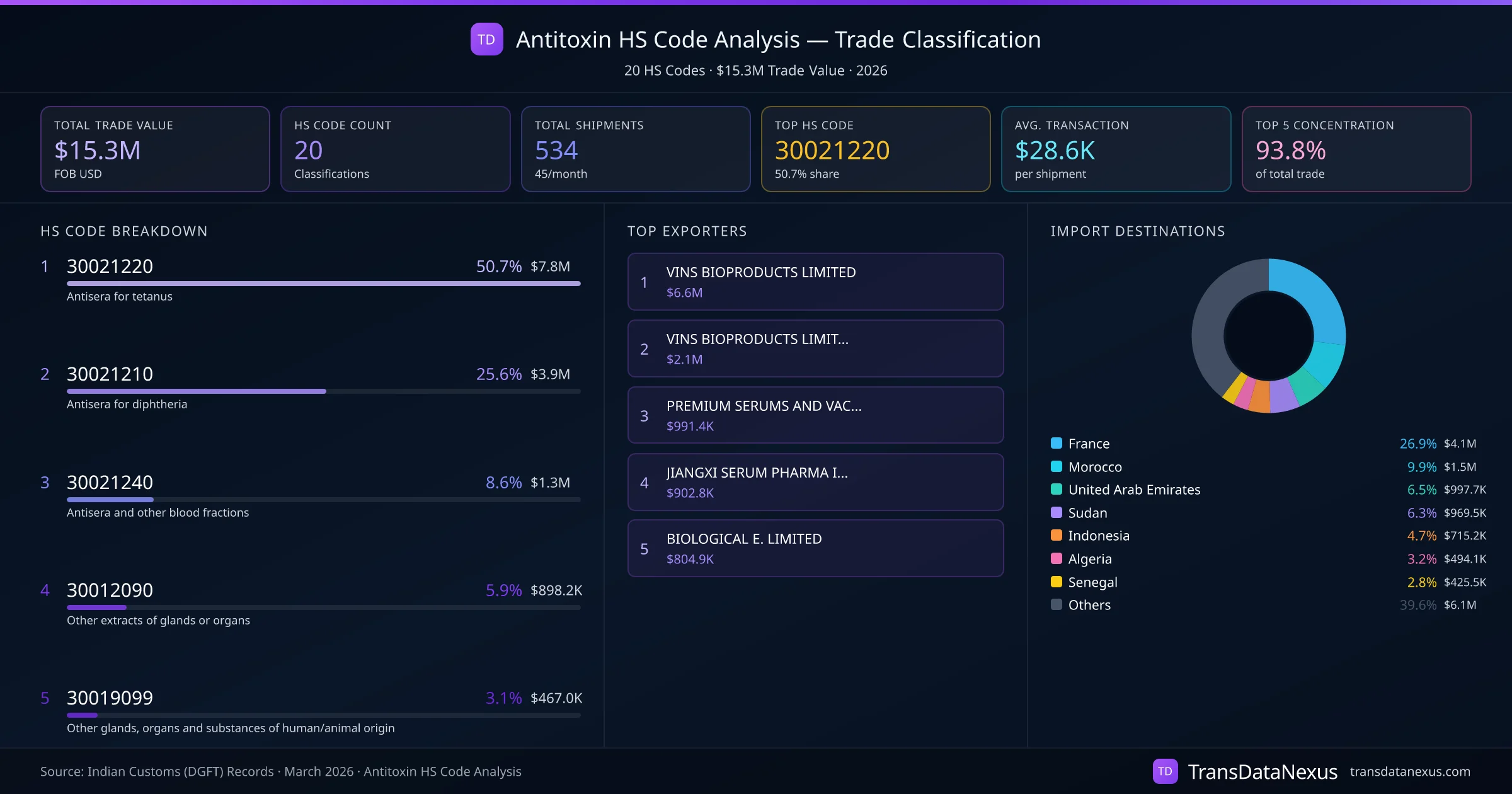
Top Antitoxin HS Code Classifications
Ranked by trade value from Indian Customs (DGFT) data
All Antitoxin HS Code Classifications
HS 30021220
Antisera for tetanus · 50.7% of Antitoxin trade
$7.8M
Trade Value
50.7%
Market Share
262
Transactions
$2.60
Avg Unit Price
Common Product Descriptions:
HS 30021210
Antisera for diphtheria · 25.6% of Antitoxin trade
$3.9M
Trade Value
25.6%
Market Share
154
Transactions
$35.91
Avg Unit Price
Common Product Descriptions:
HS 30021240
Antisera and other blood fractions · 8.6% of Antitoxin trade
$1.3M
Trade Value
8.6%
Market Share
17
Transactions
$24.53
Avg Unit Price
Common Product Descriptions:
HS 30012090
Other extracts of glands or organs · 5.9% of Antitoxin trade
$898.2K
Trade Value
5.9%
Market Share
3
Transactions
$822.64
Avg Unit Price
Common Product Descriptions:
HS 30019099
Other glands, organs and substances of human/animal origin · 3.1% of Antitoxin trade
$467.0K
Trade Value
3.1%
Market Share
1
Transactions
$849.16
Avg Unit Price
Common Product Descriptions:
HS 30
Pharmaceutical product (Chapter 30) · 3.0% of Antitoxin trade
$455.4K
Trade Value
3.0%
Market Share
1
Transactions
$828.00
Avg Unit Price
Common Product Descriptions:
HS 30024113
Vaccines for human medicine (COVID-19 etc.) · 1.0% of Antitoxin trade
$147.0K
Trade Value
1.0%
Market Share
21
Transactions
$41.88
Avg Unit Price
Common Product Descriptions:
HS 30029090
Other blood products, toxins, cultures of micro-organisms · 0.8% of Antitoxin trade
$126.6K
Trade Value
0.8%
Market Share
18
Transactions
$27.03
Avg Unit Price
Common Product Descriptions:
HS 30021230
Antisera for rabies · 0.6% of Antitoxin trade
$84.6K
Trade Value
0.6%
Market Share
2
Transactions
$31.73
Avg Unit Price
Common Product Descriptions:
HS 30021210
Antisera and other blood fractions · 0.3% of Antitoxin trade
$39.2K
Trade Value
0.3%
Market Share
3
Transactions
$18.64
Avg Unit Price
Common Product Descriptions:
HS 30021220
Antisera and other blood fractions · 0.2% of Antitoxin trade
$29.1K
Trade Value
0.2%
Market Share
3
Transactions
$6.30
Avg Unit Price
Common Product Descriptions:
HS 30024121
Vaccines for human medicine (COVID-19 etc.) · 0.1% of Antitoxin trade
$17.8K
Trade Value
0.1%
Market Share
6
Transactions
$14.21
Avg Unit Price
Common Product Descriptions:
HS 30021500
Immunological products, put up in measured doses or for retail sale · 0.1% of Antitoxin trade
$16.4K
Trade Value
0.1%
Market Share
6
Transactions
$20.83
Avg Unit Price
Common Product Descriptions:
HS 30024122
Vaccines for human medicine (COVID-19 etc.) · 0.1% of Antitoxin trade
$10.8K
Trade Value
0.1%
Market Share
3
Transactions
$18.22
Avg Unit Price
Common Product Descriptions:
HS 30021290
Other antisera and blood fractions · 0.1% of Antitoxin trade
$9.4K
Trade Value
0.1%
Market Share
22
Transactions
$10.84
Avg Unit Price
Common Product Descriptions:
HS 30049099
Other medicaments, put up in measured doses or for retail sale · 0.0% of Antitoxin trade
$6.4K
Trade Value
0.0%
Market Share
5
Transactions
$7.15
Avg Unit Price
Common Product Descriptions:
HS 30049034
Other medicaments of mixed or unmixed products (retail) · 0.0% of Antitoxin trade
$5.8K
Trade Value
0.0%
Market Share
1
Transactions
$14.56
Avg Unit Price
Common Product Descriptions:
HS 30049039
Other anti-infective/anti-parasitic medicaments (retail) · 0.0% of Antitoxin trade
$1.7K
Trade Value
0.0%
Market Share
1
Transactions
$17.20
Avg Unit Price
Common Product Descriptions:
HS 30024990
Other vaccines · 0.0% of Antitoxin trade
$987
Trade Value
0.0%
Market Share
3
Transactions
$10936.10
Avg Unit Price
Common Product Descriptions:
HS 30024129
Vaccines for human medicine (COVID-19 etc.) · 0.0% of Antitoxin trade
$0
Trade Value
0.0%
Market Share
2
Transactions
$0.00
Avg Unit Price
Common Product Descriptions:
Top Suppliers
Where Antitoxin is Exported — Geographic HS Code Analysis
Import destinations for Antitoxin from India, by trade value
India exports Antitoxin to 10+ countries under 20 HS code classifications. The largest import destination is France ($4.1M), followed by Morocco ($1.5M) and United Arab Emirates ($997.7K). These markets collectively account for the majority of India's Antitoxin pharmaceutical exports.
| Rank | Country | Trade Value | Market Share |
|---|---|---|---|
| #1 | France | $4.1M | 26.9% |
| #2 | Morocco | $1.5M | 9.9% |
| #3 | United Arab Emirates | $997.7K | 6.5% |
| #4 | Sudan | $969.5K | 6.3% |
| #5 | Indonesia | $715.2K | 4.7% |
| #6 | Algeria | $494.1K | 3.2% |
| #7 | Senegal | $425.5K | 2.8% |
| #8 | Jordan | $421.1K | 2.8% |
| #9 | Cote D Ivoire | $404.0K | 2.6% |
| #10 | Ghana | $247.1K | 1.6% |
Pharmaceutical buyers in these markets import Antitoxin primarily under HS code 30021220 (Antisera for tetanus). Import duties, regulatory requirements, and product registration vary by destination country. Contact TransData Nexus for country-specific import intelligence.
Understanding Antitoxin HS Codes
The Harmonized System (HS) is an internationally standardized system of names and numbers to classify traded products. Developed by the World Customs Organization (WCO), it is used by over 200 countries for customs tariffs, trade statistics, and regulatory compliance. Each HS code is a 6-digit number (extended to 8 digits in India's Customs Tariff Schedule) that precisely identifies a product category.
How Antitoxin HS Codes Work
Antitoxin falls under Chapter 30 (Pharmaceutical Products) of the Harmonized System. The 20 codes used for Antitoxin exports span multiple headings:
- Heading 3003 — Medicaments not put up in measured doses or for retail sale (bulk APIs, intermediates)
- Heading 3004 — Medicaments put up in measured doses or for retail sale (finished formulations)
- Heading 3005 — Wadding, gauze, bandages for medical use
- Heading 3006 — Pharmaceutical goods (sutures, reagents, dental cements)
The most significant distinction for Antitoxin is between HS 3003 (bulk/unmeasured) and HS 3004 (retail-ready). HS 3004 codes account for the majority of Antitoxin trade (as finished formulations ready for dispensing). The 8-digit Indian Customs Tariff code further specifies the therapeutic class — for example, HS 30021220 refers to "Antisera for tetanus".
Regulatory & Compliance — Antitoxin Export Classification
Correct HS code classification is critical for Antitoxin exports from India. Misclassification can result in customs delays, incorrect duty assessment, and regulatory penalties. Key compliance considerations for pharmaceutical stakeholders:
Import Duty Classification
Antitoxin import duties vary significantly by HS code and destination country. HS 3004 (finished formulations) typically attracts different duty rates than HS 3003 (bulk APIs). Many developing countries offer preferential rates for essential medicines including Antitoxin.
DGFT & Indian Customs Requirements
Indian exporters must declare the correct 8-digit ITC-HS code on shipping bills filed with the Directorate General of Foreign Trade (DGFT). Antitoxin exports require Drug Controller General of India (DCGI) approval and must comply with Drug & Cosmetics Act regulations.
WHO Prequalification
For international procurement (UNICEF, Global Fund), Antitoxin products must meet WHO Prequalification standards. WHO PQ status affects which HS codes are eligible for preferential procurement pricing and duty exemptions in recipient countries.
Country-Specific Registration
Each destination country requires product registration before import. Key markets like France and Morocco have specific pharmaceutical regulatory bodies that must approve the product before customs clearance.
Tariff Schedule — Top Markets
TransData Nexus Antitoxin HS code trade compliance intelligence
1Tariff Schedule — Top Markets
The primary HS code for Antitoxin, as per our data, is 30021220, accounting for 50.7% of trade. This code falls under Chapter 30 of the HS, which pertains to pharmaceutical products. The Most Favored Nation (MFN) tariff rates and any preferential rates under Free Trade Agreements (FTAs) with India for this HS code vary across the top importing countries: France, Morocco, United Arab Emirates, Sudan, Indonesia, Algeria, Senegal, and Jordan.
- France: As a member of the European Union (EU), France applies the EU's Common External Tariff. Pharmaceutical products under Chapter 30 generally benefit from a zero MFN tariff rate. Additionally, the EU-India Trade and Investment Agreement, currently under negotiation, may further influence tariff structures upon its conclusion.
- Morocco: Morocco's MFN tariff rates for pharmaceutical products are typically low, often ranging from 0% to 2.5%. The India-Morocco Preferential Trade Agreement provides for reduced tariffs on certain pharmaceutical products, potentially including Antitoxin.
- United Arab Emirates (UAE): The UAE generally imposes a 5% MFN tariff on pharmaceutical products. However, under the India-UAE Comprehensive Economic Partnership Agreement (CEPA), many pharmaceutical products enjoy preferential tariff rates, potentially reducing the duty on Antitoxin imports.
- Sudan: Sudan's MFN tariff rates for pharmaceutical products can vary. While specific data for HS code 30021220 is limited, essential medicines often receive tariff exemptions or reductions. Sudan and India have engaged in bilateral trade discussions, which may influence tariff rates on pharmaceutical imports.
- Indonesia: Indonesia applies an MFN tariff rate of 0% to 5% on pharmaceutical products. The India-Indonesia Comprehensive Economic Cooperation Agreement (CECA) includes provisions for reduced tariffs on various goods, including pharmaceuticals, potentially affecting Antitoxin imports.
- Algeria: Algeria's MFN tariff rates for pharmaceutical products are generally low, often at 0%. The country has a list of essential medicines that are exempt from import duties, which may include Antitoxin. Bilateral trade agreements between India and Algeria could further influence these rates.
- Senegal: Senegal, as a member of the Economic Community of West African States (ECOWAS), applies the ECOWAS Common External Tariff. Pharmaceutical products often benefit from low or zero tariffs. India's trade relations with ECOWAS members may provide additional tariff preferences.
- Jordan: Jordan's MFN tariff rates for pharmaceutical products are typically low, often at 0%. The India-Jordan Trade Agreement includes provisions for preferential tariffs on various goods, including pharmaceuticals, which may benefit Antitoxin imports.
It's important to note that many countries offer exemptions or reduced tariffs for essential medicines, recognizing their critical role in public health. Importers should consult the respective national customs authorities or the World Trade Organization (WTO) tariff databases for the most current and detailed information.
Classification Disputes & Misclassification Risks
TransData Nexus Antitoxin HS code trade compliance intelligence
1Classification Disputes & Misclassification Risks
The classification of Antitoxin under the Harmonized System can present challenges, particularly when distinguishing between HS codes 3003 and 3004.
- HS Code 3003: This code covers medicaments consisting of two or more constituents mixed together for therapeutic or prophylactic uses, not put up in measured doses or in forms or packings for retail sale. Products under this code are typically bulk forms intended for further processing or repackaging.
- HS Code 3004: This code includes medicaments consisting of mixed or unmixed products for therapeutic or prophylactic uses, put up in measured doses (including those in the form of transdermal administration systems) or in forms or packings for retail sale. This encompasses finished products ready for consumer use.
Common misclassification errors occur when the packaging and intended use of Antitoxin are not accurately considered. For instance, bulk Antitoxin intended for further manufacturing should be classified under HS code 3003, while finished products ready for retail sale fall under HS code 3004. Misclassification can lead to customs penalties, including fines and delays in shipment clearance.
Recent rulings by the World Customs Organization (WCO) and national customs authorities emphasize the importance of accurate classification based on product form and packaging. Importers and exporters are advised to provide detailed product descriptions and consult with customs experts to ensure compliance.
Pharmacopoeia & Quality Standards
TransData Nexus Antitoxin HS code trade compliance intelligence
1Pharmacopoeia & Quality Standards
Antitoxins are subject to stringent quality standards as outlined in various pharmacopoeias:
- United States Pharmacopeia (USP): The USP monograph for Antitoxins specifies requirements for identity, potency, purity, and safety. It includes tests for specific activity, sterility, and absence of contaminants.
- British Pharmacopoeia (BP): The BP provides detailed standards for Antitoxins, including assays for potency, tests for pyrogens, and guidelines for storage conditions to maintain stability.
- European Pharmacopoeia (EP): The EP monograph outlines specifications for Antitoxins, focusing on quality control measures such as potency assays, sterility tests, and limits for impurities.
- Indian Pharmacopoeia (IP): The IP includes standards for Antitoxins, detailing requirements for identity, purity, potency, and safety tests to ensure product efficacy and patient safety.
Quality control measures for Antitoxins encompass:
- Purity/Assay Requirements: Ensuring the active component meets specified potency levels and is free from contaminants.
- Dissolution Testing: While more common for solid oral dosage forms, dissolution testing may be applicable to certain Antitoxin formulations to ensure consistent bioavailability.
- Stability Testing: Conducted per International Council for Harmonisation (ICH) guidelines, stability testing evaluates how Antitoxins maintain their quality over time under various environmental conditions. This includes testing under different ICH climatic zones to ensure product efficacy throughout its shelf life.
Adherence to these pharmacopoeial standards and quality control measures is essential for regulatory approval and to ensure the safety and efficacy of Antitoxin products in the market.
Frequently Asked Questions — Antitoxin HS Codes
Common questions about Antitoxin trade classification, answered with data from Indian Customs records.
What is the HS code for Antitoxin exports from India?
The most commonly used HS code for Antitoxin exports from India is 30021220 (Antisera for tetanus), which accounts for 50.7% of all Antitoxin trade valued at $7.8M. In total, India exports Antitoxin under 20 distinct HS code classifications.
How many HS codes are used for Antitoxin trade?
Antitoxin is exported from India under 20 different HS code classifications, covering a total trade value of $15.3M across 534 shipments. The top 5 HS codes account for 93.8% of total trade.
What is HS code 30021220?
HS code 30021220 refers to "Antisera for tetanus" under Chapter 30 (Pharmaceutical Products) of the Harmonized System. For Antitoxin, this code covers $7.8M in trade value with 262 transactions, 31 suppliers, and 142 buyers across 89 countries. The average unit price under this code is $2.60.
What is the difference between HS 30021220 and 30021210 for Antitoxin?
HS 30021220 (Antisera for tetanus) accounts for 50.7% of Antitoxin trade ($7.8M) with an average unit price of $2.60, while HS 30021210 (Antisera for diphtheria) covers 25.6% ($3.9M) at $35.91 per unit. HS 30021220 involves 31 suppliers and 142 buyers, compared to 13 suppliers and 74 buyers for HS 30021210.
How much Antitoxin is exported under HS code 30021220?
Under HS code 30021220, India exports $7.8M worth of Antitoxin, representing 50.7% of total Antitoxin trade. This involves 262 shipments from 31 Indian exporters to 142 buyers in 89 countries.
Which countries import the most Antitoxin from India?
The top importing countries for Antitoxin from India are France, Morocco, United Arab Emirates. The leading importer France accounts for $4.1M in trade value. In total, Antitoxin is exported to buyers across multiple countries under 20 HS code classifications.
Who are the top Antitoxin exporters from India?
The leading Antitoxin exporters from India include VINS BIOPRODUCTS LIMITED ($6.6M), VINS BIOPRODUCTS LIMITED ($2.1M), PREMIUM SERUMS AND VACCINES PRIVATE LIMITED ($991.4K). These suppliers export across multiple HS code classifications with a combined trade value of $15.3M.
Which Antitoxin HS code has the highest unit price?
HS code 30024990 has the highest average unit price at $10936.10 per unit for Antitoxin exports. This compares to the overall market average of $28633.29 per transaction. The most traded code HS 30021220 averages $2.60 per unit.
Official References & Regulatory Resources
HS code classifications follow the WCO Harmonized System. Verify tariff rates with your national customs authority.
Research Methodology & Data Transparency
Suresh Sormare
Verified AuthorPharmaceutical Export-Import Analyst & Trade Intelligence Expert
Suresh Sormare is a pharmaceutical export-import analyst with deep expertise in Indian Customs (DGFT) data, HS code classification, and global pharmaceutical supply chains. His analysis covers 10M+ shipment records across 150+ countries and is used by manufacturers, procurement agencies, and trade consultants worldwide. Suresh specializes in identifying verified suppliers and buyers from customs records, mapping bilateral pharmaceutical trade corridors, analyzing tariff structures and regulatory frameworks across 170+ destination markets, and benchmarking competitive positioning for finished pharmaceutical formulations. His methodology combines granular customs transaction data with regulatory intelligence from FDA, EMA, WHO, CDSCO, and 40+ national drug authorities to deliver actionable trade insights for the pharmaceutical formulations sector.
linkedin.com/in/sureshsormarePrimary Data Source
All trade data is sourced from Indian Customs (DGFT) official shipping bill records — the authoritative government database for India's pharmaceutical trade. Each verified record contains exporter name, consignee (buyer) name, detailed product description, quantity, declared FOB value (USD), port of loading, destination country, and shipment date.
Analysis Methodology
- 1.HS Code Classification: 20 HS code classifications identified for Antitoxin using Indian Customs Tariff (ITC-HS) mapping.
- 2.Product Categorization: Products under each HS code matched from 5 Indian exporters using DGFT product description fields.
- 3.Trade Value Aggregation: Total trade value aggregated from 534 individual shipping bill records. Values are FOB in USD.
- 4.Country Breakdown: Exports distributed across 10 destination markets with per-country value and shipment analysis.
Government-Sourced Data
Official DGFT customs records
Transparent Methodology
Calculations fully disclosed above
534 Verified Shipments
20 HS codes analyzed
Expert-Reviewed
By pharmaceutical trade specialists