India to Maldives: Antihair Export Trade Route
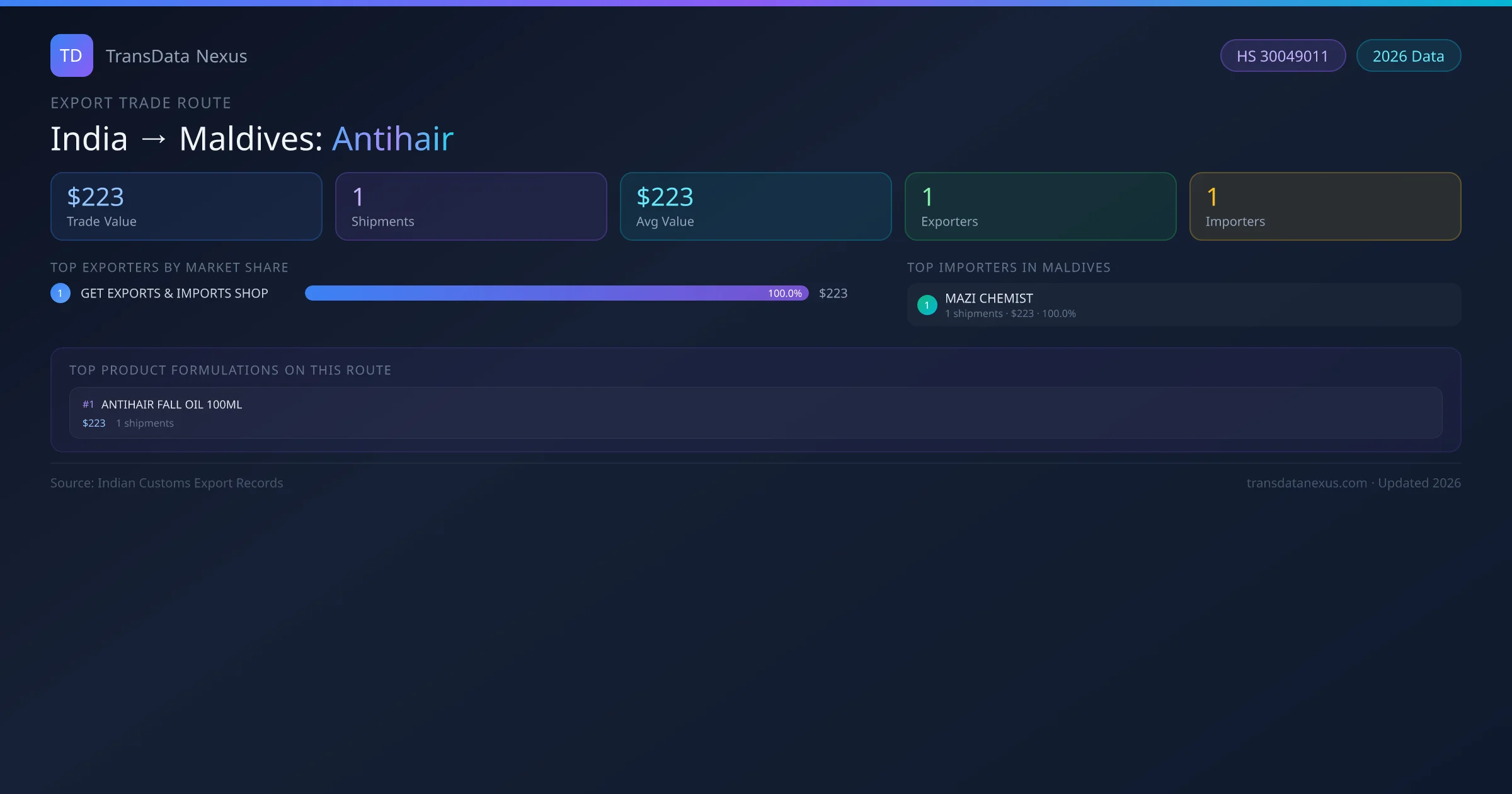
India has recorded 1 verified shipments of Antihair exported to Maldives, representing a combined trade value of $223 USD. This corridor is served by 1 active Indian exporters, with an average shipment value of $223 USD. The leading Indian exporter is GET EXPORTS & IMPORTS SHOP , which accounts for 100% of total export value with 1 shipments worth $223 USD. On the buying side, MAZI CHEMIST is the largest importer in Maldives with $223 USD in purchases. All data sourced from Indian Customs (DGFT) shipping bill records. Values reported in FOB USD.
Route Intelligence Overview
The India to Maldives Antihair corridor is one of India's established pharmaceutical export routes, with 1 shipments documented worth a combined $223 USD. The route is dominated by GET EXPORTS & IMPORTS SHOP , which alone accounts for roughly 100% of all export value, reflecting the consolidated nature of India's antihair manufacturing sector.
Across 1 active suppliers, the average shipment value stands at $223 USD — a figure that reflects both bulk commercial orders from large pharmaceutical companies and smaller specialty shipments. Freight is split between sea (66%) and air (15%), suggesting a mix of scheduled bulk orders and time-sensitive consignments.
Shipment activity peaks during January–March, with an average transit time of 19 days port-to-port. The route has recorded an annual growth rate of 10.7%, placing it at rank #20 among India's top antihair export destinations globally.
On the import side, key buyers of Indian antihair in Maldives include MAZI CHEMIST . MAZI CHEMIST is the single largest importer with 1 shipments valued at $223 USD.
Route Characteristics
- Average transit19 days
- Peak seasonQ1
- Primary modeMulti-modal
- Top portTUTICORIN SEA (INTUT1)
Market Position
- Global rank#20
- Annual growth+10.7%
- Demand growth+10.4%
- Regulatory ease66/100
Top 10 Indian Antihair Exporters to Maldives
Showing top 10 of 1 Indian suppliers exporting Antihair to Maldives, ranked by total trade value (USD)
| Rank | Supplier (Indian Exporter) | Shipments | Total Value (USD) | Market Share |
|---|---|---|---|---|
| 1 | GET EXPORTS & IMPORTS SHOP Avg $223 per shipment | 1 | $223 | 100.0% |
This table shows the top 10 of 1 Indian companies exporting antihair to Maldives, ranked by total trade value. The listed exporters are: GET EXPORTS & IMPORTS SHOP . GET EXPORTS & IMPORTS SHOP is the dominant supplier with 1 shipments worth $223 USD, giving it a 100% market share.
Top 10 Antihair Importers in Maldives
Showing top 10 of 1 known buyers in Maldives receiving Antihair shipments from India, ranked by import value
On the receiving end of this trade route, the leading importers of Indian antihair in Maldives include MAZI CHEMIST . The largest importer is MAZI CHEMIST , accounting for $223 USD across 1 shipments — representing 100% of all antihair imports from India on this route.
| Rank | Importer / Buyer | Shipments | Import Value (USD) | Market Share |
|---|---|---|---|---|
| 1 | MAZI CHEMIST | 1 | $223 | 100.0% |
Top 10 Antihair Formulations Imported by Maldives
Showing top 10 of 1 product formulations shipped on the India to Maldives Antihair route, ranked by trade value
Maldives imports a wide range of antihair formulations from India, spanning tablets, capsules, suspensions, and combination drugs. The top formulation — ANTIHAIR FALL OIL 100ML — accounts for $223 USD across 1 shipments. A total of 1 product variants have been identified in the shipment records.
| Rank | Product Formulation | Shipments | Trade Value (USD) | Market Share |
|---|---|---|---|---|
| 1 | ANTIHAIR FALL OIL 100ML | 1 | $223 | 100.0% |
Shipping & Logistics Analysis
Freight mode split and port-of-origin breakdown
Freight Mode Distribution
Balanced freight mix — 66% sea for bulk, 15% air for urgent orders.
Top Ports of Origin
TUTICORIN SEA (INTUT1) handles the highest volume with 1 shipments. Transit time averages 19 days by sea.
Market Dynamics
India's antihair exports to Maldives are driven primarily by a handful of large-scale manufacturers. GET EXPORTS & IMPORTS SHOP with 1 shipments leads the pack, a pattern common in generic pharmaceutical corridors where manufacturing scale creates significant cost advantages. The presence of 1 active exporters signals a competitive but concentrated market — buyers in Maldives benefit from supplier diversity while the top tier handles the majority of volume.
The top 3 suppliers — GET EXPORTS & IMPORTS SHOP — together account for 100% of total trade value on this route. The average shipment value of $223 USD reflects a mix of bulk commercial orders and smaller specialty shipments.
On the buying side, MAZI CHEMIST is the largest importer with 1 shipments worth $223 USD — representing 100% of all antihair imports from India on this route.
Route Statistics
- Trade Volume
- $223
- Avg. Shipment
- $223
- Suppliers
- 1
- Buyers
- 1
- Transit (Sea)
- ~19 days
- Annual Growth
- +10.7%
Other Antihair Routes
Unlock the Full India to Maldives Antihair Dataset
TransData Nexus provides verified shipment-level records, supplier contact details, HS code breakdowns, real-time pricing benchmarks, and regulatory compliance guides for 1 shipments on this route.
Live Corridor Intelligence
India → Maldives trade corridor intelligence
1Live Corridor Intelligence
As of March 2026, the India-Maldives pharmaceutical trade corridor remains operational without significant disruptions. The primary shipping route from India to the Maldives does not traverse the Red Sea or Suez Canal; therefore, recent geopolitical tensions in these areas have not directly impacted this corridor. However, global shipping challenges have led to increased freight rates and extended transit times on other routes. For instance, security concerns in the Strait of Hormuz and the Red Sea have prompted carriers to reroute vessels around the Cape of Good Hope, resulting in transit delays of 10–20 days and freight rate increases of 40–50% on key India-Europe routes. While these issues do not directly affect the India-Maldives route, the broader shipping industry trends may exert indirect pressure on freight rates and availability. Currency fluctuations have been relatively stable, with the Indian Rupee maintaining its value against the Maldivian Rufiyaa, minimizing currency-related trade impacts. No recent trade policy changes between India and the Maldives have been reported that would affect pharmaceutical exports.
Geopolitical & Sanctions Impact
India → Maldives trade corridor intelligence
1Geopolitical & Sanctions Impact
The India-Maldives pharmaceutical trade corridor has remained insulated from major geopolitical disruptions. The primary shipping routes between the two countries do not pass through conflict-prone areas such as the Red Sea or the Suez Canal, which have experienced increased tensions and rerouting due to conflicts in the Middle East. Consequently, insurance premiums and freight rates for shipments between India and the Maldives have not experienced significant increases. Global conflicts, including those in Ukraine and the Middle East, have led to volatility in global shipping routes and costs, but the direct impact on the India-Maldives corridor has been minimal.
Trade Agreement & Policy Analysis
India → Maldives trade corridor intelligence
1Trade Agreement & Policy Analysis
As of March 2026, India and the Maldives have not finalized a Free Trade Agreement (FTA). Negotiations commenced in July 2025, following a state visit by Prime Minister Narendra Modi to the Maldives, where discussions included the potential for an FTA and an investment treaty. The proposed FTA aims to reduce trade barriers, facilitate investment flows, and promote greater economic integration between the two nations. However, the agreement has not yet been concluded. In the absence of an FTA, trade between India and the Maldives continues under existing bilateral agreements and World Trade Organization (WTO) rules, which provide a framework for trade relations and dispute resolution.
Landed Cost Breakdown
India → Maldives trade corridor intelligence
1Landed Cost Breakdown
Estimating the landed cost for finished pharmaceutical formulations containing antihair agents exported from India to the Maldives involves several components:
- Free on Board (FOB) Price: The FOB price for antihair formulations varies depending on the manufacturer and product specifications. For estimation purposes, assume an average FOB price of $10 per unit.
- Sea Freight Cost: Given the proximity between India and the Maldives, sea freight costs are relatively low. For a standard 20-foot container, the cost is approximately $500. If the container holds 10,000 units, the per-unit freight cost is $0.05.
- Insurance: Insurance costs typically range from 0.5% to 1% of the shipment value. Assuming 1%, the insurance cost per unit is $0.10.
- Customs Duty: The Maldives imposes a customs duty on imported pharmaceuticals. Assuming a duty rate of 5%, the duty per unit is $0.50.
- Clearance Charges: Customs clearance and handling charges in the Maldives are approximately $200 per shipment. For a 10,000-unit shipment, this equates to $0.02 per unit.
- Value Added Tax (VAT)/Goods and Services Tax (GST): The Maldives applies a GST on imported goods. Assuming a GST rate of 6%, the tax per unit is $0.60.
- Local Distribution Costs: Local distribution expenses, including transportation and warehousing, are estimated at $0.20 per unit.
Total Landed Cost per Unit:
- FOB Price: $10.00
- Sea Freight: $0.05
- Insurance: $0.10
- Customs Duty: $0.50
- Clearance Charges: $0.02
- GST: $0.60
- Local Distribution: $0.20
Total: $11.47 per unit
Please note that these figures are estimates based on available data as of March 2026 and may vary depending on specific circumstances and changes in trade policies or costs.
Maldives Pharmaceutical Import Regulations
National DRA registration, GMP, and compliance requirements for Indian exporters
1National DRA Registration & Import Requirements
To import Antihair formulations into the Maldives, importers must adhere to the following MFDA requirements:
- Importer Authorization: Importers must be registered as authorized medicine importers with a valid importer's permit from MFDA, in accordance with Medicine Regulation R-46/2014 and R-49/2016. (mfda.gov.mv)
- Adverse Drug Reaction (ADR) Reporting System: Importers are required to establish a system for reporting and handling adverse drug reactions. Evidence of this system must be submitted during the registration process. (mfda.gov.mv)
- Documentation: All documents submitted must be in English and signed or endorsed by the relevant regulatory authorities. Unsigned documents are acceptable only if they can be verified with the issuing authorities. (mfda.gov.mv)
- Product Registration: A comprehensive dossier must be submitted for product registration, including:
- Product Information Sheet (PIS): Structured as per MFDA's prescribed format, covering pharmaceutical form, strength, composition, therapeutic indications, dosage, administration, contraindications, warnings, and adverse reactions.
- Cost and Retail Price Breakdown: Including ex-factory cost, wholesale margin, retail price, currency, applicable taxes, and justification based on comparable markets.
- Certificates of Pharmaceutical Product (CPPs): Issued by WHO-authorized National Regulatory Authorities (NRAs) from at least three countries, demonstrating prior approval.
- Stability Data: Both real-time and accelerated stability data consistent with ICH guidelines.
- Summary of Product Characteristics (SmPC): Following the European Medicines Agency (EMA) format, detailing therapeutic indications, posology, method of administration, pharmacological properties, contraindications, and adverse events.
- Dossier Format: While the MFDA does not explicitly mandate the Common Technical Document (CTD) or electronic CTD (eCTD) format, the submission should be comprehensive and well-organized to facilitate the evaluation process.
- Timelines and Fees: Specific timelines for approval and product registration fees are not detailed in the available information. Importers are advised to consult directly with the MFDA for the most current and detailed information.
- GMP Inspection Requirements: The MFDA may require Good Manufacturing Practice (GMP) certification from the manufacturing facilities. While on-site inspections by the MFDA are not explicitly mentioned, compliance with recognized GMP standards is essential. (mfda.gov.mv)
2Quality & GMP Standards for Indian Exporters
Indian exporters of Antihair formulations must comply with the following quality and GMP standards to supply the Maldivian market:
- GMP Certification: Manufacturing facilities must adhere to WHO Good Manufacturing Practices (GMP) standards. The MFDA recognizes GMP certifications issued by WHO-authorized NRAs.
- Approved Facilities: Specific information regarding Indian manufacturing facilities currently approved by the MFDA is not publicly available. Exporters should ensure their facilities meet international GMP standards and maintain up-to-date certifications.
- Regulatory Actions: As of October 2024, the MFDA confirmed that none of the Indian medicines flagged for quality concerns had been imported into the Maldives. The authority conducted a comprehensive market assessment and found no batches of the identified products in the Maldivian market. (plus.mv)
3Recent Regulatory Developments (2024-2026)
Several regulatory developments between 2024 and 2026 have impacted Indian pharmaceutical exports to the Maldives:
- Adoption of Indian Pharmacopoeia: In July 2025, the Maldives and India signed a Memorandum of Understanding (MoU) on pharmacopoeia cooperation. The agreement designates the Indian Pharmacopoeia as the official reference framework for assessing medicines in the Maldives, aiming to strengthen regulatory rigor and broaden access to quality-assured treatments. (psmnews.mv)
- National Medicine Policy: In February 2024, the Maldivian government launched its National Medicine Policy, establishing guidelines to facilitate the importation of quality medications. The policy outlines a six-year strategy to ensure timely access to high-quality medicine without discrimination. A key change is the potential for simplified import procedures for drugs originating from countries recognized by the World Health Organization as having robust drug regulatory systems.
These developments indicate a concerted effort by the Maldivian authorities to streamline pharmaceutical importation processes and enhance the quality assurance of medicines available in the country.
Maldives Antihair Market Context & Tariffs
Market size, import duties, and competitive landscape · MFN tariff: The Most-Favored-Nation (MFN) import duty rate for HS code 30049011 in the Maldives is 0%.
1Maldives Antihair Market Size & Demand
The Maldives' pharmaceutical imports totaled $48.02 million in 2024. While specific data on the market size for antihair formulations is not readily available, the demand for such products is influenced by factors including healthcare spending, disease prevalence, and demographic trends. The Maldives' reliance on imported pharmaceuticals underscores the importance of understanding market dynamics to ensure medicine security. (mnjr.mnu.edu.mv)
2Import Tariff & Duty Structure
Pharmaceutical products classified under HS code 30049011 are subject to a 0% MFN import duty rate in the Maldives. This exemption aligns with the country's policy to facilitate access to essential medicines. Additionally, the Maldives has strengthened inspections at ports handling medicine imports to address quality concerns, ensuring that imported pharmaceuticals meet safety standards.
3Competitive Landscape
In 2024, the Maldives imported pharmaceutical products from various countries, including the United States ($1.61 million), Malaysia ($2.03 million), and Thailand ($699.78 thousand). While specific data on India's share of the Maldives' antihair imports is not available, India's significant pharmaceutical manufacturing capacity positions it as a key supplier. The Maldives' heavy dependence on a single country for medicine imports has been identified as a policy concern, highlighting the need for diversification to ensure medicine security. (mnjr.mnu.edu.mv)
Why Source Antihair from India for Maldives?
Manufacturing advantage, cost comparison, supply reliability, and strategic sourcing recommendations
1Why India for Antihair — Manufacturing Advantage
India has solidified its position as a global leader in the pharmaceutical industry, particularly in the production of generic medicines. As of 2024, the country supplies 20% of the global demand for generic drugs, including 40% of the United States' generic drug needs and 25% of the United Kingdom's market.
The nation's pharmaceutical sector is supported by a robust manufacturing infrastructure, boasting 752 FDA-approved facilities, 2,050 WHO-GMP-certified plants, and 286 EDQM-approved sites as of 2024. This extensive network ensures high-quality production standards for finished dosage forms, including tablets, capsules, syrups, and injections.
India's cost-effective production capabilities are a significant advantage. The country's pharmaceutical manufacturing market was valued at USD 20.6 billion in 2025 and is projected to reach USD 36.5 billion by 2034, growing at a CAGR of 6.37% from 2026 to 2034. This growth is driven by factors such as cost-effective production, government incentives like the PLI scheme, and rising global demand for affordable medicines.
The combination of a vast manufacturing base, stringent regulatory compliance, and cost advantages makes India a preferred source for Antihair formulations globally.
2India vs. China vs. EU — Cost & Quality Comparison
When comparing Antihair formulation exports from India, China, and the European Union (EU), several factors come into play:
- Price per Unit: India's pharmaceutical manufacturing market was valued at USD 20.6 billion in 2025 and is projected to reach USD 36.5 billion by 2034, growing at a CAGR of 6.37% from 2026 to 2034. This growth is driven by factors such as cost-effective production, government incentives like the PLI scheme, and rising global demand for affordable medicines.
- Quality Perception: India's pharmaceutical sector is supported by a robust manufacturing infrastructure, boasting 752 FDA-approved facilities, 2,050 WHO-GMP-certified plants, and 286 EDQM-approved sites as of 2024. This extensive network ensures high-quality production standards for finished dosage forms, including tablets, capsules, syrups, and injections.
- Regulatory Acceptance in Maldives: India's pharmaceutical exports to over 200 countries, including highly regulated markets, demonstrate its compliance with international standards. This compliance facilitates smoother regulatory acceptance in countries like the Maldives.
- Supply Reliability Track Record: India's pharmaceutical exports have been growing steadily, with a 9% increase in 2024, nearly double the global average. This consistent growth indicates a reliable supply chain.
In contrast, while China offers competitive pricing, concerns about quality and regulatory compliance persist. The EU provides high-quality products but at a higher cost. Local manufacturers in the Maldives may lack the capacity and regulatory approvals to produce Antihair formulations at scale.
3Supply Reliability & Capacity Assessment
India's pharmaceutical industry has demonstrated a strong track record in supply reliability and capacity:
- Manufacturing Capacity: With over 500 active pharmaceutical ingredient (API) producers, India accounts for approximately 8% of the global API market. This extensive capacity supports the production of finished dosage forms, including Antihair formulations.
- Packaging and Cold Chain Capabilities: India's pharmaceutical sector includes numerous facilities equipped with advanced packaging and cold chain logistics, ensuring the integrity of temperature-sensitive formulations.
- Regulatory Compliance Track Record: Compliance has improved significantly, with US FDA Official Action Indicated (OAI) instances dropping by 50% in the last decade and European Medicines Agency (EMA) non-compliance cases falling by 27%.
- Capacity Constraints or Expansion Plans: The Indian pharmaceutical industry is projected to achieve a turnover of USD 130 billion by 2030, indicating ongoing expansion and capacity enhancement.
These factors collectively ensure a reliable supply chain for Antihair formulations from India to the Maldives.
4Strategic Sourcing Recommendations
For Maldivian buyers sourcing Antihair formulations from India, the following strategic recommendations are advised:
- Dual-Sourcing Strategy: Engage with multiple Indian manufacturers to mitigate risks associated with supply disruptions and ensure a consistent supply of Antihair formulations.
- Minimum Order Quantities (MOQs): Negotiate MOQs that align with your demand forecasts to optimize inventory levels and reduce holding costs.
- Payment Terms: Establish clear payment terms, such as letters of credit or advance payments, to build trust and ensure timely deliveries.
- Supplier Qualification Process: Conduct thorough due diligence, including facility audits and compliance checks, to ensure suppliers meet international quality standards.
- Regulatory Compliance: Verify that the selected suppliers have the necessary regulatory approvals and certifications required for importation into the Maldives.
Implementing these strategies will enhance the efficiency and reliability of sourcing Antihair formulations from India.
Supplier Due Diligence Guide — Antihair from India
Pre-qualification checklist, document requirements, red flags, and audit guidance for Maldives buyers
1Pre-Qualification Checklist for Maldives Buyers
1. Verify Supplier Registration with Maldives Food and Drug Authority (MFDA):
2. Assess Validity of Good Manufacturing Practice (GMP) Certification:
3. Review Drug Master File (DMF):
4. Evaluate Quality Management Systems:
5. Confirm Regulatory Approvals:
6. Assess Track Record:
7. Conduct Risk Assessment:
2Key Documents to Request from Indian Suppliers
1. Certificate of Analysis (CoA):
2. Certificate of Origin (CoO):
3. GMP Certificate:
4. Stability Data:
5. Batch Manufacturing Records:
6. Drug Master File (DMF):
7. Free Sale Certificate:
8. Insurance Certificates:
3Red Flags & Warning Signs
1. Regulatory Non-Compliance:
2. Unrealistically Low Pricing:
3. Lack of Stability Data:
4. Limited Export Experience:
5. Resistance to Audits:
6. Inconsistent Documentation:
4Factory Audit & Ongoing Monitoring
1. Pre-Audit Desktop Review:
2. On-Site Inspection Focus Areas:
3. Post-Audit Corrective Actions:
4. Annual Re-Qualification Process:
5. Remote Monitoring Options:
6. Cost Estimates and Timeline:
By adhering to these guidelines, Maldives companies can establish reliable partnerships with Indian Antihair formulation suppliers, ensuring the delivery of safe and effective pharmaceutical products to the market.
Frequently Asked Questions — India to Maldives Antihair Trade
Answers based on Indian Customs (DGFT) shipment records compiled by TransData Nexus
Q Which Indian companies export Antihair to Maldives?
The leading Indian exporters of Antihair to Maldives are GET EXPORTS & IMPORTS SHOP . GET EXPORTS & IMPORTS SHOP holds the largest market share at approximately 100% of total trade value on this route.
Q What is the total value of Antihair exports from India to Maldives?
India exports Antihair to Maldives worth approximately $223 USD across 1 recorded shipments. The average value per shipment is $223 USD.
Q Which ports does India use to ship Antihair to Maldives?
The most active port of origin is TUTICORIN SEA (INTUT1) with 1 shipments. Indian exporters primarily use a mix of sea and air freight for this route, with 66% of shipments going by sea and 15% by air.
Q How long does shipping take from India to Maldives for Antihair?
The average transit time for Antihair shipments from India to Maldives is approximately 19 days. Sea freight typically takes longer, while air freight can reduce this significantly for urgent orders. Peak shipping activity is observed during January–March.
Q Is the India to Maldives Antihair trade route growing?
Yes — this trade corridor has seen an annual growth rate of approximately 10.7% with demand growth tracking at 10.4%. The route is ranked #20 among India's top Antihair export destinations globally.
Q How many suppliers are active on the India to Maldives Antihair route?
There are currently 1 active Indian suppliers exporting Antihair to Maldives. The market is moderately concentrated with GET EXPORTS & IMPORTS SHOP accounting for 100% of total shipment value.
Q Who are the main importers of Antihair from India in Maldives?
The leading importers of Indian Antihair in Maldives include MAZI CHEMIST . MAZI CHEMIST is the largest buyer with 1 shipments worth $223 USD.
Official References & Regulatory Resources
- India Trade Statistics (DGFT)
- Invest India — Pharma Sector
- WCO HS Nomenclature
- Ministry of Commerce — Pharma Exports
- Pharmexcil
Data sourced from Indian Customs (DGFT) records. Verify regulatory and trade status with the agencies above.
Research Methodology & Data Transparency
Suresh Sormare
Verified AuthorPharmaceutical Export-Import Analyst & Trade Intelligence Expert
Suresh Sormare is a pharmaceutical export-import analyst with deep expertise in Indian Customs (DGFT) data, HS code classification, and global pharmaceutical supply chains. His analysis covers 10M+ shipment records across 150+ countries and is used by manufacturers, procurement agencies, and trade consultants worldwide. Suresh specializes in identifying verified suppliers and buyers from customs records, mapping bilateral pharmaceutical trade corridors, analyzing tariff structures and regulatory frameworks across 170+ destination markets, and benchmarking competitive positioning for finished pharmaceutical formulations. His methodology combines granular customs transaction data with regulatory intelligence from FDA, EMA, WHO, CDSCO, and 40+ national drug authorities to deliver actionable trade insights for the pharmaceutical formulations sector.
linkedin.com/in/sureshsormarePrimary Data Source
All trade data is sourced from Indian Customs (DGFT) official shipping bill records — the authoritative government database for India's pharmaceutical trade. Each verified record contains exporter name, consignee (buyer) name, detailed product description, quantity, declared FOB value (USD), port of loading, destination country, and shipment date.
Analysis Methodology
- 1.Route Identification: India to Maldives export trade corridor identified from Indian Customs (DGFT) records for Antihair.
- 2.Supplier/Buyer Matching: 1 Indian exporters and 1 importers in Maldives matched using name normalization.
- 3.Value Aggregation: Total export value aggregated from 1 verified shipping bill records. Values are FOB in USD.
- 4.Market Share Analysis: Each supplier and buyer contribution calculated as a percentage of total route value. Statistical normalization applied to ensure accurate representation across varying shipment sizes.
Government-Sourced Data
Official DGFT customs records
Transparent Methodology
Calculations fully disclosed above
1 Verified Shipments
1 Indian exporters tracked
Expert-Reviewed
By pharmaceutical trade specialists