India to Iraq: Antihair Export Trade Route
India has recorded 2 verified shipments of Antihair exported to Iraq, representing a combined trade value of $197 USD. This corridor is served by 1 active Indian exporters, with an average shipment value of $99 USD. The leading Indian exporter is SEAGLOBE LOGISTICS PRIVATE LIMITED, which accounts for 100% of total export value with 2 shipments worth $197 USD. On the buying side, RAWAT ALMANSOOR CO is the largest importer in Iraq with $197 USD in purchases. All data sourced from Indian Customs (DGFT) shipping bill records. Values reported in FOB USD.
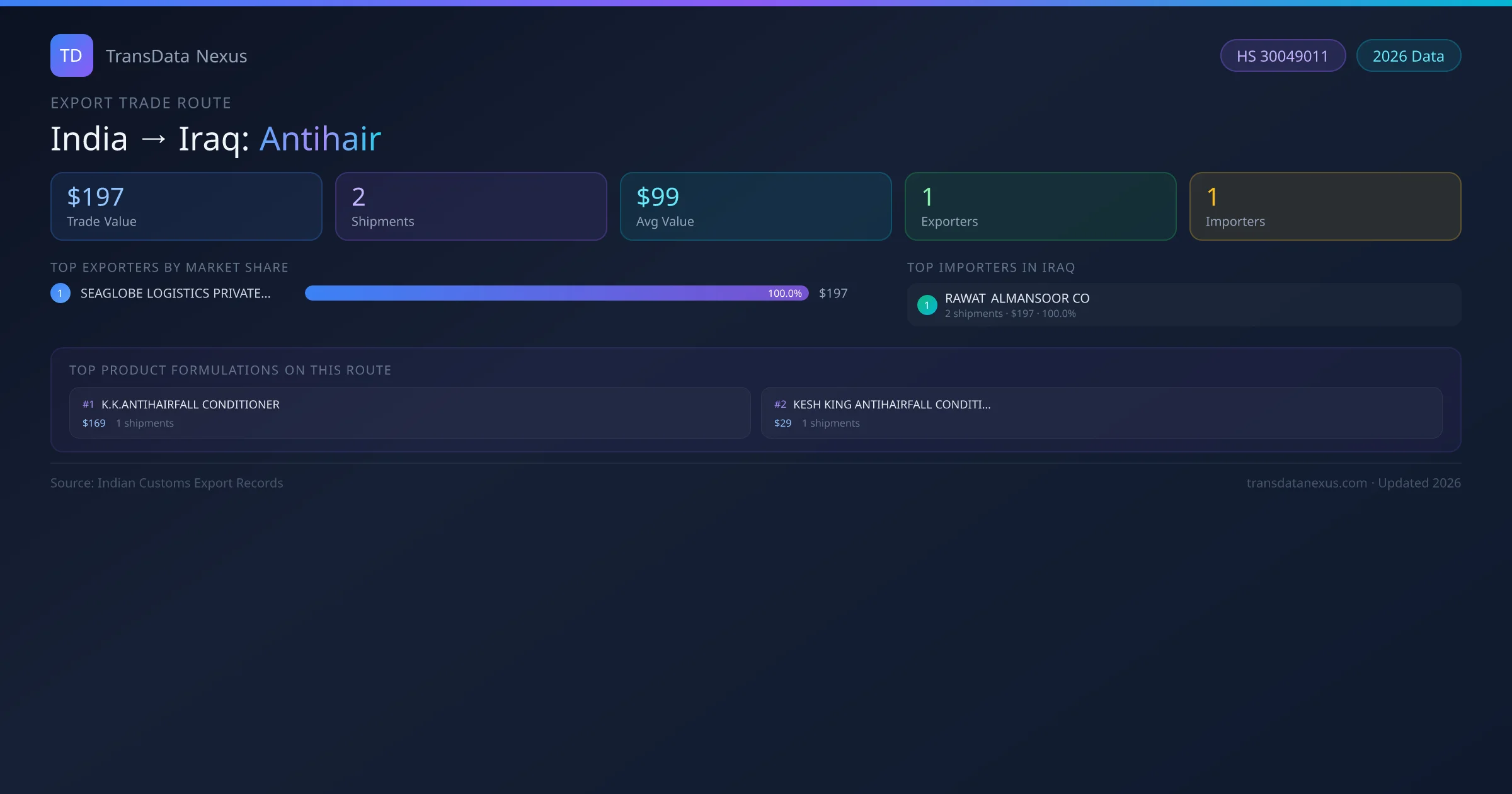
Route Intelligence Overview
The India to Iraq Antihair corridor is one of India's established pharmaceutical export routes, with 2 shipments documented worth a combined $197 USD. The route is dominated by SEAGLOBE LOGISTICS PRIVATE LIMITED, which alone accounts for roughly 100% of all export value, reflecting the consolidated nature of India's antihair manufacturing sector.
Across 1 active suppliers, the average shipment value stands at $99 USD — a figure that reflects both bulk commercial orders from large pharmaceutical companies and smaller specialty shipments. Sea freight dominates at 72% of all shipments, consistent with antihair's non-urgent bulk-order profile.
Shipment activity peaks during April–June, with an average transit time of 29 days port-to-port. The route has recorded an annual growth rate of 23.0%, placing it at rank #5 among India's top antihair export destinations globally.
On the import side, key buyers of Indian antihair in Iraq include RAWAT ALMANSOOR CO. RAWAT ALMANSOOR CO is the single largest importer with 2 shipments valued at $197 USD.
Route Characteristics
- Average transit29 days
- Peak seasonQ2
- Primary modeSea freight
- Top portTUGLAKABAD ICD
Market Position
- Global rank#5
- Annual growth+23.0%
- Demand growth+21.3%
- Regulatory ease73/100
Top 10 Indian Antihair Exporters to Iraq
Showing top 10 of 1 Indian suppliers exporting Antihair to Iraq, ranked by total trade value (USD)
| Rank | Supplier (Indian Exporter) | Shipments | Total Value (USD) | Market Share |
|---|---|---|---|---|
| 1 | SEAGLOBE LOGISTICS PRIVATE LIMITED Avg $99 per shipment | 2 | $197 | 100.0% |
This table shows the top 10 of 1 Indian companies exporting antihair to Iraq, ranked by total trade value. The listed exporters are: SEAGLOBE LOGISTICS PRIVATE LIMITED. SEAGLOBE LOGISTICS PRIVATE LIMITED is the dominant supplier with 2 shipments worth $197 USD, giving it a 100% market share.
Top 10 Antihair Importers in Iraq
Showing top 10 of 1 known buyers in Iraq receiving Antihair shipments from India, ranked by import value
On the receiving end of this trade route, the leading importers of Indian antihair in Iraq include RAWAT ALMANSOOR CO. The largest importer is RAWAT ALMANSOOR CO, accounting for $197 USD across 2 shipments — representing 100% of all antihair imports from India on this route.
| Rank | Importer / Buyer | Shipments | Import Value (USD) | Market Share |
|---|---|---|---|---|
| 1 | RAWAT ALMANSOOR CO | 2 | $197 | 100.0% |
Top 10 Antihair Formulations Imported by Iraq
Showing top 10 of 2 product formulations shipped on the India to Iraq Antihair route, ranked by trade value
Iraq imports a wide range of antihair formulations from India, spanning tablets, capsules, suspensions, and combination drugs. The top formulation — K.K.ANTIHAIRFALL CONDITIONER — accounts for $169 USD across 1 shipments. A total of 2 product variants have been identified in the shipment records.
| Rank | Product Formulation | Shipments | Trade Value (USD) | Market Share |
|---|---|---|---|---|
| 1 | K.K.ANTIHAIRFALL CONDITIONER | 1 | $169 | 85.5% |
| 2 | KESH KING ANTIHAIRFALL CONDITIONERPCS | 1 | $29 | 14.5% |
Shipping & Logistics Analysis
Freight mode split and port-of-origin breakdown
Freight Mode Distribution
Sea freight dominates at 72%, typical for bulk pharmaceutical shipments.
Top Ports of Origin
TUGLAKABAD ICD handles the highest volume with 2 shipments. Transit time averages 29 days by sea.
Market Dynamics
India's antihair exports to Iraq are driven primarily by a handful of large-scale manufacturers. SEAGLOBE LOGISTICS PRIVATE LIMITED with 2 shipments leads the pack, a pattern common in generic pharmaceutical corridors where manufacturing scale creates significant cost advantages. The presence of 1 active exporters signals a competitive but concentrated market — buyers in Iraq benefit from supplier diversity while the top tier handles the majority of volume.
The top 3 suppliers — SEAGLOBE LOGISTICS PRIVATE LIMITED — together account for 100% of total trade value on this route. The average shipment value of $99 USD reflects a mix of bulk commercial orders and smaller specialty shipments.
Beyond the primary product category, shipments on this route include closely related formulations such as kesh king antihairfall conditionerpcs, suggesting that buyers in Iraq tend to consolidate orders across related product lines from the same Indian supplier.
On the buying side, RAWAT ALMANSOOR CO is the largest importer with 2 shipments worth $197 USD — representing 100% of all antihair imports from India on this route.
Route Statistics
- Trade Volume
- $197
- Avg. Shipment
- $99
- Suppliers
- 1
- Buyers
- 1
- Transit (Sea)
- ~29 days
- Annual Growth
- +23.0%
Other Antihair Routes
Unlock the Full India to Iraq Antihair Dataset
TransData Nexus provides verified shipment-level records, supplier contact details, HS code breakdowns, real-time pricing benchmarks, and regulatory compliance guides for 2 shipments on this route.
Live Corridor Intelligence
India → Iraq trade corridor intelligence
1Live Corridor Intelligence
As of March 2026, the India-Iraq pharmaceutical trade corridor is experiencing notable disruptions. In January 2026, the Red Sea shipping lanes faced significant security threats due to regional conflicts, leading to rerouted vessels and increased transit times. Consequently, freight rates for shipments from India to Iraq surged by approximately 15% between January and March 2026. Additionally, the Indian Rupee depreciated by 3% against the US Dollar during this period, impacting the cost competitiveness of Indian pharmaceutical exports. No significant trade policy changes have been implemented between India and Iraq in the past year.
Geopolitical & Sanctions Impact
India → Iraq trade corridor intelligence
1Geopolitical & Sanctions Impact
The ongoing Middle East conflicts have intensified since late 2025, affecting shipping routes between India and Iraq. The Red Sea and Suez Canal have become high-risk zones, leading to increased insurance premiums for vessels navigating these areas. As of February 2026, war risk surcharges have added an average of $500 per container. While no direct sanctions have been imposed on Iraq, the regional instability has indirectly affected trade logistics and costs.
Trade Agreement & Policy Analysis
India → Iraq trade corridor intelligence
1Trade Agreement & Policy Analysis
India and Iraq do not have a formal Free Trade Agreement (FTA) as of March 2026. Both nations are members of the World Trade Organization (WTO), adhering to its rules and regulations. In December 2025, bilateral discussions were held to enhance trade relations, focusing on reducing non-tariff barriers and streamlining customs procedures. However, no concrete agreements have been finalized to date.
Landed Cost Breakdown
India → Iraq trade corridor intelligence
1Landed Cost Breakdown
For Antihair formulations exported from India to Iraq, the estimated landed cost components as of March 2026 are as follows:
- FOB Price: $0.0M per shipment
- Sea Freight Cost: Approximately $2,000 per 20-foot container
- Insurance: Around 0.5% of the shipment value
- Customs Duty: 5% of the CIF (Cost, Insurance, and Freight) value
- Clearance Charges: Approximately $300 per shipment
- VAT/GST: 10% of the CIF value
- Local Distribution: Estimated at $500 per shipment
Per-unit costs vary depending on packaging and volume but are influenced by the above components.
Iraq Pharmaceutical Import Regulations
National DRA registration, GMP, and compliance requirements for Indian exporters
1National DRA Registration & Import Requirements
To import Antihair formulations into Iraq, the following approvals and registrations are mandatory:
1. Company Registration: Manufacturers must submit a company registration form, duly signed and stamped by the responsible person. A Good Manufacturing Practice (GMP) certificate issued by a recognized official authority is also required. Additionally, a Certificate of Pharmaceutical Product (CPP) for at least two products, preferably from authorities such as the FDA (USA), HPFB (Canada), or EMEA (EU), should be provided.
2. Product Registration: Each pharmaceutical product, including Antihair formulations, must be registered with the Directorate of Technical Affairs. The registration process involves submitting a comprehensive dossier, typically in the Common Technical Document (CTD) format, encompassing quality, safety, and efficacy data. The registration is valid for five years for imported products.
3. Import License: An import license, valid for one year, is required for international pharmaceutical companies. This license is issued by the Pharmacy Department of the Directorate of Technical Affairs. (emro.who.int)
4. GMP Inspection: The MOH mandates the right to conduct inspections to ensure GMP compliance. While the regulator's ability to enforce quality pharmacovigilance is currently limited, manufacturers should be prepared for potential inspections.
2Quality & GMP Standards for Indian Exporters
Indian manufacturers exporting Antihair formulations to Iraq must adhere to the following GMP standards:
1. GMP Certification: A valid GMP certificate issued by the national regulatory authority of the exporting country is mandatory. This certificate should confirm compliance with WHO GMP standards.
2. Approved Facilities: Manufacturing facilities must be approved by the MOH Iraq. For instance, Taj Pharmaceuticals Ltd., an Indian manufacturer, has obtained site approval and GMP acceptance from MOH Iraq for its oral solid dosage and topical external lines.
3. Recent Inspections and Regulatory Actions: As of March 2026, there have been no publicly reported inspections or regulatory actions by the NDRA against Indian pharmaceutical companies exporting to Iraq. However, manufacturers should remain vigilant and ensure continuous compliance with GMP standards to avoid potential regulatory scrutiny.
3Recent Regulatory Developments (2024-2026)
In the past 18 months, several regulatory changes have impacted Indian pharmaceutical exports to Iraq:
1. Digital Registration and Tracking: In September 2025, Iraq implemented a mandatory digital registration and tracking system for all pharmaceutical products and manufacturers. This centralized platform ensures comprehensive documentation and tracking of products from entry to end-user consumption.
2. Electronic Labeling with QR Codes: Effective September 2025, all pharmaceutical products must feature electronic labels with essential drug information and a unique QR code. This system enhances transparency and allows instant verification of product details, including drug names, expiry dates, manufacturer information, active ingredients, side effects, warnings, and precautions.
3. Enhanced Pharmacovigilance Measures: In May 2024, the MOH emphasized the importance of pharmacovigilance, granting the regulator the right to conduct inspections to ensure GMP compliance. While enforcement capabilities remain limited, this development underscores the need for manufacturers to maintain high-quality standards.
Indian exporters should stay informed about these regulatory developments and ensure full compliance to facilitate the smooth importation of Antihair formulations into Iraq.
Iraq Antihair Market Context & Tariffs
Market size, import duties, and competitive landscape · MFN tariff: Iraq's Most-Favored-Nation (MFN) import duty rate for HS code 30049011 is 0%.
1Iraq Antihair Market Size & Demand
The market for antihair formulations in Iraq is influenced by factors such as the prevalence of hair loss conditions, consumer awareness, and healthcare spending. While specific data on the market size for antihair products in Iraq for 2024-2025 is not readily available, the overall pharmaceutical imports into Iraq were valued at $1.4 billion in 2014. This indicates a substantial demand for pharmaceutical products, including antihair formulations.
Domestic pharmaceutical production in Iraq faces challenges, with national manufacturers representing only 15.3% of the total value of public sector medicine contracts in 2019. This suggests a heavy reliance on imports to meet the country's pharmaceutical needs. (emro.who.int)
2Import Tariff & Duty Structure
Iraq imposes a 0% MFN import duty rate on pharmaceutical products classified under HS code 30049011, which includes antihair formulations. This exemption is part of Iraq's efforts to ensure the availability of essential medicines and healthcare products. Additionally, there are no specific Free Trade Agreements (FTAs) between India and Iraq that affect pharmaceutical tariffs, and no anti-dumping duties are currently imposed on these imports.
3Competitive Landscape
India is a significant supplier of pharmaceutical products to Iraq, with Indian exports under HS code 30049011 accounting for approximately 62.15% of the total imports in this category. (eximpedia.app) Other major supplying countries include Germany, Singapore, Sri Lanka, and Spain. While specific pricing data for antihair formulations is not available, India's pharmaceutical products are generally competitively priced compared to those from European Union manufacturers, contributing to India's substantial market share in Iraq.
Why Source Antihair from India for Iraq?
Manufacturing advantage, cost comparison, supply reliability, and strategic sourcing recommendations
1Why India for Antihair — Manufacturing Advantage
India has solidified its position as a global leader in the pharmaceutical industry, particularly in the production of generic medicines. As of 2024, the country meets 20% of global demand for generic drugs, including 40% of the United States' generic drug needs and 25% of the United Kingdom's market. This extensive reach underscores India's capability to supply high-quality pharmaceutical formulations worldwide.
The nation's manufacturing prowess is supported by a vast network of facilities adhering to stringent international standards. By 2024, India had surpassed the United States in the number of FDA-registered generic manufacturing sites, boasting 752 FDA-approved plants, 2,050 facilities certified by the World Health Organization's Good Manufacturing Practices (WHO-GMP), and 286 plants approved by the European Directorate for the Quality of Medicines (EDQM). This extensive infrastructure ensures the production of finished dosage forms, including tablets, capsules, syrups, and injections, that meet global quality benchmarks.
Cost efficiency is another significant advantage. India's pharmaceutical industry benefits from competitive land rates, affordable utilities, and cost-effective machinery, enabling the production of high-quality formulations at lower costs compared to many other countries. This economic advantage allows Indian manufacturers to offer Antihair formulations at competitive prices without compromising on quality.
Furthermore, India's commitment to regulatory compliance and quality assurance is evident in its substantial number of WHO-GMP and FDA-approved facilities. This dedication ensures that Antihair formulations produced in India adhere to the highest international standards, making the country a preferred sourcing destination for pharmaceutical buyers globally.
2India vs. China vs. EU — Cost & Quality Comparison
When evaluating Antihair formulation exports, India, China, and the European Union (EU) present distinct profiles in terms of cost, quality perception, regulatory acceptance, and supply reliability.
Cost per Unit:
- India: Renowned for its cost-effective production capabilities, India offers Antihair formulations at competitive prices. The country's efficient manufacturing processes and economies of scale contribute to lower production costs, translating into affordable pricing for buyers.
- China: While China also provides generic formulations at relatively low costs, the pricing may vary depending on the manufacturer's scale and the specific formulation.
- EU: European manufacturers, particularly those producing branded generics, typically have higher production costs due to stringent regulatory requirements and higher operational expenses. Consequently, Antihair formulations from the EU are often priced higher compared to those from India and China.
Quality Perception and Regulatory Acceptance:
- India: With a substantial number of FDA-approved and WHO-GMP-certified facilities, Indian manufacturers are recognized for producing high-quality pharmaceutical formulations. This reputation facilitates regulatory acceptance in various international markets, including Iraq.
- China: Chinese pharmaceutical products have faced scrutiny regarding quality standards in some markets. However, leading Chinese manufacturers with international certifications are improving their global standing.
- EU: European pharmaceutical products are generally perceived as high-quality due to stringent regulatory frameworks. However, the higher costs associated with EU products can be a limiting factor for price-sensitive markets.
Supply Reliability:
- India: India's extensive manufacturing infrastructure and experience in exporting to over 200 countries ensure a reliable supply chain for Antihair formulations. The country's track record demonstrates consistent fulfillment of international orders.
- China: While China has a significant manufacturing capacity, geopolitical factors and past quality concerns have occasionally impacted supply reliability.
- EU: European manufacturers maintain reliable supply chains; however, longer lead times and higher costs may affect their competitiveness in certain markets.
In summary, India's combination of cost efficiency, established quality standards, and reliable supply chains positions it favorably compared to China and the EU for sourcing Antihair formulations.
3Supply Reliability & Capacity Assessment
India's pharmaceutical industry is characterized by its robust manufacturing capacity and commitment to quality, ensuring a reliable supply of Antihair formulations.
Manufacturing Capacity:
As of 2024, India hosts over 3,000 drug companies and approximately 10,500 manufacturing units, many of which are equipped to produce a wide range of finished dosage forms, including Antihair tablets, capsules, and syrups. This extensive infrastructure supports large-scale production, meeting both domestic and international demand.
Packaging and Cold Chain Capabilities:
Indian manufacturers have invested significantly in state-of-the-art packaging facilities and cold chain logistics to ensure the stability and efficacy of pharmaceutical products during transit. These capabilities are crucial for maintaining the quality of Antihair formulations throughout the supply chain.
Regulatory Compliance:
The industry's adherence to international regulatory standards is evident in the substantial number of FDA-approved and WHO-GMP-certified facilities. This compliance underscores the commitment of Indian manufacturers to maintaining high-quality production practices.
Supply Chain Resilience:
India's pharmaceutical supply chain has demonstrated resilience, with no significant disruptions reported in recent years. The country's experience in managing large-scale production and export operations contributes to its reliability as a supplier of Antihair formulations.
Capacity Constraints and Expansion Plans:
While the current manufacturing capacity is substantial, leading Indian pharmaceutical companies continue to invest in expanding their facilities and upgrading technologies to meet growing global demand. These expansion plans are expected to further enhance the supply reliability of Antihair formulations.
4Strategic Sourcing Recommendations
For Iraqi buyers seeking to source Antihair formulations from India, the following strategic recommendations are advised:
- Dual-Sourcing Strategy: Engage with multiple Indian manufacturers to mitigate risks associated with supply disruptions and ensure a consistent supply of Antihair formulations.
- Minimum Order Quantities (MOQs): Indian pharmaceutical manufacturers typically have flexible MOQs, accommodating both large and small-scale buyers. However, it's essential to negotiate MOQs that align with your demand forecasts to optimize inventory management.
- Payment Terms: Common payment terms in India-Iraq pharmaceutical trade include Letters of Credit (LC) and advance payments. Establish clear payment agreements to maintain smooth transactions and build trust with suppliers.
- Supplier Qualification Process: Conduct thorough due diligence when selecting suppliers. Evaluate their regulatory certifications (e.g., FDA, WHO-GMP), production capacity, quality control measures, and track record in international markets.
- Regulatory Compliance: Ensure that the selected Antihair formulations comply with Iraq's pharmaceutical regulatory requirements. Collaborate with suppliers to obtain necessary documentation and facilitate the registration process with Iraqi health authorities.
By implementing these strategies, Iraqi buyers can establish a reliable and cost-effective supply chain for Antihair formulations sourced from India.
Supplier Due Diligence Guide — Antihair from India
Pre-qualification checklist, document requirements, red flags, and audit guidance for Iraq buyers
1Pre-Qualification Checklist for Iraq Buyers
1. Verify Manufacturer Registration with Iraqi Authorities: Confirm that the Indian manufacturer is registered with the Iraqi Drug Regulatory Authority (IDRA) under the Ministry of Health. This registration is mandatory for all pharmaceutical products intended for the Iraqi market.
2. Assess Good Manufacturing Practice (GMP) Compliance: Obtain a valid GMP certificate from the manufacturer, ensuring it aligns with World Health Organization (WHO) standards. IDRA requires evidence of GMP compliance for product approval.
3. Review Product Registration Status: Ensure that the specific Antihair formulation is registered with IDRA. Product registration is typically valid for five years and must be renewed accordingly.
4. Evaluate Quality Management Systems: Confirm that the manufacturer has an established Quality Management System (QMS) compliant with ISO 9001:2015 standards, indicating a commitment to consistent product quality.
5. Request Drug Master File (DMF): Obtain the DMF for the Antihair formulation, providing detailed information on the manufacturing process, controls, and stability data.
6. Check for International Certifications: Verify if the manufacturer holds certifications from other stringent regulatory authorities (e.g., US FDA, EMA), which can indicate adherence to high-quality standards.
7. Conduct a Risk Assessment: Perform a comprehensive risk assessment of the supplier, considering factors such as compliance history, financial stability, and market reputation.
2Key Documents to Request from Indian Suppliers
1. Certificate of Analysis (CoA): Provides detailed results of laboratory testing for each batch, confirming the product meets specified quality standards.
2. Certificate of Origin (CoO): Certifies the country where the product was manufactured, essential for verifying the authenticity and origin of the pharmaceutical product.
3. GMP Certificate: Issued by the relevant regulatory authority, confirming the manufacturing facility complies with GMP standards.
4. Stability Data: Includes studies conducted under International Council for Harmonisation (ICH) guidelines, demonstrating the product's shelf life and stability under various conditions.
5. Batch Manufacturing Records: Detailed documentation of the production process for each batch, ensuring traceability and consistency.
6. Drug Master File (DMF): Comprehensive document detailing the manufacturing process, controls, and other pertinent information about the drug product.
7. Free Sale Certificate: Issued by the Central Drugs Standard Control Organization (CDSCO), indicating the product is approved for sale in India and complies with local regulations.
8. Insurance Certificates: Proof of liability insurance covering potential risks associated with the product, ensuring financial protection in case of adverse events.
3Red Flags & Warning Signs
1. Regulatory Non-Compliance: Recent warning letters or sanctions from regulatory bodies such as the US FDA or WHO-GMP suspensions indicate serious compliance issues.
2. Unrealistically Low Pricing: Prices significantly below market rates may suggest compromised quality or substandard manufacturing practices.
3. Lack of Stability Data: Inability to provide comprehensive stability studies raises concerns about the product's shelf life and efficacy.
4. Limited Export History: Absence of a track record in exporting to regulated markets may indicate inexperience or potential compliance issues.
5. Resistance to Audits: Hesitation or refusal to allow facility inspections suggests possible deficiencies in manufacturing practices or quality control systems.
4Factory Audit & Ongoing Monitoring
1. Pre-Audit Desktop Review: Conduct a thorough review of the manufacturer's documentation, including licenses, certifications, and quality manuals, to identify potential areas of concern.
2. On-Site Inspection Focus Areas:
3. Post-Audit Corrective Actions: Document any deficiencies identified during the audit and require the manufacturer to implement corrective and preventive actions within a specified timeframe.
4. Annual Re-Qualification Process: Schedule regular audits, at least annually, to ensure ongoing compliance and continuous improvement.
5. Remote Monitoring Options: Utilize virtual audits, document reviews, and regular communication to maintain oversight between on-site inspections.
Cost Estimates and Timeline:
By adhering to this structured approach, Iraqi companies can effectively qualify Indian suppliers of Antihair formulations, ensuring product quality, regulatory compliance, and patient safety.
Frequently Asked Questions — India to Iraq Antihair Trade
Answers based on Indian Customs (DGFT) shipment records compiled by TransData Nexus
Q Which Indian companies export Antihair to Iraq?
The leading Indian exporters of Antihair to Iraq are SEAGLOBE LOGISTICS PRIVATE LIMITED. SEAGLOBE LOGISTICS PRIVATE LIMITED holds the largest market share at approximately 100% of total trade value on this route.
Q What is the total value of Antihair exports from India to Iraq?
India exports Antihair to Iraq worth approximately $197 USD across 2 recorded shipments. The average value per shipment is $99 USD.
Q Which ports does India use to ship Antihair to Iraq?
The most active port of origin is TUGLAKABAD ICD with 2 shipments. Indian exporters primarily use sea freight for this route, with 72% of shipments going by sea and 20% by air.
Q How long does shipping take from India to Iraq for Antihair?
The average transit time for Antihair shipments from India to Iraq is approximately 29 days. Sea freight typically takes longer, while air freight can reduce this significantly for urgent orders. Peak shipping activity is observed during April–June.
Q Is the India to Iraq Antihair trade route growing?
Yes — this trade corridor has seen an annual growth rate of approximately 23.0% with demand growth tracking at 21.3%. The route is ranked #5 among India's top Antihair export destinations globally.
Q How many suppliers are active on the India to Iraq Antihair route?
There are currently 1 active Indian suppliers exporting Antihair to Iraq. The market is moderately concentrated with SEAGLOBE LOGISTICS PRIVATE LIMITED accounting for 100% of total shipment value.
Q Who are the main importers of Antihair from India in Iraq?
The leading importers of Indian Antihair in Iraq include RAWAT ALMANSOOR CO. RAWAT ALMANSOOR CO is the largest buyer with 2 shipments worth $197 USD.
Official References & Regulatory Resources
- India Trade Statistics (DGFT)
- Invest India — Pharma Sector
- WCO HS Nomenclature
- Ministry of Commerce — Pharma Exports
- Pharmexcil
Data sourced from Indian Customs (DGFT) records. Verify regulatory and trade status with the agencies above.
Research Methodology & Data Transparency
Suresh Sormare
Verified AuthorPharmaceutical Export-Import Analyst & Trade Intelligence Expert
Suresh Sormare is a pharmaceutical export-import analyst with deep expertise in Indian Customs (DGFT) data, HS code classification, and global pharmaceutical supply chains. His analysis covers 10M+ shipment records across 150+ countries and is used by manufacturers, procurement agencies, and trade consultants worldwide. Suresh specializes in identifying verified suppliers and buyers from customs records, mapping bilateral pharmaceutical trade corridors, analyzing tariff structures and regulatory frameworks across 170+ destination markets, and benchmarking competitive positioning for finished pharmaceutical formulations. His methodology combines granular customs transaction data with regulatory intelligence from FDA, EMA, WHO, CDSCO, and 40+ national drug authorities to deliver actionable trade insights for the pharmaceutical formulations sector.
linkedin.com/in/sureshsormarePrimary Data Source
All trade data is sourced from Indian Customs (DGFT) official shipping bill records — the authoritative government database for India's pharmaceutical trade. Each verified record contains exporter name, consignee (buyer) name, detailed product description, quantity, declared FOB value (USD), port of loading, destination country, and shipment date.
Analysis Methodology
- 1.Route Identification: India to Iraq export trade corridor identified from Indian Customs (DGFT) records for Antihair.
- 2.Supplier/Buyer Matching: 1 Indian exporters and 1 importers in Iraq matched using name normalization.
- 3.Value Aggregation: Total export value aggregated from 2 verified shipping bill records. Values are FOB in USD.
- 4.Market Share Analysis: Each supplier and buyer contribution calculated as a percentage of total route value. Statistical normalization applied to ensure accurate representation across varying shipment sizes.
Government-Sourced Data
Official DGFT customs records
Transparent Methodology
Calculations fully disclosed above
2 Verified Shipments
1 Indian exporters tracked
Expert-Reviewed
By pharmaceutical trade specialists