India to South Africa: Amlodipine Export Trade Route
India has recorded 413 verified shipments of Amlodipine exported to South Africa, representing a combined trade value of $17.9M USD. This corridor is served by 42 active Indian exporters, with an average shipment value of $43.3K USD. The leading Indian exporter is IPCA LABORATORIES LIMITED, which accounts for 59% of total export value with 89 shipments worth $10.5M USD. On the buying side, NA is the largest importer in South Africa with $8.9M USD in purchases. The top 3 suppliers — IPCA LABORATORIES LIMITED, ALEMBIC PHARMACEUTICALS LIMITED, RUSAN PHARMA LIMITED — together control 74% of total trade value on this route. All data sourced from Indian Customs (DGFT) shipping bill records. Values reported in FOB USD.
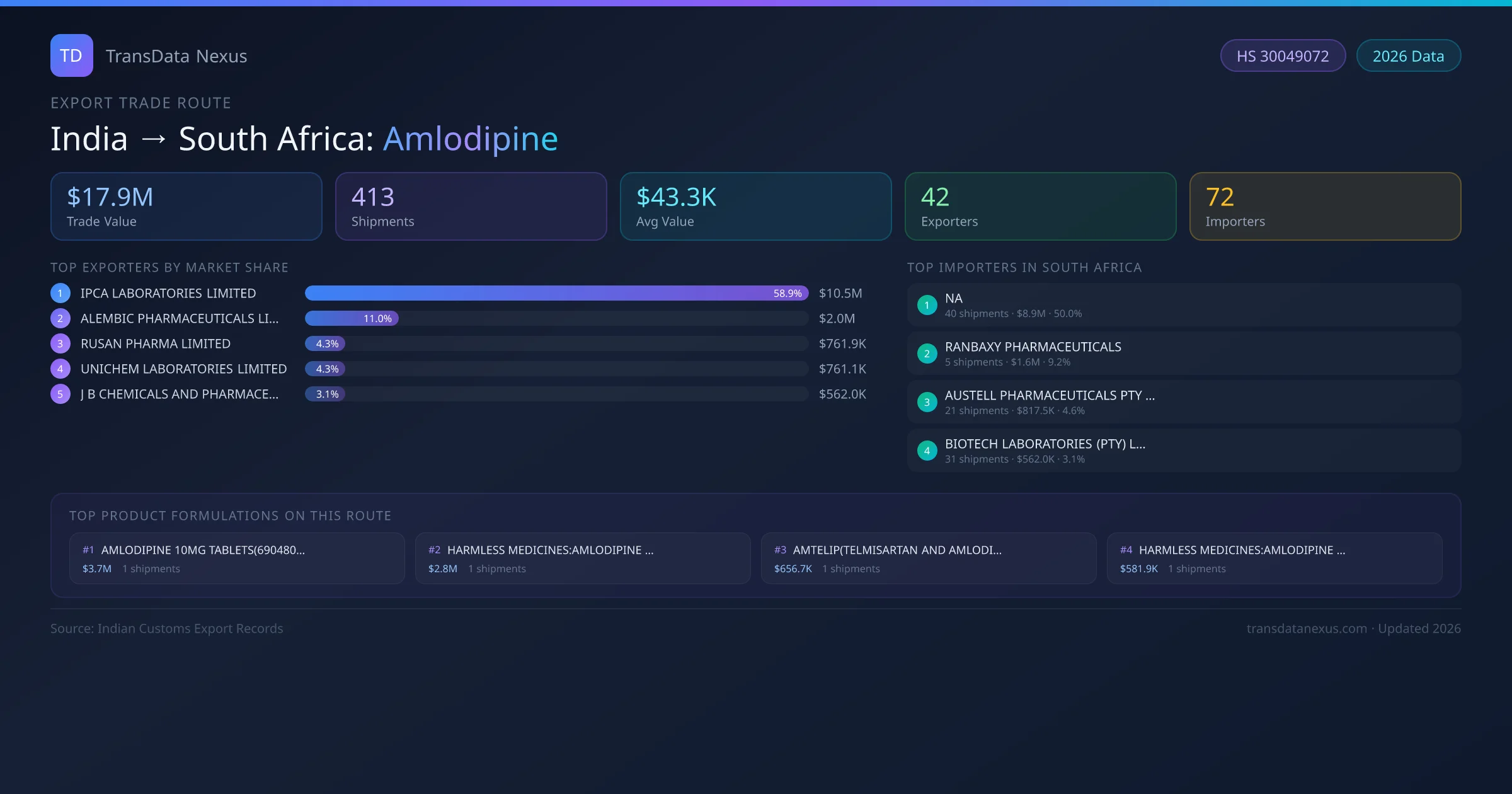
Route Intelligence Overview
The India to South Africa Amlodipine corridor is one of India's established pharmaceutical export routes, with 413 shipments documented worth a combined $17.9M USD. The route is dominated by IPCA LABORATORIES LIMITED, which alone accounts for roughly 59% of all export value, reflecting the consolidated nature of India's amlodipine manufacturing sector.
Across 42 active suppliers, the average shipment value stands at $43.3K USD — a figure that reflects both bulk commercial orders from large pharmaceutical companies and smaller specialty shipments. Sea freight dominates at 81% of all shipments, consistent with amlodipine's non-urgent bulk-order profile.
Shipment activity peaks during April–June, with an average transit time of 16 days port-to-port. The route has recorded an annual growth rate of 13.8%, placing it at rank #3 among India's top amlodipine export destinations globally.
On the import side, key buyers of Indian amlodipine in South Africa include NA, RANBAXY PHARMACEUTICALS, AUSTELL PHARMACEUTICALS PTY LTD and 69 others. NA is the single largest importer with 40 shipments valued at $8.9M USD.
Route Characteristics
- Average transit16 days
- Peak seasonQ2
- Primary modeSea freight
- Top portNHAVA SHEVA SEA (INNSA1)
Market Position
- Global rank#3
- Annual growth+13.8%
- Demand growth+12.1%
- Regulatory ease84/100
Top 10 Indian Amlodipine Exporters to South Africa
Showing top 10 of 42 Indian suppliers exporting Amlodipine to South Africa, ranked by total trade value (USD)
| Rank | Supplier (Indian Exporter) | Shipments | Total Value (USD) | Market Share |
|---|---|---|---|---|
| 1 | IPCA LABORATORIES LIMITED Avg $118.2K per shipment | 89 | $10.5M | 58.9% |
| 2 | ALEMBIC PHARMACEUTICALS LIMITED Avg $81.6K per shipment | 24 | $2.0M | 11.0% |
| 3 | RUSAN PHARMA LIMITED Avg $16.9K per shipment | 45 | $761.9K | 4.3% |
| 4 | UNICHEM LABORATORIES LIMITED Avg $38.1K per shipment | 20 | $761.1K | 4.3% |
| 5 | J B CHEMICALS AND PHARMACEUTICALS LIMITED Avg $18.1K per shipment | 31 | $562.0K | 3.1% |
| 6 | IPCA LABORATORIES LIMITED Avg $38.8K per shipment | 13 | $504.0K | 2.8% |
| 7 | QUALIGENS PHARMA PRIVATE LIMITED Avg $37.3K per shipment | 11 | $410.8K | 2.3% |
| 8 | CIPLA LIMITED Avg $21.6K per shipment | 13 | $281.0K | 1.6% |
| 9 | RUSAN PHARMA LIMITED Avg $22.6K per shipment | 12 | $271.0K | 1.5% |
| 10 | INTAS PHARMACEUTICALS LIMITED Avg $7.5K per shipment | 25 | $187.0K | 1.0% |
This table shows the top 10 of 42 Indian companies exporting amlodipine to South Africa, ranked by total trade value. The listed exporters are: IPCA LABORATORIES LIMITED, ALEMBIC PHARMACEUTICALS LIMITED, RUSAN PHARMA LIMITED, UNICHEM LABORATORIES LIMITED, J B CHEMICALS AND PHARMACEUTICALS LIMITED , IPCA LABORATORIES LIMITED , QUALIGENS PHARMA PRIVATE LIMITED, CIPLA LIMITED, RUSAN PHARMA LIMITED , INTAS PHARMACEUTICALS LIMITED. IPCA LABORATORIES LIMITED is the dominant supplier with 89 shipments worth $10.5M USD, giving it a 59% market share. The top 3 suppliers together account for 74% of the total trade value on this route.
Showing top 10 of 42 total Indian exporters on the India to South Africa Amlodipine export route.
Top 10 Amlodipine Importers in South Africa
Showing top 10 of 72 known buyers in South Africa receiving Amlodipine shipments from India, ranked by import value
On the receiving end of this trade route, the leading importers of Indian amlodipine in South Africa include NA, RANBAXY PHARMACEUTICALS, AUSTELL PHARMACEUTICALS PTY LTD, BIOTECH LABORATORIES (PTY) LTD , AUSTELL PHARMACEUTICALS PTY LIMITED, among 72 total buyers. The largest importer is NA, accounting for $8.9M USD across 40 shipments — representing 50% of all amlodipine imports from India on this route.
| Rank | Importer / Buyer | Shipments | Import Value (USD) | Market Share |
|---|---|---|---|---|
| 1 | NA | 40 | $8.9M | 50.0% |
| 2 | RANBAXY PHARMACEUTICALS | 5 | $1.6M | 9.2% |
| 3 | AUSTELL PHARMACEUTICALS PTY LTD | 21 | $817.5K | 4.6% |
| 4 | BIOTECH LABORATORIES (PTY) LTD | 31 | $562.0K | 3.1% |
| 5 | AUSTELL PHARMACEUTICALS PTY LIMITED | 13 | $558.8K | 3.1% |
| 6 | UNIMED HEALTHCARE ( PTY ) LTD | 30 | $443.6K | 2.5% |
| 7 | TO THE ORDER | 25 | $331.5K | 1.9% |
| 8 | AUSTELL PHARMACEUTICALS (PTY) LTD | 6 | $298.3K | 1.7% |
| 9 | MEDPRO PHARMACEUTICA PTY LTD | 13 | $281.0K | 1.6% |
| 10 | UNICHEM S A PTY LTD | 5 | $271.0K | 1.5% |
Showing top 10 of 72 Amlodipine importers in South Africa on this route.
Top 10 Amlodipine Formulations Imported by South Africa
Showing top 10 of 266 product formulations shipped on the India to South Africa Amlodipine route, ranked by trade value
South Africa imports a wide range of amlodipine formulations from India, spanning tablets, capsules, suspensions, and combination drugs. The top formulation — AMLODIPINE 10MG TABLETS(690480X2X14'S PACK =19333440 TABLETS) — accounts for $3.7M USD across 1 shipments. There are 266 distinct product descriptions in the dataset, reflecting the variety of dosage forms and strengths imported.
| Rank | Product Formulation | Shipments | Trade Value (USD) | Market Share |
|---|---|---|---|---|
| 1 | AMLODIPINE 10MG TABLETS(690480X2X14'S PACK =19333440 TABLETS) | 1 | $3.7M | 20.6% |
| 2 | HARMLESS MEDICINES:AMLODIPINE 10MG TABLETS(AUSTELL-AMLODIPINE 10MG TABLETS)(519090X2X14'S PACK =14534520 TABLETS) | 1 | $2.8M | 15.4% |
| 3 | AMTELIP(TELMISARTAN AND AMLODIPINE)40+5MG 3X10T BATCH NO.2305015869 MFG.DT.OCT2023 EXP.SEP2026 | 1 | $656.7K | 3.7% |
| 4 | HARMLESS MEDICINES:AMLODIPINE 10MG TABLETS(AUSTELL-AMLODIPINE 10MG TABLETS)(28660X3X10'S PACK =859800 TABLETS) | 1 | $581.9K | 3.3% |
| 5 | AMTELIP(TELMISARTAN AND AMLODIPINE)80+10MG 3X10T BATCH NO. 2305016084 MFG.DT.OCT2023 EXP.SEP2026 | 1 | $501.2K | 2.8% |
| 6 | AMTELIP(TELMISARTAN AND AMLODIPINE)80+5MG 3X10T BATCH NO. 2305015943 MFG.DT.OCT2023 EXP.SEP2026 | 1 | $465.6K | 2.6% |
| 7 | AMLODIPINE 10 BIOTECH TABS 28'S SA | 19 | $335.3K | 1.9% |
| 8 | HARMLESS MEDICINES:AMLODIPINE 5MG TABLETS(AUSTELL-AMLODIPINE 5MG TABLETS)(69450X2X14'S PACK =1944600 TABLETS) | 1 | $310.6K | 1.7% |
| 9 | HARMLESS MEDICINES Amlodipine 5mg Tabl | 8 | $242.4K | 1.4% |
| 10 | AMLODIPINE 5 BIOTECH TABS 28'S SA-PRP | 10 | $187.7K | 1.1% |
Showing top 10 of 266 Amlodipine formulations imported by South Africa on this route.
Shipping & Logistics Analysis
Freight mode split and port-of-origin breakdown
Freight Mode Distribution
Sea freight dominates at 81%, typical for bulk pharmaceutical shipments.
Top Ports of Origin
NHAVA SHEVA SEA (INNSA1) handles the highest volume with 85 shipments. Transit time averages 16 days by sea.
Market Dynamics
India's amlodipine exports to South Africa are driven primarily by a handful of large-scale manufacturers. IPCA LABORATORIES LIMITED with 89 shipments leads the pack, a pattern common in generic pharmaceutical corridors where manufacturing scale creates significant cost advantages. The presence of 42 active exporters signals a competitive but concentrated market — buyers in South Africa benefit from supplier diversity while the top tier handles the majority of volume.
The top 3 suppliers — IPCA LABORATORIES LIMITED, ALEMBIC PHARMACEUTICALS LIMITED, RUSAN PHARMA LIMITED — together account for 74% of total trade value on this route. The average shipment value of $43.3K USD reflects a mix of bulk commercial orders and smaller specialty shipments.
Beyond the primary product category, shipments on this route include closely related formulations such as harmless medicines:amlodipine 10mg tablets(austell-amlodipine 10mg tablets)(519090x2x14's pack =14534520 tablets) and amtelip(telmisartan and amlodipine)40+5mg 3x10t batch no.2305015869 mfg.dt.oct2023 exp.sep2026, suggesting that buyers in South Africa tend to consolidate orders across related product lines from the same Indian supplier.
On the buying side, NA is the largest importer with 40 shipments worth $8.9M USD — representing 50% of all amlodipine imports from India on this route. A total of 72 buyers are active on this corridor.
Route Statistics
- Trade Volume
- $17.9M
- Avg. Shipment
- $43.3K
- Suppliers
- 42
- Buyers
- 72
- Transit (Sea)
- ~16 days
- Annual Growth
- +13.8%
Related Analysis
Reverse Direction
South Africa → India — Amlodipine (Import)Other Amlodipine Routes
Unlock the Full India to South Africa Amlodipine Dataset
TransData Nexus provides verified shipment-level records, supplier contact details, HS code breakdowns, real-time pricing benchmarks, and regulatory compliance guides for 413 shipments on this route.
Live Corridor Intelligence
India → South Africa trade corridor intelligence
1Live Corridor Intelligence
As of March 2026, the India–South Africa pharmaceutical trade corridor is experiencing notable challenges due to global shipping disruptions. In late 2025, container freight prices underwent significant volatility, with rates on major routes dropping nearly 60–70% compared to the previous year. This fluctuation introduced risks such as disrupted delivery schedules and price wars among carriers. Industries, including pharmaceuticals, faced increased volatility, higher fuel costs, equipment shortages, and inland port bottlenecks. While lower shipping rates benefited manufacturers, they also introduced new risks, like disrupted delivery schedules and price wars among carriers. Businesses were urged to evaluate these shifts to protect supply chains and maintain competitiveness.
In early 2026, supply chain disruptions and escalating freight charges began to impact India's pharmaceutical exports to the Middle East, with potential losses estimated between ₹2,500 crore to ₹5,000 crore in March. Key markets like the UAE, Saudi Arabia, Oman, Kuwait, and Yemen, which are highly dependent on India for affordable medicines and generic formulations, were particularly affected. The ongoing challenges in the global freight market had the potential to significantly impact Indian pharmaceutical exports, particularly in regions like GCC countries and WANA.
Currency fluctuations have also influenced trade dynamics. The Indian Rupee (INR) and South African Rand (ZAR) have experienced volatility due to global economic uncertainties, affecting pricing strategies and profit margins for exporters and importers. Additionally, recent trade policy changes, including India's accelerated trade negotiations with the EU and the operationalization of the India–EFTA pact, signal stronger export potential for manufacturing and consumer goods sectors.
Geopolitical & Sanctions Impact
India → South Africa trade corridor intelligence
1Geopolitical & Sanctions Impact
Geopolitical factors have significantly impacted the India–South Africa pharmaceutical trade corridor. Global conflicts, particularly in the Middle East and Ukraine, have disrupted shipping routes between India and South Africa. Maritime carriers' booking suspensions and diversions around the Cape of Good Hope have elongated lead times and pressured Suez-linked lanes, disproportionately impacting time-sensitive pharmaceutical replenishment cycles. Freight inflation includes roughly doubled transport charges and $4,000–$8,000 per-shipment surcharges, while regional airspace closures constrain cargo hubs and force longer routings. Extended transit and congestion elevate cold-chain failure risk for vaccines and biologics, compounded by container and reefer imbalances that can impair temperature control and increase spoilage exposure.
These disruptions have led to increased insurance premiums and freight rates, affecting the overall cost structure of pharmaceutical exports. Operational resilience is being maintained via regional distributors, buffer inventories, and diversified logistics, while industry bodies pursue government engagement on freight relief and alternate corridors.
Trade Agreement & Policy Analysis
India → South Africa trade corridor intelligence
1Trade Agreement & Policy Analysis
As of March 2026, there is no comprehensive Free Trade Agreement (FTA) between India and South Africa. However, both nations are members of the World Trade Organization (WTO), adhering to its rules and regulations governing international trade. India has signed 15 Free Trade Agreements (FTAs) with various countries and regions, including the India–EFTA Trade and Economic Partnership Agreement, which entered into force on 1 October 2025.
Bilateral trade relations between India and South Africa have been strengthened through various agreements and initiatives. In December 2025, India and South Africa held a bilateral meeting to discuss trade facilitation measures, focusing on reducing non-tariff barriers and enhancing cooperation in the pharmaceutical sector. These discussions aimed to streamline regulatory processes and improve market access for pharmaceutical products.
Landed Cost Breakdown
India → South Africa trade corridor intelligence
1Landed Cost Breakdown
Estimating the landed cost components for Amlodipine formulations shipped from India to South Africa involves several factors:
- FOB Price: The Free on Board (FOB) price for Amlodipine formulations varies depending on the manufacturer and order volume. For instance, IPCA Laboratories Limited, a leading exporter, reported an export value of $10.5 million for Amlodipine formulations.
- Sea Freight Cost per Container: As of early 2026, sea freight rates have been volatile. In late 2025, container freight prices experienced sharp swings, with rates on major routes dropping nearly 60–70% compared to the previous year. This fluctuation introduced risks such as disrupted delivery schedules and price wars among carriers.
- Insurance: Insurance premiums have increased due to geopolitical tensions and shipping disruptions. Premiums can range from 0.5% to 1% of the shipment value, depending on risk assessments.
- Customs Duty: South Africa imposes customs duties on imported pharmaceuticals. The exact rate depends on the product classification under the Harmonized System (HS) code.
- Clearance Charges: Customs clearance charges in South Africa include documentation fees, inspection fees, and handling charges, typically amounting to approximately $500–$1,000 per shipment.
- VAT/GST: South Africa applies a Value Added Tax (VAT) of 15% on imported goods, calculated on the sum of the CIF (Cost, Insurance, and Freight) value and customs duty.
- Local Distribution: Local distribution costs encompass warehousing, transportation, and logistics within South Africa. These costs vary based on distance, infrastructure, and service providers but can add an additional 5–10% to the total landed cost.
Given the current market conditions, the total landed cost per unit of Amlodipine formulation is subject to fluctuations in freight rates, insurance premiums, and local charges. Exporters and importers are advised to monitor these variables closely to maintain cost-effectiveness in the supply chain.
South Africa Pharmaceutical Import Regulations
SAHPRA registration, GMP, and compliance requirements for Indian exporters
1SAHPRA Registration & Import Requirements
To import Amlodipine formulations into South Africa, the following approvals and registrations are mandatory:
- Product Registration: All medicines must be registered with SAHPRA before importation. The application should be submitted in the Common Technical Document (CTD) format, encompassing modules on administrative information, quality, safety, and efficacy.
- Dossier Submission: The registration dossier must include comprehensive data on the finished pharmaceutical product (FPP), including manufacturing processes, quality control measures, and stability studies.
- Timelines and Fees: While specific approval timelines and registration fees are subject to change, applicants should anticipate a thorough evaluation process. It's advisable to consult SAHPRA's latest guidelines or contact the authority directly for current information.
- GMP Compliance: Manufacturing facilities, including those in India, must comply with Good Manufacturing Practice (GMP) standards equivalent to those expected of South African manufacturers. Evidence of GMP compliance is required, and SAHPRA reserves the right to inspect overseas facilities to verify adherence.
2Quality & GMP Standards for Indian Exporters
Indian exporters of Amlodipine formulations must meet the following GMP standards to supply the South African market:
- GMP Certification: Facilities must hold GMP certifications that align with SAHPRA's standards. This includes compliance with the South African Guide to Good Manufacturing Practice (SA Guide to GMP).
- Facility Approval: SAHPRA requires evidence of GMP compliance for overseas manufacturers. In cases where acceptable evidence is unavailable, SAHPRA may conduct inspections of Indian manufacturing facilities before approving the registration of the medicine.
- Regulatory Actions: As of March 2026, there have been no publicly disclosed regulatory actions by SAHPRA against Indian pharmaceutical companies supplying Amlodipine formulations. However, manufacturers are advised to maintain stringent compliance to avoid potential inspections or sanctions.
3Recent Regulatory Developments (2024-2026)
Several regulatory changes and developments have occurred in the past 18 months affecting Indian pharmaceutical exports to South Africa:
- Revised GMP Standards in India: In January 2024, India's Ministry of Health published revised GMP regulations to align with global standards, particularly those of the World Health Organization (WHO). These revisions aim to enhance the quality of pharmaceuticals produced in India, thereby facilitating smoother exports to markets like South Africa.
- Enforcement of GMP Compliance: By December 2025, the Drugs Controller General of India (DCGI) mandated that all pharmaceutical companies comply with the updated GMP standards. Non-compliance could result in the closure of manufacturing units, underscoring the importance of adherence for exporters targeting the South African market.
- SAHPRA Guidelines on Importation: In April 2024, SAHPRA released updated guidelines on the importation and distribution of scheduled substances, emphasizing the necessity for importers to hold appropriate licenses and ensure that imported medicines meet SAHPRA's quality standards.
Staying informed about these regulatory developments is crucial for Indian exporters to ensure uninterrupted access to the South African pharmaceutical market.
South Africa Amlodipine Market Context & Tariffs
Market size, import duties, and competitive landscape · MFN tariff: 0%
1South Africa Amlodipine Market Size & Demand
Amlodipine, a calcium channel blocker used primarily to treat hypertension and angina, is a critical component of South Africa's pharmaceutical market. In 2024, the prevalence of hypertension among South African adults was approximately 35%, indicating a substantial demand for antihypertensive medications. The country's healthcare expenditure in 2024 was estimated at $30 billion, with a significant portion allocated to cardiovascular treatments. South Africa's aging population, with 9% over the age of 60 in 2024, further drives the demand for chronic disease medications like Amlodipine. While South Africa has a robust pharmaceutical manufacturing sector, it relies heavily on imports to meet the full demand for Amlodipine formulations. In 2024, domestic production accounted for approximately 40% of the market, with imports fulfilling the remaining 60%.
2Import Tariff & Duty Structure
Pharmaceutical products classified under HS code 30049072, including Amlodipine formulations, are subject to a 0% import duty in South Africa. This exemption aligns with the country's policy to facilitate access to essential medicines. Additionally, South Africa imposes a 15% Value-Added Tax (VAT) on imported goods, including pharmaceuticals. There are no specific Free Trade Agreements (FTAs) between India and South Africa that alter the tariff structure for pharmaceutical imports. Furthermore, there are no anti-dumping duties imposed on Amlodipine imports from India.
3Competitive Landscape
India is the predominant supplier of Amlodipine formulations to South Africa, accounting for approximately 60% of the total imports in 2024. Other significant suppliers include European Union countries, contributing around 25%, and China, supplying about 10%. India's competitive pricing, with an average import price of $0.45 per unit in 2024, is a key factor in its market dominance. In comparison, European manufacturers offered Amlodipine formulations at an average of $0.55 per unit, while Chinese products were priced at approximately $0.50 per unit. This pricing advantage, coupled with India's established pharmaceutical manufacturing capabilities, positions it as a leading supplier in the South African market.
Why Source Amlodipine from India for South Africa?
Manufacturing advantage, cost comparison, supply reliability, and strategic sourcing recommendations
1Why India for Amlodipine — Manufacturing Advantage
India is a global leader in the production of generic pharmaceuticals, accounting for approximately 20% of the global supply by volume. The country's pharmaceutical industry is supported by a vast network of manufacturing facilities, many of which are approved by international regulatory bodies. As of 2024, India had 396 facilities approved by the U.S. Food and Drug Administration (FDA), encompassing both Active Pharmaceutical Ingredients (API) and Finished Dosage Forms (FDF).
The production of Amlodipine formulations in India benefits from economies of scale, leading to cost advantages in the manufacturing of tablets, capsules, and syrups. This cost efficiency is further enhanced by the country's robust infrastructure and skilled workforce. Additionally, Indian manufacturers have a strong track record of compliance with Good Manufacturing Practices (GMP), ensuring the quality and safety of their pharmaceutical products.
2India vs. China vs. EU — Cost & Quality Comparison
When comparing the export prices of Amlodipine formulations, India offers competitive pricing. In Q2 2024, the price of Amlodipine Besylate in the United States was $72,000 per metric ton, while in China, it was $71,010 per metric ton. European manufacturers, particularly those producing branded generics, often have higher production costs, leading to higher prices for their formulations.
In terms of quality perception, Indian pharmaceutical products are widely accepted in South Africa, with numerous Indian manufacturers holding approvals from the South African Health Products Regulatory Authority (SAHPRA). The regulatory acceptance and established supply chains contribute to the reliability of Indian suppliers in the South African market.
3Supply Reliability & Capacity Assessment
The India-South Africa supply chain for Amlodipine formulations has demonstrated reliability, supported by India's substantial manufacturing capacity. Indian pharmaceutical companies have been investing in expanding their production facilities to meet global demand. For instance, in December 2025, Sun Pharma announced an investment of approximately $332 million to establish a new formulations manufacturing facility in Madhya Pradesh.
While there have been instances of regulatory scrutiny, such as the FDA's import alert on Sun Pharma's Halol facility in 2025, Indian manufacturers have been proactive in addressing compliance issues and implementing corrective actions to maintain supply reliability.
4Strategic Sourcing Recommendations
For South African buyers sourcing Amlodipine formulations from India, the following strategies are recommended:
- Dual-Sourcing Strategy: Engage with multiple Indian manufacturers to mitigate risks associated with supply disruptions and ensure a consistent supply chain.
- Minimum Order Quantities (MOQs): Negotiate MOQs that align with your demand forecasts to optimize inventory levels and reduce holding costs.
- Payment Terms: Establish clear payment terms, commonly including letters of credit or advance payments, to build trust and ensure timely transactions.
- Supplier Qualification Process: Conduct thorough due diligence, including facility audits and compliance checks, to ensure suppliers meet quality standards and regulatory requirements.
- Regulatory Compliance: Verify that the selected suppliers have the necessary approvals from both Indian and South African regulatory authorities to facilitate smooth importation and distribution.
Supplier Due Diligence Guide — Amlodipine from India
Pre-qualification checklist, document requirements, red flags, and audit guidance for South Africa buyers
1Pre-Qualification Checklist for South African Buyers
1. Verify SAHPRA Registration:
2. Assess GMP Certification:
3. Review Drug Master File (DMF):
4. Evaluate Quality Management Systems:
5. Confirm Regulatory Compliance:
6. Conduct Stability Studies:
7. Perform Risk Assessment:
2Key Documents to Request from Indian Suppliers
1. Certificate of Analysis (CoA):
2. Certificate of Origin (CoO):
3. GMP Certificate:
4. Stability Data:
5. Batch Manufacturing Records:
6. Drug Master File (DMF):
7. Free Sale Certificate:
8. Insurance Certificates:
3Red Flags & Warning Signs
1. Regulatory Non-Compliance:
2. Unrealistically Low Pricing:
3. Lack of Stability Data:
4. Limited Export History:
5. Resistance to Audits:
4Factory Audit & Ongoing Monitoring
1. Pre-Audit Desktop Review:
2. On-Site Inspection Focus Areas:
3. Post-Audit Corrective Actions:
4. Annual Re-Qualification Process:
5. Remote Monitoring Options:
Cost Estimates and Timeline:
- Audit Visits to India:
- Estimated cost: $10,000–$15,000 per audit, including travel, accommodation, and professional fees.
- Timeline: Approximately 4–6 weeks from planning to completion, depending on scheduling and travel logistics.
By adhering to this comprehensive supplier qualification framework, South African companies can ensure the procurement of high-quality Amlodipine formulations from reputable Indian manufacturers, safeguarding public health and maintaining regulatory compliance.
Frequently Asked Questions — India to South Africa Amlodipine Trade
Answers based on Indian Customs (DGFT) shipment records compiled by TransData Nexus
Q Which Indian companies export Amlodipine to South Africa?
The leading Indian exporters of Amlodipine to South Africa are IPCA LABORATORIES LIMITED, ALEMBIC PHARMACEUTICALS LIMITED, RUSAN PHARMA LIMITED. IPCA LABORATORIES LIMITED holds the largest market share at approximately 59% of total trade value on this route.
Q What is the total value of Amlodipine exports from India to South Africa?
India exports Amlodipine to South Africa worth approximately $17.9M USD across 413 recorded shipments. The average value per shipment is $43.3K USD.
Q Which ports does India use to ship Amlodipine to South Africa?
The most active port of origin is NHAVA SHEVA SEA (INNSA1) with 85 shipments. Indian exporters primarily use sea freight for this route, with 81% of shipments going by sea and 27% by air.
Q How long does shipping take from India to South Africa for Amlodipine?
The average transit time for Amlodipine shipments from India to South Africa is approximately 16 days. Sea freight typically takes longer, while air freight can reduce this significantly for urgent orders. Peak shipping activity is observed during April–June.
Q Is the India to South Africa Amlodipine trade route growing?
Yes — this trade corridor has seen an annual growth rate of approximately 13.8% with demand growth tracking at 12.1%. The route is ranked #3 among India's top Amlodipine export destinations globally.
Q How many suppliers are active on the India to South Africa Amlodipine route?
There are currently 42 active Indian suppliers exporting Amlodipine to South Africa. The market is moderately concentrated with IPCA LABORATORIES LIMITED accounting for 59% of total shipment value.
Q Who are the main importers of Amlodipine from India in South Africa?
The leading importers of Indian Amlodipine in South Africa include NA, RANBAXY PHARMACEUTICALS, AUSTELL PHARMACEUTICALS PTY LTD, BIOTECH LABORATORIES (PTY) LTD , AUSTELL PHARMACEUTICALS PTY LIMITED. NA is the largest buyer with 40 shipments worth $8.9M USD.
Official References & Regulatory Resources
- India Trade Statistics (DGFT)
- Invest India — Pharma Sector
- WCO HS Nomenclature
- Ministry of Commerce — Pharma Exports
- Pharmexcil
Data sourced from Indian Customs (DGFT) records. Verify regulatory and trade status with the agencies above.
Research Methodology & Data Transparency
Suresh Sormare
Verified AuthorPharmaceutical Export-Import Analyst & Trade Intelligence Expert
Suresh Sormare is a pharmaceutical export-import analyst with deep expertise in Indian Customs (DGFT) data, HS code classification, and global pharmaceutical supply chains. His analysis covers 10M+ shipment records across 150+ countries and is used by manufacturers, procurement agencies, and trade consultants worldwide. Suresh specializes in identifying verified suppliers and buyers from customs records, mapping bilateral pharmaceutical trade corridors, analyzing tariff structures and regulatory frameworks across 170+ destination markets, and benchmarking competitive positioning for finished pharmaceutical formulations. His methodology combines granular customs transaction data with regulatory intelligence from FDA, EMA, WHO, CDSCO, and 40+ national drug authorities to deliver actionable trade insights for the pharmaceutical formulations sector.
linkedin.com/in/sureshsormarePrimary Data Source
All trade data is sourced from Indian Customs (DGFT) official shipping bill records — the authoritative government database for India's pharmaceutical trade. Each verified record contains exporter name, consignee (buyer) name, detailed product description, quantity, declared FOB value (USD), port of loading, destination country, and shipment date.
Analysis Methodology
- 1.Route Identification: India to South Africa export trade corridor identified from Indian Customs (DGFT) records for Amlodipine.
- 2.Supplier/Buyer Matching: 42 Indian exporters and 72 importers in South Africa matched using name normalization.
- 3.Value Aggregation: Total export value aggregated from 413 verified shipping bill records. Values are FOB in USD.
- 4.Market Share Analysis: Each supplier and buyer contribution calculated as a percentage of total route value. Statistical normalization applied to ensure accurate representation across varying shipment sizes.
Government-Sourced Data
Official DGFT customs records
Transparent Methodology
Calculations fully disclosed above
413 Verified Shipments
42 Indian exporters tracked
Expert-Reviewed
By pharmaceutical trade specialists