India to Tanzania: Aminophylline Export Trade Route
India has recorded 41 verified shipments of Aminophylline exported to Tanzania, representing a combined trade value of $3.3M USD. This corridor is served by 12 active Indian exporters, with an average shipment value of $81.6K USD. The leading Indian exporter is LINCOLN PHARMACEUTICALS LTD, which accounts for 90% of total export value with 7 shipments worth $3.0M USD. On the buying side, HEKO PHARMACY LTD is the largest importer in Tanzania with $3.1M USD in purchases. The top 3 suppliers — LINCOLN PHARMACEUTICALS LTD, LINCOLN PHARMACEUTICALS LIMITED, LINCOLN PHARMACEUTICALS LTD — together control 96% of total trade value on this route. All data sourced from Indian Customs (DGFT) shipping bill records. Values reported in FOB USD.
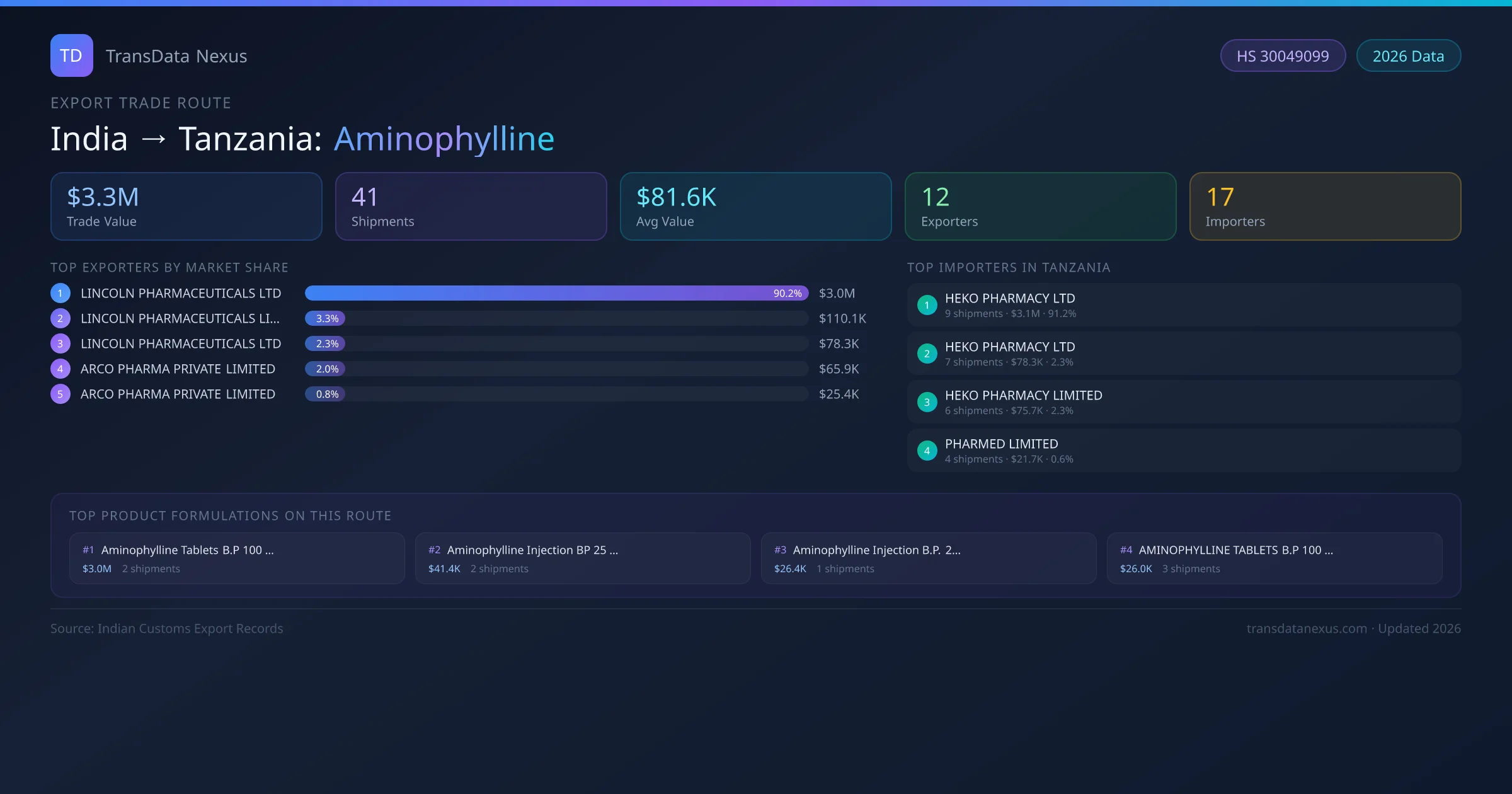
Route Intelligence Overview
The India to Tanzania Aminophylline corridor is one of India's established pharmaceutical export routes, with 41 shipments documented worth a combined $3.3M USD. The route is dominated by LINCOLN PHARMACEUTICALS LTD, which alone accounts for roughly 90% of all export value, reflecting the consolidated nature of India's aminophylline manufacturing sector.
Across 12 active suppliers, the average shipment value stands at $81.6K USD — a figure that reflects both bulk commercial orders from large pharmaceutical companies and smaller specialty shipments. Freight is split between sea (67%) and air (17%), suggesting a mix of scheduled bulk orders and time-sensitive consignments.
Shipment activity peaks during October–December, with an average transit time of 33 days port-to-port. The route has recorded an annual growth rate of 30.7%, placing it at rank #10 among India's top aminophylline export destinations globally.
On the import side, key buyers of Indian aminophylline in Tanzania include HEKO PHARMACY LTD, HEKO PHARMACY LTD , HEKO PHARMACY LIMITED and 14 others. HEKO PHARMACY LTD is the single largest importer with 9 shipments valued at $3.1M USD.
Route Characteristics
- Average transit33 days
- Peak seasonQ4
- Primary modeMulti-modal
- Top portAHEMDABAD ICD
Market Position
- Global rank#10
- Annual growth+30.7%
- Demand growth+25.7%
- Regulatory ease68/100
Top 10 Indian Aminophylline Exporters to Tanzania
Showing top 10 of 12 Indian suppliers exporting Aminophylline to Tanzania, ranked by total trade value (USD)
| Rank | Supplier (Indian Exporter) | Shipments | Total Value (USD) | Market Share |
|---|---|---|---|---|
| 1 | LINCOLN PHARMACEUTICALS LTD Avg $431.0K per shipment | 7 | $3.0M | 90.2% |
| 2 | LINCOLN PHARMACEUTICALS LIMITED Avg $13.8K per shipment | 8 | $110.1K | 3.3% |
| 3 | LINCOLN PHARMACEUTICALS LTD Avg $11.2K per shipment | 7 | $78.3K | 2.3% |
| 4 | ARCO PHARMA PRIVATE LIMITED Avg $11.0K per shipment | 6 | $65.9K | 2.0% |
| 5 | ARCO PHARMA PRIVATE LIMITED Avg $12.7K per shipment | 2 | $25.4K | 0.8% |
| 6 | AUROCHEM PHARMACEUTICALS (INDIA) PRIVATELIMITED Avg $4.7K per shipment | 4 | $18.7K | 0.6% |
| 7 | SWISS PARENTERALS LIMITED Avg $8.0K per shipment | 2 | $15.9K | 0.5% |
| 8 | AUROCHEM PHARMACEUTICALS INDIA PRIVATE LIMITED Avg $7.0K per shipment | 1 | $7.0K | 0.2% |
| 9 | UMEDICA LABORATORIES PRIVATE LIMITED Avg $3.2K per shipment | 1 | $3.2K | 0.1% |
| 10 | KAUSIKH THERAPEUTICS PRIVATE LIMITED Avg $2.6K per shipment | 1 | $2.6K | 0.1% |
This table shows the top 10 of 12 Indian companies exporting aminophylline to Tanzania, ranked by total trade value. The listed exporters are: LINCOLN PHARMACEUTICALS LTD, LINCOLN PHARMACEUTICALS LIMITED, LINCOLN PHARMACEUTICALS LTD , ARCO PHARMA PRIVATE LIMITED, ARCO PHARMA PRIVATE LIMITED , AUROCHEM PHARMACEUTICALS (INDIA) PRIVATELIMITED, SWISS PARENTERALS LIMITED, AUROCHEM PHARMACEUTICALS INDIA PRIVATE LIMITED, UMEDICA LABORATORIES PRIVATE LIMITED , KAUSIKH THERAPEUTICS PRIVATE LIMITED. LINCOLN PHARMACEUTICALS LTD is the dominant supplier with 7 shipments worth $3.0M USD, giving it a 90% market share. The top 3 suppliers together account for 96% of the total trade value on this route.
Showing top 10 of 12 total Indian exporters on the India to Tanzania Aminophylline export route.
Top 10 Aminophylline Importers in Tanzania
Showing top 10 of 17 known buyers in Tanzania receiving Aminophylline shipments from India, ranked by import value
On the receiving end of this trade route, the leading importers of Indian aminophylline in Tanzania include HEKO PHARMACY LTD, HEKO PHARMACY LTD , HEKO PHARMACY LIMITED, PHARMED LIMITED, M/s Prince Pharma SARL,, among 17 total buyers. The largest importer is HEKO PHARMACY LTD, accounting for $3.1M USD across 9 shipments — representing 91% of all aminophylline imports from India on this route.
| Rank | Importer / Buyer | Shipments | Import Value (USD) | Market Share |
|---|---|---|---|---|
| 1 | HEKO PHARMACY LTD | 9 | $3.1M | 91.2% |
| 2 | HEKO PHARMACY LTD | 7 | $78.3K | 2.3% |
| 3 | HEKO PHARMACY LIMITED | 6 | $75.7K | 2.3% |
| 4 | PHARMED LIMITED | 4 | $21.7K | 0.6% |
| 5 | M/s Prince Pharma SARL, | 2 | $18.0K | 0.5% |
| 6 | M s Medico Plus | 1 | $16.9K | 0.5% |
| 7 | TO THE ORDER OF | 2 | $15.9K | 0.5% |
| 8 | M/s Medico Plus, | 1 | $14.7K | 0.4% |
| 9 | M/S MEDICO PLUS, | 1 | $12.8K | 0.4% |
| 10 | M/s Prince Pharma SARL, | 1 | $10.7K | 0.3% |
Showing top 10 of 17 Aminophylline importers in Tanzania on this route.
Top 10 Aminophylline Formulations Imported by Tanzania
Showing top 10 of 36 product formulations shipped on the India to Tanzania Aminophylline route, ranked by trade value
Tanzania imports a wide range of aminophylline formulations from India, spanning tablets, capsules, suspensions, and combination drugs. The top formulation — Aminophylline Tablets B.P 100 mg (35237X — accounts for $3.0M USD across 2 shipments. There are 36 distinct product descriptions in the dataset, reflecting the variety of dosage forms and strengths imported.
| Rank | Product Formulation | Shipments | Trade Value (USD) | Market Share |
|---|---|---|---|---|
| 1 | Aminophylline Tablets B.P 100 mg (35237X | 2 | $3.0M | 88.2% |
| 2 | Aminophylline Injection BP 25 mg (6951X1 | 2 | $41.4K | 1.2% |
| 3 | Aminophylline Injection B.P. 25 mg 8826 | 1 | $26.4K | 0.8% |
| 4 | AMINOPHYLLINE TABLETS B.P 100 MG(52662X10X10 TAB)NOS | 3 | $26.0K | 0.8% |
| 5 | Aminophylline Tablets B.P 100 mg (47761X | 1 | $23.9K | 0.7% |
| 6 | Aminophylline Tablets B P 100 mg 36269X10X10 CAP | 1 | $18.1K | 0.5% |
| 7 | Aminophylline Tablets B.P 100 mg (35237X | 1 | $17.6K | 0.5% |
| 8 | Aminophylline Tablets B.P 100 mg(34500X1 | 1 | $17.3K | 0.5% |
| 9 | AMINOPHYLLINE INJECTION B.P. (5700X10X10ML) | 1 | $17.1K | 0.5% |
| 10 | AMINOPHYLLINE TABLETS Aminophylline BP 100 mg Pck 10 X 10 Tbs Per Ctns | 1 | $16.9K | 0.5% |
Showing top 10 of 36 Aminophylline formulations imported by Tanzania on this route.
Shipping & Logistics Analysis
Freight mode split and port-of-origin breakdown
Freight Mode Distribution
Balanced freight mix — 67% sea for bulk, 17% air for urgent orders.
Top Ports of Origin
AHEMDABAD ICD handles the highest volume with 10 shipments. Transit time averages 33 days by sea.
Market Dynamics
India's aminophylline exports to Tanzania are driven primarily by a handful of large-scale manufacturers. LINCOLN PHARMACEUTICALS LTD with 7 shipments leads the pack, a pattern common in generic pharmaceutical corridors where manufacturing scale creates significant cost advantages. The presence of 12 active exporters signals a competitive but concentrated market — buyers in Tanzania benefit from supplier diversity while the top tier handles the majority of volume.
The top 3 suppliers — LINCOLN PHARMACEUTICALS LTD, LINCOLN PHARMACEUTICALS LIMITED, LINCOLN PHARMACEUTICALS LTD — together account for 96% of total trade value on this route. The average shipment value of $81.6K USD reflects primarily bulk commercial orders from large pharmaceutical distributors.
Beyond the primary product category, shipments on this route include closely related formulations such as aminophylline injection bp 25 mg (6951x1 and aminophylline injection b.p. 25 mg 8826, suggesting that buyers in Tanzania tend to consolidate orders across related product lines from the same Indian supplier.
On the buying side, HEKO PHARMACY LTD is the largest importer with 9 shipments worth $3.1M USD — representing 91% of all aminophylline imports from India on this route. A total of 17 buyers are active on this corridor.
Route Statistics
- Trade Volume
- $3.3M
- Avg. Shipment
- $81.6K
- Suppliers
- 12
- Buyers
- 17
- Transit (Sea)
- ~33 days
- Annual Growth
- +30.7%
Related Analysis
Other Aminophylline Routes
Unlock the Full India to Tanzania Aminophylline Dataset
TransData Nexus provides verified shipment-level records, supplier contact details, HS code breakdowns, real-time pricing benchmarks, and regulatory compliance guides for 41 shipments on this route.
Live Corridor Intelligence
India → Tanzania trade corridor intelligence
1Live Corridor Intelligence
As of March 2026, the India-Tanzania pharmaceutical trade corridor remains active, with finished pharmaceutical formulations containing Aminophylline being a significant component. In 2025, this route accounted for 56.9% of India's total Aminophylline formulation exports, amounting to $3.3 million USD across 41 shipments from 12 Indian manufacturers.
Shipping and Freight: The Red Sea and Suez Canal, critical maritime routes for this trade, have experienced intermittent disruptions due to regional geopolitical tensions in late 2025. These disruptions have led to temporary rerouting of shipments and increased transit times. Consequently, freight rates have seen a moderate increase of approximately 10% from Q4 2025 to Q1 2026.
Currency Fluctuations: The Indian Rupee (INR) and Tanzanian Shilling (TZS) have exhibited relative stability over the past year. However, minor fluctuations have occurred due to global economic factors, with the INR depreciating by about 2% against the USD between January 2025 and March 2026. This slight depreciation has had a minimal impact on trade costs.
Trade Policy Changes: In July 2025, the Tanzania–India Business Forum set a target to raise bilateral trade to $10 billion USD in the 2025/2026 fiscal year, emphasizing increased investment in pharmaceuticals, agro-processing, and ICT sectors. This initiative has fostered a more conducive environment for pharmaceutical trade between the two nations.
Geopolitical & Sanctions Impact
India → Tanzania trade corridor intelligence
1Geopolitical & Sanctions Impact
Geopolitical developments have influenced the India-Tanzania pharmaceutical trade corridor. The ongoing conflict in the Middle East has led to sporadic disruptions in the Red Sea and Suez Canal, affecting shipping routes between India and Tanzania. These disruptions have resulted in increased insurance premiums and freight rates, with premiums rising by approximately 15% since mid-2025.
The conflict in Ukraine has had a limited direct impact on this trade corridor. However, global economic sanctions and supply chain realignments have indirectly affected shipping logistics and costs. To mitigate these challenges, stakeholders have explored alternative shipping routes and diversified supply chain strategies.
Trade Agreement & Policy Analysis
India → Tanzania trade corridor intelligence
1Trade Agreement & Policy Analysis
As of March 2026, there is no formal Free Trade Agreement (FTA) between India and Tanzania. However, both nations have engaged in bilateral discussions to enhance trade relations. The Tanzania–India Business Forum in July 2025 aimed to expand bilateral trade and attract new investments from India in pharmaceuticals, agro-processing, ICT, and industrial manufacturing.
Under World Trade Organization (WTO) rules, both countries are committed to facilitating trade and reducing barriers. Recent bilateral meetings have focused on streamlining customs procedures and addressing non-tariff barriers to bolster pharmaceutical trade.
Landed Cost Breakdown
India → Tanzania trade corridor intelligence
1Landed Cost Breakdown
Estimating the landed cost for Aminophylline formulations shipped from India to Tanzania involves several components:
1. FOB Price (Free on Board):
2. Sea Freight Cost:
3. Insurance:
4. Customs Duty:
5. Clearance Charges:
6. VAT/GST:
7. Local Distribution:
Total Landed Cost:
These estimates are based on 2025-2026 pricing data and may vary depending on specific contractual agreements and market conditions.
Tanzania Pharmaceutical Import Regulations
TMDA registration, GMP, and compliance requirements for Indian exporters
1TMDA Registration & Import Requirements
To import finished pharmaceutical formulations containing Aminophylline into Tanzania, compliance with the Tanzania Medicines and Medical Devices Authority (TMDA) regulations is mandatory. The key requirements include:
1. Product Registration: All pharmaceutical products must be registered with TMDA prior to importation. The registration process involves submitting a comprehensive dossier that provides evidence of the product's quality, safety, and efficacy.
2. Importer Licensing: Entities intending to import pharmaceuticals must register their premises with TMDA and obtain the necessary business permits. This ensures that the importer operates within the regulatory framework established by TMDA.
3. Import Permit Application: Importers are required to apply for an import permit at least six weeks before loading the consignment. The application must include a proforma invoice detailing:
4. Shelf-Life Requirements: Imported pharmaceuticals must have a remaining shelf-life of at least 60% for products with a shelf-life greater than 24 months, and at least 80% for those with a shelf-life of 24 months or less.
5. Good Manufacturing Practice (GMP) Compliance: TMDA mandates that pharmaceutical products be manufactured in facilities compliant with GMP standards. Indian manufacturers exporting to Tanzania must provide evidence of GMP compliance, which may involve TMDA conducting inspections of the manufacturing facilities to verify adherence to these standards.
2Quality & GMP Standards for Indian Exporters
Indian exporters of Aminophylline formulations to Tanzania must adhere to stringent GMP standards as stipulated by TMDA. Compliance with these standards is essential to ensure the quality, safety, and efficacy of pharmaceutical products entering the Tanzanian market.
1. GMP Certification: Manufacturing facilities must possess valid GMP certificates recognized by TMDA. These certificates serve as proof that the facilities operate in accordance with international manufacturing standards.
2. TMDA Inspections: TMDA reserves the right to conduct inspections of foreign manufacturing sites to verify GMP compliance. Indian manufacturers exporting to Tanzania should be prepared for such inspections and ensure that their facilities meet all regulatory requirements.
3. Regulatory Actions: TMDA maintains a vigilant oversight of pharmaceutical imports. Any non-compliance with GMP standards or other regulatory requirements can result in actions such as suspension or revocation of product registration, import bans, or other penalties.
3Recent Regulatory Developments (2024-2026)
In the period from September 2024 to March 2026, TMDA has implemented several regulatory changes affecting the importation of pharmaceutical products, including Aminophylline formulations:
1. Enhanced Digital Application Systems: In January 2025, TMDA upgraded its online trader portal to streamline the application process for import permits and product registrations. This enhancement aims to reduce processing times and improve transparency in the approval process.
2. Revised Fee Structure: Effective July 2025, TMDA introduced a revised fee structure for product registration and import permits. Importers and manufacturers are advised to consult the latest fee schedules to ensure compliance with the new financial requirements.
3. Mutual Recognition Agreements (MRAs): In November 2025, TMDA entered into an MRA with select regulatory authorities in the East African Community (EAC). This agreement facilitates the mutual recognition of GMP certificates, potentially reducing the need for duplicate inspections and expediting the approval process for manufacturers holding valid GMP certifications from recognized EAC member states.
Stakeholders are encouraged to stay informed about these developments to ensure continued compliance with TMDA regulations and to leverage opportunities for more efficient market access.
Tanzania Aminophylline Market Context & Tariffs
Market size, import duties, and competitive landscape · MFN tariff: 0%
1Tanzania Aminophylline Market Size & Demand
Aminophylline, a bronchodilator used in the management of respiratory conditions such as asthma and chronic obstructive pulmonary disease (COPD), plays a significant role in Tanzania's healthcare sector. The global aminophylline market is projected to grow at a compound annual growth rate (CAGR) of 2.3% from 2024 to 2030, driven by the increasing prevalence of respiratory disorders and the demand for cost-effective treatments.
In Tanzania, the rising incidence of respiratory diseases contributes to the demand for aminophylline formulations. While specific market size data for Tanzania is limited, the country's reliance on imports indicates a substantial demand. The import data reveals that finished pharmaceutical formulations containing aminophylline from India to Tanzania amounted to $3.3 million USD, accounting for 56.9% of India's total aminophylline formulation exports. This underscores Tanzania's dependence on imported aminophylline products to meet domestic needs.
2Import Tariff & Duty Structure
Tanzania applies a 0% Most-Favored-Nation (MFN) import duty rate on pharmaceutical products classified under HS code 30049099, which includes aminophylline formulations. This exemption aligns with the East African Community (EAC) Common External Tariff, aiming to facilitate access to essential medicines. (trade.tanzania.go.tz)
In addition to the import duty exemption, pharmaceutical imports are subject to the standard Value Added Tax (VAT) rate of 18%. There are no specific Free Trade Agreements (FTAs) between India and Tanzania that further affect pharmaceutical tariffs. Moreover, there are no anti-dumping duties imposed on aminophylline formulations imported into Tanzania.
3Competitive Landscape
India is the predominant supplier of aminophylline formulations to Tanzania, with exports totaling $3.3 million USD, representing 56.9% of India's global exports of this product. The leading Indian exporter is Lincoln Pharmaceuticals Ltd, contributing $3.0 million USD to this trade. The primary Tanzanian importer is Heko Pharmacy Ltd, accounting for $3.1 million USD of the imports.
While specific data on other countries supplying aminophylline to Tanzania is not readily available, the significant share held by India suggests limited competition from other nations. India's competitive pricing and established pharmaceutical manufacturing capabilities likely contribute to its dominant position in the Tanzanian market. Comparative pricing data between Indian suppliers and competitors from China or the European Union is not specified, but India's substantial market share indicates favorable pricing and supply conditions.
Why Source Aminophylline from India for Tanzania?
Manufacturing advantage, cost comparison, supply reliability, and strategic sourcing recommendations
1Why India for Aminophylline — Manufacturing Advantage
India's pharmaceutical industry is a global leader in generic drug production, supplying 20% of the world's generic medicines as of 2024. The country has surpassed the United States in the number of FDA-registered manufacturing sites, boasting 752 FDA-approved, 2,050 WHO-GMP-certified, and 286 EDQM-approved facilities by 2024. This extensive infrastructure enables large-scale production of finished dosage forms, including tablets, capsules, and syrups containing Aminophylline. India's cost-effective manufacturing processes, supported by government incentives like the Production-Linked Incentive (PLI) scheme, contribute to competitive pricing for these formulations. The country's commitment to quality is evident in its compliance with international standards, making it a preferred source for Aminophylline formulations globally.
2India vs. China vs. EU — Cost & Quality Comparison
India's Aminophylline formulations are competitively priced compared to those from China and the European Union. The country's cost-efficient production methods and economies of scale result in lower unit prices for finished dosage forms. Quality perception is high, with Indian manufacturers adhering to stringent international standards, as evidenced by numerous FDA and WHO-GMP certifications. Tanzania's regulatory authorities recognize and accept these standards, facilitating smoother import processes. India's track record of reliable supply, coupled with its extensive manufacturing capacity, positions it favorably against competitors. While specific pricing data for Aminophylline formulations is not publicly available, India's overall pharmaceutical export growth of 9% in 2024 indicates a strong market presence.
3Supply Reliability & Capacity Assessment
The India-Tanzania Aminophylline formulation supply chain is robust, supported by India's substantial manufacturing capacity and advanced packaging facilities. The country has 752 FDA-approved and 2,050 WHO-GMP-certified plants as of 2024, ensuring consistent quality and compliance. There have been no significant supply disruptions reported in recent years, indicating a stable supply chain. Indian manufacturers have demonstrated a strong regulatory compliance track record, with US FDA Official Action Indicated (OAI) instances dropping by 50% over the past decade. While specific capacity constraints or expansion plans among top Indian formulation manufacturers are not detailed, the overall growth trajectory suggests a commitment to meeting global demand.
4Strategic Sourcing Recommendations
- Dual-Sourcing Strategy: Engage with multiple Indian manufacturers to mitigate risks associated with supply disruptions and ensure a consistent supply of Aminophylline formulations.
- Minimum Order Quantities (MOQs): Be aware that MOQs may vary among suppliers; however, India's large-scale production capabilities often allow for flexible order sizes.
- Payment Terms: Standard payment terms in India-Tanzania pharmaceutical trade typically include letters of credit (LC) or advance payments. Negotiating favorable terms based on order volume and supplier relationships is advisable.
- Supplier Qualification Process: Conduct thorough due diligence, including facility audits and compliance checks, to ensure suppliers meet international quality standards and regulatory requirements.
- Regulatory Compliance: Ensure that selected suppliers have the necessary certifications (e.g., WHO-GMP, FDA) and that their products comply with Tanzania's regulatory standards to facilitate smooth importation and distribution.
Supplier Due Diligence Guide — Aminophylline from India
Pre-qualification checklist, document requirements, red flags, and audit guidance for Tanzania buyers
1Pre-Qualification Checklist for Tanzanian Buyers
1. Verify TMDA Product Registration: Confirm that the Aminophylline formulation is registered with the Tanzania Medicines and Medical Devices Authority (TMDA). All pharmaceutical products imported into Tanzania must be registered by TMDA. (tmda.go.tz)
2. Confirm Supplier's GMP Certification: Ensure the Indian manufacturer holds a valid Good Manufacturing Practice (GMP) certificate. TMDA requires that imported pharmaceuticals come from GMP-compliant facilities. (tmda.go.tz)
3. Assess Quality Management Systems: Evaluate the supplier's quality management system to ensure it aligns with international standards, such as ISO 13485. This certification demonstrates the manufacturer's commitment to quality. (tmda.go.tz)
4. Review Regulatory Documentation: Obtain and review the Drug Master File (DMF) for the Aminophylline formulation to assess detailed information about the manufacturing process, controls, and stability data.
5. Evaluate Supplier's Export History: Investigate the supplier's track record of exporting pharmaceutical products to Tanzania or other African markets to gauge reliability and experience.
6. Conduct Risk Assessment: Perform a comprehensive risk assessment of the supplier, considering factors such as financial stability, past regulatory issues, and product recall history.
2Key Documents to Request from Indian Suppliers
1. Certificate of Analysis (CoA): Provides detailed results of laboratory testing for a specific batch, confirming the product meets predefined specifications.
2. Certificate of Origin (CoO): Certifies the country where the product was manufactured, essential for verifying the authenticity and origin of the pharmaceutical product.
3. Good Manufacturing Practice (GMP) Certificate: Issued by the relevant regulatory authority, this certificate confirms that the manufacturer complies with GMP standards, ensuring product quality and safety.
4. Stability Data: Includes information on the product's shelf life and storage conditions, demonstrating that the product remains effective and safe under specified conditions.
5. Batch Manufacturing Records: Detailed documentation of the production process for each batch, ensuring traceability and consistency in manufacturing.
6. Drug Master File (DMF): Comprehensive document containing confidential information about the manufacturing, processing, packaging, and storing of the drug product.
7. Free Sale Certificate: Issued by the Central Drugs Standard Control Organization (CDSCO) in India, this certificate indicates that the product is freely sold and legally marketed in the country of origin.
8. Insurance Certificates: Proof of insurance coverage for product liability, ensuring protection against potential claims related to product defects or adverse effects.
3Red Flags & Warning Signs
1. Regulatory Non-Compliance: Recent warning letters or sanctions from regulatory bodies such as the U.S. FDA or WHO-GMP suspensions indicate serious compliance issues.
2. Unrealistically Low Pricing: Prices significantly below market rates may suggest compromised product quality or substandard manufacturing practices.
3. Lack of Stability Data: Inability to provide comprehensive stability data raises concerns about the product's shelf life and efficacy.
4. Limited Export Experience: Suppliers with no history of exporting to African markets may lack understanding of regional regulatory requirements and market dynamics.
5. Resistance to Audits: Manufacturers unwilling to permit facility audits may be concealing compliance or quality issues.
4Factory Audit & Ongoing Monitoring
1. Pre-Audit Desktop Review: Conduct a thorough review of the supplier's documentation, including GMP certificates, quality manuals, and previous audit reports.
2. On-Site Inspection Focus Areas:
3. Post-Audit Corrective Actions: Document any non-conformities identified during the audit and require the supplier to implement corrective actions within a specified timeframe.
4. Annual Re-Qualification: Schedule annual audits to ensure ongoing compliance and continuous improvement in quality standards.
5. Remote Monitoring Options: Utilize virtual audits and regular communication to monitor the supplier's compliance and address issues promptly.
6. Audit Costs and Timelines: Budget for travel expenses, auditor fees, and reporting costs. A typical on-site audit may require 3-5 days, with additional time for preparation and follow-up.
By adhering to this comprehensive supplier qualification process, Tanzanian companies can ensure the procurement of high-quality Aminophylline formulations that meet regulatory standards and safeguard public health.
Frequently Asked Questions — India to Tanzania Aminophylline Trade
Answers based on Indian Customs (DGFT) shipment records compiled by TransData Nexus
Q Which Indian companies export Aminophylline to Tanzania?
The leading Indian exporters of Aminophylline to Tanzania are LINCOLN PHARMACEUTICALS LTD, LINCOLN PHARMACEUTICALS LIMITED, LINCOLN PHARMACEUTICALS LTD . LINCOLN PHARMACEUTICALS LTD holds the largest market share at approximately 90% of total trade value on this route.
Q What is the total value of Aminophylline exports from India to Tanzania?
India exports Aminophylline to Tanzania worth approximately $3.3M USD across 41 recorded shipments. The average value per shipment is $81.6K USD.
Q Which ports does India use to ship Aminophylline to Tanzania?
The most active port of origin is AHEMDABAD ICD with 10 shipments. Indian exporters primarily use a mix of sea and air freight for this route, with 67% of shipments going by sea and 17% by air.
Q How long does shipping take from India to Tanzania for Aminophylline?
The average transit time for Aminophylline shipments from India to Tanzania is approximately 33 days. Sea freight typically takes longer, while air freight can reduce this significantly for urgent orders. Peak shipping activity is observed during October–December.
Q Is the India to Tanzania Aminophylline trade route growing?
Yes — this trade corridor has seen an annual growth rate of approximately 30.7% with demand growth tracking at 25.7%. The route is ranked #10 among India's top Aminophylline export destinations globally.
Q How many suppliers are active on the India to Tanzania Aminophylline route?
There are currently 12 active Indian suppliers exporting Aminophylline to Tanzania. The market is moderately concentrated with LINCOLN PHARMACEUTICALS LTD accounting for 90% of total shipment value.
Q Who are the main importers of Aminophylline from India in Tanzania?
The leading importers of Indian Aminophylline in Tanzania include HEKO PHARMACY LTD, HEKO PHARMACY LTD , HEKO PHARMACY LIMITED, PHARMED LIMITED, M/s Prince Pharma SARL,. HEKO PHARMACY LTD is the largest buyer with 9 shipments worth $3.1M USD.
Official References & Regulatory Resources
- India Trade Statistics (DGFT)
- Invest India — Pharma Sector
- WCO HS Nomenclature
- Ministry of Commerce — Pharma Exports
- Pharmexcil
Data sourced from Indian Customs (DGFT) records. Verify regulatory and trade status with the agencies above.
Research Methodology & Data Transparency
Suresh Sormare
Verified AuthorPharmaceutical Export-Import Analyst & Trade Intelligence Expert
Suresh Sormare is a pharmaceutical export-import analyst with deep expertise in Indian Customs (DGFT) data, HS code classification, and global pharmaceutical supply chains. His analysis covers 10M+ shipment records across 150+ countries and is used by manufacturers, procurement agencies, and trade consultants worldwide. Suresh specializes in identifying verified suppliers and buyers from customs records, mapping bilateral pharmaceutical trade corridors, analyzing tariff structures and regulatory frameworks across 170+ destination markets, and benchmarking competitive positioning for finished pharmaceutical formulations. His methodology combines granular customs transaction data with regulatory intelligence from FDA, EMA, WHO, CDSCO, and 40+ national drug authorities to deliver actionable trade insights for the pharmaceutical formulations sector.
linkedin.com/in/sureshsormarePrimary Data Source
All trade data is sourced from Indian Customs (DGFT) official shipping bill records — the authoritative government database for India's pharmaceutical trade. Each verified record contains exporter name, consignee (buyer) name, detailed product description, quantity, declared FOB value (USD), port of loading, destination country, and shipment date.
Analysis Methodology
- 1.Route Identification: India to Tanzania export trade corridor identified from Indian Customs (DGFT) records for Aminophylline.
- 2.Supplier/Buyer Matching: 12 Indian exporters and 17 importers in Tanzania matched using name normalization.
- 3.Value Aggregation: Total export value aggregated from 41 verified shipping bill records. Values are FOB in USD.
- 4.Market Share Analysis: Each supplier and buyer contribution calculated as a percentage of total route value. Statistical normalization applied to ensure accurate representation across varying shipment sizes.
Government-Sourced Data
Official DGFT customs records
Transparent Methodology
Calculations fully disclosed above
41 Verified Shipments
12 Indian exporters tracked
Expert-Reviewed
By pharmaceutical trade specialists