India to Mexico: Amino Export Trade Route
India has recorded 77 verified shipments of Amino exported to Mexico, representing a combined trade value of $7.9M USD. This corridor is served by 5 active Indian exporters, with an average shipment value of $102.7K USD. The leading Indian exporter is SRI KRISHNA PHARMACEUTICALS LIMITED, which accounts for 84% of total export value with 61 shipments worth $6.6M USD. On the buying side, TO is the largest importer in Mexico with $3.7M USD in purchases. The top 3 suppliers — SRI KRISHNA PHARMACEUTICALS LIMITED, GRANULES INDIA LIMITED, ADVANOV PHARMA PRIVATE LIMITED — together control 99% of total trade value on this route. All data sourced from Indian Customs (DGFT) shipping bill records. Values reported in FOB USD.
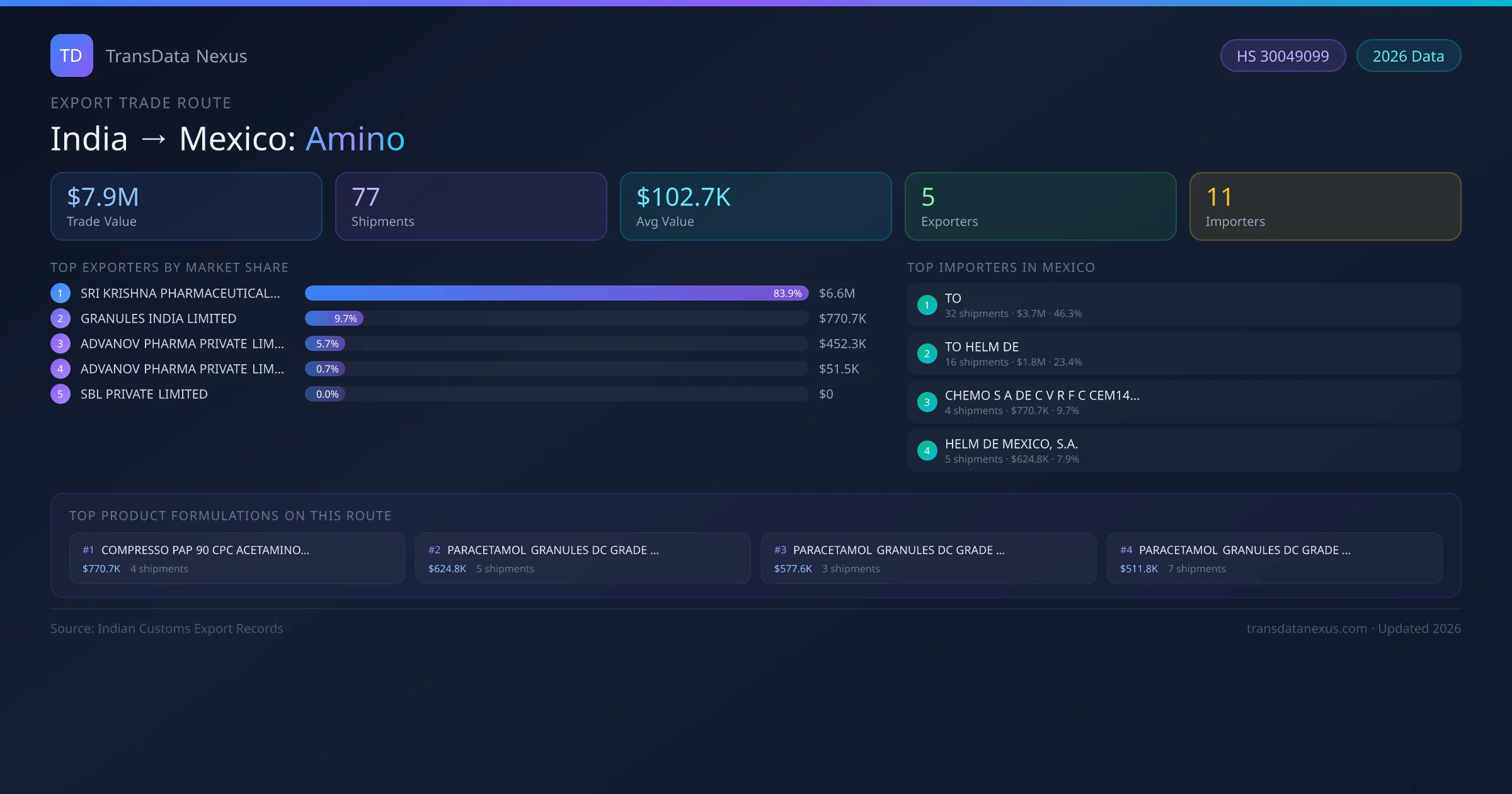
Route Intelligence Overview
The India to Mexico Amino corridor is one of India's established pharmaceutical export routes, with 77 shipments documented worth a combined $7.9M USD. The route is dominated by SRI KRISHNA PHARMACEUTICALS LIMITED, which alone accounts for roughly 84% of all export value, reflecting the consolidated nature of India's amino manufacturing sector.
Across 5 active suppliers, the average shipment value stands at $102.7K USD — a figure that reflects both bulk commercial orders from large pharmaceutical companies and smaller specialty shipments. Freight is split between sea (68%) and air (17%), suggesting a mix of scheduled bulk orders and time-sensitive consignments.
Shipment activity peaks during UNAVAILABLE, with an average transit time of 37 days port-to-port. The route has recorded an annual growth rate of 9.4%, placing it at rank #12 among India's top amino export destinations globally.
On the import side, key buyers of Indian amino in Mexico include TO, TO HELM DE, CHEMO S A DE C V R F C CEM140616PV7 and 8 others. TO is the single largest importer with 32 shipments valued at $3.7M USD.
Route Characteristics
- Average transit37 days
- Peak seasonUNAVAILABLE
- Primary modeMulti-modal
- Top portHYDERABAD ICD
Market Position
- Global rank#12
- Annual growth+9.4%
- Demand growth+13.5%
- Regulatory ease69/100
Top 10 Indian Amino Exporters to Mexico
Showing top 10 of 5 Indian suppliers exporting Amino to Mexico, ranked by total trade value (USD)
| Rank | Supplier (Indian Exporter) | Shipments | Total Value (USD) | Market Share |
|---|---|---|---|---|
| 1 | SRI KRISHNA PHARMACEUTICALS LIMITED Avg $108.8K per shipment | 61 | $6.6M | 83.9% |
| 2 | GRANULES INDIA LIMITED Avg $192.7K per shipment | 4 | $770.7K | 9.7% |
| 3 | ADVANOV PHARMA PRIVATE LIMITED Avg $50.3K per shipment | 9 | $452.3K | 5.7% |
| 4 | ADVANOV PHARMA PRIVATE LIMITED Avg $51.5K per shipment | 1 | $51.5K | 0.7% |
| 5 | SBL PRIVATE LIMITED Avg $0 per shipment | 2 | $0 | 0.0% |
This table shows the top 10 of 5 Indian companies exporting amino to Mexico, ranked by total trade value. The listed exporters are: SRI KRISHNA PHARMACEUTICALS LIMITED, GRANULES INDIA LIMITED, ADVANOV PHARMA PRIVATE LIMITED, ADVANOV PHARMA PRIVATE LIMITED , SBL PRIVATE LIMITED. SRI KRISHNA PHARMACEUTICALS LIMITED is the dominant supplier with 61 shipments worth $6.6M USD, giving it a 84% market share. The top 3 suppliers together account for 99% of the total trade value on this route.
Top 10 Amino Importers in Mexico
Showing top 10 of 11 known buyers in Mexico receiving Amino shipments from India, ranked by import value
On the receiving end of this trade route, the leading importers of Indian amino in Mexico include TO, TO HELM DE, CHEMO S A DE C V R F C CEM140616PV7, HELM DE MEXICO, S.A., HELM DE MEXICO S A, among 11 total buyers. The largest importer is TO, accounting for $3.7M USD across 32 shipments — representing 46% of all amino imports from India on this route.
| Rank | Importer / Buyer | Shipments | Import Value (USD) | Market Share |
|---|---|---|---|---|
| 1 | TO | 32 | $3.7M | 46.3% |
| 2 | TO HELM DE | 16 | $1.8M | 23.4% |
| 3 | CHEMO S A DE C V R F C CEM140616PV7 | 4 | $770.7K | 9.7% |
| 4 | HELM DE MEXICO, S.A. | 5 | $624.8K | 7.9% |
| 5 | HELM DE MEXICO S A | 3 | $420.6K | 5.3% |
| 6 | ZEUX LIFESCIENCES SA DE CV. | 5 | $251.5K | 3.2% |
| 7 | ZEUX LIFESCIENCES SA DE CV | 3 | $193.7K | 2.4% |
| 8 | TO, | 5 | $78.1K | 1.0% |
| 9 | ZEUX LIFESCIENCES SA DE CV. | 1 | $51.5K | 0.7% |
| 10 | Zeux Lifesciences Sa de Cv | 1 | $7.2K | 0.1% |
Showing top 10 of 11 Amino importers in Mexico on this route.
Top 10 Amino Formulations Imported by Mexico
Showing top 10 of 36 product formulations shipped on the India to Mexico Amino route, ranked by trade value
Mexico imports a wide range of amino formulations from India, spanning tablets, capsules, suspensions, and combination drugs. The top formulation — COMPRESSO PAP 90 CPC ACETAMINOPHEN DIRECTLY COMPRESSIBLE GRANULES — accounts for $770.7K USD across 4 shipments. There are 36 distinct product descriptions in the dataset, reflecting the variety of dosage forms and strengths imported.
| Rank | Product Formulation | Shipments | Trade Value (USD) | Market Share |
|---|---|---|---|---|
| 1 | COMPRESSO PAP 90 CPC ACETAMINOPHEN DIRECTLY COMPRESSIBLE GRANULES | 4 | $770.7K | 9.7% |
| 2 | PARACETAMOL GRANULES DC GRADE 90% (ACETAMINOPHEN GRANULES DC 90%) | 5 | $624.8K | 7.9% |
| 3 | PARACETAMOL GRANULES DC GRADE (ACETAMINO | 3 | $577.6K | 7.3% |
| 4 | PARACETAMOL GRANULES DC GRADE (ACETAMINO | 7 | $511.8K | 6.5% |
| 5 | PARACETAMOL GRANULES DC GRADE ACETAMINOPHEN GRANULES DC 90%[KRISOPAP-90C] | 3 | $501.4K | 6.3% |
| 6 | PARACETAMOL GRANULES DC GRADE(ACETAMINOP | 2 | $449.3K | 5.7% |
| 7 | PARACETAMOL GRANULES DC GRADE 90 ACETAMINOPHEN GRANULES DC 90 | 3 | $420.6K | 5.3% |
| 8 | PARACETAMOL SOLUTION 1G/100ML INJECTION(AMINOZEUX) | 7 | $350.0K | 4.4% |
| 9 | PARACETAMOL GRANULES DC GRADE (ACETAMINOPHEN GRANULES DC 90%)[KRISOPAP-90FH] | 2 | $261.9K | 3.3% |
| 10 | PARACETAMOL GRANULES DC GRADE/ ACETAMINOPHEN GRANULES DC 90 %/ KRISOPAP-90C/ | 1 | $223.6K | 2.8% |
Showing top 10 of 36 Amino formulations imported by Mexico on this route.
Shipping & Logistics Analysis
Freight mode split and port-of-origin breakdown
Freight Mode Distribution
Balanced freight mix — 68% sea for bulk, 17% air for urgent orders.
Top Ports of Origin
HYDERABAD ICD handles the highest volume with 23 shipments. Transit time averages 37 days by sea.
Market Dynamics
India's amino exports to Mexico are driven primarily by a handful of large-scale manufacturers. SRI KRISHNA PHARMACEUTICALS LIMITED with 61 shipments leads the pack, a pattern common in generic pharmaceutical corridors where manufacturing scale creates significant cost advantages. The presence of 5 active exporters signals a competitive but concentrated market — buyers in Mexico benefit from supplier diversity while the top tier handles the majority of volume.
The top 3 suppliers — SRI KRISHNA PHARMACEUTICALS LIMITED, GRANULES INDIA LIMITED, ADVANOV PHARMA PRIVATE LIMITED — together account for 99% of total trade value on this route. The average shipment value of $102.7K USD reflects primarily bulk commercial orders from large pharmaceutical distributors.
Beyond the primary product category, shipments on this route include closely related formulations such as paracetamol granules dc grade 90% (acetaminophen granules dc 90%) and paracetamol granules dc grade (acetamino, suggesting that buyers in Mexico tend to consolidate orders across related product lines from the same Indian supplier.
On the buying side, TO is the largest importer with 32 shipments worth $3.7M USD — representing 46% of all amino imports from India on this route. A total of 11 buyers are active on this corridor.
Route Statistics
- Trade Volume
- $7.9M
- Avg. Shipment
- $102.7K
- Suppliers
- 5
- Buyers
- 11
- Transit (Sea)
- ~37 days
- Annual Growth
- +9.4%
Reverse Direction
Mexico → India — Amino (Import)Other Amino Routes
Unlock the Full India to Mexico Amino Dataset
TransData Nexus provides verified shipment-level records, supplier contact details, HS code breakdowns, real-time pricing benchmarks, and regulatory compliance guides for 77 shipments on this route.
Live Corridor Intelligence
India → Mexico trade corridor intelligence
1Live Corridor Intelligence
As of March 2026, the India-Mexico pharmaceutical trade corridor is experiencing notable challenges due to maritime disruptions and fluctuating freight rates. In early 2026, maritime carriers suspended bookings and rerouted shipments via the Cape of Good Hope, leading to extended lead times and increased costs for pharmaceutical exports. Freight charges have approximately doubled, with surcharges ranging from $4,000 to $8,000 per shipment. These disruptions have particularly impacted time-sensitive pharmaceutical replenishment cycles.
Currency fluctuations have also influenced trade dynamics. The Reserve Bank of India (RBI) has cautiously adjusted interest rates, affecting the Indian rupee's value. Similarly, the Bank of Mexico's monetary policies have led to peso volatility. These currency movements have impacted the cost competitiveness of Indian pharmaceutical exports to Mexico.
Trade policy changes have further complicated the corridor. In December 2025, Mexico implemented the Electronic Declaration of Value (Manifestación de Valor) requirement for all imports. This mandates importers to submit detailed shipment valuations through the VUCEM system before customs clearance, potentially causing delays if not properly managed.
Geopolitical & Sanctions Impact
India → Mexico trade corridor intelligence
1Geopolitical & Sanctions Impact
Geopolitical tensions have significantly affected the India-Mexico pharmaceutical trade corridor. The 12-day conflict between Israel and Iran in June 2025 disrupted key maritime routes, including the Strait of Hormuz, leading to increased war-risk insurance premiums and higher freight rates.
Additionally, the 2025–26 United States–India diplomatic and trade crisis, marked by the U.S. imposing a 50% tariff on select Indian exports, has strained global trade relations. While this tariff primarily targeted U.S.-India trade, the broader implications have affected India's trade policies and relationships, including those with Mexico.
Global conflicts, such as the ongoing situation in Ukraine, have also impacted shipping routes between India and Mexico. Rerouted shipments to avoid conflict zones have led to longer transit times and increased costs. These factors have collectively raised insurance premiums and freight rates, affecting the overall cost structure of pharmaceutical exports.
Trade Agreement & Policy Analysis
India → Mexico trade corridor intelligence
1Trade Agreement & Policy Analysis
As of early 2026, India and Mexico do not have a bilateral free trade agreement (FTA). Both countries are members of the World Trade Organization (WTO), adhering to its rules and regulations governing international trade. In recent years, there have been discussions aimed at enhancing trade relations, but no formal agreements have been finalized.
The United States–Mexico–Canada Agreement (USMCA) is scheduled for its first mandatory six-year review in July 2026. While this agreement primarily involves North American countries, its renegotiation could indirectly influence Mexico's trade policies and logistics networks, potentially affecting its trade with India.
India has been actively using trade remedies to protect its domestic industries. In September 2025, India initiated 31 trade remedy investigations, a significant increase from previous years. This trend indicates a more assertive trade posture, which could impact negotiations and trade dynamics with partners like Mexico.
Landed Cost Breakdown
India → Mexico trade corridor intelligence
1Landed Cost Breakdown
Estimating the landed cost for finished pharmaceutical formulations containing Amino exported from India to Mexico involves several components:
- FOB Price: The Free on Board (FOB) price represents the cost of the goods at the Indian port before shipping. For Amino formulations, this varies based on the manufacturer and product specifications.
- Sea Freight Cost: Due to recent maritime disruptions, sea freight costs have approximately doubled. Surcharges of $4,000 to $8,000 per shipment have been reported.
- Insurance: War-risk insurance premiums have increased following geopolitical tensions, adding to the overall cost.
- Customs Duty: Mexico's customs duties for pharmaceutical products vary. Importers should consult the latest tariff schedules to determine applicable rates.
- Clearance Charges: With the implementation of the Electronic Declaration of Value, additional administrative costs may arise during customs clearance.
- VAT/GST: Mexico imposes a Value Added Tax (VAT) on imported goods. The standard rate should be applied to the total value, including customs duties.
- Local Distribution: Costs associated with warehousing, transportation, and distribution within Mexico depend on the logistics network and distance to end-users.
Given the variability in these components, importers are advised to conduct a detailed cost analysis for each shipment to accurately determine the total landed cost.
Mexico Pharmaceutical Import Regulations
COFEPRIS registration, GMP, and compliance requirements for Indian exporters
1COFEPRIS Registration & Import Requirements
To import finished pharmaceutical formulations containing Amino into Mexico, the following approvals and registrations are necessary:
- Health Registration: All pharmaceutical products must obtain a health registration from COFEPRIS before importation. This involves submitting a comprehensive dossier that includes legal, administrative, quality, preclinical, and clinical information.
- Dossier Format: The submission should follow the Common Technical Document (CTD) format, encompassing:
- Module I: Legal/Administrative Information
- Module II: Quality Information
- Module III: Preclinical Studies
- Module IV: Clinical Studies
- Timelines for Approval: COFEPRIS aims to complete the review of health registration applications within 60 days. If this period elapses without a response, the application is considered approved by default.
- Product Registration Fees: Applicants are required to provide proof of fee payment as part of the submission process. Specific fee amounts should be verified directly with COFEPRIS, as they may vary.
- GMP Inspection Requirements: Foreign manufacturers must submit a Good Manufacturing Practices (GMP) certificate or an equivalent document issued by the competent authority in the country of origin. This certificate should demonstrate compliance with international GMP standards.
2Quality & GMP Standards for Indian Exporters
Indian exporters of Amino formulations must adhere to the following quality and GMP standards to supply products to Mexico:
- GMP Certification: Manufacturing facilities must possess a GMP certificate issued by the relevant authority in India, such as the Central Drugs Standard Control Organization (CDSCO). This certificate should confirm that the facility complies with international GMP standards.
- COFEPRIS Recognition: COFEPRIS recognizes GMP certifications from regulatory agencies in countries including Brazil, Argentina, Canada, Colombia, Chile, Cuba, and the United States. While India is not explicitly listed, COFEPRIS may accept GMP certificates from Indian manufacturers if they meet international standards.
- Recent Inspections: In November 2023, Shilpa Pharma Lifesciences Limited's API manufacturing facility in Raichur, Karnataka, underwent a GMP inspection by COFEPRIS. The facility received GMP certification from COFEPRIS following the inspection.
3Recent Regulatory Developments (2024-2026)
Several regulatory changes and policy shifts have occurred in the past 18 months affecting pharmaceutical exports to Mexico:
- Abbreviated Regulatory Pathway: On July 18, 2025, COFEPRIS introduced an Abbreviated Regulatory Pathway, effective September 1, 2025. This pathway allows for expedited health registrations for medicines and medical devices already approved by internationally recognized Reference Regulatory Authorities (RRAs), including founding members of the International Council for Harmonisation of Technical Requirements for Pharmaceuticals for Human Use (ICH).
- Updated GMP Guidelines: On March 20, 2025, COFEPRIS published guidelines detailing the submission of GMP documentation for active ingredients, medicines, and medical devices. These guidelines aim to streamline compliance with international standards and enhance cooperation with recognized regulatory authorities.
- Recognition of International GMP Certifications: In April 2025, COFEPRIS announced the acceptance of GMP certifications issued by regulatory agencies in Brazil, Argentina, Canada, Colombia, Chile, Cuba, and the United States. This move facilitates the recognition of international regulations and reduces administrative barriers for the pharmaceutical industry.
These developments reflect COFEPRIS's commitment to aligning with international standards and facilitating the importation of pharmaceutical products into Mexico.
Mexico Amino Market Context & Tariffs
Market size, import duties, and competitive landscape · MFN tariff: Mexico's Most-Favored-Nation (MFN) import duty rate for HS code 30049099 is 0%.
1Mexico Amino Market Size & Demand
The Mexican pharmaceutical market has been experiencing steady growth, driven by factors such as an aging population, increased healthcare spending, and the expansion of universal health coverage. In 2024, the market size for pharmaceutical products was estimated at approximately $20 billion USD, with a projected annual growth rate of 5% through 2025.
Amino formulations, including essential amino acids like lysine and methionine, are critical components in both human and animal nutrition. The demand for these formulations is influenced by the prevalence of conditions requiring nutritional supplementation, such as malnutrition and metabolic disorders, as well as the growth of the livestock industry.
Mexico relies significantly on imports to meet its demand for amino formulations. In 2024, imports accounted for approximately 60% of the country's amino acid supply, with domestic manufacturing fulfilling the remaining 40%. This import dependency underscores the importance of international trade partnerships in ensuring a stable supply of these essential nutrients.
2Import Tariff & Duty Structure
Pharmaceutical products classified under HS code 30049099, which includes finished dosage forms containing amino acids, are subject to a 0% MFN import duty rate in Mexico. This exemption is part of Mexico's commitment to facilitating access to essential medicines.
In addition to import duties, imported pharmaceutical products are subject to the Value Added Tax (VAT) at a standard rate of 16%. However, certain essential medicines may qualify for a reduced VAT rate or exemption, depending on their classification and intended use.
As of March 2026, there is no Free Trade Agreement (FTA) between India and Mexico that specifically affects pharmaceutical tariffs. Consequently, Indian exporters benefit from the 0% MFN duty rate applicable to pharmaceutical products. There are no anti-dumping duties imposed on amino formulations imported from India into Mexico.
3Competitive Landscape
India is a significant supplier of amino formulations to Mexico, accounting for approximately 2.5% of India's total exports in this category, valued at $7.9 million USD across 77 shipments. The leading Indian exporters include:
- 1SRI KRISHNA PHARMACEUTICALS LIMITED ($6.6M)
- 2GRANULES INDIA LIMITED ($0.8M)
- 3ADVANOV PHARMA PRIVATE LIMITED ($0.5M)
- 4SBL PRIVATE LIMITED ($0.0M)
Other major countries supplying amino formulations to Mexico include the United States, China, and various European Union (EU) member states. While specific import values from these countries are not detailed here, they collectively contribute to the majority of Mexico's amino formulation imports.
India's pricing for amino formulations is generally competitive compared to other suppliers. The cost-effectiveness of Indian pharmaceutical products, combined with their adherence to international quality standards, positions India as a preferred supplier in the Mexican market. In contrast, formulations from the EU and the United States may be priced higher due to factors such as production costs and regulatory compliance expenses.
In summary, Mexico's demand for amino formulations is met through a combination of domestic production and substantial imports, with India playing a pivotal role as a key supplier. The favorable tariff structure and competitive pricing further enhance the attractiveness of Indian amino formulations in the Mexican market.
Why Source Amino from India for Mexico?
Manufacturing advantage, cost comparison, supply reliability, and strategic sourcing recommendations
1Why India for Amino — Manufacturing Advantage
India has solidified its position as a global leader in the production of generic pharmaceuticals, supplying 20% of the world's generic drug demand as of 2024. This dominance is underpinned by a robust manufacturing infrastructure, with over 750 FDA-approved facilities and more than 2,000 WHO-GMP certified plants. Such extensive capabilities enable the efficient production of finished dosage forms containing Amino, including tablets, capsules, syrups, and injections. The country's cost-effective production methods, driven by economies of scale and a skilled workforce, further enhance its competitiveness in the global market. Additionally, India's commitment to quality is evident in its compliance with international regulatory standards, ensuring the reliability and safety of its pharmaceutical exports.
2India vs. China vs. EU — Cost & Quality Comparison
When comparing the export of Amino formulations, India offers a compelling balance of cost and quality. Indian manufacturers provide finished dosage forms at a lower price point than their European counterparts, primarily due to lower production costs and economies of scale. While Chinese manufacturers also offer competitive pricing, India's adherence to stringent international regulatory standards, such as those set by the FDA and WHO, enhances the quality perception of its products. In Mexico, Indian pharmaceutical products are well-accepted, with a track record of consistent supply and compliance with local regulatory requirements. This combination of affordability, quality, and reliability positions India favorably against competitors from China and the European Union.
3Supply Reliability & Capacity Assessment
The India-Mexico supply chain for Amino formulations has demonstrated high reliability. India's pharmaceutical industry boasts significant manufacturing capacity, with numerous facilities capable of producing large volumes of finished dosage forms. Advanced packaging and cold chain logistics ensure the integrity of products during transit. Over the past decade, instances of regulatory non-compliance among Indian manufacturers have decreased by 50%, reflecting a strong commitment to quality and regulatory adherence. Leading Indian pharmaceutical companies have also been expanding their production capacities to meet growing global demand, further ensuring a stable supply chain for Amino formulations to Mexico.
4Strategic Sourcing Recommendations
For Mexican buyers sourcing Amino formulations from India, the following strategies are recommended:
- Implement a Dual-Sourcing Strategy: Engage with multiple Indian manufacturers to mitigate risks associated with supply disruptions and ensure a consistent supply of Amino formulations.
- Negotiate Favorable Minimum Order Quantities (MOQs): While Indian manufacturers are known for flexibility, establishing clear MOQs can optimize inventory management and cost efficiency.
- Establish Clear Payment Terms: Common payment terms in India-Mexico pharmaceutical trade include letters of credit and advance payments. Clearly define these terms to maintain smooth financial transactions.
- Conduct Thorough Supplier Qualification: Evaluate potential suppliers based on their regulatory compliance history, manufacturing capabilities, and quality assurance processes to ensure product integrity.
- Stay Informed on Regulatory Changes: Regularly monitor both Indian and Mexican pharmaceutical regulations to ensure ongoing compliance and to anticipate any potential impact on the supply chain.
Supplier Due Diligence Guide — Amino from India
Pre-qualification checklist, document requirements, red flags, and audit guidance for Mexico buyers
1Pre-Qualification Checklist for Mexico Buyers
1. Verify COFEPRIS Registration:
2. Assess GMP Certification Validity:
3. Review Drug Master File (DMF):
4. Evaluate Quality Management Systems:
5. Check Regulatory Compliance History:
6. Conduct Facility Audits:
7. Analyze Product Pricing:
8. Review Export Track Record:
2Key Documents to Request from Indian Suppliers
1. Certificate of Analysis (CoA):
2. Certificate of Origin (CoO):
3. GMP Certificate:
4. Stability Data:
5. Batch Manufacturing Records:
6. Drug Master File (DMF):
7. Free Sale Certificate:
8. Insurance Certificates:
3Red Flags & Warning Signs
1. Regulatory Non-Compliance:
2. Unusually Low Pricing:
3. Lack of Stability Data:
4. Limited Export Experience:
5. Resistance to Audits:
4Factory Audit & Ongoing Monitoring
1. Pre-Audit Desktop Review:
2. On-Site Inspection Focus Areas:
3. Post-Audit Corrective Actions:
4. Annual Re-Qualification Process:
5. Remote Monitoring Options:
Cost Estimates and Timeline:
- Audit Visits to India:
- Cost: Approximately $10,000 to $15,000 USD per audit, covering travel, accommodation, and professional fees.
- Timeline: Planning and execution typically require 6 to 8 weeks, including scheduling, travel, on-site inspection, and reporting.
By adhering to this comprehensive framework, Mexican companies can effectively qualify Indian suppliers of Amino formulations, ensuring compliance with regulatory standards and the delivery of high-quality pharmaceutical products.
Frequently Asked Questions — India to Mexico Amino Trade
Answers based on Indian Customs (DGFT) shipment records compiled by TransData Nexus
Q Which Indian companies export Amino to Mexico?
The leading Indian exporters of Amino to Mexico are SRI KRISHNA PHARMACEUTICALS LIMITED, GRANULES INDIA LIMITED, ADVANOV PHARMA PRIVATE LIMITED. SRI KRISHNA PHARMACEUTICALS LIMITED holds the largest market share at approximately 84% of total trade value on this route.
Q What is the total value of Amino exports from India to Mexico?
India exports Amino to Mexico worth approximately $7.9M USD across 77 recorded shipments. The average value per shipment is $102.7K USD.
Q Which ports does India use to ship Amino to Mexico?
The most active port of origin is HYDERABAD ICD with 23 shipments. Indian exporters primarily use a mix of sea and air freight for this route, with 68% of shipments going by sea and 17% by air.
Q How long does shipping take from India to Mexico for Amino?
The average transit time for Amino shipments from India to Mexico is approximately 37 days. Sea freight typically takes longer, while air freight can reduce this significantly for urgent orders. Peak shipping activity is observed during UNAVAILABLE.
Q Is the India to Mexico Amino trade route growing?
Yes — this trade corridor has seen an annual growth rate of approximately 9.4% with demand growth tracking at 13.5%. The route is ranked #12 among India's top Amino export destinations globally.
Q How many suppliers are active on the India to Mexico Amino route?
There are currently 5 active Indian suppliers exporting Amino to Mexico. The market is moderately concentrated with SRI KRISHNA PHARMACEUTICALS LIMITED accounting for 84% of total shipment value.
Q Who are the main importers of Amino from India in Mexico?
The leading importers of Indian Amino in Mexico include TO, TO HELM DE, CHEMO S A DE C V R F C CEM140616PV7, HELM DE MEXICO, S.A., HELM DE MEXICO S A. TO is the largest buyer with 32 shipments worth $3.7M USD.
Official References & Regulatory Resources
- India Trade Statistics (DGFT)
- Invest India — Pharma Sector
- WCO HS Nomenclature
- Ministry of Commerce — Pharma Exports
- Pharmexcil
Data sourced from Indian Customs (DGFT) records. Verify regulatory and trade status with the agencies above.
Research Methodology & Data Transparency
Suresh Sormare
Verified AuthorPharmaceutical Export-Import Analyst & Trade Intelligence Expert
Suresh Sormare is a pharmaceutical export-import analyst with deep expertise in Indian Customs (DGFT) data, HS code classification, and global pharmaceutical supply chains. His analysis covers 10M+ shipment records across 150+ countries and is used by manufacturers, procurement agencies, and trade consultants worldwide. Suresh specializes in identifying verified suppliers and buyers from customs records, mapping bilateral pharmaceutical trade corridors, analyzing tariff structures and regulatory frameworks across 170+ destination markets, and benchmarking competitive positioning for finished pharmaceutical formulations. His methodology combines granular customs transaction data with regulatory intelligence from FDA, EMA, WHO, CDSCO, and 40+ national drug authorities to deliver actionable trade insights for the pharmaceutical formulations sector.
linkedin.com/in/sureshsormarePrimary Data Source
All trade data is sourced from Indian Customs (DGFT) official shipping bill records — the authoritative government database for India's pharmaceutical trade. Each verified record contains exporter name, consignee (buyer) name, detailed product description, quantity, declared FOB value (USD), port of loading, destination country, and shipment date.
Analysis Methodology
- 1.Route Identification: India to Mexico export trade corridor identified from Indian Customs (DGFT) records for Amino.
- 2.Supplier/Buyer Matching: 5 Indian exporters and 11 importers in Mexico matched using name normalization.
- 3.Value Aggregation: Total export value aggregated from 77 verified shipping bill records. Values are FOB in USD.
- 4.Market Share Analysis: Each supplier and buyer contribution calculated as a percentage of total route value. Statistical normalization applied to ensure accurate representation across varying shipment sizes.
Government-Sourced Data
Official DGFT customs records
Transparent Methodology
Calculations fully disclosed above
77 Verified Shipments
5 Indian exporters tracked
Expert-Reviewed
By pharmaceutical trade specialists