India to Pakistan: Amikacin Export Trade Route
India has recorded 33 verified shipments of Amikacin exported to Pakistan, representing a combined trade value of $2.7M USD. This corridor is served by 12 active Indian exporters, with an average shipment value of $80.7K USD. The leading Indian exporter is LINCOLN PHARMACEUTICALS LTD, which accounts for 95% of total export value with 4 shipments worth $2.5M USD. On the buying side, KHAN SEHAT LTD is the largest importer in Pakistan with $2.5M USD in purchases. The top 3 suppliers — LINCOLN PHARMACEUTICALS LTD, REGAL SALES AGENCIES , PLICA VACCINES PRIVATE LIMITED — together control 97% of total trade value on this route. All data sourced from Indian Customs (DGFT) shipping bill records. Values reported in FOB USD.
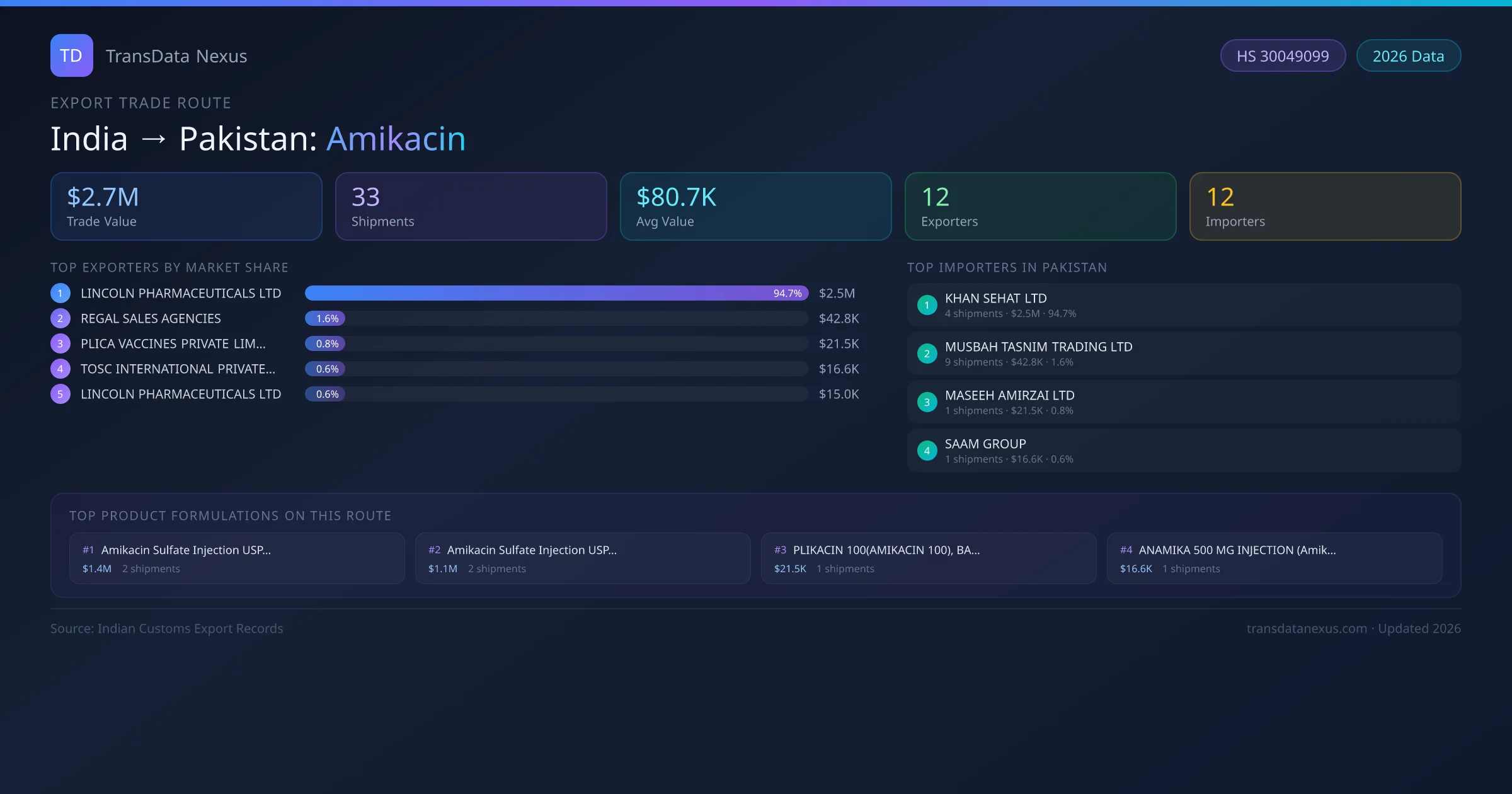
Route Intelligence Overview
The India to Pakistan Amikacin corridor is one of India's established pharmaceutical export routes, with 33 shipments documented worth a combined $2.7M USD. The route is dominated by LINCOLN PHARMACEUTICALS LTD, which alone accounts for roughly 95% of all export value, reflecting the consolidated nature of India's amikacin manufacturing sector.
Across 12 active suppliers, the average shipment value stands at $80.7K USD — a figure that reflects both bulk commercial orders from large pharmaceutical companies and smaller specialty shipments. Sea freight dominates at 84% of all shipments, consistent with amikacin's non-urgent bulk-order profile.
Shipment activity peaks during UNAVAILABLE, with an average transit time of 26 days port-to-port. The route has recorded an annual growth rate of 22.9%, placing it at rank #4 among India's top amikacin export destinations globally.
On the import side, key buyers of Indian amikacin in Pakistan include KHAN SEHAT LTD, MUSBAH TASNIM TRADING LTD , MASEEH AMIRZAI LTD and 9 others. KHAN SEHAT LTD is the single largest importer with 4 shipments valued at $2.5M USD.
Route Characteristics
- Average transit26 days
- Peak seasonUNAVAILABLE
- Primary modeSea freight
- Top portNHAVA SHEVA SEA (INNSA1)
Market Position
- Global rank#4
- Annual growth+22.9%
- Demand growth+21.2%
- Regulatory ease89/100
Top 10 Indian Amikacin Exporters to Pakistan
Showing top 10 of 12 Indian suppliers exporting Amikacin to Pakistan, ranked by total trade value (USD)
| Rank | Supplier (Indian Exporter) | Shipments | Total Value (USD) | Market Share |
|---|---|---|---|---|
| 1 | LINCOLN PHARMACEUTICALS LTD Avg $630.5K per shipment | 4 | $2.5M | 94.7% |
| 2 | REGAL SALES AGENCIES Avg $4.8K per shipment | 9 | $42.8K | 1.6% |
| 3 | PLICA VACCINES PRIVATE LIMITED Avg $21.5K per shipment | 1 | $21.5K | 0.8% |
| 4 | TOSC INTERNATIONAL PRIVATE LIMITED Avg $16.6K per shipment | 1 | $16.6K | 0.6% |
| 5 | LINCOLN PHARMACEUTICALS LTD Avg $7.5K per shipment | 2 | $15.0K | 0.6% |
| 6 | REGAIN LABORATORIES Avg $6.2K per shipment | 2 | $12.3K | 0.5% |
| 7 | MEZ PHARMACEUTICAL PRIVATE LIMITED Avg $7.5K per shipment | 1 | $7.5K | 0.3% |
| 8 | MARS REMEDIES PRIVATE LIMITED Avg $3.6K per shipment | 2 | $7.2K | 0.3% |
| 9 | MOREPEN LABORATORIES LIMITED Avg $3.4K per shipment | 2 | $6.8K | 0.3% |
| 10 | BRAWN LABORATORIES LIMITED Avg $5.1K per shipment | 1 | $5.1K | 0.2% |
This table shows the top 10 of 12 Indian companies exporting amikacin to Pakistan, ranked by total trade value. The listed exporters are: LINCOLN PHARMACEUTICALS LTD, REGAL SALES AGENCIES , PLICA VACCINES PRIVATE LIMITED, TOSC INTERNATIONAL PRIVATE LIMITED , LINCOLN PHARMACEUTICALS LTD , REGAIN LABORATORIES, MEZ PHARMACEUTICAL PRIVATE LIMITED, MARS REMEDIES PRIVATE LIMITED , MOREPEN LABORATORIES LIMITED, BRAWN LABORATORIES LIMITED . LINCOLN PHARMACEUTICALS LTD is the dominant supplier with 4 shipments worth $2.5M USD, giving it a 95% market share. The top 3 suppliers together account for 97% of the total trade value on this route.
Showing top 10 of 12 total Indian exporters on the India to Pakistan Amikacin export route.
Top 10 Amikacin Importers in Pakistan
Showing top 10 of 12 known buyers in Pakistan receiving Amikacin shipments from India, ranked by import value
On the receiving end of this trade route, the leading importers of Indian amikacin in Pakistan include KHAN SEHAT LTD, MUSBAH TASNIM TRADING LTD , MASEEH AMIRZAI LTD, SAAM GROUP , KHAN SEHAT LTD , among 12 total buyers. The largest importer is KHAN SEHAT LTD, accounting for $2.5M USD across 4 shipments — representing 95% of all amikacin imports from India on this route.
| Rank | Importer / Buyer | Shipments | Import Value (USD) | Market Share |
|---|---|---|---|---|
| 1 | KHAN SEHAT LTD | 4 | $2.5M | 94.7% |
| 2 | MUSBAH TASNIM TRADING LTD | 9 | $42.8K | 1.6% |
| 3 | MASEEH AMIRZAI LTD | 1 | $21.5K | 0.8% |
| 4 | SAAM GROUP | 1 | $16.6K | 0.6% |
| 5 | KHAN SEHAT LTD | 2 | $15.0K | 0.6% |
| 6 | M/S YAHYA JEESHAN TRADING CO. | 2 | $12.3K | 0.5% |
| 7 | ASIL PHARMA LLC | 1 | $7.5K | 0.3% |
| 8 | BRADARAN QADARI TRADING COMPANY | 2 | $7.2K | 0.3% |
| 9 | TRUST ANESTHETIC LIMITED | 2 | $6.8K | 0.3% |
| 10 | AL-HAJ WAZIR GUL DANISHMAL LTD | 1 | $5.1K | 0.2% |
Showing top 10 of 12 Amikacin importers in Pakistan on this route.
Top 10 Amikacin Formulations Imported by Pakistan
Showing top 10 of 19 product formulations shipped on the India to Pakistan Amikacin route, ranked by trade value
Pakistan imports a wide range of amikacin formulations from India, spanning tablets, capsules, suspensions, and combination drugs. The top formulation — Amikacin Sulfate Injection USP (Emica-50 — accounts for $1.4M USD across 2 shipments. There are 19 distinct product descriptions in the dataset, reflecting the variety of dosage forms and strengths imported.
| Rank | Product Formulation | Shipments | Trade Value (USD) | Market Share |
|---|---|---|---|---|
| 1 | Amikacin Sulfate Injection USP (Emica-50 | 2 | $1.4M | 53.9% |
| 2 | Amikacin Sulfate Injection USP (Emica-10 | 2 | $1.1M | 40.7% |
| 3 | PLIKACIN 100(AMIKACIN 100), BATCH NO. PVI24035, MFG DT: 11/24, EXP DT: 10/27 | 1 | $21.5K | 0.8% |
| 4 | ANAMIKA 500 MG INJECTION (Amikacin Injec | 1 | $16.6K | 0.6% |
| 5 | AMIKA-500 MG 2ML AMIKACIN 500MG | 3 | $15.0K | 0.6% |
| 6 | AMICLAN-500MG INJ. 500MG AMIKACIN 500MG | 3 | $14.2K | 0.5% |
| 7 | AMIGOLD-500MG INJ 2ML AMIKACIN 500MG | 3 | $13.6K | 0.5% |
| 8 | Amikacin Sulfate Injection USP (Emica-50 | 1 | $8.6K | 0.3% |
| 9 | SINOKSIN Amikacin 100mg /2ml Inj BATCH NO.V23GG001 MANUFACTURING DT.May-23 EXP DT.Apr-26 | 1 | $7.5K | 0.3% |
| 10 | INJ. AMEDIL-500MG 2ML E.2ML CONT.AMIKACIN SULFATE B.P. EQ. TO AMIKACIN 500MG, METHYL PARABEN B.P. 0.08%W/V(IAKF301 | 1 | $7.4K | 0.3% |
Showing top 10 of 19 Amikacin formulations imported by Pakistan on this route.
Shipping & Logistics Analysis
Freight mode split and port-of-origin breakdown
Freight Mode Distribution
Sea freight dominates at 84%, typical for bulk pharmaceutical shipments.
Top Ports of Origin
NHAVA SHEVA SEA (INNSA1) handles the highest volume with 9 shipments. Transit time averages 26 days by sea.
Market Dynamics
India's amikacin exports to Pakistan are driven primarily by a handful of large-scale manufacturers. LINCOLN PHARMACEUTICALS LTD with 4 shipments leads the pack, a pattern common in generic pharmaceutical corridors where manufacturing scale creates significant cost advantages. The presence of 12 active exporters signals a competitive but concentrated market — buyers in Pakistan benefit from supplier diversity while the top tier handles the majority of volume.
The top 3 suppliers — LINCOLN PHARMACEUTICALS LTD, REGAL SALES AGENCIES , PLICA VACCINES PRIVATE LIMITED — together account for 97% of total trade value on this route. The average shipment value of $80.7K USD reflects primarily bulk commercial orders from large pharmaceutical distributors.
Beyond the primary product category, shipments on this route include closely related formulations such as amikacin sulfate injection usp (emica-10 and plikacin 100(amikacin 100), batch no. pvi24035, mfg dt: 11/24, exp dt: 10/27, suggesting that buyers in Pakistan tend to consolidate orders across related product lines from the same Indian supplier.
On the buying side, KHAN SEHAT LTD is the largest importer with 4 shipments worth $2.5M USD — representing 95% of all amikacin imports from India on this route. A total of 12 buyers are active on this corridor.
Route Statistics
- Trade Volume
- $2.7M
- Avg. Shipment
- $80.7K
- Suppliers
- 12
- Buyers
- 12
- Transit (Sea)
- ~26 days
- Annual Growth
- +22.9%
Other Amikacin Routes
Unlock the Full India to Pakistan Amikacin Dataset
TransData Nexus provides verified shipment-level records, supplier contact details, HS code breakdowns, real-time pricing benchmarks, and regulatory compliance guides for 33 shipments on this route.
Live Corridor Intelligence
India → Pakistan trade corridor intelligence
1Live Corridor Intelligence
As of March 2026, the India-Pakistan pharmaceutical trade corridor is experiencing significant disruptions due to escalating geopolitical tensions in the Middle East. The conflict involving the US, Israel, and Iran has led to increased freight rates and war risk insurance premiums, impacting shipping routes critical to this trade. Industry stakeholders in Pakistan have expressed concerns over these rising costs, noting that while current inventories are sufficient to prevent immediate shortages, the surge in freight and insurance expenses poses challenges for future trade activities. Some traders have temporarily halted import and export operations until the situation stabilizes and costs return to normal levels. (pakistantoday.com.pk)
In India, pharmaceutical exporters are bracing for shipment delays and higher logistics costs. The rerouting of ships and aircraft, along with rising war-risk insurance premiums, has pushed up freight rates and created uncertainty for time-sensitive pharmaceutical exports. Prolonged instability in the region could delay supplies and squeeze margins for Indian pharmaceutical companies that depend on West Asian trade corridors.
Additionally, the US-Iran escalation has disrupted vital trade corridors, leaving Indian pharmaceutical exporters on edge. The pharmaceutical sector is bracing for another round of supply-chain disruption as escalating conflict in West Asia threatens to push up logistics and energy costs.
Geopolitical & Sanctions Impact
India → Pakistan trade corridor intelligence
1Geopolitical & Sanctions Impact
The ongoing conflict in the Middle East, particularly the US-Israel conflict with Iran, has significantly impacted shipping routes between India and Pakistan. The escalation has led to increased freight and war risk charges, posing challenges for Pakistan's trade outlook. While current inventories are sufficient to prevent immediate shortages, the surge in freight costs and war risk premiums could pose significant challenges for future trade activities. (pakistantoday.com.pk)
In India, pharmaceutical exporters are bracing for shipment delays and higher logistics costs as escalating tensions in the Middle East disrupt key cargo routes. Rerouting of ships and aircraft, along with rising war-risk insurance premiums, has pushed up freight rates and created uncertainty for time-sensitive pharmaceutical exports. Prolonged instability in the region could delay supplies and squeeze margins for Indian pharmaceutical companies that depend on West Asian trade corridors.
Trade Agreement & Policy Analysis
India → Pakistan trade corridor intelligence
1Trade Agreement & Policy Analysis
As of early 2026, there is no formal Free Trade Agreement (FTA) between India and Pakistan. Trade relations between the two countries have been historically complex, influenced by geopolitical tensions and policy decisions. In May 2025, following the Pahalgam terror attack, India imposed a ban on ships carrying goods originating in or exported from Pakistan. This ban led to a sharp rise in freight charges and longer shipping times for Pakistani importers, as they had to rely on alternative routes and feeder vessels.
The World Trade Organization (WTO) continues to emphasize the importance of trade facilitation measures among member countries. In March 2025, WTO members underscored the need for continued focus on trade facilitation implementation and assistance, highlighting provisions for expediting the movement, release, and clearance of goods, including goods in transit.
Landed Cost Breakdown
India → Pakistan trade corridor intelligence
1Landed Cost Breakdown
Estimating the landed cost components for Amikacin formulations shipped from India to Pakistan involves several factors:
- FOB Price: The Free on Board (FOB) price for Amikacin formulations varies depending on the manufacturer and specific product. For instance, LINCOLN PHARMACEUTICALS LTD exported Amikacin formulations worth $2.5 million to Pakistan.
- Sea Freight Cost per Container: Due to recent geopolitical tensions, freight rates have surged. Reports indicate that freight charges have roughly doubled, with additional surcharges ranging from $4,000 to $8,000 per shipment.
- Insurance: War risk insurance premiums have increased due to the conflict in the Middle East, adding to the overall cost of shipping. (pakistantoday.com.pk)
- Customs Duty: Pakistan imposes customs duties on imported pharmaceutical products. The exact rate depends on the product classification under the Harmonized System (HS) code.
- Clearance Charges: These include port handling fees, documentation charges, and other administrative costs incurred during the customs clearance process.
- VAT/GST: Pakistan applies a General Sales Tax (GST) on imported goods, including pharmaceuticals. The standard GST rate is 17%, but exemptions or reduced rates may apply to certain pharmaceutical products.
- Local Distribution: Costs associated with warehousing, transportation, and distribution within Pakistan add to the landed cost.
Given the current volatility in freight rates and insurance premiums, the total landed cost per unit or per container can fluctuate significantly. Importers and exporters are advised to monitor these costs closely and adjust pricing strategies accordingly.
Pakistan Pharmaceutical Import Regulations
National DRA registration, GMP, and compliance requirements for Indian exporters
1National DRA Registration & Import Requirements
To import Amikacin formulations into Pakistan, the following approvals and registrations are mandatory:
- Drug Import License (D.I.L): Importers must obtain a D.I.L by submitting Form 2, accompanied by the applicable fee and an undertaking on Form 3. The D.I.L is issued on Form 5 and remains valid for two years from the date of issuance, unless suspended or canceled earlier. (dra.gov.pk)
- Product Registration: Each Amikacin formulation intended for import must be registered with DRAP. The registration process involves submitting a Common Technical Document (CTD) dossier, as specified in Form 5F. This dossier should include comprehensive data on the product's quality, safety, and efficacy. (dra.gov.pk)
- Import Clearance Certificate: For each shipment, importers are required to obtain an Import Clearance Certificate by applying through DRAP's online portal, providing mandatory documents. The processing timeline for this certificate is approximately five days. (dra.gov.pk)
- Good Manufacturing Practice (GMP) Compliance: Indian manufacturing facilities producing Amikacin formulations must comply with DRAP's GMP guidelines. While DRAP may conduct inspections of foreign manufacturing sites, it also recognizes GMP certifications from authorities in WHO-GMP reference markets. (dra.gov.pk)
2Quality & GMP Standards for Indian Exporters
Indian exporters of Amikacin formulations must adhere to the following quality and GMP standards to supply products to Pakistan:
- GMP Certification: Manufacturing facilities must hold valid GMP certifications that align with DRAP's standards. Compliance with the Pharmaceutical Inspection Co-operation Scheme (PIC/S) GMP guidelines is recommended, as DRAP has been implementing these standards in a phased manner since 2019. (dra.gov.pk)
- Approved Facilities: While DRAP maintains a list of approved manufacturing facilities, specific details about Indian manufacturers currently approved to export Amikacin formulations to Pakistan are not publicly disclosed.
- Regulatory Actions: In April 2025, DRAP issued a recall alert for substandard pharmaceutical products, including Amikacin injections, due to quality concerns such as visible particulates. This underscores the importance of stringent quality control measures for exporters.
3Recent Regulatory Developments (2024-2026)
Several regulatory changes and initiatives have been introduced by DRAP between 2024 and 2026 that impact the importation of pharmaceutical products:
- Antimicrobial Data Submission: As of August 2025, registration holders of pharmaceutical products, including Amikacin formulations, are required to submit batch production and import data for antimicrobials regularly through the Drug Regulatory Information System (DRIS). This initiative aims to support antimicrobial stewardship policies to combat antimicrobial resistance (AMR) in Pakistan. (dra.gov.pk)
- Streamlined Registration Processes: In August 2025, DRAP announced the streamlining of the evaluation and processing of Form 5F (CTD) applications under S.R.O. 713(I)/2018. This policy aims to expedite the registration process for pharmaceutical products, potentially reducing approval timelines for importers. (dra.gov.pk)
- Implementation of PIC/S GMP Guidelines: DRAP has been implementing the PIC/S GMP guidelines in a staged manner since 2019. This ongoing initiative enhances the quality standards for pharmaceutical manufacturing, affecting both local producers and foreign exporters. (dra.gov.pk)
Importers and exporters must stay informed about these regulatory developments to ensure compliance and facilitate the smooth importation of Amikacin formulations into Pakistan.
Pakistan Amikacin Market Context & Tariffs
Market size, import duties, and competitive landscape · MFN tariff: Pakistan's Most-Favored-Nation (MFN) import duty rate for HS code 30049099 is 0%.
1Pakistan Amikacin Market Size & Demand
Amikacin, an aminoglycoside antibiotic, is primarily used in Pakistan to treat severe bacterial infections, including those caused by multidrug-resistant strains. The demand for Amikacin formulations is driven by the prevalence of such infections, the country's healthcare infrastructure, and the availability of treatment options. In the fiscal year 2024-2025, Pakistan's healthcare expenditure increased by 8%, reflecting a growing investment in medical services and pharmaceuticals. While specific data on the market size for Amikacin formulations is limited, the importation of these products indicates a reliance on international suppliers to meet domestic demand. Domestic manufacturing of Amikacin formulations exists but is supplemented by imports to ensure adequate supply.
2Import Tariff & Duty Structure
Pharmaceutical products classified under HS code 30049099, including Amikacin formulations, are subject to a 0% import duty in Pakistan. Additionally, these products are exempt from the General Sales Tax (GST), aligning with Pakistan's policy to facilitate the importation of essential medicines. There are no Free Trade Agreements (FTAs) between India and Pakistan that specifically affect pharmaceutical tariffs, nor are there any anti-dumping duties imposed on these imports.
3Competitive Landscape
India is a significant supplier of Amikacin formulations to Pakistan, accounting for 12.6% of India's total exports of these products, valued at $2.7 million USD across 33 shipments. The primary exporter is Lincoln Pharmaceuticals Ltd, contributing $2.5 million USD to this trade. Other countries, including China and various European Union member states, also export Amikacin formulations to Pakistan, though specific data on their market shares is not readily available. India's competitive pricing and established pharmaceutical industry position it as a key player in supplying Amikacin formulations to the Pakistani market.
Why Source Amikacin from India for Pakistan?
Manufacturing advantage, cost comparison, supply reliability, and strategic sourcing recommendations
1Why India for Amikacin — Manufacturing Advantage
India is a leading global producer of generic pharmaceuticals, accounting for approximately 31.9% of the United States' imported finished dosage forms (FDFs) between 2020 and 2024. This dominance is supported by a robust manufacturing infrastructure, with 134 FDA-registered FDF facilities as of November 2024. The country's cost-effective production is attributed to economies of scale, competitive labor costs, and a well-established supply chain. Notably, Indian manufacturers such as Granules India Limited have received approvals from stringent regulatory bodies, including the U.S. FDA, for their facilities dedicated to finished dosage forms. This combination of scale, cost efficiency, and regulatory compliance positions India as a preferred source for Amikacin formulations.
2India vs. China vs. EU — Cost & Quality Comparison
When comparing Amikacin formulations from India, China, and the European Union (EU), several factors emerge:
- Price per Unit: Indian manufacturers offer competitive pricing due to lower production costs. In contrast, EU-produced formulations are typically more expensive, reflecting higher labor and operational expenses. Chinese products are cost-effective; however, concerns about quality and regulatory compliance can affect their market acceptance.
- Quality Perception: Indian pharmaceutical companies have a strong reputation for adhering to international quality standards, with numerous facilities approved by the U.S. FDA and WHO-GMP. Chinese manufacturers have faced scrutiny over quality issues, leading to a perception of inconsistency. EU manufacturers are renowned for high-quality products but at a premium price point.
- Regulatory Acceptance in Pakistan: Pakistan's regulatory authorities recognize and accept Indian pharmaceutical products, facilitating smoother import processes. Chinese products may encounter additional scrutiny due to past quality concerns, while EU products are accepted but may be less cost-effective.
- Supply Reliability: Indian manufacturers have a proven track record of reliable supply chains, supported by extensive production capacities and established logistics networks. Chinese suppliers have experienced disruptions due to regulatory interventions and quality issues. EU suppliers offer reliability but with longer lead times and higher costs.
3Supply Reliability & Capacity Assessment
The India-Pakistan Amikacin formulation supply chain is characterized by:
- Manufacturing Capacity: India's pharmaceutical sector includes numerous facilities dedicated to the production of finished dosage forms, ensuring substantial capacity to meet demand. For instance, Granules India Limited operates multiple state-of-the-art plants for finished dosage forms.
- Packaging and Cold Chain Capabilities: Indian manufacturers have advanced packaging facilities and robust cold chain logistics, ensuring product integrity during transit.
- Regulatory Compliance: Indian pharmaceutical companies maintain high compliance with international regulatory standards, with many facilities holding approvals from the U.S. FDA, WHO-GMP, and other stringent authorities.
- Supply Disruptions: There have been no significant supply disruptions reported in recent years, indicating a stable supply chain.
- Capacity Constraints or Expansion Plans: Leading Indian manufacturers continue to invest in expanding their production capacities to meet growing global demand. For example, Granules India Limited received U.S. FDA approval for a new facility in Hyderabad in November 2025, enhancing their finished dosage manufacturing capabilities.
4Strategic Sourcing Recommendations
For Pakistani buyers sourcing Amikacin formulations from India, the following strategies are recommended:
- Dual-Sourcing Strategy: Engage with multiple Indian suppliers to mitigate risks associated with supply disruptions and ensure consistent product availability.
- Minimum Order Quantities (MOQs): Negotiate MOQs that align with your demand forecasts to optimize inventory levels and reduce holding costs.
- Payment Terms: Establish clear payment terms, such as letters of credit or advance payments, to build trust and ensure timely transactions.
- Supplier Qualification Process: Conduct thorough due diligence, including facility audits and compliance checks, to ensure suppliers meet quality and regulatory standards.
- Regulatory Compliance: Verify that the selected suppliers have the necessary approvals from relevant authorities, such as the U.S. FDA and WHO-GMP, to ensure product quality and compliance.
By implementing these strategies, Pakistani buyers can secure a reliable and cost-effective supply of Amikacin formulations from India.
Supplier Due Diligence Guide — Amikacin from India
Pre-qualification checklist, document requirements, red flags, and audit guidance for Pakistan buyers
1Pre-Qualification Checklist for Pakistan Buyers
1. Verify Manufacturer's Registration with DRAP: Confirm that the Indian supplier is registered with the Drug Regulatory Authority of Pakistan (DRAP) for the specific Amikacin formulation intended for import.
2. Assess GMP Certification Validity: Obtain and review the supplier's Good Manufacturing Practice (GMP) certificate to ensure it is current and issued by a recognized regulatory authority.
3. Review Drug Master File (DMF): Request the supplier's DMF for Amikacin formulations to evaluate detailed information on manufacturing processes, controls, and quality standards.
4. Evaluate Quality Management Systems: Assess the supplier's quality management system to ensure it aligns with international standards and DRAP guidelines.
5. Confirm Regulatory Compliance: Ensure the supplier complies with all relevant regulations, including those set by DRAP and international bodies.
6. Conduct Risk Assessment: Perform a risk assessment of the supplier's operations, considering factors such as supply chain reliability, historical compliance, and financial stability.
7. Plan for On-Site Audit: Schedule an on-site audit of the supplier's manufacturing facility to verify compliance with GMP and other quality standards.
2Key Documents to Request from Indian Suppliers
1. Certificate of Analysis (CoA): Provides detailed results of laboratory testing for a specific batch, confirming the product meets predefined specifications.
2. Certificate of Origin (CoO): Certifies the country where the product was manufactured, essential for regulatory and tariff purposes.
3. GMP Certificate: Issued by a competent authority, this certificate confirms the manufacturer complies with GMP standards.
4. Stability Data: Includes studies conducted under various conditions to demonstrate the product's shelf life and storage requirements, ensuring efficacy and safety over time.
5. Batch Manufacturing Records: Detailed documentation of the production process for each batch, ensuring traceability and consistency.
6. Drug Master File (DMF): Comprehensive document detailing the manufacturing, processing, packaging, and storage of the drug product.
7. Free Sale Certificate: Issued by the Central Drugs Standard Control Organization (CDSCO), indicating the product is approved for sale in the manufacturer's country.
8. Insurance Certificates: Proof of liability insurance coverage, ensuring protection against potential claims related to product quality or safety.
3Red Flags & Warning Signs
1. Regulatory Actions: Recent warning letters or sanctions from regulatory bodies such as the U.S. FDA or WHO-GMP suspensions indicate compliance issues.
2. Unusually Low Pricing: Prices significantly below market rates may suggest compromised quality or substandard manufacturing practices.
3. Lack of Stability Data: Inability to provide comprehensive stability studies raises concerns about product shelf life and efficacy.
4. Limited Export History: Absence of a track record in exporting to regulated markets may indicate inexperience or non-compliance with international standards.
5. Resistance to Audits: Hesitation or refusal to allow facility inspections suggests potential compliance or quality issues.
4Factory Audit & Ongoing Monitoring
1. Pre-Audit Desktop Review: Analyze all provided documentation, including quality manuals, SOPs, and previous audit reports, to identify potential areas of concern.
2. On-Site Inspection Focus Areas:
3. Post-Audit Corrective Actions: Document findings and require the supplier to implement corrective and preventive actions within a specified timeframe.
4. Annual Re-Qualification: Conduct yearly audits to ensure ongoing compliance and address any new risks or changes in operations.
5. Remote Monitoring Options: Utilize virtual audits, regular reporting, and third-party inspections to maintain oversight between on-site visits.
Cost Estimates and Timeline:
By adhering to this structured approach, Pakistani pharmaceutical companies can effectively qualify Indian suppliers of Amikacin formulations, ensuring product quality, regulatory compliance, and patient safety.
Frequently Asked Questions — India to Pakistan Amikacin Trade
Answers based on Indian Customs (DGFT) shipment records compiled by TransData Nexus
Q Which Indian companies export Amikacin to Pakistan?
The leading Indian exporters of Amikacin to Pakistan are LINCOLN PHARMACEUTICALS LTD, REGAL SALES AGENCIES , PLICA VACCINES PRIVATE LIMITED. LINCOLN PHARMACEUTICALS LTD holds the largest market share at approximately 95% of total trade value on this route.
Q What is the total value of Amikacin exports from India to Pakistan?
India exports Amikacin to Pakistan worth approximately $2.7M USD across 33 recorded shipments. The average value per shipment is $80.7K USD.
Q Which ports does India use to ship Amikacin to Pakistan?
The most active port of origin is NHAVA SHEVA SEA (INNSA1) with 9 shipments. Indian exporters primarily use sea freight for this route, with 84% of shipments going by sea and 29% by air.
Q How long does shipping take from India to Pakistan for Amikacin?
The average transit time for Amikacin shipments from India to Pakistan is approximately 26 days. Sea freight typically takes longer, while air freight can reduce this significantly for urgent orders. Peak shipping activity is observed during UNAVAILABLE.
Q Is the India to Pakistan Amikacin trade route growing?
Yes — this trade corridor has seen an annual growth rate of approximately 22.9% with demand growth tracking at 21.2%. The route is ranked #4 among India's top Amikacin export destinations globally.
Q How many suppliers are active on the India to Pakistan Amikacin route?
There are currently 12 active Indian suppliers exporting Amikacin to Pakistan. The market is moderately concentrated with LINCOLN PHARMACEUTICALS LTD accounting for 95% of total shipment value.
Q Who are the main importers of Amikacin from India in Pakistan?
The leading importers of Indian Amikacin in Pakistan include KHAN SEHAT LTD, MUSBAH TASNIM TRADING LTD , MASEEH AMIRZAI LTD, SAAM GROUP , KHAN SEHAT LTD . KHAN SEHAT LTD is the largest buyer with 4 shipments worth $2.5M USD.
Official References & Regulatory Resources
- India Trade Statistics (DGFT)
- Invest India — Pharma Sector
- WCO HS Nomenclature
- Ministry of Commerce — Pharma Exports
- Pharmexcil
Data sourced from Indian Customs (DGFT) records. Verify regulatory and trade status with the agencies above.
Research Methodology & Data Transparency
Suresh Sormare
Verified AuthorPharmaceutical Export-Import Analyst & Trade Intelligence Expert
Suresh Sormare is a pharmaceutical export-import analyst with deep expertise in Indian Customs (DGFT) data, HS code classification, and global pharmaceutical supply chains. His analysis covers 10M+ shipment records across 150+ countries and is used by manufacturers, procurement agencies, and trade consultants worldwide. Suresh specializes in identifying verified suppliers and buyers from customs records, mapping bilateral pharmaceutical trade corridors, analyzing tariff structures and regulatory frameworks across 170+ destination markets, and benchmarking competitive positioning for finished pharmaceutical formulations. His methodology combines granular customs transaction data with regulatory intelligence from FDA, EMA, WHO, CDSCO, and 40+ national drug authorities to deliver actionable trade insights for the pharmaceutical formulations sector.
linkedin.com/in/sureshsormarePrimary Data Source
All trade data is sourced from Indian Customs (DGFT) official shipping bill records — the authoritative government database for India's pharmaceutical trade. Each verified record contains exporter name, consignee (buyer) name, detailed product description, quantity, declared FOB value (USD), port of loading, destination country, and shipment date.
Analysis Methodology
- 1.Route Identification: India to Pakistan export trade corridor identified from Indian Customs (DGFT) records for Amikacin.
- 2.Supplier/Buyer Matching: 12 Indian exporters and 12 importers in Pakistan matched using name normalization.
- 3.Value Aggregation: Total export value aggregated from 33 verified shipping bill records. Values are FOB in USD.
- 4.Market Share Analysis: Each supplier and buyer contribution calculated as a percentage of total route value. Statistical normalization applied to ensure accurate representation across varying shipment sizes.
Government-Sourced Data
Official DGFT customs records
Transparent Methodology
Calculations fully disclosed above
33 Verified Shipments
12 Indian exporters tracked
Expert-Reviewed
By pharmaceutical trade specialists