India to Germany: Allopurinol Export Trade Route
India has recorded 273 verified shipments of Allopurinol exported to Germany, representing a combined trade value of $15.6M USD. This corridor is served by 6 active Indian exporters, with an average shipment value of $57.0K USD. The leading Indian exporter is INDOCO REMEDIES LIMITED, which accounts for 52% of total export value with 149 shipments worth $8.2M USD. On the buying side, NA is the largest importer in Germany with $11.4M USD in purchases. The top 3 suppliers — INDOCO REMEDIES LIMITED, INDOCO REMEDIES LIMITED , HARMAN FINOCHEM LIMITED — together control 92% of total trade value on this route. All data sourced from Indian Customs (DGFT) shipping bill records. Values reported in FOB USD.
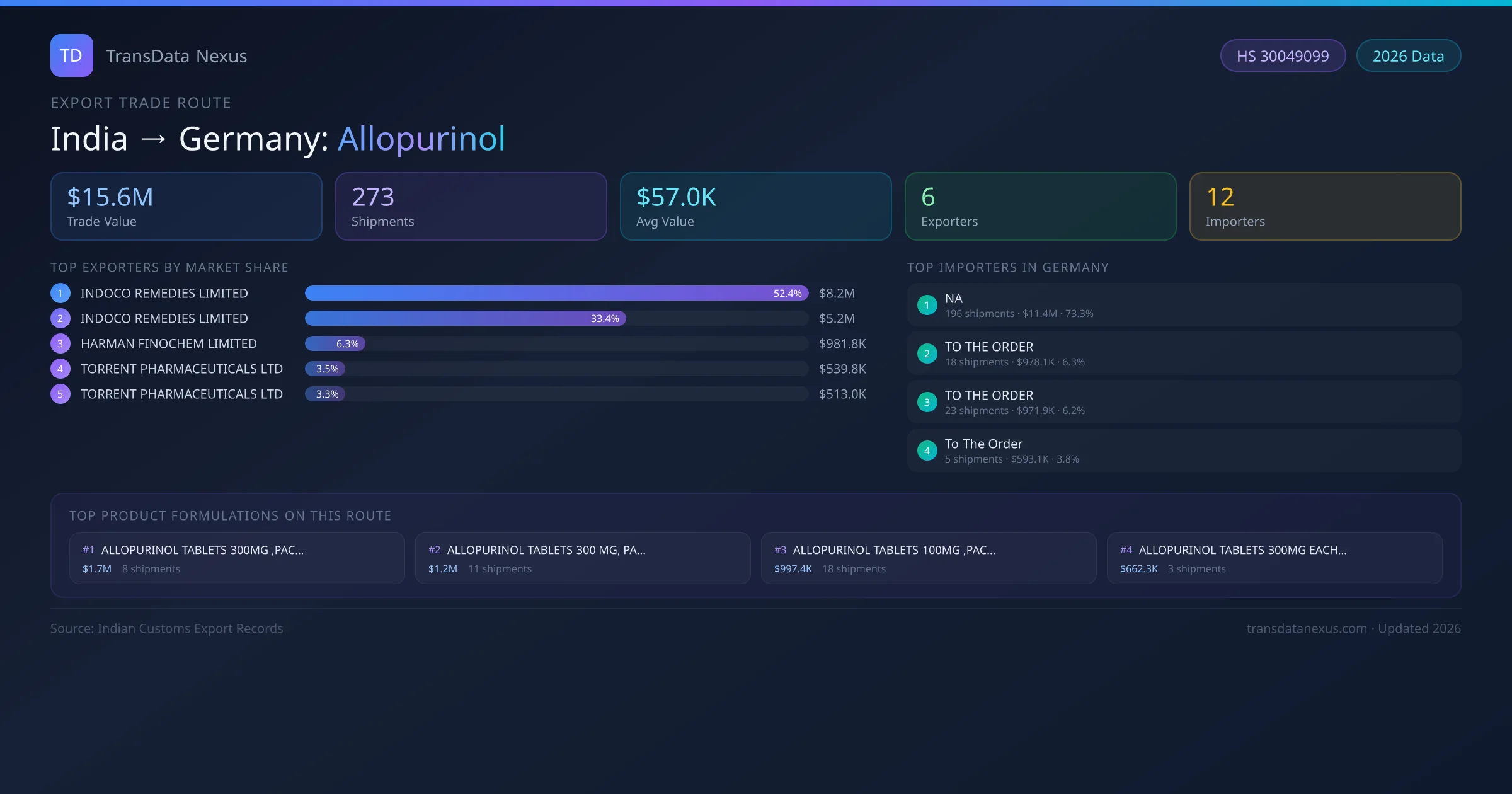
Route Intelligence Overview
The India to Germany Allopurinol corridor is one of India's established pharmaceutical export routes, with 273 shipments documented worth a combined $15.6M USD. The route is dominated by INDOCO REMEDIES LIMITED, which alone accounts for roughly 52% of all export value, reflecting the consolidated nature of India's allopurinol manufacturing sector.
Across 6 active suppliers, the average shipment value stands at $57.0K USD — a figure that reflects both bulk commercial orders from large pharmaceutical companies and smaller specialty shipments. Sea freight dominates at 75% of all shipments, consistent with allopurinol's non-urgent bulk-order profile.
Shipment activity peaks during January-March, with an average transit time of 20 days port-to-port. The route has recorded an annual growth rate of 9.4%, placing it at rank #15 among India's top allopurinol export destinations globally.
On the import side, key buyers of Indian allopurinol in Germany include NA, TO THE ORDER, TO THE ORDER and 9 others. NA is the single largest importer with 196 shipments valued at $11.4M USD.
Route Characteristics
- Average transit20 days
- Peak seasonQ4
- Primary modeSea freight
- Top portNHAVA SHEVA SEA (INNSA1)
Market Position
- Global rank#15
- Annual growth+9.4%
- Demand growth+26.6%
- Regulatory ease77/100
Top 10 Indian Allopurinol Exporters to Germany
Showing top 10 of 6 Indian suppliers exporting Allopurinol to Germany, ranked by total trade value (USD)
| Rank | Supplier (Indian Exporter) | Shipments | Total Value (USD) | Market Share |
|---|---|---|---|---|
| 1 | INDOCO REMEDIES LIMITED Avg $54.7K per shipment | 149 | $8.2M | 52.4% |
| 2 | INDOCO REMEDIES LIMITED Avg $62.6K per shipment | 83 | $5.2M | 33.4% |
| 3 | HARMAN FINOCHEM LIMITED Avg $65.5K per shipment | 15 | $981.8K | 6.3% |
| 4 | TORRENT PHARMACEUTICALS LTD Avg $54.0K per shipment | 10 | $539.8K | 3.5% |
| 5 | TORRENT PHARMACEUTICALS LTD Avg $39.5K per shipment | 13 | $513.0K | 3.3% |
| 6 | TORRENT PHARMACEUTICALS LIMITED Avg $56.3K per shipment | 3 | $169.0K | 1.1% |
This table shows the top 10 of 6 Indian companies exporting allopurinol to Germany, ranked by total trade value. The listed exporters are: INDOCO REMEDIES LIMITED, INDOCO REMEDIES LIMITED , HARMAN FINOCHEM LIMITED, TORRENT PHARMACEUTICALS LTD, TORRENT PHARMACEUTICALS LTD , TORRENT PHARMACEUTICALS LIMITED. INDOCO REMEDIES LIMITED is the dominant supplier with 149 shipments worth $8.2M USD, giving it a 52% market share. The top 3 suppliers together account for 92% of the total trade value on this route.
Top 10 Allopurinol Importers in Germany
Showing top 10 of 12 known buyers in Germany receiving Allopurinol shipments from India, ranked by import value
On the receiving end of this trade route, the leading importers of Indian allopurinol in Germany include NA, TO THE ORDER, TO THE ORDER , To The Order, HEUMANN PHARMA GMBH CO.GENERICA KG., among 12 total buyers. The largest importer is NA, accounting for $11.4M USD across 196 shipments — representing 73% of all allopurinol imports from India on this route.
| Rank | Importer / Buyer | Shipments | Import Value (USD) | Market Share |
|---|---|---|---|---|
| 1 | NA | 196 | $11.4M | 73.3% |
| 2 | TO THE ORDER | 18 | $978.1K | 6.3% |
| 3 | TO THE ORDER | 23 | $971.9K | 6.2% |
| 4 | To The Order | 5 | $593.1K | 3.8% |
| 5 | HEUMANN PHARMA GMBH CO.GENERICA KG. | 4 | $417.4K | 2.7% |
| 6 | TO THE ORDER OF | 5 | $386.2K | 2.5% |
| 7 | HEUMANN PHARMA GMBH CO.GENERICA KG. | 11 | $340.2K | 2.2% |
| 8 | HEUMANN PHARMA GMBH CO GENERICA KG | 3 | $169.0K | 1.1% |
| 9 | HEUMANN PHARMA GMBH & CO. GENERICA | 1 | $103.0K | 0.7% |
| 10 | HEUMANN PHARMA GMBH CO. GENERICA KG | 5 | $97.0K | 0.6% |
Showing top 10 of 12 Allopurinol importers in Germany on this route.
Top 10 Allopurinol Formulations Imported by Germany
Showing top 10 of 118 product formulations shipped on the India to Germany Allopurinol route, ranked by trade value
Germany imports a wide range of allopurinol formulations from India, spanning tablets, capsules, suspensions, and combination drugs. The top formulation — ALLOPURINOL TABLETS 300MG ,PACK OF 10X1 — accounts for $1.7M USD across 8 shipments. There are 118 distinct product descriptions in the dataset, reflecting the variety of dosage forms and strengths imported.
| Rank | Product Formulation | Shipments | Trade Value (USD) | Market Share |
|---|---|---|---|---|
| 1 | ALLOPURINOL TABLETS 300MG ,PACK OF 10X1 | 8 | $1.7M | 10.9% |
| 2 | ALLOPURINOL TABLETS 300 MG, PACK OF 10X10'S (EACH ALLOPURINOL TABLETOF 300MG CONTAINS ALLOPURINOL 300MG EQUI | 11 | $1.2M | 7.5% |
| 3 | ALLOPURINOL TABLETS 100MG ,PACK OF 10X1 | 18 | $997.4K | 6.4% |
| 4 | ALLOPURINOL TABLETS 300MG EACH ALLOP | 3 | $662.3K | 4.3% |
| 5 | ALLOPURINOL TABLETS 100 MG, PACK OF 10X10'S (EACH ALLOPURINOL TABLETOF 100 MG CONTAINS ALLOPURINOL 100 MG EQ | 9 | $600.0K | 3.9% |
| 6 | ALLOPURINOL TABLETS 300MG PACK OF 10X10S EACH ALLOPURINOL TABLET OF 300MG CONTAINS ALLOPURINOL 300MG EQUIVALENT TO | 3 | $561.3K | 3.6% |
| 7 | ALLOPURINOL TABLETS 300MG, PACK OF10X10S EACH ALLOPURINOL TABLET OF 300MG CONTAINS ALLOPURINOL(OTHER DETAIL AS PER INVNOS | 6 | $399.1K | 2.6% |
| 8 | ALLOPURINOL TABLETS 100MG, PACK OF 105'S | 6 | $382.4K | 2.5% |
| 9 | ALLOPURINOL TABLETS 300 MG, PACK OF 10X10'S (EACH ALLOPURINOL TABLETOF 300MG CONTAINS ALLOPURINOL 300MG EQU | 4 | $370.0K | 2.4% |
| 10 | ALLOPURINOL TABLETS 300MG, PACK OF 10X10 | 4 | $283.7K | 1.8% |
Showing top 10 of 118 Allopurinol formulations imported by Germany on this route.
Shipping & Logistics Analysis
Freight mode split and port-of-origin breakdown
Freight Mode Distribution
Sea freight dominates at 75%, typical for bulk pharmaceutical shipments.
Top Ports of Origin
NHAVA SHEVA SEA (INNSA1) handles the highest volume with 117 shipments. Transit time averages 20 days by sea.
Market Dynamics
India's allopurinol exports to Germany are driven primarily by a handful of large-scale manufacturers. INDOCO REMEDIES LIMITED with 149 shipments leads the pack, a pattern common in generic pharmaceutical corridors where manufacturing scale creates significant cost advantages. The presence of 6 active exporters signals a competitive but concentrated market — buyers in Germany benefit from supplier diversity while the top tier handles the majority of volume.
The top 3 suppliers — INDOCO REMEDIES LIMITED, INDOCO REMEDIES LIMITED , HARMAN FINOCHEM LIMITED — together account for 92% of total trade value on this route. The average shipment value of $57.0K USD reflects primarily bulk commercial orders from large pharmaceutical distributors.
Beyond the primary product category, shipments on this route include closely related formulations such as allopurinol tablets 300 mg, pack of 10x10's (each allopurinol tabletof 300mg contains allopurinol 300mg equi and allopurinol tablets 100mg ,pack of 10x1 , suggesting that buyers in Germany tend to consolidate orders across related product lines from the same Indian supplier.
On the buying side, NA is the largest importer with 196 shipments worth $11.4M USD — representing 73% of all allopurinol imports from India on this route. A total of 12 buyers are active on this corridor.
Route Statistics
- Trade Volume
- $15.6M
- Avg. Shipment
- $57.0K
- Suppliers
- 6
- Buyers
- 12
- Transit (Sea)
- ~20 days
- Annual Growth
- +9.4%
Related Analysis
Reverse Direction
Germany → India — Allopurinol (Import)Other Allopurinol Routes
Unlock the Full India to Germany Allopurinol Dataset
TransData Nexus provides verified shipment-level records, supplier contact details, HS code breakdowns, real-time pricing benchmarks, and regulatory compliance guides for 273 shipments on this route.
Live Corridor Intelligence
India → Germany trade corridor intelligence
1Live Corridor Intelligence
As of March 2026, the India-Germany pharmaceutical trade corridor is experiencing significant disruptions due to geopolitical tensions in the Middle East. Heightened security risks in the Strait of Hormuz and the Red Sea–Suez Canal corridor have led major carriers to suspend or restrict transits, resulting in extended transit times by 10–20 days and a 40–50% increase in freight rates on key India–Europe routes. These disruptions have particularly impacted time-sensitive pharmaceutical shipments, including finished formulations containing Allopurinol.
Currency fluctuations have also affected trade dynamics. The Indian Rupee has depreciated against the Euro, increasing the cost of imports for German buyers. Additionally, the implementation of the India–European Union Free Trade Agreement (FTA) on January 27, 2026, is expected to influence trade policies and tariffs, although specific product-level schedules and commitments are yet to be clarified.
Geopolitical & Sanctions Impact
India → Germany trade corridor intelligence
1Geopolitical & Sanctions Impact
Geopolitical tensions, notably the 12-day conflict between Israel and Iran in June 2025, have significantly impacted shipping routes between India and Germany. The conflict led to extreme GPS and AIS signal jamming in the Strait of Hormuz, making safe navigation nearly impossible without military escorts. This situation triggered an immediate surge in war-risk insurance premiums, adding approximately $10 per barrel to fuel costs and directly translating into higher freight rates for bulk carriers.
These disruptions have forced vessels to reroute around the Cape of Good Hope, extending transit times and increasing costs. The longer routes have also led to higher greenhouse gas emissions, with shipping emissions rising by 5% in 2024.
Trade Agreement & Policy Analysis
India → Germany trade corridor intelligence
1Trade Agreement & Policy Analysis
The India–European Union Free Trade Agreement, signed on January 27, 2026, aims to eliminate or reduce tariffs on the majority of goods traded between India and the EU. While the agreement covers over 90% of traded goods by value, specific product-level schedules and legally binding commitments are expected to be clarified following the publication of the treaty text and associated annexes.
Additionally, the India–EFTA Trade and Economic Partnership Agreement (TEPA), which entered into force on October 1, 2025, includes commitments on sustainable development and an investment pledge of $100 billion from the EFTA side to India over 15 years.
Landed Cost Breakdown
India → Germany trade corridor intelligence
1Landed Cost Breakdown
Estimating the landed cost components for Allopurinol formulations shipped from India to Germany involves several factors:
- FOB Price: The Free on Board (FOB) price for finished pharmaceutical formulations containing Allopurinol varies depending on the manufacturer and order volume.
- Sea Freight Cost per Container: Due to current disruptions, freight rates have increased by 40–50%. For a standard 20-foot container, this translates to an approximate cost of $4,000–$6,000.
- Insurance: War-risk insurance premiums have surged, adding approximately $10 per barrel to fuel costs, which directly impacts shipping expenses.
- Customs Duty: Under the new India–EU FTA, specific tariff reductions are anticipated, but exact rates for pharmaceutical products are pending clarification.
- Clearance Charges: Customs clearance charges in Germany typically range from €100 to €200 per shipment, depending on the complexity and services required.
- VAT/GST: Germany imposes a Value Added Tax (VAT) of 19% on imported goods, applicable to the total value, including CIF (Cost, Insurance, and Freight) and customs duties.
- Local Distribution: Costs for local distribution within Germany depend on the logistics provider and distance to the final destination.
Given the current volatility in freight rates and insurance premiums, the total landed cost per unit for Allopurinol formulations has increased, impacting pricing strategies and profit margins for exporters and importers alike.
Germany Pharmaceutical Import Regulations
EMA registration, GMP, and compliance requirements for Indian exporters
1EMA Registration & Import Requirements
To import Allopurinol formulations into Germany, the following approvals and registrations are necessary:
- Marketing Authorization: A valid marketing authorization is mandatory for all medicinal products intended for the German market. Applications must be submitted in the Common Technical Document (CTD) or electronic CTD (eCTD) format.
- Import Authorization: An import permit, as stipulated in § 72 of the German Medicines Act (AMG), is required for importing medicinal products from non-EU countries. This permit ensures that the importer meets the same personnel and material requirements as those for manufacturing medicinal products.
- Good Manufacturing Practice (GMP) Compliance: Manufacturing facilities outside the EU must comply with EU GMP standards. Compliance is verified through inspections conducted by EU authorities or recognized under Mutual Recognition Agreements (MRAs).
- Timelines and Fees: Approval timelines and registration fees vary based on the specific application and product.
2Quality & GMP Standards for Indian Exporters
Indian manufacturers exporting Allopurinol formulations to Germany must adhere to the following GMP standards:
- EU GMP Certification: Manufacturers must comply with EU GMP guidelines, ensuring that products are consistently produced and controlled according to quality standards.
- GMP Inspections: EU authorities conduct inspections of non-EU manufacturing sites to verify compliance. A GMP certificate is issued if the facility meets the required standards.
- Recent Inspections and Actions: In August 2016, the German authority "Landesamt für soziale Dienste Schleswig-Holstein" issued a GMP Non-Compliance Statement for an Indian API manufacturer, Artemis Biotech, due to deficiencies in quality assurance oversight.
3Recent Regulatory Developments (2024-2026)
Recent developments affecting Indian pharmaceutical exports to Germany include:
- Revised GMP Rules in India: In January 2024, India's Ministry of Health revised GMP regulations to align with global standards, introducing a pharmaceutical quality system, quality risk management, and validation of equipment.
- EU GMP Annex Revisions: In February 2026, the EMA initiated consultations to revise Annex 6 (Manufacture of Medicinal Gases) and Annex 15 (Qualification and Validation) of the EU GMP guidelines, aiming to reflect current industry practices and technological advancements.
These developments underscore the importance of continuous compliance with evolving GMP standards to maintain market access in Germany.
Germany Allopurinol Market Context & Tariffs
Market size, import duties, and competitive landscape · MFN tariff: 0%
1Germany Allopurinol Market Size & Demand
In 2024, the German gout therapeutics market was valued at $162.2 million, with projections indicating growth to $244.0 million by 2030, reflecting a compound annual growth rate (CAGR) of 6.9% from 2025 to 2030. This growth is driven by factors such as an aging population, increased prevalence of gout and hyperuricemia, and rising healthcare expenditures. Allopurinol, a primary treatment for gout, is integral to this market expansion.
Germany's pharmaceutical industry is robust, with a mix of domestic manufacturing and imports to meet demand. While specific data on domestic production versus imports of Allopurinol formulations is not readily available, the country's strong pharmaceutical sector suggests significant local manufacturing capabilities complemented by imports to fulfill market needs.
2Import Tariff & Duty Structure
Germany imposes a 0% Most-Favored-Nation (MFN) import duty on pharmaceutical products under HS code 30049099, which includes Allopurinol formulations. Additionally, pharmaceutical products are typically subject to the standard Value Added Tax (VAT) rate in Germany, which is 19%. There are no specific Free Trade Agreements (FTAs) between India and Germany that alter this tariff structure for pharmaceutical imports. Furthermore, there are no known anti-dumping duties imposed on Allopurinol formulations imported into Germany.
3Competitive Landscape
India is a significant supplier of Allopurinol formulations to Germany, with exports valued at $15.6 million, accounting for 3.2% of India's total Allopurinol formulation exports of $492.9 million. The top Indian exporters to Germany include INDOCO REMEDIES LIMITED and HARMAN FINOCHEM LIMITED.
Other major countries supplying Allopurinol formulations to Germany include China and various European Union manufacturers. India's competitive pricing, coupled with its established pharmaceutical manufacturing infrastructure, positions it favorably against competitors. However, specific comparative pricing data between India and other suppliers like China or EU manufacturers is not readily available.
Why Source Allopurinol from India for Germany?
Manufacturing advantage, cost comparison, supply reliability, and strategic sourcing recommendations
1Why India for Allopurinol — Manufacturing Advantage
India is a leading global supplier of generic pharmaceuticals, accounting for approximately 24% of the world's active pharmaceutical ingredient (API) production. (eur-lex.europa.eu) The country has a robust infrastructure for manufacturing finished dosage forms, including tablets and capsules containing Allopurinol. This extensive manufacturing capacity is supported by a significant number of facilities compliant with international standards. As of April 2024, 748 Indian sites (both bulk drugs and formulations) were registered with the U.S. FDA, underscoring India's commitment to quality and regulatory compliance. Additionally, India's cost-effective production processes, driven by economies of scale and a skilled workforce, enable competitive pricing for Allopurinol formulations without compromising quality.
2India vs. China vs. EU — Cost & Quality Comparison
When comparing Allopurinol formulations from India, China, and the European Union (EU), several factors come into play:
- Cost: India's pharmaceutical industry benefits from lower production costs due to economies of scale and a skilled workforce, resulting in competitively priced Allopurinol formulations. China also offers cost advantages; however, concerns about quality and regulatory compliance have been noted. The EU, while maintaining high-quality standards, typically has higher production costs, leading to more expensive formulations.
- Quality Perception: India has a strong reputation for producing high-quality generic medicines, supported by numerous WHO-GMP and FDA-approved facilities. China's pharmaceutical industry has faced scrutiny over quality issues, impacting its global perception. The EU is renowned for stringent quality standards, ensuring high-quality products.
- Regulatory Acceptance in Germany: Indian pharmaceutical products are widely accepted in Germany, with Indian manufacturers holding a significant share of the generic market. Chinese products face more stringent scrutiny due to past quality concerns. EU-manufactured products are inherently accepted, given the harmonized regulatory environment.
- Supply Reliability: India has a proven track record of reliable supply chains for pharmaceutical formulations, including Allopurinol. China's supply reliability has been questioned due to regulatory and quality issues. The EU maintains reliable supply chains but at higher costs.
3Supply Reliability & Capacity Assessment
India's pharmaceutical industry demonstrates robust manufacturing capacity for finished dosage forms, including Allopurinol formulations. The country's facilities are equipped with advanced packaging and cold chain capabilities, ensuring product integrity during transit. Recent inspections, such as the U.S. FDA's approval of Granules India's Hyderabad facility in August 2025, highlight India's commitment to regulatory compliance and quality assurance. While occasional supply disruptions have occurred, Indian manufacturers have proactively addressed these issues, maintaining a reliable supply chain. Top Indian formulation manufacturers continue to expand their capacities to meet growing global demand.
4Strategic Sourcing Recommendations
For German buyers sourcing Allopurinol formulations from India, the following strategies are recommended:
- Dual-Sourcing Strategy: Engage with multiple Indian manufacturers to mitigate risks associated with supply disruptions and ensure a consistent supply of Allopurinol formulations.
- Minimum Order Quantities (MOQs): Understand and negotiate MOQs with suppliers, as these can vary based on manufacturer capabilities and batch sizes.
- Payment Terms: Familiarize yourself with common payment terms in India-Germany pharmaceutical trade, such as Letters of Credit (LC) or advance payments, to establish mutually beneficial agreements.
- Supplier Qualification Process: Implement a thorough supplier qualification process, including audits of manufacturing facilities, verification of regulatory approvals (e.g., WHO-GMP, FDA), and assessment of quality control systems.
- Regulatory Compliance: Ensure that selected suppliers comply with both Indian and German regulatory requirements, facilitating smooth importation and market entry.
Supplier Due Diligence Guide — Allopurinol from India
Pre-qualification checklist, document requirements, red flags, and audit guidance for Germany buyers
1Pre-Qualification Checklist for Germany Buyers
1. Regulatory Compliance Verification:
2. Quality System Assessment:
3. Certifications and Accreditations:
4. Track Record and Reputation:
5. Product-Specific Considerations:
2Key Documents to Request from Indian Suppliers
1. Certificate of Analysis (CoA): Provides detailed results of laboratory testing for a specific batch, confirming the product meets predefined specifications.
2. Certificate of Origin (CoO): Certifies the country where the product was manufactured, essential for customs and regulatory purposes.
3. GMP Certificate: Demonstrates that the manufacturing facility complies with Good Manufacturing Practice standards, ensuring product quality and safety.
4. Stability Data: Includes studies conducted under ICH guidelines to show the product's shelf life and how it maintains quality under various environmental conditions.
5. Batch Manufacturing Records: Detailed documentation of the production process for each batch, ensuring traceability and consistency.
6. Drug Master File (DMF): Comprehensive document submitted to regulatory authorities detailing the manufacturing, processing, packaging, and storing of the drug product.
7. Free Sale Certificate from CDSCO: Issued by the Central Drugs Standard Control Organization, indicating the product is approved for sale in India and meets regulatory standards.
8. Insurance Certificates: Proof of liability insurance coverage, providing protection against potential claims related to product quality or safety.
3Red Flags & Warning Signs
1. Regulatory Non-Compliance:
2. Financial Concerns:
3. Quality Assurance Deficiencies:
4. Operational Transparency Issues:
4Factory Audit & Ongoing Monitoring
1. Pre-Audit Desktop Review:
2. On-Site Inspection Focus Areas:
3. Post-Audit Corrective Action Expectations:
4. Annual Re-Qualification Process:
5. Remote Monitoring Options:
Cost Estimates and Timeline for Audit Visits to India:
- Cost Estimates:
- Travel Expenses: Approximately €2,000–€3,000, including flights, accommodation, and local transportation.
- Audit Fees: Professional auditor fees range from €1,500–€2,500 per day.
- Timeline:
- Planning and Coordination: 2–4 weeks to schedule and prepare for the audit.
- On-Site Audit: Typically 2–3 days, depending on the facility size and complexity.
- Post-Audit Reporting: 1–2 weeks to compile findings and recommendations.
By adhering to this comprehensive approach, German pharmaceutical companies can effectively qualify Indian suppliers of Allopurinol formulations, ensuring compliance with regulatory standards and safeguarding product quality.
Frequently Asked Questions — India to Germany Allopurinol Trade
Answers based on Indian Customs (DGFT) shipment records compiled by TransData Nexus
Q Which Indian companies export Allopurinol to Germany?
The leading Indian exporters of Allopurinol to Germany are INDOCO REMEDIES LIMITED, INDOCO REMEDIES LIMITED , HARMAN FINOCHEM LIMITED. INDOCO REMEDIES LIMITED holds the largest market share at approximately 52% of total trade value on this route.
Q What is the total value of Allopurinol exports from India to Germany?
India exports Allopurinol to Germany worth approximately $15.6M USD across 273 recorded shipments. The average value per shipment is $57.0K USD.
Q Which ports does India use to ship Allopurinol to Germany?
The most active port of origin is NHAVA SHEVA SEA (INNSA1) with 117 shipments. Indian exporters primarily use sea freight for this route, with 75% of shipments going by sea and 22% by air.
Q How long does shipping take from India to Germany for Allopurinol?
The average transit time for Allopurinol shipments from India to Germany is approximately 20 days. Sea freight typically takes longer, while air freight can reduce this significantly for urgent orders. Peak shipping activity is observed during January-March.
Q Is the India to Germany Allopurinol trade route growing?
Yes — this trade corridor has seen an annual growth rate of approximately 9.4% with demand growth tracking at 26.6%. The route is ranked #15 among India's top Allopurinol export destinations globally.
Q How many suppliers are active on the India to Germany Allopurinol route?
There are currently 6 active Indian suppliers exporting Allopurinol to Germany. The market is moderately concentrated with INDOCO REMEDIES LIMITED accounting for 52% of total shipment value.
Q Who are the main importers of Allopurinol from India in Germany?
The leading importers of Indian Allopurinol in Germany include NA, TO THE ORDER, TO THE ORDER , To The Order, HEUMANN PHARMA GMBH CO.GENERICA KG.. NA is the largest buyer with 196 shipments worth $11.4M USD.
Official References & Regulatory Resources
- India Trade Statistics (DGFT)
- Invest India — Pharma Sector
- WCO HS Nomenclature
- Ministry of Commerce — Pharma Exports
- Pharmexcil
Data sourced from Indian Customs (DGFT) records. Verify regulatory and trade status with the agencies above.
Research Methodology & Data Transparency
Suresh Sormare
Verified AuthorPharmaceutical Export-Import Analyst & Trade Intelligence Expert
Suresh Sormare is a pharmaceutical export-import analyst with deep expertise in Indian Customs (DGFT) data, HS code classification, and global pharmaceutical supply chains. His analysis covers 10M+ shipment records across 150+ countries and is used by manufacturers, procurement agencies, and trade consultants worldwide. Suresh specializes in identifying verified suppliers and buyers from customs records, mapping bilateral pharmaceutical trade corridors, analyzing tariff structures and regulatory frameworks across 170+ destination markets, and benchmarking competitive positioning for finished pharmaceutical formulations. His methodology combines granular customs transaction data with regulatory intelligence from FDA, EMA, WHO, CDSCO, and 40+ national drug authorities to deliver actionable trade insights for the pharmaceutical formulations sector.
linkedin.com/in/sureshsormarePrimary Data Source
All trade data is sourced from Indian Customs (DGFT) official shipping bill records — the authoritative government database for India's pharmaceutical trade. Each verified record contains exporter name, consignee (buyer) name, detailed product description, quantity, declared FOB value (USD), port of loading, destination country, and shipment date.
Analysis Methodology
- 1.Route Identification: India to Germany export trade corridor identified from Indian Customs (DGFT) records for Allopurinol.
- 2.Supplier/Buyer Matching: 6 Indian exporters and 12 importers in Germany matched using name normalization.
- 3.Value Aggregation: Total export value aggregated from 273 verified shipping bill records. Values are FOB in USD.
- 4.Market Share Analysis: Each supplier and buyer contribution calculated as a percentage of total route value. Statistical normalization applied to ensure accurate representation across varying shipment sizes.
Government-Sourced Data
Official DGFT customs records
Transparent Methodology
Calculations fully disclosed above
273 Verified Shipments
6 Indian exporters tracked
Expert-Reviewed
By pharmaceutical trade specialists