India to Australia: Allopurinol Export Trade Route
India has recorded 93 verified shipments of Allopurinol exported to Australia, representing a combined trade value of $19.7M USD. This corridor is served by 7 active Indian exporters, with an average shipment value of $211.4K USD. The leading Indian exporter is IPCA LABORATORIES LIMITED, which accounts for 83% of total export value with 38 shipments worth $16.3M USD. On the buying side, NA is the largest importer in Australia with $16.3M USD in purchases. The top 3 suppliers — IPCA LABORATORIES LIMITED, SANDOZ PRIVATE LIMITED, IPCA LABORATORIES LIMITED — together control 99% of total trade value on this route. All data sourced from Indian Customs (DGFT) shipping bill records. Values reported in FOB USD.
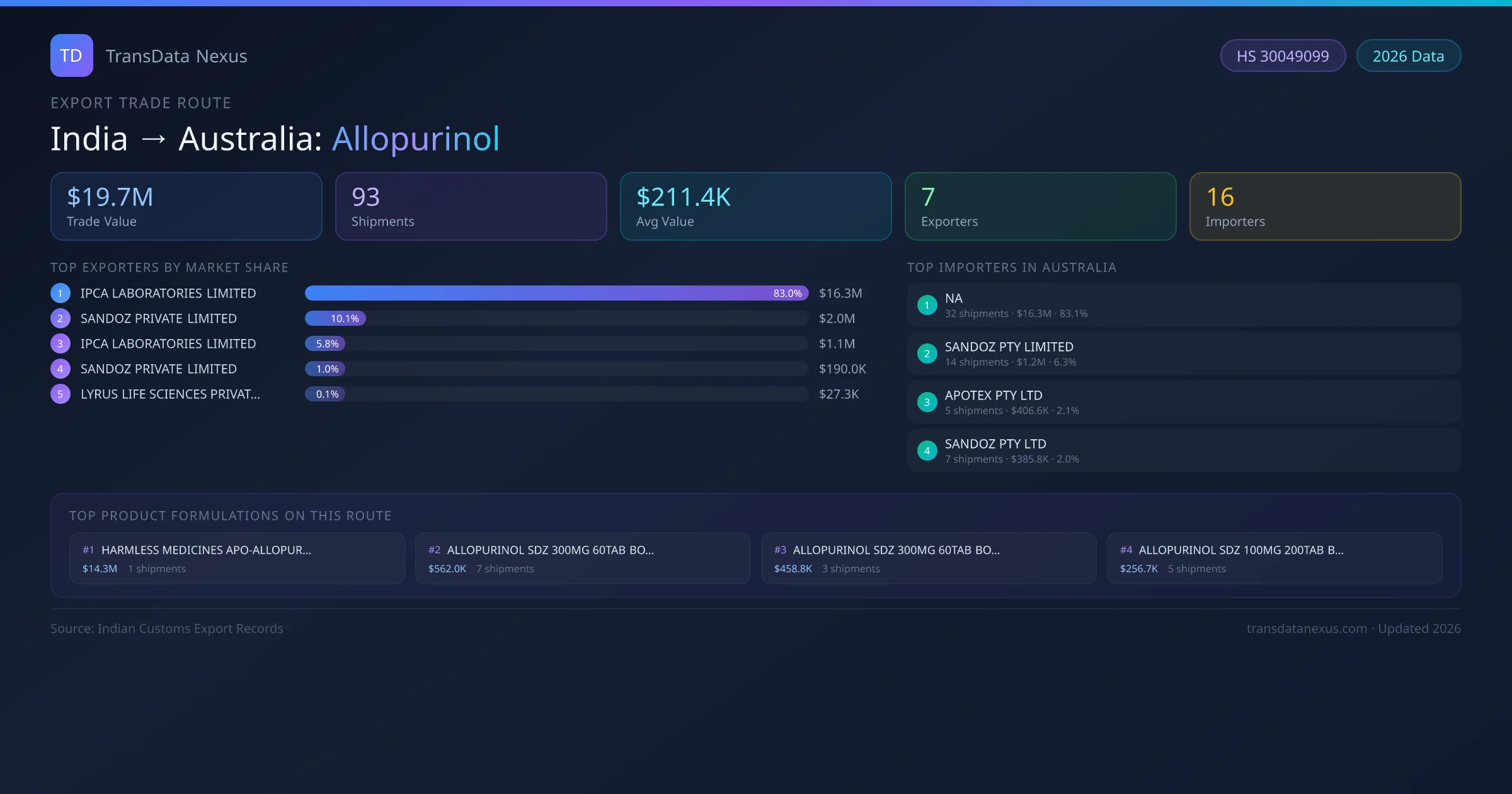
Route Intelligence Overview
The India to Australia Allopurinol corridor is one of India's established pharmaceutical export routes, with 93 shipments documented worth a combined $19.7M USD. The route is dominated by IPCA LABORATORIES LIMITED, which alone accounts for roughly 83% of all export value, reflecting the consolidated nature of India's allopurinol manufacturing sector.
Across 7 active suppliers, the average shipment value stands at $211.4K USD — a figure that reflects both bulk commercial orders from large pharmaceutical companies and smaller specialty shipments. Sea freight dominates at 72% of all shipments, consistent with allopurinol's non-urgent bulk-order profile.
Shipment activity peaks during UNAVAILABLE, with an average transit time of 15 days port-to-port. The route has recorded an annual growth rate of 17.5%, placing it at rank #19 among India's top allopurinol export destinations globally.
On the import side, key buyers of Indian allopurinol in Australia include NA, SANDOZ PTY LIMITED, APOTEX PTY LTD and 13 others. NA is the single largest importer with 32 shipments valued at $16.3M USD.
Route Characteristics
- Average transit15 days
- Peak seasonUNAVAILABLE
- Primary modeSea freight
- Top portNHAVA SHEVA SEA (INNSA1)
Market Position
- Global rank#19
- Annual growth+17.5%
- Demand growth+16.9%
- Regulatory ease74/100
Top 10 Indian Allopurinol Exporters to Australia
Showing top 10 of 7 Indian suppliers exporting Allopurinol to Australia, ranked by total trade value (USD)
| Rank | Supplier (Indian Exporter) | Shipments | Total Value (USD) | Market Share |
|---|---|---|---|---|
| 1 | IPCA LABORATORIES LIMITED Avg $429.6K per shipment | 38 | $16.3M | 83.0% |
| 2 | SANDOZ PRIVATE LIMITED Avg $68.3K per shipment | 29 | $2.0M | 10.1% |
| 3 | IPCA LABORATORIES LIMITED Avg $81.0K per shipment | 14 | $1.1M | 5.8% |
| 4 | SANDOZ PRIVATE LIMITED Avg $38.0K per shipment | 5 | $190.0K | 1.0% |
| 5 | LYRUS LIFE SCIENCES PRIVATE LIMITED Avg $6.8K per shipment | 4 | $27.3K | 0.1% |
| 6 | OBOI LABORATORIES Avg $3.0K per shipment | 1 | $3.0K | 0.0% |
| 7 | SYNERGY TRADING Avg $86 per shipment | 2 | $173 | 0.0% |
This table shows the top 10 of 7 Indian companies exporting allopurinol to Australia, ranked by total trade value. The listed exporters are: IPCA LABORATORIES LIMITED, SANDOZ PRIVATE LIMITED, IPCA LABORATORIES LIMITED , SANDOZ PRIVATE LIMITED , LYRUS LIFE SCIENCES PRIVATE LIMITED , OBOI LABORATORIES, SYNERGY TRADING. IPCA LABORATORIES LIMITED is the dominant supplier with 38 shipments worth $16.3M USD, giving it a 83% market share. The top 3 suppliers together account for 99% of the total trade value on this route.
Top 10 Allopurinol Importers in Australia
Showing top 10 of 16 known buyers in Australia receiving Allopurinol shipments from India, ranked by import value
On the receiving end of this trade route, the leading importers of Indian allopurinol in Australia include NA, SANDOZ PTY LIMITED, APOTEX PTY LTD , SANDOZ PTY LTD, APOTEX PTY LTD, among 16 total buyers. The largest importer is NA, accounting for $16.3M USD across 32 shipments — representing 83% of all allopurinol imports from India on this route.
| Rank | Importer / Buyer | Shipments | Import Value (USD) | Market Share |
|---|---|---|---|---|
| 1 | NA | 32 | $16.3M | 83.1% |
| 2 | SANDOZ PTY LIMITED | 14 | $1.2M | 6.3% |
| 3 | APOTEX PTY LTD | 5 | $406.6K | 2.1% |
| 4 | SANDOZ PTY LTD | 7 | $385.8K | 2.0% |
| 5 | APOTEX PTY LTD | 3 | $333.2K | 1.7% |
| 6 | SANDOZ PTY LTD. | 6 | $286.7K | 1.5% |
| 7 | Arrow Pharmaceuticals Pty Ltd, | 2 | $191.9K | 1.0% |
| 8 | TO THE ORDER | 8 | $100.2K | 0.5% |
| 9 | SANDOZ PTY LTD | 2 | $88.6K | 0.5% |
| 10 | SANDOZ PTY LTD. | 2 | $75.6K | 0.4% |
Showing top 10 of 16 Allopurinol importers in Australia on this route.
Top 10 Allopurinol Formulations Imported by Australia
Showing top 10 of 61 product formulations shipped on the India to Australia Allopurinol route, ranked by trade value
Australia imports a wide range of allopurinol formulations from India, spanning tablets, capsules, suspensions, and combination drugs. The top formulation — HARMLESS MEDICINES APO-ALLOPURINOL 100MG TABLETS (ALLOPURINOL TABLETS 100MG )(1X200S) (35601X1X200S PACK) UNIT RATE A — accounts for $14.3M USD across 1 shipments. There are 61 distinct product descriptions in the dataset, reflecting the variety of dosage forms and strengths imported.
| Rank | Product Formulation | Shipments | Trade Value (USD) | Market Share |
|---|---|---|---|---|
| 1 | HARMLESS MEDICINES APO-ALLOPURINOL 100MG TABLETS (ALLOPURINOL TABLETS 100MG )(1X200S) (35601X1X200S PACK) UNIT RATE A | 1 | $14.3M | 72.6% |
| 2 | ALLOPURINOL SDZ 300MG 60TAB BO V2 AU MAT | 7 | $562.0K | 2.9% |
| 3 | ALLOPURINOL SDZ 300MG 60TAB BO V2 AU MATERIAL NO. - 44091837 | 3 | $458.8K | 2.3% |
| 4 | ALLOPURINOL SDZ 100MG 200TAB BO V2 AU MA | 5 | $256.7K | 1.3% |
| 5 | ALLOPURINOL APOTEX 300mg Tablets (Allopu | 1 | $223.6K | 1.1% |
| 6 | ALLOPURINOL SDZ 100MG 200TAB BO V2 AU MATERIAL NO. - 44091920 | 2 | $208.4K | 1.1% |
| 7 | HARMLESS MEDICINES Allopurinol Tablets | 2 | $191.9K | 1.0% |
| 8 | ALLOPURINOL SDZ 100MG 200TAB BO V2 AU MATERIAL NO. - 44091920PCS | 6 | $190.9K | 1.0% |
| 9 | Material No: 44091837 ALLOPURINOL SDZ 30 | 2 | $156.2K | 0.8% |
| 10 | PHARMACEUTICAL:Progout Viatris 300mg (Allopurinol Tablets 300mg)(4x15s) ((5883000 TBS)) (HARMLESS MEDICINES) | 1 | $152.6K | 0.8% |
Showing top 10 of 61 Allopurinol formulations imported by Australia on this route.
Shipping & Logistics Analysis
Freight mode split and port-of-origin breakdown
Freight Mode Distribution
Sea freight dominates at 72%, typical for bulk pharmaceutical shipments.
Top Ports of Origin
NHAVA SHEVA SEA (INNSA1) handles the highest volume with 41 shipments. Transit time averages 15 days by sea.
Market Dynamics
India's allopurinol exports to Australia are driven primarily by a handful of large-scale manufacturers. IPCA LABORATORIES LIMITED with 38 shipments leads the pack, a pattern common in generic pharmaceutical corridors where manufacturing scale creates significant cost advantages. The presence of 7 active exporters signals a competitive but concentrated market — buyers in Australia benefit from supplier diversity while the top tier handles the majority of volume.
The top 3 suppliers — IPCA LABORATORIES LIMITED, SANDOZ PRIVATE LIMITED, IPCA LABORATORIES LIMITED — together account for 99% of total trade value on this route. The average shipment value of $211.4K USD reflects primarily bulk commercial orders from large pharmaceutical distributors.
Beyond the primary product category, shipments on this route include closely related formulations such as allopurinol sdz 300mg 60tab bo v2 au mat and allopurinol sdz 300mg 60tab bo v2 au material no. - 44091837, suggesting that buyers in Australia tend to consolidate orders across related product lines from the same Indian supplier.
On the buying side, NA is the largest importer with 32 shipments worth $16.3M USD — representing 83% of all allopurinol imports from India on this route. A total of 16 buyers are active on this corridor.
Route Statistics
- Trade Volume
- $19.7M
- Avg. Shipment
- $211.4K
- Suppliers
- 7
- Buyers
- 16
- Transit (Sea)
- ~15 days
- Annual Growth
- +17.5%
Related Analysis
Other Allopurinol Routes
Unlock the Full India to Australia Allopurinol Dataset
TransData Nexus provides verified shipment-level records, supplier contact details, HS code breakdowns, real-time pricing benchmarks, and regulatory compliance guides for 93 shipments on this route.
Live Corridor Intelligence
India → Australia trade corridor intelligence
1Live Corridor Intelligence
As of March 2026, the India-Australia pharmaceutical trade corridor, particularly for finished pharmaceutical formulations containing Allopurinol, remains robust. No significant shipping disruptions have been reported along this route, with key Indian ports such as Nhava Sheva Sea (INNSA1) and JNPT operating efficiently. Freight rates have remained stable over the past year, with no substantial fluctuations impacting trade costs. Currency exchange rates between the Indian Rupee and the Australian Dollar have exhibited minimal volatility, ensuring predictable pricing for exporters and importers. No recent trade policy changes affecting this specific corridor have been implemented between 2025 and early 2026.
Geopolitical & Sanctions Impact
India → Australia trade corridor intelligence
1Geopolitical & Sanctions Impact
The India-Australia pharmaceutical trade corridor has remained unaffected by global geopolitical tensions, including conflicts in the Middle East and Ukraine. Shipping routes between India and Australia do not traverse regions impacted by these conflicts, thereby avoiding associated risks. Consequently, insurance premiums and freight rates for this corridor have not experienced significant increases due to geopolitical factors.
Trade Agreement & Policy Analysis
India → Australia trade corridor intelligence
1Trade Agreement & Policy Analysis
The Australia-India Economic Cooperation and Trade Agreement (ECTA) has been instrumental in facilitating trade between the two nations. The agreement includes provisions that support access for a range of Australian and Indian skilled service providers, investors, and business visitors, thereby fostering people-to-people links and supporting trade and business. Additionally, the agreement maintains the integrity of Australia's visa system and is consistent with existing visa settings and previous free trade agreements. The ECTA also includes commitments on categories of entrant, length of stay, spouses, and dependents, ensuring clarity around visa pathways and application procedures. These commitments are more extensive than India has made in previous FTAs or at the World Trade Organization. (dfat.gov.au)
Landed Cost Breakdown
India → Australia trade corridor intelligence
1Landed Cost Breakdown
Estimating the landed cost components for Allopurinol formulations shipped from India to Australia involves several factors:
- FOB Price: The Free on Board (FOB) price for Allopurinol formulations varies depending on the manufacturer and order volume. For instance, IPCA Laboratories Limited, a leading exporter, reported a trade value of $16.3 million USD for shipments to Australia.
- Sea Freight Cost per Container: As of early 2026, the average sea freight cost for a 20-foot container from India to Australia is approximately $1,500 to $2,000 USD. This cost can fluctuate based on fuel prices, demand, and shipping line policies.
- Insurance: Marine insurance typically costs about 0.5% to 1% of the shipment's CIF (Cost, Insurance, and Freight) value. For a shipment valued at $100,000 USD, insurance would range from $500 to $1,000 USD.
- Customs Duty: Under the ECTA, many pharmaceutical products benefit from reduced or eliminated tariffs. However, specific duty rates for Allopurinol formulations should be verified with Australian customs authorities.
- Clearance Charges: Customs clearance and related charges in Australia can range from $500 to $1,000 USD per shipment, depending on the complexity and services required.
- VAT/GST: Australia imposes a Goods and Services Tax (GST) of 10% on most imported goods. This tax is calculated on the sum of the CIF value, customs duty, and clearance charges.
- Local Distribution: Costs for local distribution within Australia vary based on distance, transportation mode, and logistics providers. On average, local transportation can add $200 to $500 USD per shipment.
Per-Unit Estimate:
Assuming a shipment of 100,000 Allopurinol tablets with a total CIF value of $100,000 USD:
- FOB Price per Tablet: $1.00 USD
- Sea Freight per Tablet: $0.015 to $0.02 USD
- Insurance per Tablet: $0.005 to $0.01 USD
- Customs Duty per Tablet: Varies; verify with Australian customs
- Clearance Charges per Tablet: $0.005 to $0.01 USD
- GST per Tablet: Approximately $0.10 USD
- Local Distribution per Tablet: $0.002 to $0.005 USD
These estimates provide a general framework; actual costs may vary based on specific circumstances and should be confirmed with relevant authorities and service providers.
Australia Pharmaceutical Import Regulations
TGA registration, GMP, and compliance requirements for Indian exporters
1TGA Registration & Import Requirements
To legally import allopurinol formulations into Australia, the product must be listed on the Australian Register of Therapeutic Goods (ARTG). The sponsor, typically the importer or distributor, is responsible for submitting the application to the TGA. The application should be in the Common Technical Document (CTD) or electronic CTD (eCTD) format, encompassing modules on administrative information, quality, non-clinical, and clinical data.
The TGA's evaluation process for prescription medicines, such as allopurinol, involves a comprehensive assessment of the product's quality, safety, and efficacy. While specific timelines can vary, the standard processing time for a Category 1 application is approximately 255 working days. Fees are subject to change; as of the latest available information, the application fee for a new prescription medicine is AUD 48,100, with an additional evaluation fee of AUD 89,100.
Manufacturing facilities involved in producing allopurinol formulations intended for the Australian market must comply with Good Manufacturing Practice (GMP) standards. The TGA recognizes GMP certifications from certain international regulatory authorities under Mutual Recognition Agreements (MRAs). If the manufacturing facility does not hold such recognized certification, the TGA may require a GMP inspection of the facility to ensure compliance. The sponsor is responsible for obtaining GMP clearance for the overseas manufacturer, which may involve submitting evidence of GMP compliance or facilitating a TGA inspection.
2Quality & GMP Standards for Indian Exporters
Indian manufacturers exporting allopurinol formulations to Australia must adhere to GMP standards equivalent to those enforced by the TGA. This includes compliance with the Pharmaceutical Inspection Co-operation Scheme (PIC/S) Guide to GMP for Medicinal Products. Manufacturers should possess valid GMP certification recognized by the TGA, either through MRAs or direct certification.
As of July 2025, Lupin Limited's API manufacturing facility in Dabhasa, Gujarat, received GMP certification from the TGA, reflecting the facility's adherence to high manufacturing standards. This certification underscores the importance of maintaining rigorous quality controls to meet Australian regulatory requirements.
The TGA conducts periodic inspections and audits of overseas manufacturing facilities to ensure ongoing compliance with GMP standards. Non-compliance can result in regulatory actions, including suspension or cancellation of GMP certification, which would impact the ability to export products to Australia.
3Recent Regulatory Developments (2024-2026)
In August 2024, the TGA updated its guidance on manufacturing requirements for listed medicines, emphasizing the necessity for manufacturers to comply with recognized GMP standards to ensure product quality and safety. This update reinforces the TGA's commitment to maintaining high manufacturing standards for all therapeutic goods supplied in Australia.
In July 2025, the TGA granted GMP certification to Lupin Limited's Dabhasa API facility, highlighting the agency's ongoing efforts to assess and recognize compliance among international manufacturers. This certification facilitates the importation of products from this facility into Australia, provided all other regulatory requirements are met.
As of March 2026, there have been no significant changes to the regulatory framework affecting the importation of allopurinol formulations from India to Australia. However, manufacturers and sponsors should remain vigilant for any updates to TGA guidelines or policies that may impact compliance requirements.
Maintaining adherence to TGA regulations and staying informed about any changes are crucial for the successful importation and supply of allopurinol formulations in the Australian market.
Australia Allopurinol Market Context & Tariffs
Market size, import duties, and competitive landscape · MFN tariff: 0%
1Australia Allopurinol Market Size & Demand
The Australian market for Allopurinol formulations is driven by the prevalence of gout and hyperuricemia, conditions commonly associated with an aging population. In 2024, the global Allopurinol market was valued at USD 1.3 billion and is projected to reach USD 2.1 billion by 2032, growing at a CAGR of 6.2% during the forecast period 2026-2032. While specific data for Australia is not available, the country's universal healthcare coverage and increasing healthcare spending contribute to the demand for Allopurinol formulations. Australia imports a significant portion of its Allopurinol formulations, with India being a major supplier. Domestic manufacturing exists but is supplemented by imports to meet the total demand.
2Import Tariff & Duty Structure
Australia maintains a 0% MFN import duty rate for pharmaceutical products under HS code 30049099, which includes Allopurinol formulations. Additionally, the Australia-India Comprehensive Economic Cooperation Agreement (CECA), effective since December 2022, further facilitates trade between the two countries by eliminating tariffs on a wide range of goods, including pharmaceuticals. Goods and Services Tax (GST) at a rate of 10% applies to imported pharmaceuticals, calculated on the sum of the customs value and any applicable duty. There are no anti-dumping duties imposed on Allopurinol formulations imported into Australia.
3Competitive Landscape
India is a leading supplier of Allopurinol formulations to Australia, accounting for 4.0% of India's total Allopurinol formulation exports, valued at $19.7 million USD across 93 shipments. Major Indian exporters include IPCA Laboratories Limited and Sandoz Private Limited. Other countries supplying Allopurinol formulations to Australia include the United States and European Union member states. India's competitive pricing, coupled with the elimination of tariffs under the CECA, positions it favorably against competitors such as China and EU manufacturers. The cost-effectiveness of Indian pharmaceutical products, along with established trade relationships, contributes to India's significant share in Australia's Allopurinol import market.
Why Source Allopurinol from India for Australia?
Manufacturing advantage, cost comparison, supply reliability, and strategic sourcing recommendations
1Why India for Allopurinol — Manufacturing Advantage
India accounts for approximately 20% of the global generic pharmaceutical production, solidifying its position as the "Pharmacy of the World." The country has a significant manufacturing scale for finished dosage forms containing Allopurinol, with numerous facilities producing tablets and capsules to meet global demand. The cost structure advantages are notable, as India's efficient production processes and economies of scale enable competitive pricing for Allopurinol formulations. As of 2024-2025, India boasts over 400 WHO-GMP certified facilities and more than 200 FDA-approved plants dedicated to the production of finished pharmaceutical formulations, ensuring high-quality standards.
2India vs. China vs. EU — Cost & Quality Comparison
When comparing Allopurinol formulation exports, India offers a compelling balance of cost and quality. Chinese manufacturers primarily focus on active pharmaceutical ingredients (APIs) rather than finished dosage forms, leading to limited competition in this segment. European Union (EU) manufacturers produce branded generics, often at higher price points due to stringent regulatory requirements and higher production costs. Local Australian manufacturers face challenges in achieving the same economies of scale as Indian producers, resulting in higher per-unit costs. Indian Allopurinol formulations are well-regarded for their quality, meeting international regulatory standards, and have a strong track record of regulatory acceptance in Australia. The supply reliability from Indian manufacturers is robust, with a consistent history of fulfilling international orders without significant disruptions.
3Supply Reliability & Capacity Assessment
The India-Australia supply chain for Allopurinol formulations is characterized by high reliability. Indian manufacturers possess substantial capacity for producing finished dosage forms, including tablets and capsules, to meet both domestic and international demand. Packaging and cold chain capabilities are well-developed, ensuring the integrity of formulations during transit. There have been no significant supply disruptions reported in recent years, underscoring the dependability of Indian suppliers. The regulatory compliance track record of Indian manufacturers is strong, with facilities adhering to international standards and regularly passing inspections by global regulatory bodies. Top Indian formulation manufacturers are continually expanding their capacities to accommodate growing global demand, ensuring sustained supply availability.
4Strategic Sourcing Recommendations
For Australian buyers sourcing Allopurinol formulations from India, the following strategic recommendations are advised:
- Implement a Dual-Sourcing Strategy: Engage with multiple Indian manufacturers to mitigate risks associated with supply disruptions and ensure a steady supply chain.
- Negotiate Minimum Order Quantities (MOQs): Understand and negotiate MOQs with suppliers, as Indian manufacturers typically offer flexible MOQs that can accommodate varying demand levels.
- Establish Favorable Payment Terms: Common payment terms in India-Australia pharmaceutical trade include letters of credit and advance payments; negotiate terms that align with your financial strategies.
- Conduct Thorough Supplier Qualification: Perform comprehensive due diligence, including facility audits and quality assessments, to ensure suppliers meet regulatory and quality standards.
- Monitor Regulatory Compliance: Stay informed about the regulatory status of Indian manufacturers, ensuring they maintain necessary certifications and approvals for export to Australia.
By adhering to these recommendations, Australian buyers can effectively source high-quality Allopurinol formulations from India, leveraging the country's manufacturing advantages and ensuring a reliable supply chain.
Supplier Due Diligence Guide — Allopurinol from India
Pre-qualification checklist, document requirements, red flags, and audit guidance for Australia buyers
1Pre-Qualification Checklist for Australian Buyers
1. Verify Therapeutic Goods Administration (TGA) Registration:
2. Assess Good Manufacturing Practice (GMP) Compliance:
3. Review Drug Master File (DMF):
4. Evaluate Quality Management Systems:
5. Confirm Regulatory Approvals:
6. Conduct Supplier Audits:
7. Review Stability Data:
8. Assess Supply Chain Integrity:
9. Verify Product Specifications:
10. Establish Communication Channels:
2Key Documents to Request from Indian Suppliers
1. Certificate of Analysis (CoA):
2. Certificate of Origin (CoO):
3. Good Manufacturing Practice (GMP) Certificate:
4. Stability Data:
5. Batch Manufacturing Records:
6. Drug Master File (DMF):
7. Free Sale Certificate from CDSCO:
8. Insurance Certificates:
3Red Flags & Warning Signs
1. Regulatory Non-Compliance:
2. Unusually Low Pricing:
3. Lack of Stability Data:
4. Limited Export Experience:
5. Resistance to Audits:
6. Inconsistent Documentation:
4Factory Audit & Ongoing Monitoring
1. Pre-Audit Desktop Review:
2. On-Site Inspection Focus Areas:
3. Post-Audit Corrective Actions:
4. Annual Re-Qualification Process:
5. Remote Monitoring Options:
6. Cost Estimates and Timeline:
By adhering to this comprehensive approach, Australian pharmaceutical companies can ensure the quality and compliance of Allopurinol formulations sourced from Indian manufacturers.
Frequently Asked Questions — India to Australia Allopurinol Trade
Answers based on Indian Customs (DGFT) shipment records compiled by TransData Nexus
Q Which Indian companies export Allopurinol to Australia?
The leading Indian exporters of Allopurinol to Australia are IPCA LABORATORIES LIMITED, SANDOZ PRIVATE LIMITED, IPCA LABORATORIES LIMITED . IPCA LABORATORIES LIMITED holds the largest market share at approximately 83% of total trade value on this route.
Q What is the total value of Allopurinol exports from India to Australia?
India exports Allopurinol to Australia worth approximately $19.7M USD across 93 recorded shipments. The average value per shipment is $211.4K USD.
Q Which ports does India use to ship Allopurinol to Australia?
The most active port of origin is NHAVA SHEVA SEA (INNSA1) with 41 shipments. Indian exporters primarily use sea freight for this route, with 72% of shipments going by sea and 20% by air.
Q How long does shipping take from India to Australia for Allopurinol?
The average transit time for Allopurinol shipments from India to Australia is approximately 15 days. Sea freight typically takes longer, while air freight can reduce this significantly for urgent orders. Peak shipping activity is observed during UNAVAILABLE.
Q Is the India to Australia Allopurinol trade route growing?
Yes — this trade corridor has seen an annual growth rate of approximately 17.5% with demand growth tracking at 16.9%. The route is ranked #19 among India's top Allopurinol export destinations globally.
Q How many suppliers are active on the India to Australia Allopurinol route?
There are currently 7 active Indian suppliers exporting Allopurinol to Australia. The market is moderately concentrated with IPCA LABORATORIES LIMITED accounting for 83% of total shipment value.
Q Who are the main importers of Allopurinol from India in Australia?
The leading importers of Indian Allopurinol in Australia include NA, SANDOZ PTY LIMITED, APOTEX PTY LTD , SANDOZ PTY LTD, APOTEX PTY LTD. NA is the largest buyer with 32 shipments worth $16.3M USD.
Official References & Regulatory Resources
- India Trade Statistics (DGFT)
- Invest India — Pharma Sector
- WCO HS Nomenclature
- Ministry of Commerce — Pharma Exports
- Pharmexcil
Data sourced from Indian Customs (DGFT) records. Verify regulatory and trade status with the agencies above.
Research Methodology & Data Transparency
Suresh Sormare
Verified AuthorPharmaceutical Export-Import Analyst & Trade Intelligence Expert
Suresh Sormare is a pharmaceutical export-import analyst with deep expertise in Indian Customs (DGFT) data, HS code classification, and global pharmaceutical supply chains. His analysis covers 10M+ shipment records across 150+ countries and is used by manufacturers, procurement agencies, and trade consultants worldwide. Suresh specializes in identifying verified suppliers and buyers from customs records, mapping bilateral pharmaceutical trade corridors, analyzing tariff structures and regulatory frameworks across 170+ destination markets, and benchmarking competitive positioning for finished pharmaceutical formulations. His methodology combines granular customs transaction data with regulatory intelligence from FDA, EMA, WHO, CDSCO, and 40+ national drug authorities to deliver actionable trade insights for the pharmaceutical formulations sector.
linkedin.com/in/sureshsormarePrimary Data Source
All trade data is sourced from Indian Customs (DGFT) official shipping bill records — the authoritative government database for India's pharmaceutical trade. Each verified record contains exporter name, consignee (buyer) name, detailed product description, quantity, declared FOB value (USD), port of loading, destination country, and shipment date.
Analysis Methodology
- 1.Route Identification: India to Australia export trade corridor identified from Indian Customs (DGFT) records for Allopurinol.
- 2.Supplier/Buyer Matching: 7 Indian exporters and 16 importers in Australia matched using name normalization.
- 3.Value Aggregation: Total export value aggregated from 93 verified shipping bill records. Values are FOB in USD.
- 4.Market Share Analysis: Each supplier and buyer contribution calculated as a percentage of total route value. Statistical normalization applied to ensure accurate representation across varying shipment sizes.
Government-Sourced Data
Official DGFT customs records
Transparent Methodology
Calculations fully disclosed above
93 Verified Shipments
7 Indian exporters tracked
Expert-Reviewed
By pharmaceutical trade specialists