World Health Organization Warehouse
Pharmaceutical Importer · United Arab Emirates · Other Focus · $504.0K Total Trade · DGFT Verified
World Health Organization Warehouse is a pharmaceutical importer based in United Arab Emirates with a total trade value of $504.0K across 2 products in 2 therapeutic categories. Based on 12 verified import shipments from Indian Customs (DGFT) records, the company actively imports across multiple product segments. World Health Organization Warehouse sources from 12 verified Indian suppliers, with Galentic Pharma India Private Limited accounting for 24.8% of imports.
World Health Organization Warehouse — Import Portfolio & Supplier Network
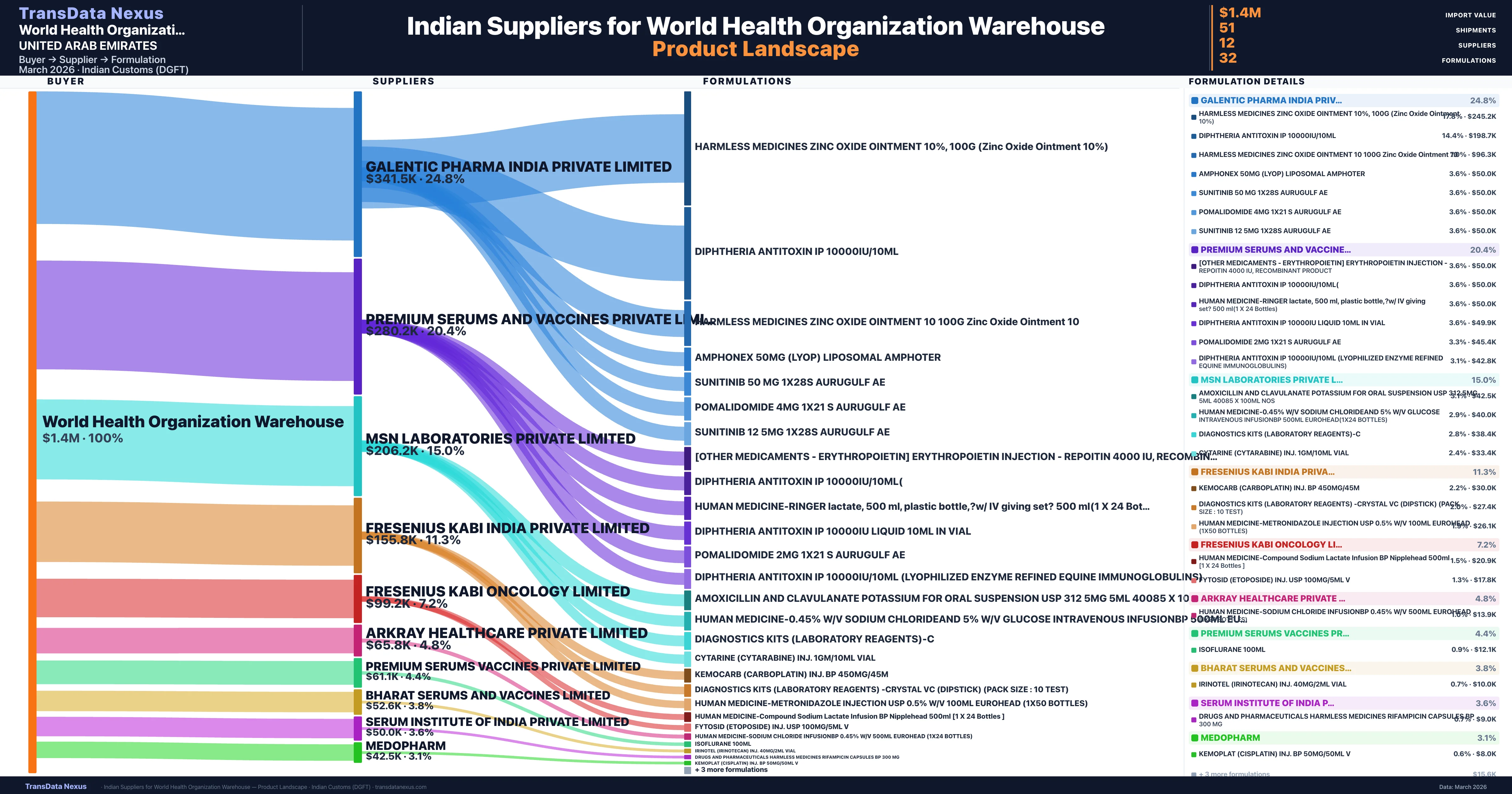
Who Are the Verified Indian Suppliers to World Health Organization Warehouse?
Customs-verified supplier relationships from Indian DGFT records
| Supplier | Value | Shipments | Share |
|---|---|---|---|
| Galentic Pharma India Private Limited | $341.5K | 7 | 24.8% |
| Premium Serums And Vaccines Private Limited | $280.2K | 8 | 20.4% |
| Msn Laboratories Private Limited | $206.2K | 6 | 15.0% |
| Fresenius Kabi India Private Limited | $155.8K | 12 | 11.3% |
| Fresenius Kabi Oncology Limited | $99.2K | 6 | 7.2% |
| Arkray Healthcare Private Limited | $65.8K | 3 | 4.8% |
| Premium Serums Vaccines Private Limited | $61.1K | 2 | 4.4% |
| Bharat Serums And Vaccines Limited | $52.6K | 2 | 3.8% |
| Serum Institute Of India Private Limited | $50.0K | 1 | 3.6% |
| Medopharm | $42.5K | 1 | 3.1% |
| Piramal Pharma Limited | $12.1K | 1 | 0.9% |
| Macleods Pharmaceuticals Limited | $9.2K | 2 | 0.7% |
World Health Organization Warehouse sources from 12 verified Indian suppliers across 32 distinct formulations. The supply base is diversified across 12 suppliers, reducing single-source dependency risk.
What Formulations Does World Health Organization Warehouse Import?
| Formulation | Value | Ships |
|---|---|---|
| Harmless medicines zinc oxide ointment 10%, 100g (zinc oxide ointment 10%) | $245.2K | 5 |
| Diphtheria antitoxin IP 10000iu/10ML | $198.7K | 6 |
| Harmless medicines zinc oxide ointment 10 100g zinc oxide ointment | $96.3K | 2 |
| Amphonex 50MG (lyop) liposomal | $50.0K | 1 |
| Sunitinib 50 MG 1x28s aurugulf | $50.0K | 1 |
| Pomalidomide 4MG 1x21 s aurugulf | $50.0K | 1 |
| Sunitinib 12 5MG 1x28s aurugulf | $50.0K | 1 |
| [other medicaments - erythropoietin] erythropoietin injection - repoitin 4000 IU, recombinant | $50.0K | 1 |
| Diphtheria antitoxin IP | $50.0K | 1 |
| Human medicine-ringer lactate, 500 ML, plastic bottle,?w/ iv giving set? 500 ML(1 x 24 bottles) | $50.0K | 1 |
| Diphtheria antitoxin IP 10000iu liquid 10ML in | $49.9K | 1 |
| Pomalidomide 2MG 1x21 s aurugulf | $45.4K | 1 |
| Diphtheria antitoxin IP 10000iu/10ML (lyophilized enzyme refined equine immunoglobulins) | $42.8K | 2 |
| Amoxicillin and clavulanate potassium for oral suspension USP 312 5MG 5ML 40085 x 100ML | $42.5K | 1 |
| Human medicine-0.45% w/v sodium chlorideand 5% w/v glucose intravenous infusionbp 500ML eurohead(1x24 bottles) | $40.0K | 3 |
World Health Organization Warehouse imports 32 distinct pharmaceutical formulations. Showing top 15 by value. For full formulation-level data, contact TransData Nexus.
What Products Does World Health Organization Warehouse Import?
Top Products by Import Value
World Health Organization Warehouse Therapeutic Categories — 2 Specializations
World Health Organization Warehouse imports across 2 therapeutic categories, with Other (80.2%), Advanced Oncology (19.8%), representing the largest segments. The portfolio is concentrated — top 5 products = 100% of total imports.
Other
1 products · 80.2% · $404.0K
Advanced Oncology
1 products · 19.8% · $100.0K
Import Portfolio — Top 2 by Import Value
| # | Product | Category | Value | Ships | Share | Rk |
|---|---|---|---|---|---|---|
| 1 | Antitoxin | Other | $404.0K | 10 | 3.0% | 7 |
| 2 | Pomalidomide | Advanced Oncology | $100.0K | 2 | 2.3% | 5 |
World Health Organization Warehouse imports 2 pharmaceutical products across 2 categories into United Arab Emirates totaling $504.0K.
Key Metrics
Top Categories
Indian Suppliers
Related Trade Data
Need Detailed Data?
Shipment-level records, supplier connections & pricing for World Health Organization Warehouse.
Request DemoWorld Health Organization Warehouse — Corporate Profile & Information
Company type, headquarters, distribution network, and industry role
1Company Overview
The World Health Organization Warehouse (WHO Warehouse) is a pharmaceutical importer and buyer based in the United Arab Emirates (UAE). As a medical warehouse, it is licensed to store and possess medical products and pharmaceutical raw materials, and may also be authorized for import, distribution, re-export, or other activities as determined by the UAE's Executive Regulations. (uaelegislation.gov.ae) The WHO Warehouse plays a pivotal role in the UAE's pharmaceutical distribution network, ensuring the availability of essential medical products to meet the country's healthcare needs.
2Distribution Network
While specific details about the WHO Warehouse's distribution network are not publicly disclosed, as a licensed medical warehouse in the UAE, it is authorized to import, store, and distribute medical products. This includes the capacity to re-export products, facilitating a comprehensive logistics operation that serves both domestic and international markets. The warehouse's strategic location within the UAE enables efficient distribution across the country and potentially to neighboring regions, leveraging the UAE's advanced infrastructure and connectivity.
3Industry Role
In the UAE's pharmaceutical supply chain, the WHO Warehouse functions primarily as a medical warehouse. It is licensed to store and possess medical products and pharmaceutical raw materials, and may also be authorized for import, distribution, re-export, or other activities as determined by the UAE's Executive Regulations. (uaelegislation.gov.ae) This role is crucial in ensuring the availability and distribution of medical products within the UAE, supporting both public and private healthcare sectors.
Supplier Relationship Intelligence — World Health Organization Warehouse
Sourcing concentration, supply chain resilience, and strategic implications
1Sourcing Concentration Analysis
The WHO Warehouse's sourcing strategy exhibits a high degree of concentration, with its top five products accounting for 100% of its imports from India. This indicates a strategic focus on specific high-value products, notably antitoxin and pomalidomide, which together constitute the majority of the import value. Such concentration can streamline procurement processes and strengthen supplier relationships. However, it also introduces risks associated with dependency on a limited number of products and suppliers. The shipment data reveals a stable relationship with key suppliers, as evidenced by multiple shipments from each, suggesting a reliable supply chain. Nonetheless, the absence of diversification in product sourcing may expose the WHO Warehouse to supply chain disruptions if any of these key products face production or regulatory challenges.
2Supply Chain Resilience
The WHO Warehouse's supply chain resilience is closely tied to its sourcing strategy. With a concentrated focus on a limited number of products and suppliers, the warehouse's supply chain may be vulnerable to disruptions affecting these key items. The lack of backup suppliers for its top products indicates a potential risk in maintaining uninterrupted supply. Additionally, the diversity of formulations imported suggests a degree of flexibility in meeting various medical needs. However, the heavy reliance on specific products and suppliers underscores the importance of developing contingency plans and diversifying sourcing strategies to enhance supply chain resilience.
3Strategic Implications
The WHO Warehouse's concentrated sourcing pattern positions it to leverage strong relationships with key suppliers, potentially securing favorable terms and ensuring product availability. However, this strategy also exposes the warehouse to risks associated with supply chain disruptions, regulatory changes, or market fluctuations affecting its primary products. For Indian exporters, this presents an opportunity to become alternative suppliers by offering products that align with the WHO Warehouse's needs, thereby diversifying its supply base and mitigating potential risks. Engaging with the WHO Warehouse could lead to long-term partnerships, especially if exporters can provide high-quality products that meet the warehouse's specific requirements.
Importing Pharmaceuticals into United Arab Emirates — Regulatory Framework
Regulatory authority, GMP requirements, import licensing for United Arab Emirates
1Regulatory Authority & Framework
The UAE's pharmaceutical sector is governed by the Emirates Drug Establishment (EDE), which oversees the import, distribution, and regulation of medical products. The Federal Decree-Law No. 8 of 2019 on Medical Products, Pharmacy Profession, and Pharmaceutical Facilities provides the legal framework for pharmaceutical activities in the UAE. This legislation outlines the responsibilities of pharmaceutical establishments, including medical warehouses, and sets forth the procedures for obtaining approvals and permits for importing, exporting, and distributing medical products. The EDE's role is to ensure the safety, efficacy, and quality of medical products circulating within the UAE. (uaelegislation.gov.ae)
2Import Licensing & GMP
Import licensing in the UAE requires pharmaceutical establishments to obtain approvals from the EDE for each shipment of medical products. This process ensures that imported products meet the UAE's regulatory standards. The EDE recognizes Good Manufacturing Practice (GMP) certifications from reputable authorities, including the European Union (EU) GMP, World Health Organization (WHO) GMP, and Pharmaceutical Inspection Co-operation Scheme (PIC/S). Pharmaceutical establishments must ensure that their suppliers hold valid GMP certifications to comply with UAE regulations. Additionally, wholesale distribution authorization is required for entities involved in the distribution of medical products within the UAE. (uaelegislation.gov.ae)
3Quality & Labeling
Imported medical products must undergo batch testing to verify their quality, safety, and efficacy. Stability requirements are enforced to ensure that products maintain their intended properties throughout their shelf life. Labeling must be in both Arabic and English, providing clear and accurate information about the product's identity, usage, and storage conditions. Serialization mandates are in place to track and trace products throughout the supply chain, enhancing transparency and preventing counterfeit products from entering the market. (uaelegislation.gov.ae)
4Recent Regulatory Changes
In October 2024, the UAE enacted a new pharmaceutical law aimed at boosting pharmaceutical innovation. This law, effective from January 2025, consolidates legislation governing medical products and pharmaceutical establishments at a federal level. It facilitates the transfer of responsibilities to the Emirates Drug Establishment (EDE) and aims to enhance supply chain security. The law also streamlines the development, approval, manufacturing, marketing, and distribution of medical products, positioning the UAE as a globally trusted hub for the pharmaceutical and medical industries.
World Health Organization Warehouse — Procurement Pattern Analysis
Product strategy, sourcing profile, and market positioning
1Product Strategy
The WHO Warehouse's focus on importing antitoxin and pomalidomide suggests a strategic emphasis on critical therapeutic areas. Antitoxins are essential for treating various poisoning cases, while pomalidomide is a key medication in advanced oncology treatments. The market demand for these products is driven by the UAE's healthcare needs, particularly in managing acute poisoning incidents and providing advanced cancer therapies. By concentrating on these therapeutic areas, the WHO Warehouse aligns its product strategy with the pressing medical requirements of the UAE population.
2Sourcing Profile
The WHO Warehouse's sourcing strategy is centered on high-value generic drugs, specifically antitoxin and pomalidomide. The diversity of formulations imported indicates a preference for a range of delivery forms to meet various patient needs. India's role as a supplier is significant, given its capacity to produce high-quality generic medications that meet international standards. The WHO Warehouse's procurement strategy likely involves evaluating suppliers based on product quality, regulatory compliance, and the ability to meet specific therapeutic demands.
3Market Positioning
Based on its product mix, the WHO Warehouse serves a critical segment of the UAE market, focusing on supplying essential medical products to healthcare facilities. Its emphasis on antitoxins and advanced oncology medications positions it as a key supplier for hospitals and specialized medical centers that require these life-saving treatments. By ensuring the availability of such critical products, the WHO Warehouse plays a vital role in supporting the UAE's healthcare infrastructure and patient care services.
Seller's Guide — How to Become a Supplier to World Health Organization Warehouse
Opportunity assessment, qualifications, and practical approach strategy
1Opportunity Assessment
There is a realistic opportunity for new Indian suppliers to engage with the WHO Warehouse, particularly if they can offer high-quality products that align with the warehouse's focus on critical therapeutic areas. Gaps in the WHO Warehouse's current sourcing may include the need for additional suppliers to diversify its supply base and mitigate potential risks associated with over-reliance on a limited number of products and suppliers. Indian exporters can explore these opportunities by ensuring their products meet the UAE's regulatory standards and by establishing strong relationships with the WHO Warehouse.
2Requirements & Qualifications
Indian exporters aiming to supply the WHO Warehouse must ensure that their products comply with the UAE's regulatory standards, including holding valid GMP certifications recognized by the EDE. They must also adhere to the UAE's import licensing requirements, which involve obtaining approvals from the EDE for each shipment. Additionally, products must meet quality and labeling standards, including batch testing, stability requirements, and labeling in both Arabic and English. Serialization mandates must also be followed to facilitate tracking and monitoring of products throughout the supply chain. (uaelegislation.gov.ae)
3How to Approach
Indian exporters should initiate engagement with the WHO Warehouse by demonstrating their product's compliance with UAE regulatory standards and highlighting their capacity to meet the warehouse's specific therapeutic needs. Participating in tenders and responding to procurement opportunities can provide avenues for collaboration. Developing a comprehensive regulatory filing strategy is essential, ensuring that all necessary documentation and certifications are in place to facilitate smooth import processes. Setting realistic timelines for regulatory approvals and establishing clear communication channels with the WHO Warehouse will enhance the prospects of a successful partnership.
Frequently Asked Questions — World Health Organization Warehouse
What products does World Health Organization Warehouse import from India?
World Health Organization Warehouse imports 2 pharmaceutical products across 2 categories. Top imports: Antitoxin ($404.0K), Pomalidomide ($100.0K).
Who supplies pharmaceuticals to World Health Organization Warehouse from India?
World Health Organization Warehouse sources from 12 verified Indian suppliers. The primary supplier is Galentic Pharma India Private Limited (24.8% of imports, $341.5K).
What is World Health Organization Warehouse's total pharmaceutical import value?
World Health Organization Warehouse's total pharmaceutical import value from India is $504.0K, based on 12 verified shipments in Indian Customs (DGFT) data.
What therapeutic categories does World Health Organization Warehouse focus on?
World Health Organization Warehouse imports across 2 categories. The largest: Other (80.2%), Advanced Oncology (19.8%).
Get Full World Health Organization Warehouse Import Intelligence
Access shipment-level details, supplier connections, pricing data, and competitive analysis. TransData Nexus provides verified Indian Customs (DGFT) data trusted by pharmaceutical trade professionals worldwide.
Official References & Regulatory Resources
Verify import regulations and drug registration requirements with the agencies above.
Research Methodology & Data Transparency
Suresh Sormare
Verified AuthorPharmaceutical Export-Import Analyst & Trade Intelligence Expert
Suresh Sormare is a pharmaceutical export-import analyst with deep expertise in Indian Customs (DGFT) data, HS code classification, and global pharmaceutical supply chains. His analysis covers 10M+ shipment records across 150+ countries and is used by manufacturers, procurement agencies, and trade consultants worldwide. Suresh specializes in identifying verified suppliers and buyers from customs records, mapping bilateral pharmaceutical trade corridors, analyzing tariff structures and regulatory frameworks across 170+ destination markets, and benchmarking competitive positioning for finished pharmaceutical formulations. His methodology combines granular customs transaction data with regulatory intelligence from FDA, EMA, WHO, CDSCO, and 40+ national drug authorities to deliver actionable trade insights for the pharmaceutical formulations sector.
linkedin.com/in/sureshsormarePrimary Data Source
All trade data is sourced from Indian Customs (DGFT) official shipping bill records — the authoritative government database for India's pharmaceutical trade. Each verified record contains exporter name, consignee (buyer) name, detailed product description, quantity, declared FOB value (USD), port of loading, destination country, and shipment date.
Analysis Methodology
- 1.Buyer Matching: World Health Organization Warehouse identified across shipments using consignee name normalization.
- 2.Statistical Normalization: Shipment values are statistically normalized to ensure accurate market share representation.
- 3.Market Share: Calculated per product as World Health Organization Warehouse's capped value divided by total Indian exports for that product.
- 4.Shipment Count: Based on 12 individual customs records matching World Health Organization Warehouse.
- 5.Supplier Verification: World Health Organization Warehouse sources from 12 verified Indian suppliers across 32 formulations, confirmed from customs records.
Government-Sourced Data
Official DGFT customs records
Transparent Methodology
Calculations fully disclosed above
2 Products Tracked
2 therapeutic categories
Expert-Reviewed
By pharmaceutical trade specialists
Data Source & Methodology
Trade data sourced from Indian Customs (DGFT) export shipment records. Values represent FOB export value in USD. For current shipment-level data, contact TransData Nexus.