United Nations Development Programm
Pharmaceutical Importer · Pakistan · Antiviral & HIV Medications Focus · $2.8M Total Trade · DGFT Verified
United Nations Development Programm is a pharmaceutical importer based in Pakistan with a total trade value of $2.8M across 3 products in 1 therapeutic categories. Based on 56 verified import shipments from Indian Customs (DGFT) records, the company actively imports across multiple product segments. United Nations Development Programm sources from 10 verified Indian suppliers, with Emcure Pharmaceuticals Limited accounting for 59.0% of imports.
United Nations Development Programm — Import Portfolio & Supplier Network
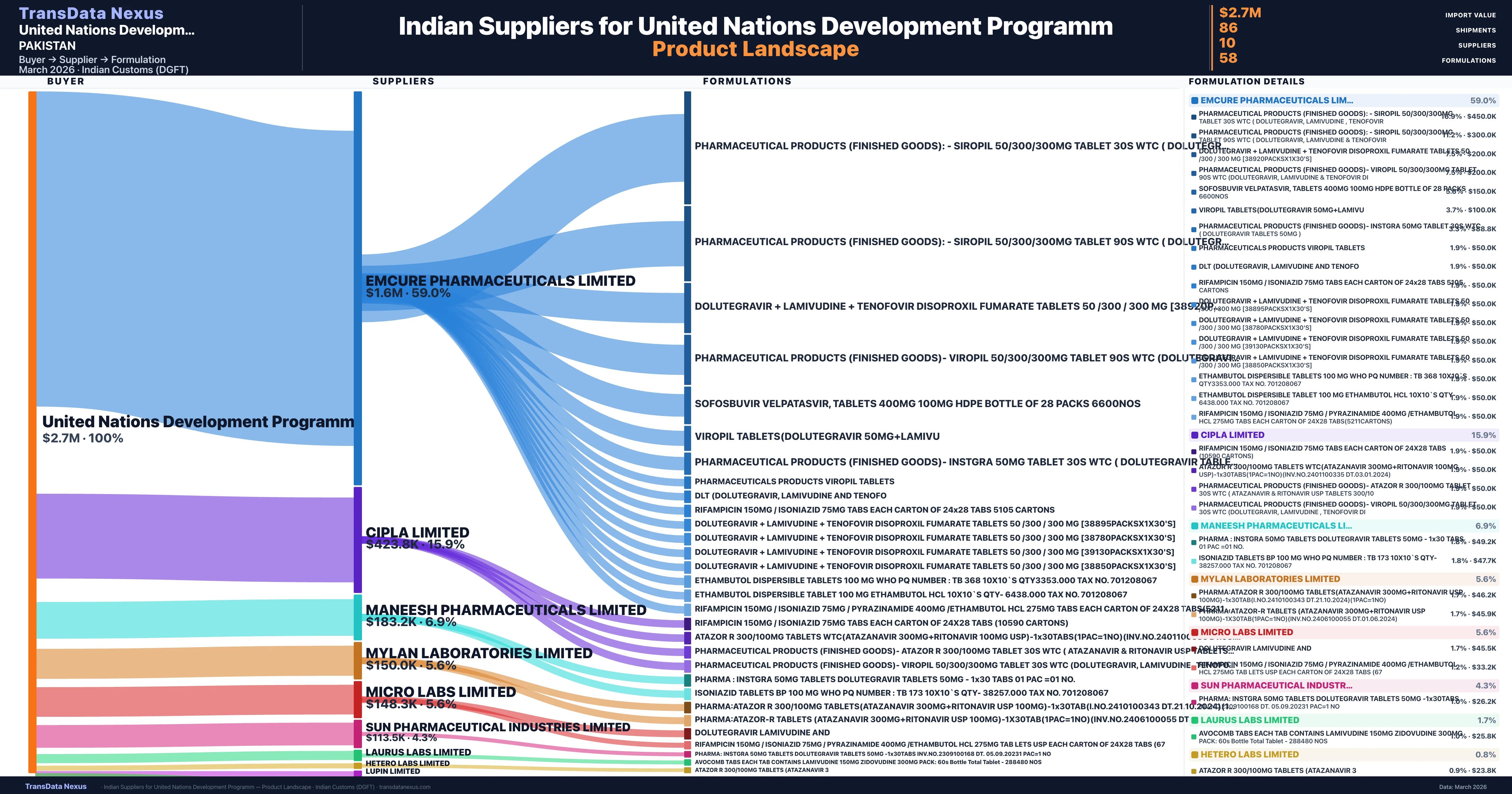
Who Are the Verified Indian Suppliers to United Nations Development Programm?
Customs-verified supplier relationships from Indian DGFT records
| Supplier | Value | Shipments | Share |
|---|---|---|---|
| Emcure Pharmaceuticals Limited | $1.6M | 43 | 59.0% |
| Cipla Limited | $423.8K | 15 | 15.9% |
| Maneesh Pharmaceuticals Limited | $183.2K | 7 | 6.9% |
| Mylan Laboratories Limited | $150.0K | 3 | 5.6% |
| Micro Labs Limited | $148.3K | 4 | 5.6% |
| Sun Pharmaceutical Industries Limited | $113.5K | 6 | 4.3% |
| Laurus Labs Limited | $45.5K | 1 | 1.7% |
| Hetero Labs Limited | $21.0K | 3 | 0.8% |
| Lupin Limited | $7.6K | 3 | 0.3% |
| Macleods Pharmaceuticals Limited | $739 | 1 | 0.0% |
United Nations Development Programm sources from 10 verified Indian suppliers across 58 distinct formulations. The supply base is diversified across 10 suppliers, reducing single-source dependency risk.
What Formulations Does United Nations Development Programm Import?
| Formulation | Value | Ships |
|---|---|---|
| Pharmaceutical products (finished goods): - siropil 50/300/300MG tablet 30s wtc ( dolutegravir, lamivudine | $450.0K | 9 |
| Pharmaceutical products (finished goods): - siropil 50/300/300MG tablet 90s wtc ( dolutegravir, lamivudine & | $300.0K | 6 |
| Dolutegravir + lamivudine + tenofovir disoproxil fumarate tablets 50 /300 / 300 MG | $200.0K | 4 |
| Pharmaceutical products (finished goods)- viropil 50/300/300MG tablet 90s wtc (dolutegravir, lamivudine & tenofovir | $200.0K | 4 |
| Sofosbuvir velpatasvir, tablets 400MG 100MG hdpe bottle of 28 packs | $150.0K | 3 |
| Viropil tablets(dolutegravir | $100.0K | 2 |
| Pharmaceutical products (finished goods)- instgra 50MG tablet 30s wtc ( dolutegravir tablets 50MG ) | $88.8K | 3 |
| Pharmaceuticals products viropil | $50.0K | 1 |
| Dlt (dolutegravir, lamivudine and | $50.0K | 1 |
| Rifampicin 150MG / isoniazid 75MG tabs Each carton of 24x28 tabs 5105 | $50.0K | 1 |
| Dolutegravir + lamivudine + tenofovir disoproxil fumarate tablets 50 /300 / 300 MG | $50.0K | 1 |
| Dolutegravir + lamivudine + tenofovir disoproxil fumarate tablets 50 /300 / 300 MG | $50.0K | 1 |
| Dolutegravir + lamivudine + tenofovir disoproxil fumarate tablets 50 /300 / 300 MG | $50.0K | 1 |
| Dolutegravir + lamivudine + tenofovir disoproxil fumarate tablets 50 /300 / 300 MG | $50.0K | 1 |
| Ethambutol dispersible tablets 100 MG who pq number : tb 368 10x10`s qty3353.000 tax no. | $50.0K | 1 |
United Nations Development Programm imports 58 distinct pharmaceutical formulations. Showing top 15 by value. For full formulation-level data, contact TransData Nexus.
What Products Does United Nations Development Programm Import?
Top Products by Import Value
United Nations Development Programm Therapeutic Categories — 1 Specializations
United Nations Development Programm imports across 1 therapeutic categories, with Antiviral & HIV Medications (100.0%), representing the largest segments. The portfolio is concentrated — top 5 products = 100% of total imports.
Antiviral & HIV Medications
3 products · 100.0% · $2.8M
Import Portfolio — Top 3 by Import Value
| # | Product | Category | Value | Ships | Share | Rk |
|---|---|---|---|---|---|---|
| 1 | Dolutegravir | Antiviral & HIV Medications | $1.6M | 31 | 0.0% | 10 |
| 2 | Tenofovir | Antiviral & HIV Medications | $1.1M | 22 | 0.0% | 14 |
| 3 | Velpatasvir | Antiviral & HIV Medications | $150.0K | 3 | 0.6% | 9 |
United Nations Development Programm imports 3 pharmaceutical products across 1 categories into Pakistan totaling $2.8M.
Key Metrics
Top Categories
Indian Suppliers
Related Trade Data
Need Detailed Data?
Shipment-level records, supplier connections & pricing for United Nations Development Programm.
Request DemoUnited Nations Development Programm — Corporate Profile & Information
Company type, headquarters, distribution network, and industry role
1Company Overview
The United Nations Development Programme (UNDP) in Pakistan is a pivotal entity dedicated to advancing sustainable development and humanitarian initiatives across the nation. As part of the UNDP's global network, the Pakistan office operates under the auspices of the United Nations, focusing on a wide array of development projects, including health, education, and governance. While UNDP is not a pharmaceutical company, it plays a significant role in the procurement and distribution of medical supplies, including pharmaceuticals, to support its health-related projects. This involves sourcing medicines and medical equipment to bolster healthcare infrastructure and services, particularly in underserved regions. UNDP's procurement processes are characterized by transparency and adherence to international standards, ensuring that the acquired products meet the necessary quality and safety criteria. The organization collaborates with various stakeholders, including government agencies, international donors, and local partners, to effectively implement its health programs. Through these efforts, UNDP contributes to enhancing the accessibility and quality of healthcare services in Pakistan, aligning with its broader mission to promote human development and well-being.
2Distribution Network
UNDP Pakistan's distribution network is designed to ensure the efficient delivery of medical supplies and equipment to various healthcare facilities across the country. While specific warehouse locations are not publicly disclosed, the organization utilizes a combination of centralized and decentralized storage facilities to manage its inventory. Logistics capabilities are robust, leveraging partnerships with local and international logistics providers to facilitate timely and secure transportation of goods. Geographically, UNDP's distribution extends nationwide, encompassing both urban centers and remote areas, thereby ensuring equitable access to medical resources. The organization's logistics operations are guided by principles of efficiency, cost-effectiveness, and compliance with national and international standards, reflecting its commitment to supporting Pakistan's healthcare system comprehensively.
3Industry Role
In Pakistan's pharmaceutical supply chain, UNDP functions primarily as a procurement and distribution intermediary rather than a traditional wholesaler or parallel importer. Its role is to source and supply medical products to healthcare facilities, particularly in regions where access to essential medicines is limited. By leveraging its international network and procurement expertise, UNDP ensures that healthcare providers receive quality-assured pharmaceuticals and medical supplies. This approach not only addresses immediate health needs but also contributes to strengthening the overall healthcare infrastructure in Pakistan. UNDP's involvement is crucial in bridging gaps within the supply chain, ensuring that essential medicines reach the populations that need them most.
Supplier Relationship Intelligence — United Nations Development Programm
Sourcing concentration, supply chain resilience, and strategic implications
1Sourcing Concentration Analysis
UNDP's sourcing strategy for pharmaceuticals is characterized by a diversified supplier base, mitigating the risks associated with single-source dependency. The organization's procurement data indicates engagements with multiple suppliers, including EMCURE Pharmaceuticals Limited, Cipla Limited, and Mylan Laboratories Limited, among others. This diversified approach enhances supply chain stability and resilience, ensuring a continuous and reliable supply of essential medicines. The distribution of procurement volumes across various suppliers suggests a strategic choice to balance cost-effectiveness with quality assurance, rather than an over-reliance on a single supplier. Such a strategy is prudent in the pharmaceutical industry, where supply chain disruptions can have significant implications for public health.
2Supply Chain Resilience
UNDP's pharmaceutical supply chain demonstrates resilience through its diversified supplier network and strategic sourcing practices. By engaging with multiple suppliers, UNDP mitigates the risks associated with potential disruptions from any single source. The organization's procurement data reveals a range of suppliers, including EMCURE Pharmaceuticals Limited, Cipla Limited, and Mylan Laboratories Limited, indicating a strategic approach to sourcing. While specific details about backup suppliers and formulation diversity are not publicly disclosed, the existing supplier base suggests a proactive strategy to ensure continuity of supply. Additionally, UNDP's adherence to international procurement standards and its partnerships with reputable suppliers further enhance the resilience of its supply chain. This approach ensures that UNDP can effectively respond to the dynamic needs of Pakistan's healthcare system, even in the face of potential supply chain challenges.
3Strategic Implications
UNDP's diversified sourcing strategy positions it effectively within Pakistan's pharmaceutical supply chain, balancing cost considerations with the need for quality-assured products. By engaging with multiple suppliers, UNDP not only secures a stable supply of essential medicines but also fosters healthy competition among suppliers, potentially leading to better pricing and improved product offerings. For Indian pharmaceutical exporters, this presents an opportunity to engage with UNDP by meeting the organization's stringent quality standards and participating in its competitive procurement processes. Establishing partnerships with UNDP can enhance an exporter’s credibility and visibility in the Pakistani market, aligning with UNDP's mission to provide best value for money in its procurement activities.
Importing Pharmaceuticals into Pakistan — Regulatory Framework
Regulatory authority, GMP requirements, import licensing for Pakistan
1Regulatory Authority & Framework
The Drug Regulatory Authority of Pakistan (DRAP) is the primary regulatory body overseeing the pharmaceutical sector in Pakistan. Established under the DRAP Act of 2012, DRAP is responsible for ensuring the quality, safety, and efficacy of therapeutic goods, including pharmaceuticals, medical devices, and biological products. The regulatory framework governing pharmaceutical imports is primarily outlined in the Drugs Act of 1976 and the DRAP Act of 2012. These acts provide the legal basis for the import, export, manufacturing, and distribution of drugs in Pakistan, aiming to protect public health by regulating the pharmaceutical industry. The importation of pharmaceutical products is subject to compliance with these laws, ensuring that only safe and effective medicines enter the Pakistani market.
2Import Licensing & GMP
Importers of pharmaceutical products into Pakistan must obtain a Drug Import License (DIL) from DRAP. The application process involves submitting the necessary documentation through DRAP's online portal, with a typical processing timeline of approximately five days. Additionally, a No Objection Certificate (NOC) for the import of finished drugs for commercial purposes is required, ensuring that the imported products meet the prescribed standards of quality, safety, and efficacy. Regarding Good Manufacturing Practice (GMP) certifications, DRAP recognizes certifications from reputable international bodies, including the World Health Organization (WHO) and the Pharmaceutical Inspection Co-operation Scheme (PIC/S). Importers must ensure that their suppliers hold valid GMP certifications from recognized authorities to comply with DRAP's regulatory requirements. Furthermore, importers must possess an active National Tax Number (NTN), Sales Tax Registration, and be registered with the Securities and Exchange Commission of Pakistan (SECP) if operating as a company. These requirements ensure that importers adhere to national standards and regulations, maintaining the integrity of the pharmaceutical supply chain.
3Quality & Labeling
Imported pharmaceutical products must undergo batch testing to verify their quality, safety, and efficacy before being released into the market. Stability requirements are enforced to ensure that products maintain their intended quality throughout their shelf life. Labeling must comply with the Drugs (Labeling and Packaging) Rules of 1986, which mandate that all imported packaged medicines display the name and prescription material in accordance with these regulations. Additionally, labeling must be in the local language, and products must adhere to halal certification requirements, as stipulated by the Ministry of National Health Services, Regulations, and Coordination. Serialization mandates are in place to enhance traceability and prevent counterfeit products from entering the supply chain. These measures collectively ensure that imported pharmaceutical products meet the necessary standards and are safe for public use.
4Recent Regulatory Changes
In January 2026, Pakistan's Ministry of Commerce imposed immediate restrictions on the import of Trichloromethane, commonly known as chloroform, placing it in Appendix-B of the Import Policy Order, 2022. Under this amendment, chloroform can only be imported by pharmaceutical companies, subject to obtaining a No Objection Certificate (NOC) from DRAP. This regulatory change aims to enhance oversight and control over the importation of chloroform, ensuring that its use is restricted to legitimate pharmaceutical applications. The move reflects Pakistan's commitment to strengthening regulatory controls and maintaining the integrity of its pharmaceutical supply chain.
United Nations Development Programm — Procurement Pattern Analysis
Product strategy, sourcing profile, and market positioning
1Product Strategy
UNDP's focus on antiviral and HIV medications aligns with its mission to address critical health challenges in Pakistan. The procurement of drugs such as Dolutegravir, Tenofovir, and Velpatasvir indicates a strategic emphasis on combating HIV/AIDS, a significant public health concern in the country. The market demand for these medications is driven by the need to provide effective treatment options to individuals living with HIV, thereby improving health outcomes and quality of life. By sourcing these specific therapeutic areas, UNDP aims to enhance the accessibility and affordability of essential HIV treatments, contributing to the broader goal of controlling and eventually eliminating the HIV epidemic in Pakistan.
2Sourcing Profile
UNDP's sourcing strategy for generic drugs involves engaging with multiple suppliers to ensure a stable and reliable supply of essential medications. The organization's procurement data reveals partnerships with suppliers such as EMCURE Pharmaceuticals Limited, Cipla Limited, and Mylan Laboratories Limited, among others. This diversified approach mitigates the risks associated with single-source dependency and fosters healthy competition among suppliers, potentially leading to better pricing and improved product offerings. India's pharmaceutical industry plays a significant role in UNDP's overall procurement strategy, given its capacity to produce high-quality generic medicines at competitive prices. By sourcing from Indian exporters, UNDP leverages the country's manufacturing capabilities to meet the healthcare needs of Pakistan effectively.
3Market Positioning
UNDP's procurement of antiviral and HIV medications positions it as a key supplier to public
Frequently Asked Questions — United Nations Development Programm
What products does United Nations Development Programm import from India?
United Nations Development Programm imports 3 pharmaceutical products across 1 categories. Top imports: Dolutegravir ($1.6M), Tenofovir ($1.1M), Velpatasvir ($150.0K).
Who supplies pharmaceuticals to United Nations Development Programm from India?
United Nations Development Programm sources from 10 verified Indian suppliers. The primary supplier is Emcure Pharmaceuticals Limited (59.0% of imports, $1.6M).
What is United Nations Development Programm's total pharmaceutical import value?
United Nations Development Programm's total pharmaceutical import value from India is $2.8M, based on 56 verified shipments in Indian Customs (DGFT) data.
What therapeutic categories does United Nations Development Programm focus on?
United Nations Development Programm imports across 1 categories. The largest: Antiviral & HIV Medications (100.0%).
Get Full United Nations Development Programm Import Intelligence
Access shipment-level details, supplier connections, pricing data, and competitive analysis. TransData Nexus provides verified Indian Customs (DGFT) data trusted by pharmaceutical trade professionals worldwide.
Official References & Regulatory Resources
Verify import regulations and drug registration requirements with the agencies above.
Research Methodology & Data Transparency
Suresh Sormare
Verified AuthorPharmaceutical Export-Import Analyst & Trade Intelligence Expert
Suresh Sormare is a pharmaceutical export-import analyst with deep expertise in Indian Customs (DGFT) data, HS code classification, and global pharmaceutical supply chains. His analysis covers 10M+ shipment records across 150+ countries and is used by manufacturers, procurement agencies, and trade consultants worldwide. Suresh specializes in identifying verified suppliers and buyers from customs records, mapping bilateral pharmaceutical trade corridors, analyzing tariff structures and regulatory frameworks across 170+ destination markets, and benchmarking competitive positioning for finished pharmaceutical formulations. His methodology combines granular customs transaction data with regulatory intelligence from FDA, EMA, WHO, CDSCO, and 40+ national drug authorities to deliver actionable trade insights for the pharmaceutical formulations sector.
linkedin.com/in/sureshsormarePrimary Data Source
All trade data is sourced from Indian Customs (DGFT) official shipping bill records — the authoritative government database for India's pharmaceutical trade. Each verified record contains exporter name, consignee (buyer) name, detailed product description, quantity, declared FOB value (USD), port of loading, destination country, and shipment date.
Analysis Methodology
- 1.Buyer Matching: United Nations Development Programm identified across shipments using consignee name normalization.
- 2.Statistical Normalization: Shipment values are statistically normalized to ensure accurate market share representation.
- 3.Market Share: Calculated per product as United Nations Development Programm's capped value divided by total Indian exports for that product.
- 4.Shipment Count: Based on 56 individual customs records matching United Nations Development Programm.
- 5.Supplier Verification: United Nations Development Programm sources from 10 verified Indian suppliers across 58 formulations, confirmed from customs records.
Government-Sourced Data
Official DGFT customs records
Transparent Methodology
Calculations fully disclosed above
3 Products Tracked
1 therapeutic categories
Expert-Reviewed
By pharmaceutical trade specialists
Data Source & Methodology
Trade data sourced from Indian Customs (DGFT) export shipment records. Values represent FOB export value in USD. For current shipment-level data, contact TransData Nexus.