Unimed Sdn. BHD
Pharmaceutical Importer · Malaysia · Vitamins & Supplements Focus · $3.1M Total Trade · DGFT Verified
Unimed Sdn. BHD is a pharmaceutical importer based in Malaysia with a total trade value of $3.1M across 3 products in 2 therapeutic categories. Based on 65 verified import shipments from Indian Customs (DGFT) records, the company actively imports across multiple product segments. Unimed Sdn. BHD sources from 4 verified Indian suppliers, with J B Chemicals And Pharmaceuticals Limited accounting for 74.2% of imports.
Unimed Sdn. BHD — Import Portfolio & Supplier Network
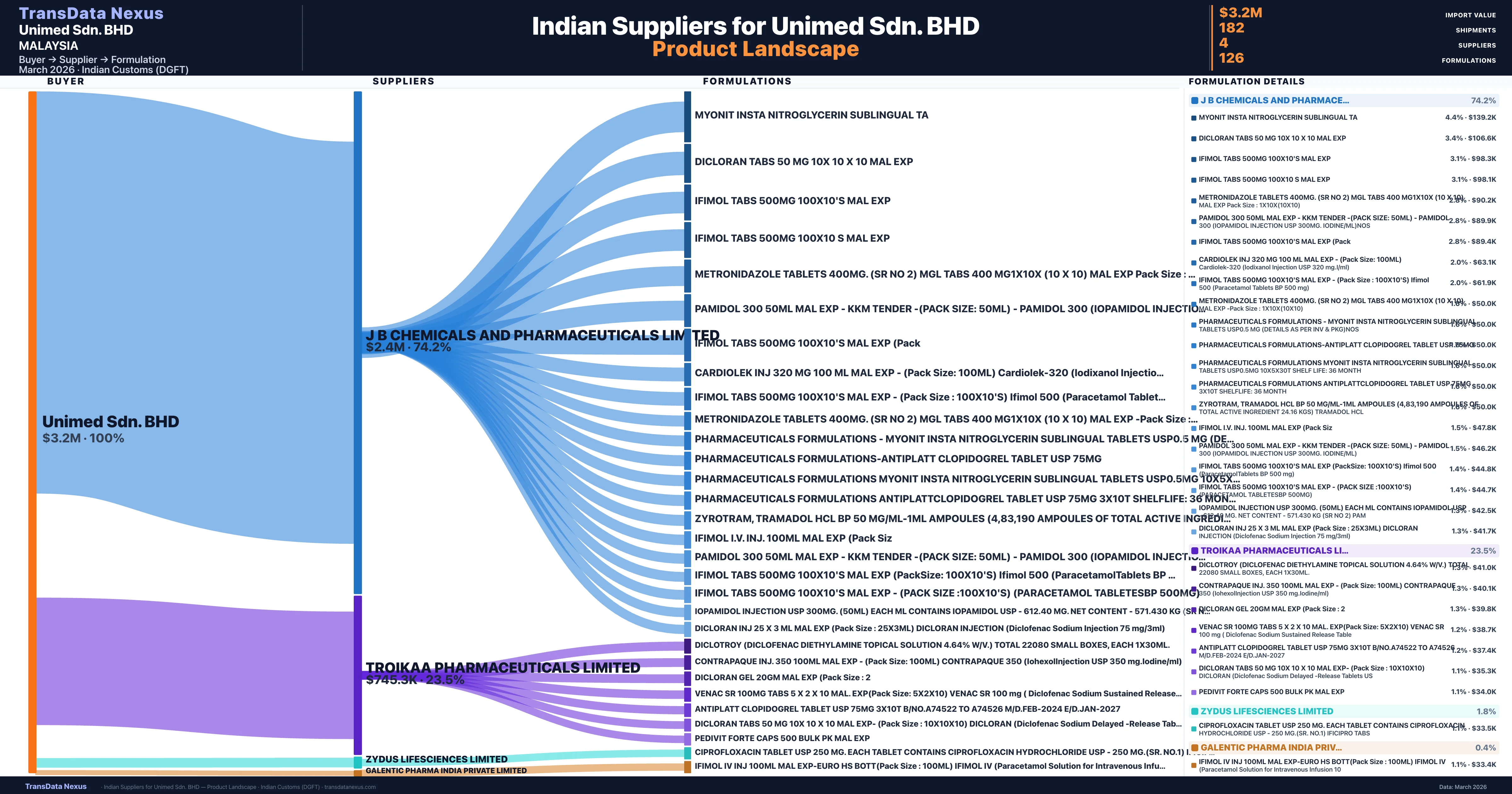
Who Are the Verified Indian Suppliers to Unimed Sdn. BHD?
Customs-verified supplier relationships from Indian DGFT records
| Supplier | Value | Shipments | Share |
|---|---|---|---|
| J B Chemicals And Pharmaceuticals Limited | $2.4M | 143 | 74.2% |
| Troikaa Pharmaceuticals Limited | $745.3K | 31 | 23.5% |
| Zydus Lifesciences Limited | $56.2K | 6 | 1.8% |
| Galentic Pharma India Private Limited | $14.2K | 2 | 0.4% |
Unimed Sdn. BHD sources from 4 verified Indian suppliers across 126 distinct formulations. The supply base is diversified across 4 suppliers, reducing single-source dependency risk.
What Formulations Does Unimed Sdn. BHD Import?
| Formulation | Value | Ships |
|---|---|---|
| Myonit insta nitroglycerin sublingual | $139.2K | 3 |
| Dicloran tabs 50 MG 10x 10 x 10 mal | $106.6K | 6 |
| Ifimol tabs 500MG 100x10's mal | $98.3K | 3 |
| Ifimol tabs 500MG 100x10 s mal | $98.1K | 3 |
| Metronidazole tablets 400MG. (sr no 2) mgl tabs 400 mg1x10x (10 x 10) mal exp Pack size : 1x10x(10x10) | $90.2K | 2 |
| Pamidol 300 50ML mal exp - kkm tender -(Pack size: 50ML) - pamidol 300 (iopamidol injection USP 300MG. iodine/ML | $89.9K | 2 |
| Ifimol tabs 500MG 100x10's mal exp | $89.4K | 2 |
| Cardiolek INJ 320 MG 100 ML mal exp - (Pack size: 100ML) cardiolek-320 (lodixanol injection USP 320 MG.i/ML) | $63.1K | 2 |
| Ifimol tabs 500MG 100x10's mal exp - (Pack size : 100x10's) ifimol 500 (paracetamol tablets BP 500 MG) | $61.9K | 2 |
| Metronidazole tablets 400MG. (sr no 2) mgl tabs 400 mg1x10x (10 x 10) mal exp -Pack size : 1x10x(10x10) | $50.0K | 1 |
| Pharmaceuticals formulations - myonit insta nitroglycerin sublingual tablets usp0.5 MG (details as per inv & pkg | $50.0K | 1 |
| Pharmaceuticals formulations-antiplatt clopidogrel tablet USP 75MG | $50.0K | 1 |
| Pharmaceuticals formulations myonit insta nitroglycerin sublingual tablets usp0.5MG 10x5x30t shelf life: 36 | $50.0K | 1 |
| Pharmaceuticals formulations antiplattclopidogrel tablet USP 75MG 3x10t shelflife: 36 | $50.0K | 1 |
| Zyrotram, tramadol hcl BP 50 MG/ML-1ML ampoules (4,83,190 ampoules of total active ingredient 24.16 kgs) tramadol | $50.0K | 1 |
Unimed Sdn. BHD imports 126 distinct pharmaceutical formulations. Showing top 15 by value. For full formulation-level data, contact TransData Nexus.
What Products Does Unimed Sdn. BHD Import?
Top Products by Import Value
Unimed Sdn. BHD Therapeutic Categories — 2 Specializations
Unimed Sdn. BHD imports across 2 therapeutic categories, with Vitamins & Supplements (66.6%), Cardiovascular (33.4%), representing the largest segments. The portfolio is concentrated — top 5 products = 100% of total imports.
Vitamins & Supplements
1 products · 66.6% · $2.0M
Cardiovascular
2 products · 33.4% · $1.0M
Import Portfolio — Top 3 by Import Value
| # | Product | Category | Value | Ships | Share | Rk |
|---|---|---|---|---|---|---|
| 1 | Zinc | Vitamins & Supplements | $2.0M | 41 | 2.6% | 9 |
| 2 | Bisoprolol | Cardiovascular | $577.7K | 15 | 0.7% | 18 |
| 3 | Nitroglycerin | Cardiovascular | $450.0K | 9 | 3.1% | 2 |
Unimed Sdn. BHD imports 3 pharmaceutical products across 2 categories into Malaysia totaling $3.1M.
Key Metrics
Top Categories
Indian Suppliers
Related Trade Data
Need Detailed Data?
Shipment-level records, supplier connections & pricing for Unimed Sdn. BHD.
Request DemoUnimed Sdn. BHD — Corporate Profile & Information
Company type, headquarters, distribution network, and industry role
1Company Overview
Unimed Sdn. Bhd., established in 1981, is a prominent pharmaceutical company headquartered in Kuala Lumpur, Malaysia. With over four decades of experience, Unimed specializes in importing, marketing, and distributing a diverse range of healthcare products, including generic pharmaceutical formulations, nutraceuticals, medical devices, and herbal supplements. The company operates with a dedicated workforce of approximately 250 employees, encompassing a committed sales team that plays a pivotal role in advancing Unimed's mission and vision. (unimed.com.my)
Unimed's operations extend across Peninsular Malaysia, East Malaysia, Singapore, and Brunei, reflecting its significant presence in the Southeast Asian region. The company's strategic expansion beyond ASEAN includes markets such as Hong Kong, Yemen, and Iraq, underscoring its global outreach. In 2008, Unimed expanded its manufacturing capabilities by acquiring KCK Pharmaceutical Industries Sdn. Bhd. in Penang, Malaysia. This facility, staffed by approximately 300 employees, produces a variety of products, including oral liquids, solids, creams, and ointments, primarily serving government hospitals and general practitioner clinics in Malaysia. (unimed.com.my)
2Distribution Network
Unimed Sdn. Bhd. has developed a robust distribution network to ensure efficient delivery of its products across Malaysia and beyond. The company's headquarters in Kuala Lumpur serve as the central hub for its operations. To enhance logistics and distribution management, Unimed has expanded its warehouse facilities, facilitating prompt and reliable service to its customers. (unimedonline.com.my)
In addition to its domestic operations, Unimed has initiated logistics and distribution hubs in Sarawak, Sabah, and Kedah, aiming to create a sustainable supply chain management system. These hubs are expected to bolster the company's distribution capabilities, ensuring timely and efficient delivery of products to various regions. (unimed.com.my)
3Industry Role
Unimed Sdn. Bhd. plays a multifaceted role in Malaysia's pharmaceutical supply chain. As a primary wholesaler and distributor, the company imports a wide array of pharmaceutical products, including generic finished formulations, medical devices, and nutraceuticals. Its operations encompass the entire supply chain, from sourcing and importing products to marketing and distributing them to various healthcare providers and institutions. This comprehensive approach positions Unimed as a key player in ensuring the availability of quality healthcare products in Malaysia. (unimed.com.my)
Supplier Relationship Intelligence — Unimed Sdn. BHD
Sourcing concentration, supply chain resilience, and strategic implications
1Sourcing Concentration Analysis
Unimed Sdn. Bhd. demonstrates a high degree of sourcing concentration, with a total import value from India amounting to $3.1 million USD across 65 shipments. The company's portfolio is heavily concentrated, with the top five products accounting for 100% of the total import value. This concentration indicates a strategic focus on specific products, potentially leveraging favorable pricing or established supplier relationships.
The primary supplier, J B Chemicals and Pharmaceuticals Limited, accounts for 74.2% of the total import value, suggesting a strong and stable relationship. Secondary suppliers, such as Troikaa Pharmaceuticals Limited and Zydus Lifesciences Limited, contribute 23.5% and 1.8%, respectively. The limited number of suppliers and the dominance of a single supplier may expose Unimed to risks related to supply chain disruptions or changes in supplier dynamics. However, this concentration could also reflect strategic partnerships and streamlined procurement processes.
2Supply Chain Resilience
Unimed Sdn. Bhd.'s supply chain resilience is influenced by its concentrated sourcing strategy. The reliance on a limited number of suppliers, particularly J B Chemicals and Pharmaceuticals Limited, may pose risks in the event of supply chain disruptions, regulatory changes, or shifts in supplier priorities. The company's focus on a narrow range of products, with the top five accounting for the entire import value, further underscores this concentration.
To enhance supply chain resilience, Unimed could consider diversifying its supplier base and product portfolio. Engaging with additional suppliers and expanding the range of imported products may mitigate risks associated with over-reliance on specific sources. Additionally, establishing contingency plans and maintaining open communication channels with suppliers can further strengthen the supply chain's robustness.
3Strategic Implications
Unimed Sdn. Bhd.'s sourcing pattern, characterized by a concentrated portfolio and reliance on a limited number of suppliers, has several strategic implications. For Unimed, this approach may lead to cost efficiencies and streamlined operations due to established supplier relationships. However, the concentration also exposes the company to potential risks, including supply chain disruptions and limited flexibility in product offerings.
For Indian exporters seeking to become alternative suppliers to Unimed, understanding the company's current sourcing dynamics is crucial. Offering complementary products or competitive pricing could present opportunities to enter Unimed's supply chain. Building relationships with Unimed's procurement team and demonstrating the ability to meet quality and regulatory standards will be essential steps in establishing a successful partnership.
Importing Pharmaceuticals into Malaysia — Regulatory Framework
Regulatory authority, GMP requirements, import licensing for Malaysia
1Regulatory Authority & Framework
In Malaysia, the primary regulatory authority overseeing pharmaceutical imports is the National Pharmaceutical Regulatory Agency (NPRA), operating under the Ministry of Health. The NPRA is responsible for ensuring the safety, efficacy, and quality of pharmaceutical products available in the Malaysian market. Key legislation governing pharmaceutical imports includes the Sale of Drugs Act 1952 and the Control of Drugs and Cosmetics Regulations 1984, which provide the legal framework for the registration, importation, and distribution of pharmaceutical products.
For Indian generics to be marketed in Malaysia, they must undergo a registration process with the NPRA. This process involves submitting comprehensive documentation, including product dossiers, clinical data, and evidence of Good Manufacturing Practice (GMP) compliance. The NPRA evaluates these submissions to ensure that imported generics meet the required standards for safety, efficacy, and quality.
2Import Licensing & GMP
Import licensing requirements in Malaysia stipulate that pharmaceutical products must be registered with the NPRA before they can be imported and marketed. Manufacturers and importers must obtain a valid import license, which is contingent upon the registration status of the product. Additionally, the NPRA recognizes GMP certificates from internationally accredited bodies, such as the World Health Organization (WHO) and the Pharmaceutical Inspection Co-operation Scheme (PIC/S). This recognition facilitates the acceptance of foreign manufacturing standards, provided they align with Malaysia's regulatory requirements.
Wholesale distribution authorization is also mandatory for entities involved in the distribution of pharmaceutical products. This authorization ensures that distributors adhere to the standards set by the NPRA, including proper storage conditions, inventory management, and distribution practices. Compliance with these regulations is essential for maintaining the integrity of the pharmaceutical supply chain in Malaysia.
3Quality & Labeling
Pharmaceutical products imported into Malaysia are subject to batch testing to verify their quality, safety, and efficacy. The NPRA conducts these tests to ensure that products meet the required standards before they are released into the market. Stability studies are also mandated to determine the shelf life and storage conditions of pharmaceutical products, ensuring their effectiveness over time.
Labeling requirements in Malaysia stipulate that product labels must be in the Malay language, with additional information in English permitted. Labels must include essential details such as the product name, active ingredients, dosage form, strength, batch number, manufacturing and expiry dates, storage conditions, and the manufacturer's details. Serialization mandates are in place to enhance traceability and prevent counterfeit products from entering the supply chain. These measures are designed to protect consumers and maintain the integrity of the pharmaceutical market in Malaysia.
4Recent Regulatory Changes
Between 2024 and 2026, Malaysia has implemented several regulatory changes affecting pharmaceutical imports. The NPRA has introduced stricter guidelines for the registration of pharmaceutical products, emphasizing the need for comprehensive clinical data and evidence of GMP compliance. Additionally, there has been an increased focus on post-market surveillance, with enhanced monitoring of imported products to ensure ongoing compliance with safety and efficacy standards. These changes aim to strengthen the regulatory framework and ensure that only high-quality pharmaceutical products are available to consumers in Malaysia.
Unimed Sdn. BHD — Procurement Pattern Analysis
Product strategy, sourcing profile, and market positioning
1Product Strategy
Unimed Sdn. Bhd.'s product strategy focuses on importing niche pharmaceutical products and locally manufacturing generics for regional and international markets. The company's emphasis on niche generics and nutritional supplements aligns with its mission to provide cost-effective healthcare solutions to its stakeholders. By focusing on these specific therapeutic areas, Unimed aims to meet the diverse healthcare needs of the Malaysian population while maintaining a competitive edge in the market. (unimed.com.my)
2Sourcing Profile
Unimed Sdn. Bhd. primarily sources generic pharmaceutical products from India, leveraging the country's established manufacturing capabilities and cost advantages. The company's sourcing strategy involves importing finished pharmaceutical formulations, including tablets, capsules, syrups, and injections, rather than raw Active Pharmaceutical Ingredients (APIs) or bulk drugs. This approach allows Unimed to offer a diverse product portfolio while ensuring compliance with Malaysia's regulatory standards.
Frequently Asked Questions — Unimed Sdn. BHD
What products does Unimed Sdn. BHD import from India?
Unimed Sdn. BHD imports 3 pharmaceutical products across 2 categories. Top imports: Zinc ($2.0M), Bisoprolol ($577.7K), Nitroglycerin ($450.0K).
Who supplies pharmaceuticals to Unimed Sdn. BHD from India?
Unimed Sdn. BHD sources from 4 verified Indian suppliers. The primary supplier is J B Chemicals And Pharmaceuticals Limited (74.2% of imports, $2.4M).
What is Unimed Sdn. BHD's total pharmaceutical import value?
Unimed Sdn. BHD's total pharmaceutical import value from India is $3.1M, based on 65 verified shipments in Indian Customs (DGFT) data.
What therapeutic categories does Unimed Sdn. BHD focus on?
Unimed Sdn. BHD imports across 2 categories. The largest: Vitamins & Supplements (66.6%), Cardiovascular (33.4%).
Get Full Unimed Sdn. BHD Import Intelligence
Access shipment-level details, supplier connections, pricing data, and competitive analysis. TransData Nexus provides verified Indian Customs (DGFT) data trusted by pharmaceutical trade professionals worldwide.
Official References & Regulatory Resources
Verify import regulations and drug registration requirements with the agencies above.
Research Methodology & Data Transparency
Suresh Sormare
Verified AuthorPharmaceutical Export-Import Analyst & Trade Intelligence Expert
Suresh Sormare is a pharmaceutical export-import analyst with deep expertise in Indian Customs (DGFT) data, HS code classification, and global pharmaceutical supply chains. His analysis covers 10M+ shipment records across 150+ countries and is used by manufacturers, procurement agencies, and trade consultants worldwide. Suresh specializes in identifying verified suppliers and buyers from customs records, mapping bilateral pharmaceutical trade corridors, analyzing tariff structures and regulatory frameworks across 170+ destination markets, and benchmarking competitive positioning for finished pharmaceutical formulations. His methodology combines granular customs transaction data with regulatory intelligence from FDA, EMA, WHO, CDSCO, and 40+ national drug authorities to deliver actionable trade insights for the pharmaceutical formulations sector.
linkedin.com/in/sureshsormarePrimary Data Source
All trade data is sourced from Indian Customs (DGFT) official shipping bill records — the authoritative government database for India's pharmaceutical trade. Each verified record contains exporter name, consignee (buyer) name, detailed product description, quantity, declared FOB value (USD), port of loading, destination country, and shipment date.
Analysis Methodology
- 1.Buyer Matching: Unimed Sdn. BHD identified across shipments using consignee name normalization, aggregating 2 name variants.
- 2.Statistical Normalization: Shipment values are statistically normalized to ensure accurate market share representation.
- 3.Market Share: Calculated per product as Unimed Sdn. BHD's capped value divided by total Indian exports for that product.
- 4.Shipment Count: Based on 65 individual customs records matching Unimed Sdn. BHD.
- 5.Supplier Verification: Unimed Sdn. BHD sources from 4 verified Indian suppliers across 126 formulations, confirmed from customs records.
Government-Sourced Data
Official DGFT customs records
Transparent Methodology
Calculations fully disclosed above
3 Products Tracked
2 therapeutic categories
Expert-Reviewed
By pharmaceutical trade specialists
Data Source & Methodology
Trade data sourced from Indian Customs (DGFT) export shipment records. Values represent FOB export value in USD. Profile aggregates 2 company name variants from customs records. For current shipment-level data, contact TransData Nexus.