Programme National DE Lutte
Pharmaceutical Importer · Cote D Ivoire · Antimalarial & Antiparasitic Focus · $200.0K Total Trade · DGFT Verified
Programme National DE Lutte is a pharmaceutical importer based in Cote D Ivoire with a total trade value of $200.0K across 2 products in 1 therapeutic categories. Based on 4 verified import shipments from Indian Customs (DGFT) records, the company actively imports across multiple product segments. Programme National DE Lutte sources from 11 verified Indian suppliers, with Macleods Pharmaceuticals Limited accounting for 44.3% of imports.
Programme National DE Lutte — Import Portfolio & Supplier Network
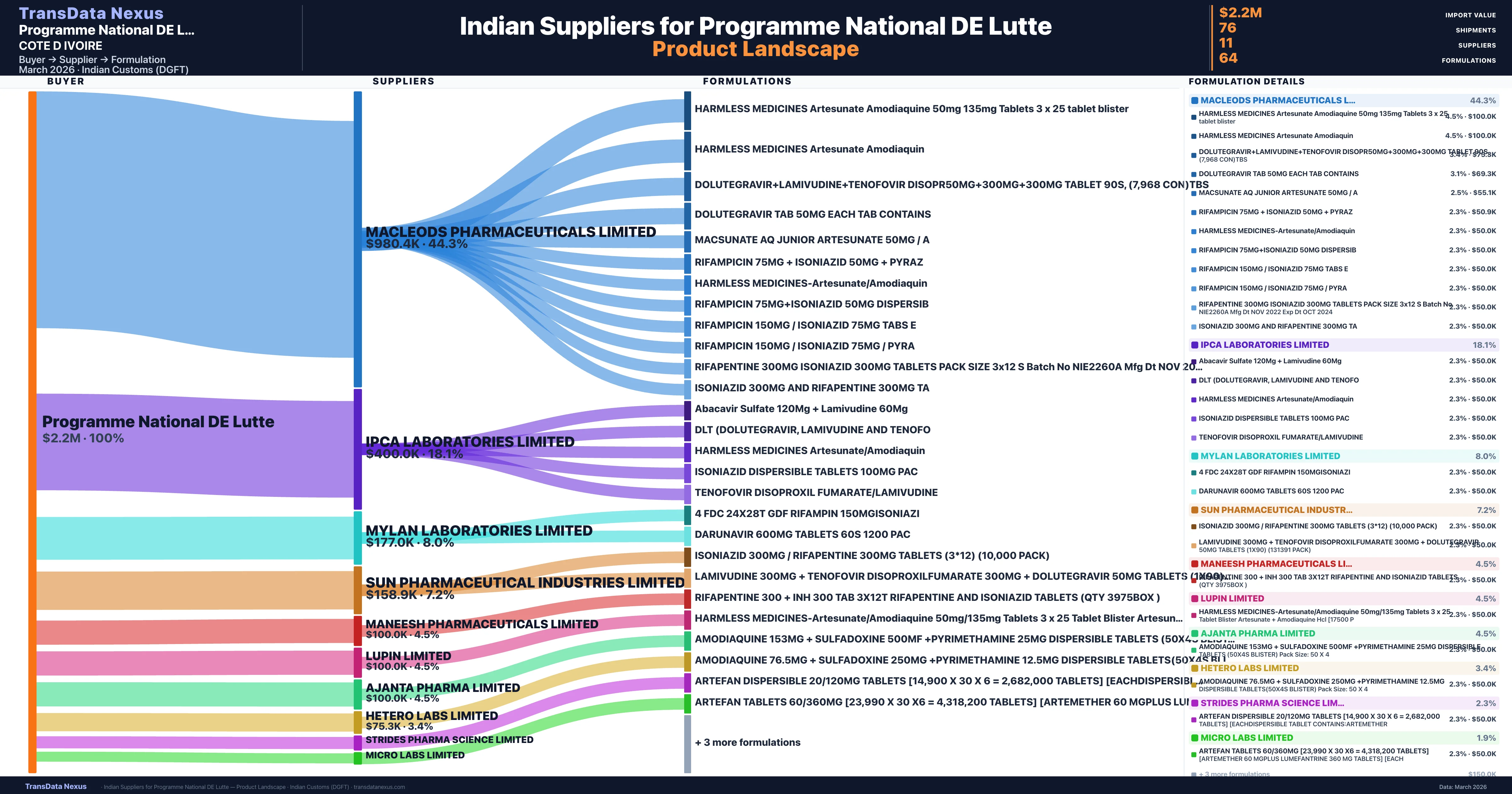
Who Are the Verified Indian Suppliers to Programme National DE Lutte?
Customs-verified supplier relationships from Indian DGFT records
| Supplier | Value | Shipments | Share |
|---|---|---|---|
| Macleods Pharmaceuticals Limited | $980.4K | 45 | 44.3% |
| Ipca Laboratories Limited | $400.0K | 8 | 18.1% |
| Mylan Laboratories Limited | $177.0K | 4 | 8.0% |
| Sun Pharmaceutical Industries Limited | $158.9K | 4 | 7.2% |
| Maneesh Pharmaceuticals Limited | $100.0K | 3 | 4.5% |
| Lupin Limited | $100.0K | 2 | 4.5% |
| Ajanta Pharma Limited | $100.0K | 3 | 4.5% |
| Hetero Labs Limited | $75.3K | 3 | 3.4% |
| Strides Pharma Science Limited | $50.0K | 1 | 2.3% |
| Micro Labs Limited | $41.3K | 1 | 1.9% |
| Aurobindo Pharma Limited | $28.5K | 2 | 1.3% |
Programme National DE Lutte sources from 11 verified Indian suppliers across 64 distinct formulations. The supply base is diversified across 11 suppliers, reducing single-source dependency risk.
What Formulations Does Programme National DE Lutte Import?
| Formulation | Value | Ships |
|---|---|---|
| Harmless medicines artesunate amodiaquine 50MG 135MG tablets 3 x 25 tablet | $100.0K | 2 |
| Harmless medicines artesunate | $100.0K | 2 |
| Dolutegravir+lamivudine+tenofovir disopr50mg+300MG+300MG tablet 90s, (7,968 con | $75.3K | 3 |
| Dolutegravir TAB 50MG Each TAB | $69.3K | 2 |
| Macsunate aq junior artesunate 50MG / | $55.1K | 2 |
| Rifampicin 75MG + isoniazid 50MG + | $50.9K | 3 |
| Harmless medicines-artesunate/amodiaquin | $50.0K | 1 |
| Rifampicin 75MG+isoniazid 50MG | $50.0K | 1 |
| Rifampicin 150MG / isoniazid 75MG tabs | $50.0K | 1 |
| Rifampicin 150MG / isoniazid 75MG / | $50.0K | 1 |
| Rifapentine 300MG isoniazid 300MG tablets Pack size 3x12 s batch no nie2260a mfg dt nov 2022 exp dt oct | $50.0K | 1 |
| Isoniazid 300MG and rifapentine 300MG | $50.0K | 1 |
| Abacavir sulfate 120MG + lamivudine 60MG | $50.0K | 1 |
| Dlt (dolutegravir, lamivudine and | $50.0K | 1 |
| Harmless medicines artesunate/amodiaquin | $50.0K | 1 |
Programme National DE Lutte imports 64 distinct pharmaceutical formulations. Showing top 15 by value. For full formulation-level data, contact TransData Nexus.
What Products Does Programme National DE Lutte Import?
Top Products by Import Value
Programme National DE Lutte Therapeutic Categories — 1 Specializations
Programme National DE Lutte imports across 1 therapeutic categories, with Antimalarial & Antiparasitic (100.0%), representing the largest segments. The portfolio is concentrated — top 5 products = 100% of total imports.
Antimalarial & Antiparasitic
2 products · 100.0% · $200.0K
Import Portfolio — Top 2 by Import Value
| # | Product | Category | Value | Ships | Share | Rk |
|---|---|---|---|---|---|---|
| 1 | Pyrimethamine | Antimalarial & Antiparasitic | $100.0K | 2 | 0.2% | 8 |
| 2 | Sulfadoxine | Antimalarial & Antiparasitic | $100.0K | 2 | 0.2% | 7 |
Programme National DE Lutte imports 2 pharmaceutical products across 1 categories into Cote D Ivoire totaling $200.0K.
Key Metrics
Top Categories
Indian Suppliers
Related Trade Data
Need Detailed Data?
Shipment-level records, supplier connections & pricing for Programme National DE Lutte.
Request DemoProgramme National DE Lutte — Corporate Profile & Information
Company type, headquarters, distribution network, and industry role
1Company Overview
Programme National DE Lutte (PNL) is a government-led initiative in Côte d'Ivoire, primarily focused on combating infectious diseases, notably malaria. As a public health program, PNL operates under the Ministry of Health and Public Hygiene, coordinating national efforts to prevent and treat malaria through various interventions, including the procurement and distribution of pharmaceutical products. While not a commercial entity, PNL functions as a central buyer and distributor, sourcing essential medications to ensure nationwide availability. Its role is pivotal in the pharmaceutical supply chain, particularly in the antimalarial sector, where it collaborates with both local and international suppliers to meet the country's health needs.
2Distribution Network
PNL's distribution network is strategically designed to ensure the efficient delivery of antimalarial medications across Côte d'Ivoire. The program collaborates with regional health authorities and local pharmacies to facilitate the widespread availability of treatments. While specific warehouse locations and logistics capabilities are not publicly detailed, PNL's operations are integrated with the national health infrastructure, leveraging existing facilities and transportation networks to reach both urban and rural areas. This integration ensures that antimalarial drugs are accessible to the entire population, aligning with the program's mission to combat malaria effectively.
3Industry Role
In Côte d'Ivoire's pharmaceutical supply chain, PNL serves as a primary wholesaler and distributor, focusing exclusively on antimalarial and antiparasitic medications. By centralizing the procurement and distribution of these essential drugs, PNL plays a critical role in standardizing treatment protocols and ensuring equitable access across the country. Its operations are distinct from commercial importers, as PNL's activities are driven by public health objectives rather than profit motives, emphasizing the importance of malaria control in national health policy.
Supplier Relationship Intelligence — Programme National DE Lutte
Sourcing concentration, supply chain resilience, and strategic implications
1Sourcing Concentration Analysis
PNL's sourcing strategy exhibits a high degree of concentration, importing two primary products—Pyrimethamine and Sulfadoxine—each valued at $100,000 USD, accounting for 50% of its total imports from India. This focus on two antimalarial agents suggests a strategic choice to streamline procurement and ensure consistent supply. The program's reliance on a limited number of products may enhance negotiation leverage with suppliers and simplify logistics. However, this concentration also poses risks; any disruptions in the supply chain for these specific medications could significantly impact PNL's ability to meet national demand. The stability of PNL's relationships with its Indian suppliers is crucial, as evidenced by the program's engagement with multiple suppliers, which may provide a buffer against potential supply chain disruptions.
2Supply Chain Resilience
PNL's supply chain resilience is bolstered by its engagement with multiple Indian pharmaceutical suppliers, including MACLEODS PHARMACEUTICALS LIMITED, IPCA LABORATORIES LIMITED, and MYLAN LABORATORIES LIMITED. This diversified supplier base mitigates the risks associated with single-source dependency, enhancing the program's ability to maintain a steady supply of antimalarial medications. The importation of 64 unique formulations indicates a strategic approach to sourcing, allowing PNL to adapt to varying treatment protocols and patient needs. While the program's focus on finished pharmaceutical formulations from India suggests a reliance on international suppliers, it also reflects a commitment to quality and efficacy, as these suppliers are subject to stringent regulatory standards. PNL's adherence to Côte d'Ivoire's regulatory requirements, including obtaining necessary import authorizations and ensuring compliance with good manufacturing practices, further strengthens the resilience of its supply chain.
3Strategic Implications
PNL's concentrated sourcing pattern positions it as a significant player in the antimalarial medication market within Côte d'Ivoire. For Indian exporters, this presents an opportunity to establish or strengthen partnerships with PNL, given the program's substantial procurement volume. Suppliers that can offer consistent quality, competitive pricing, and reliable delivery schedules are well-positioned to meet PNL's needs. Additionally, PNL's focus on antimalarial and antiparasitic drugs aligns with India's robust pharmaceutical manufacturing capabilities in these therapeutic areas, suggesting a strategic fit for potential suppliers. However, the high concentration of PNL's imports also means that any changes in the program's procurement strategy or shifts in supplier relationships could have a significant impact on individual exporters.
Importing Pharmaceuticals into Cote D Ivoire — Regulatory Framework
Regulatory authority, GMP requirements, import licensing for Cote D Ivoire
1Regulatory Authority & Framework
In Côte d'Ivoire, the regulation of pharmaceutical products is overseen by the Ivorian Pharmaceutical Regulatory Authority (AIRP), established under Law No. 2017-541 of 3 August 2017. This law provides the institutional and functional framework for the pharmaceutical sector, ensuring the availability of accessible, safe, effective, and high-quality pharmaceutical products. The AIRP is responsible for issuing import and export authorizations, monitoring compliance with good manufacturing practices, and enforcing regulations related to pharmaceutical products. For the importation of pharmaceutical products, including antimalarial medications, importers must obtain an Official Import Authorization (OIA) from the AIRP prior to shipment. This authorization process involves submitting an application that includes a pro forma invoice, a list of products to be imported, and other relevant documentation. The AIRP's role is critical in maintaining the integrity of the pharmaceutical supply chain and ensuring that imported products meet the country's health standards. (gucecotedivoire.ci)
2Import Licensing & GMP
Import licensing in Côte d'Ivoire is governed by the AIRP, which requires importers to obtain an Official Import Authorization (OIA) before shipping pharmaceutical products into the country. The application for an OIA must include a pro forma invoice, a list of products to be imported, and other pertinent documents. Additionally, importers must ensure that their products comply with good manufacturing practices (GMP) recognized by international standards, such as EU GMP, WHO GMP, or PIC/S. This compliance is essential for the registration and approval of pharmaceutical products in Côte d'Ivoire. Furthermore, importers must obtain a wholesale distribution authorization, which involves meeting specific regulatory requirements set by the AIRP to ensure the safe and effective distribution of pharmaceutical products within the country. (gucecotedivoire.ci)
3Quality & Labeling
Imported pharmaceutical products in Côte d'Ivoire must undergo batch testing to ensure they meet the country's health and safety standards. This testing is typically conducted by the manufacturer or a recognized third-party laboratory and must be documented in a certificate of analysis or certificate of conformity. The labeling of pharmaceutical products must be in French, the official language of Côte d'Ivoire, and must include essential information such as the product name, dosage form, strength, batch number, expiry date, and storage conditions. Serialization mandates may apply to facilitate traceability and prevent counterfeit products; however, specific requirements should be verified with the AIRP. Compliance with these quality and labeling standards is crucial for the registration and importation of pharmaceutical products into Côte d'Ivoire. (gucecotedivoire.ci)
4Recent Regulatory Changes
Between 2024 and 2026, Côte d'Ivoire has implemented several regulatory changes affecting the importation of pharmaceutical products. Notably, the introduction of the Official Import Authorization (OIA) process by the AIRP has streamlined the import authorization procedure, requiring importers to submit a comprehensive application that includes a pro forma invoice, a list of products to be imported, and other relevant documentation. Additionally, the AIRP has emphasized the need for compliance with international good manufacturing practices (GMP), such as EU GMP, WHO GMP, or PIC/S, for the registration and approval of pharmaceutical products. These changes aim to enhance the quality and safety of imported pharmaceutical products and align Côte d'Ivoire's regulatory framework with international standards. (gucecotedivoire.ci)
Programme National DE Lutte — Procurement Pattern Analysis
Product strategy, sourcing profile, and market positioning
1Product Strategy
PNL's focus on antimalarial and antiparasitic medications aligns with the high prevalence of malaria in Côte d'Ivoire, where the disease remains a leading cause of morbidity and mortality. The program's procurement strategy is driven by the need to provide effective and accessible treatments to the population, ensuring that both urban and rural communities have access to essential antimalarial drugs. By concentrating on these therapeutic areas, PNL aims to reduce the burden of malaria through consistent and widespread distribution of medications, thereby contributing to the country's public health objectives.
2Sourcing Profile
PNL's sourcing strategy is centered on importing finished pharmaceutical formulations from India, a country renowned for its robust pharmaceutical manufacturing sector. This approach allows PNL to leverage India's expertise in producing high-quality antimalarial and antiparasitic medications. The program's focus on finished formulations indicates a preference for ready-to-use products, facilitating efficient distribution and minimizing the complexities associated with raw material imports. India's established regulatory standards and competitive pricing further enhance its suitability as a sourcing partner for PNL.
3Market Positioning
PNL serves the public health sector in Côte d'Ivoire, focusing on the distribution of antimalarial and antiparasitic medications. Its operations are distinct from commercial entities, as PNL's activities are driven by public health objectives rather than profit motives. By centralizing the procurement and distribution of these essential drugs, PNL ensures equitable access across the country, aligning with national health policies aimed at controlling and eliminating malaria.
Seller's Guide — How to Become a Supplier to Programme National DE Lutte
Opportunity assessment, qualifications, and practical approach strategy
1Opportunity Assessment
For new Indian suppliers, there is a realistic opportunity to engage with PNL, given the program's substantial procurement volume and its
Frequently Asked Questions — Programme National DE Lutte
What products does Programme National DE Lutte import from India?
Programme National DE Lutte imports 2 pharmaceutical products across 1 categories. Top imports: Pyrimethamine ($100.0K), Sulfadoxine ($100.0K).
Who supplies pharmaceuticals to Programme National DE Lutte from India?
Programme National DE Lutte sources from 11 verified Indian suppliers. The primary supplier is Macleods Pharmaceuticals Limited (44.3% of imports, $980.4K).
What is Programme National DE Lutte's total pharmaceutical import value?
Programme National DE Lutte's total pharmaceutical import value from India is $200.0K, based on 4 verified shipments in Indian Customs (DGFT) data.
What therapeutic categories does Programme National DE Lutte focus on?
Programme National DE Lutte imports across 1 categories. The largest: Antimalarial & Antiparasitic (100.0%).
Get Full Programme National DE Lutte Import Intelligence
Access shipment-level details, supplier connections, pricing data, and competitive analysis. TransData Nexus provides verified Indian Customs (DGFT) data trusted by pharmaceutical trade professionals worldwide.
Official References & Regulatory Resources
Verify import regulations and drug registration requirements with the agencies above.
Research Methodology & Data Transparency
Suresh Sormare
Verified AuthorPharmaceutical Export-Import Analyst & Trade Intelligence Expert
Suresh Sormare is a pharmaceutical export-import analyst with deep expertise in Indian Customs (DGFT) data, HS code classification, and global pharmaceutical supply chains. His analysis covers 10M+ shipment records across 150+ countries and is used by manufacturers, procurement agencies, and trade consultants worldwide. Suresh specializes in identifying verified suppliers and buyers from customs records, mapping bilateral pharmaceutical trade corridors, analyzing tariff structures and regulatory frameworks across 170+ destination markets, and benchmarking competitive positioning for finished pharmaceutical formulations. His methodology combines granular customs transaction data with regulatory intelligence from FDA, EMA, WHO, CDSCO, and 40+ national drug authorities to deliver actionable trade insights for the pharmaceutical formulations sector.
linkedin.com/in/sureshsormarePrimary Data Source
All trade data is sourced from Indian Customs (DGFT) official shipping bill records — the authoritative government database for India's pharmaceutical trade. Each verified record contains exporter name, consignee (buyer) name, detailed product description, quantity, declared FOB value (USD), port of loading, destination country, and shipment date.
Analysis Methodology
- 1.Buyer Matching: Programme National DE Lutte identified across shipments using consignee name normalization.
- 2.Statistical Normalization: Shipment values are statistically normalized to ensure accurate market share representation.
- 3.Market Share: Calculated per product as Programme National DE Lutte's capped value divided by total Indian exports for that product.
- 4.Shipment Count: Based on 4 individual customs records matching Programme National DE Lutte.
- 5.Supplier Verification: Programme National DE Lutte sources from 11 verified Indian suppliers across 64 formulations, confirmed from customs records.
Government-Sourced Data
Official DGFT customs records
Transparent Methodology
Calculations fully disclosed above
2 Products Tracked
1 therapeutic categories
Expert-Reviewed
By pharmaceutical trade specialists
Data Source & Methodology
Trade data sourced from Indian Customs (DGFT) export shipment records. Values represent FOB export value in USD. For current shipment-level data, contact TransData Nexus.