Lifescience Logistics
Pharmaceutical Importer · United States · Cardiovascular Focus · $19.1M Total Trade · DGFT Verified
Lifescience Logistics is a pharmaceutical importer based in United States with a total trade value of $19.1M across 5 products in 4 therapeutic categories. Based on 402 verified import shipments from Indian Customs (DGFT) records, Lifescience Logistics is the #1 buyer in 2 products including Celecoxib, Verapamil. Lifescience Logistics sources from 6 verified Indian suppliers, with Umedica Laboratories Private Limited accounting for 66.6% of imports.
Lifescience Logistics — Import Portfolio & Supplier Network
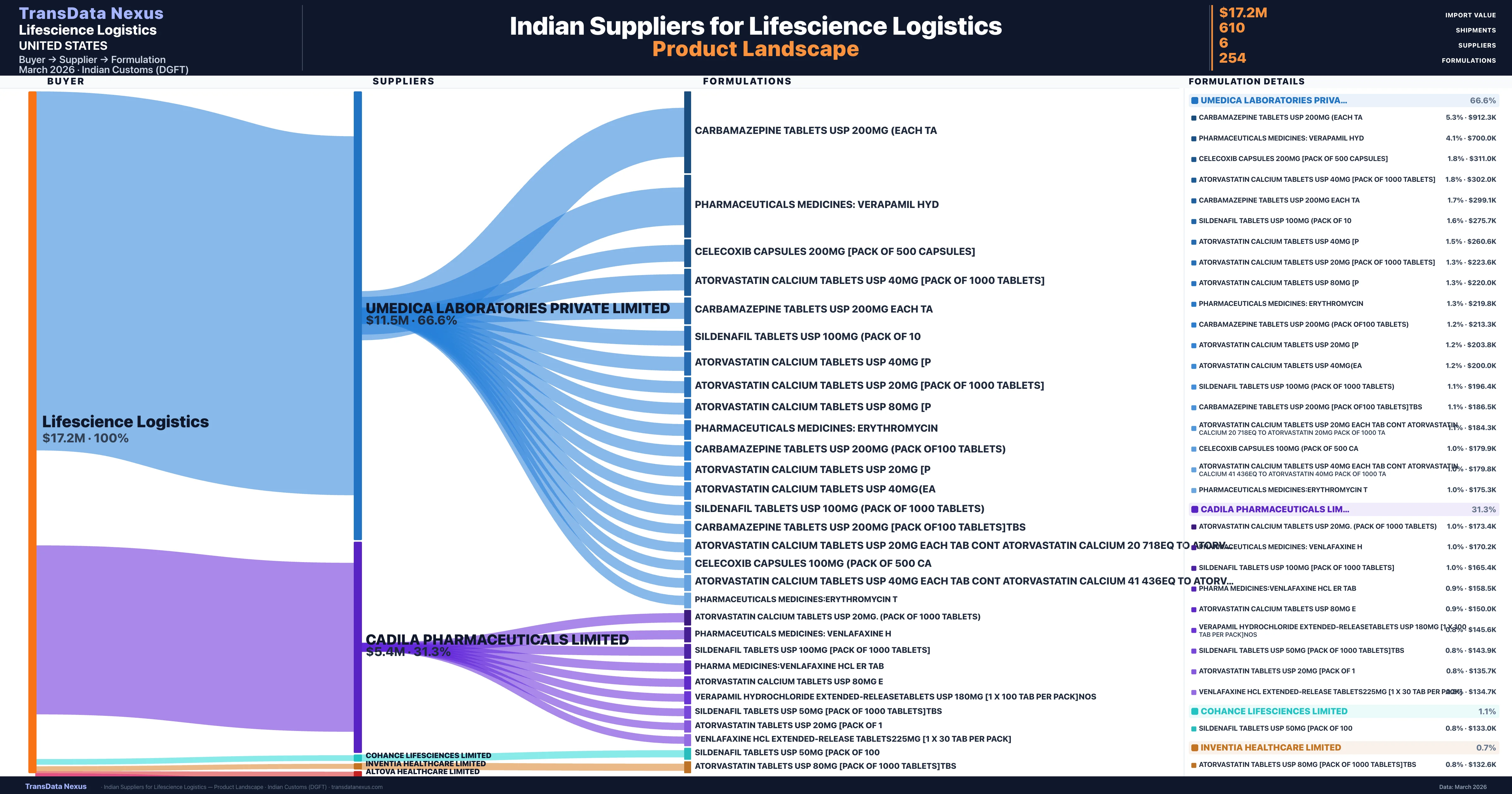
Who Are the Verified Indian Suppliers to Lifescience Logistics?
Customs-verified supplier relationships from Indian DGFT records
| Supplier | Value | Shipments | Share |
|---|---|---|---|
| Umedica Laboratories Private Limited | $11.5M | 409 | 66.6% |
| Cadila Pharmaceuticals Limited | $5.4M | 181 | 31.3% |
| Cohance Lifesciences Limited | $181.0K | 13 | 1.1% |
| Inventia Healthcare Limited | $125.7K | 5 | 0.7% |
| Altova Healthcare Limited | $50.0K | 1 | 0.3% |
| Gland Pharma Limited | $194 | 1 | 0.0% |
Lifescience Logistics sources from 6 verified Indian suppliers across 254 distinct formulations. The supply base is diversified across 6 suppliers, reducing single-source dependency risk.
What Formulations Does Lifescience Logistics Import?
| Formulation | Value | Ships |
|---|---|---|
| Carbamazepine tablets USP 200MG (Each | $912.3K | 24 |
| Pharmaceuticals medicines: verapamil | $700.0K | 14 |
| Celecoxib capsules 200MG [Pack of 500 | $311.0K | 10 |
| Atorvastatin calcium tablets USP 40MG [Pack of 1000 | $302.0K | 11 |
| Carbamazepine tablets USP 200MG Each | $299.1K | 10 |
| Sildenafil tablets USP 100MG (Pack of | $275.7K | 7 |
| Atorvastatin calcium tablets USP 40MG | $260.6K | 6 |
| Atorvastatin calcium tablets USP 20MG [Pack of 1000 | $223.6K | 7 |
| Atorvastatin calcium tablets USP 80MG | $220.0K | 6 |
| Pharmaceuticals medicines | $219.8K | 7 |
| Carbamazepine tablets USP 200MG (Pack of100 tablets) | $213.3K | 12 |
| Atorvastatin calcium tablets USP 20MG | $203.8K | 6 |
| Atorvastatin calcium tablets USP | $200.0K | 4 |
| Sildenafil tablets USP 100MG (Pack of 1000 tablets) | $196.4K | 5 |
| Carbamazepine tablets USP 200MG [Pack of100 | $186.5K | 12 |
Lifescience Logistics imports 254 distinct pharmaceutical formulations. Showing top 15 by value. For full formulation-level data, contact TransData Nexus.
What Products Does Lifescience Logistics Import?
Top Products by Import Value
Lifescience Logistics Therapeutic Categories — 4 Specializations
Lifescience Logistics imports across 4 therapeutic categories, with Cardiovascular (48.7%), Vitamins & Supplements (30.6%), Analgesics & Antipyretics (15.5%) representing the largest segments. The portfolio is concentrated — top 5 products = 100% of total imports.
Cardiovascular
2 products · 48.7% · $9.3M
Vitamins & Supplements
1 products · 30.6% · $5.8M
Analgesics & Antipyretics
1 products · 15.5% · $3.0M
Antibiotics
1 products · 5.2% · $989.1K
Import Portfolio — Top 5 by Import Value
| # | Product | Category | Value | Ships | Share | Rk |
|---|---|---|---|---|---|---|
| 1 | Atorvastatin | Cardiovascular | $6.7M | 133 | 0.6% | 5 |
| 2 | Calcium | Vitamins & Supplements | $5.8M | 117 | 0.7% | 6 |
| 3 | Celecoxib | Analgesics & Antipyretics | $3.0M | 59 | 2.2% | 1 |
| 4 | Verapamil | Cardiovascular | $2.6M | 53 | 0.7% | 1 |
| 5 | Erythromycin | Antibiotics | $989.1K | 40 | 1.2% | 8 |
Lifescience Logistics imports 5 pharmaceutical products across 4 categories into United States totaling $19.1M. The company is the #1 buyer for 2 products: Celecoxib, Verapamil.
Key Metrics
Top Categories
Indian Suppliers
Related Trade Data
Need Detailed Data?
Shipment-level records, supplier connections & pricing for Lifescience Logistics.
Request DemoLifescience Logistics — Corporate Profile & Information
Company type, headquarters, distribution network, and industry role
1Company Overview
Lifescience Logistics is a U.S.-based pharmaceutical importer specializing in the acquisition of finished pharmaceutical formulations from India. Operating as a buyer, the company plays a pivotal role in sourcing and importing a diverse range of pharmaceutical products to meet the demands of the U.S. market. Headquartered in the United States, Lifescience Logistics collaborates with various Indian pharmaceutical manufacturers to ensure a steady supply of medications across multiple therapeutic categories.
In the United States pharmaceutical distribution landscape, Lifescience Logistics functions as a key intermediary, facilitating the entry of foreign-manufactured drugs into the domestic market. By importing finished formulations, the company contributes to the availability of a wide array of pharmaceutical products, thereby enhancing the diversity and accessibility of medications for healthcare providers and patients nationwide.
2Distribution Network
While specific details about Lifescience Logistics' warehouse locations and logistics capabilities are not publicly disclosed, the company is known to operate a distribution network within the United States. This network is designed to efficiently handle the storage and distribution of pharmaceutical products, ensuring timely delivery to various stakeholders in the healthcare sector. The logistics infrastructure is tailored to meet the stringent requirements of pharmaceutical distribution, including temperature control and regulatory compliance.
3Industry Role
Lifescience Logistics serves as a pharmaceutical importer, sourcing finished pharmaceutical formulations from Indian manufacturers and facilitating their entry into the U.S. market. By acting as an intermediary between foreign manufacturers and domestic healthcare providers, the company plays a crucial role in diversifying the pharmaceutical supply chain and enhancing the availability of medications. This position allows Lifescience Logistics to influence market dynamics by introducing a variety of products, potentially impacting pricing and competition within the U.S. pharmaceutical sector.
Supplier Relationship Intelligence — Lifescience Logistics
Sourcing concentration, supply chain resilience, and strategic implications
1Sourcing Concentration Analysis
Lifescience Logistics demonstrates a high degree of sourcing concentration, with a significant portion of its imports originating from a single supplier, Umedica Laboratories Private Limited. This supplier accounts for approximately 66.6% of the total import value, indicating a strong reliance on this manufacturer. Such concentration can present risks, including potential supply chain disruptions if issues arise with the primary supplier. However, the company's extensive number of shipments (409) from Umedica suggests a stable and ongoing relationship, which may mitigate some of these risks. The remaining imports are distributed among other suppliers, with Cadila Pharmaceuticals Limited contributing 31.3% and smaller contributions from other manufacturers.
2Supply Chain Resilience
The resilience of Lifescience Logistics' supply chain is closely tied to its sourcing strategy. The heavy reliance on Umedica Laboratories Private Limited for the majority of imports indicates a potential vulnerability to supply chain disruptions. While the company imports a diverse range of formulations (254 unique products), the concentration of sourcing from a single supplier may limit its ability to quickly adapt to changes or challenges within that supplier's operations. Additionally, the exposure to specific shipping routes and the regulatory compliance status of the primary supplier are critical factors influencing the overall resilience of the supply chain.
3Strategic Implications
The sourcing pattern of Lifescience Logistics, characterized by a heavy reliance on Umedica Laboratories Private Limited, has significant strategic implications. For Lifescience Logistics, this concentration may lead to cost efficiencies and streamlined operations due to the established relationship with a primary supplier. However, it also exposes the company to risks associated with supply chain disruptions. For Indian exporters, understanding this sourcing pattern presents an opportunity to position themselves as alternative suppliers, especially if they can offer competitive pricing, reliable quality, and the ability to meet regulatory standards required by U.S. authorities.
Importing Pharmaceuticals into United States — Regulatory Framework
Regulatory authority, GMP requirements, import licensing for United States
1Regulatory Authority & Framework
In the United States, the Food and Drug Administration (FDA) serves as the primary regulatory authority overseeing the importation of pharmaceutical products. The FDA enforces the Federal Food, Drug, and Cosmetic Act (FD&C Act), which sets forth the legal framework for drug imports, ensuring that all imported drugs meet the standards for quality, safety, and effectiveness. The FDA's regulations require that imported drugs be manufactured in compliance with quality requirements, appropriately labeled, and approved for sale in the U.S. market. Additionally, the FDA reviews shipments of imported drugs to determine their admissibility into the U.S., and drugs that do not meet FDA standards may be refused entry.
2Import Licensing & GMP
Import licensing requirements for pharmaceutical products entering the United States are governed by the FDA. Importers must ensure that their products comply with FDA regulations, including obtaining necessary approvals and certifications. Good Manufacturing Practice (GMP) certification is a critical component of this compliance. The FDA recognizes GMP certifications from various international standards, including EU GMP, WHO GMP, and PIC/S. Importers must verify that their suppliers hold valid GMP certifications to ensure the quality and safety of the imported pharmaceutical products. Additionally, wholesale distribution authorization is required for entities involved in the distribution of pharmaceutical products within the U.S. market.
3Quality & Labeling
Imported pharmaceutical products must adhere to FDA requirements for quality and labeling. Batch testing is essential to verify that each batch of imported drugs meets the required standards for safety, efficacy, and quality. Stability requirements ensure that the products maintain their intended quality throughout their shelf life. Labeling must comply with FDA regulations, including providing accurate and truthful information in English, and may include specific requirements for over-the-counter drugs, prescription drugs, and investigational drugs. Serialization mandates may also apply, requiring unique identifiers on drug packages to enhance traceability and prevent counterfeit products.
4Recent Regulatory Changes
Between 2024 and 2026, the FDA has implemented several policy changes affecting the importation of pharmaceutical products from India. These changes include updates to import procedures, enhanced scrutiny of drug labeling and packaging, and stricter enforcement of GMP compliance. The FDA has also introduced new pathways for the importation of certain prescription drugs originally intended for foreign markets, aiming to streamline the process while maintaining safety and efficacy standards. Importers must stay informed about these regulatory changes to ensure continued compliance and to mitigate potential disruptions in their supply chains.
Lifescience Logistics — Procurement Pattern Analysis
Product strategy, sourcing profile, and market positioning
1Product Strategy
Lifescience Logistics focuses on importing pharmaceutical products across three primary therapeutic categories: cardiovascular, vitamins & supplements, and analgesics & antipyretics. This strategic focus aligns with market demand for essential medications in these areas. The company's top five imported products—Celecoxib, Verapamil, Atorvastatin, Calcium, and Erythromycin—are commonly prescribed for conditions such as hypertension, cholesterol management, pain relief, and bacterial infections. By concentrating on these therapeutic areas, Lifescience Logistics aims to meet the critical healthcare needs of the U.S. population, ensuring the availability of vital medications.
2Sourcing Profile
Lifescience Logistics employs a sourcing strategy that emphasizes importing finished pharmaceutical formulations from Indian manufacturers. This approach allows the company to leverage India's robust pharmaceutical manufacturing capabilities, which are known for producing high-quality generics at competitive prices. The focus on finished formulations enables Lifescience Logistics to offer a diverse product portfolio without the complexities associated with raw material sourcing or manufacturing. India's compliance with international GMP standards further supports the company's sourcing strategy, ensuring that imported products meet the stringent quality requirements of the U.S. market.
3Market Positioning
Based on its product mix, Lifescience Logistics serves the wholesale distribution segment of the U.S. pharmaceutical market. By importing a range of essential medications, the company supplies these products to various stakeholders, including hospitals, clinics, pharmacies, and other healthcare providers. This positioning allows Lifescience Logistics to contribute to the overall availability and accessibility of critical pharmaceutical products, supporting the healthcare infrastructure across the United States.
Seller's Guide — How to Become a Supplier to Lifescience Logistics
Opportunity assessment, qualifications, and practical approach strategy
1Opportunity Assessment
There is a realistic opportunity for new Indian suppliers to engage with Lifescience Logistics, particularly if they can offer products that complement the company's existing portfolio. Potential gaps in Lifescience Logistics's current sourcing include specific formulations or dosage forms not currently imported. Indian exporters can explore these opportunities by ensuring their products meet FDA regulatory requirements, possess valid GMP certifications, and align with the therapeutic areas of interest to Lifescience Logistics. Establishing a reliable supply chain and demonstrating consistent product quality will be crucial for new suppliers seeking to enter this market segment.
2Requirements & Qualifications
Indian exporters aiming to supply Lifescience Logistics and the broader U.S. market must adhere to several key requirements. Products must be manufactured in compliance with recognized GMP standards, such as EU GMP, WHO GMP, or PIC/S. Exporters must obtain necessary import licenses and ensure that their products meet FDA labeling and packaging regulations, including providing accurate and truthful information in English. Additionally, products must pass FDA inspections and be approved for sale in the U.S. market. Maintaining a robust quality management system and staying informed about regulatory changes are essential for ongoing compliance.
3How to Approach
Indian exporters seeking to establish a relationship with Lifescience Logistics should begin by ensuring their products meet all FDA regulatory requirements, including GMP compliance and appropriate labeling
Frequently Asked Questions — Lifescience Logistics
What products does Lifescience Logistics import from India?
Lifescience Logistics imports 5 pharmaceutical products across 4 categories. Top imports: Atorvastatin ($6.7M), Calcium ($5.8M), Celecoxib ($3.0M), Verapamil ($2.6M), Erythromycin ($989.1K).
Who supplies pharmaceuticals to Lifescience Logistics from India?
Lifescience Logistics sources from 6 verified Indian suppliers. The primary supplier is Umedica Laboratories Private Limited (66.6% of imports, $11.5M).
What is Lifescience Logistics's total pharmaceutical import value?
Lifescience Logistics's total pharmaceutical import value from India is $19.1M, based on 402 verified shipments in Indian Customs (DGFT) data.
What therapeutic categories does Lifescience Logistics focus on?
Lifescience Logistics imports across 4 categories. The largest: Cardiovascular (48.7%), Vitamins & Supplements (30.6%), Analgesics & Antipyretics (15.5%).
Get Full Lifescience Logistics Import Intelligence
Access shipment-level details, supplier connections, pricing data, and competitive analysis. TransData Nexus provides verified Indian Customs (DGFT) data trusted by pharmaceutical trade professionals worldwide.
Official References & Regulatory Resources
Verify import regulations and drug registration requirements with the agencies above.
Research Methodology & Data Transparency
Suresh Sormare
Verified AuthorPharmaceutical Export-Import Analyst & Trade Intelligence Expert
Suresh Sormare is a pharmaceutical export-import analyst with deep expertise in Indian Customs (DGFT) data, HS code classification, and global pharmaceutical supply chains. His analysis covers 10M+ shipment records across 150+ countries and is used by manufacturers, procurement agencies, and trade consultants worldwide. Suresh specializes in identifying verified suppliers and buyers from customs records, mapping bilateral pharmaceutical trade corridors, analyzing tariff structures and regulatory frameworks across 170+ destination markets, and benchmarking competitive positioning for finished pharmaceutical formulations. His methodology combines granular customs transaction data with regulatory intelligence from FDA, EMA, WHO, CDSCO, and 40+ national drug authorities to deliver actionable trade insights for the pharmaceutical formulations sector.
linkedin.com/in/sureshsormarePrimary Data Source
All trade data is sourced from Indian Customs (DGFT) official shipping bill records — the authoritative government database for India's pharmaceutical trade. Each verified record contains exporter name, consignee (buyer) name, detailed product description, quantity, declared FOB value (USD), port of loading, destination country, and shipment date.
Analysis Methodology
- 1.Buyer Matching: Lifescience Logistics identified across shipments using consignee name normalization, aggregating 2 name variants.
- 2.Statistical Normalization: Shipment values are statistically normalized to ensure accurate market share representation.
- 3.Market Share: Calculated per product as Lifescience Logistics's capped value divided by total Indian exports for that product.
- 4.Shipment Count: Based on 402 individual customs records matching Lifescience Logistics.
- 5.Supplier Verification: Lifescience Logistics sources from 6 verified Indian suppliers across 254 formulations, confirmed from customs records.
Government-Sourced Data
Official DGFT customs records
Transparent Methodology
Calculations fully disclosed above
5 Products Tracked
4 therapeutic categories
Expert-Reviewed
By pharmaceutical trade specialists
Data Source & Methodology
Trade data sourced from Indian Customs (DGFT) export shipment records. Values represent FOB export value in USD. Profile aggregates 2 company name variants from customs records. For current shipment-level data, contact TransData Nexus.