IP. Lili
Pharmaceutical Importer · Kazakhstan · Ayurvedic & Herbal Products Focus · $58.1K Total Trade · DGFT Verified
IP. Lili is a pharmaceutical importer based in Kazakhstan with a total trade value of $58.1K across 3 products in 2 therapeutic categories. Based on 176 verified import shipments from Indian Customs (DGFT) records, IP. Lili is the #1 buyer in 1 product including Kwatha. IP. Lili sources from 2 verified Indian suppliers, with Bangla Dom accounting for 96.4% of imports.
IP. Lili — Import Portfolio & Supplier Network
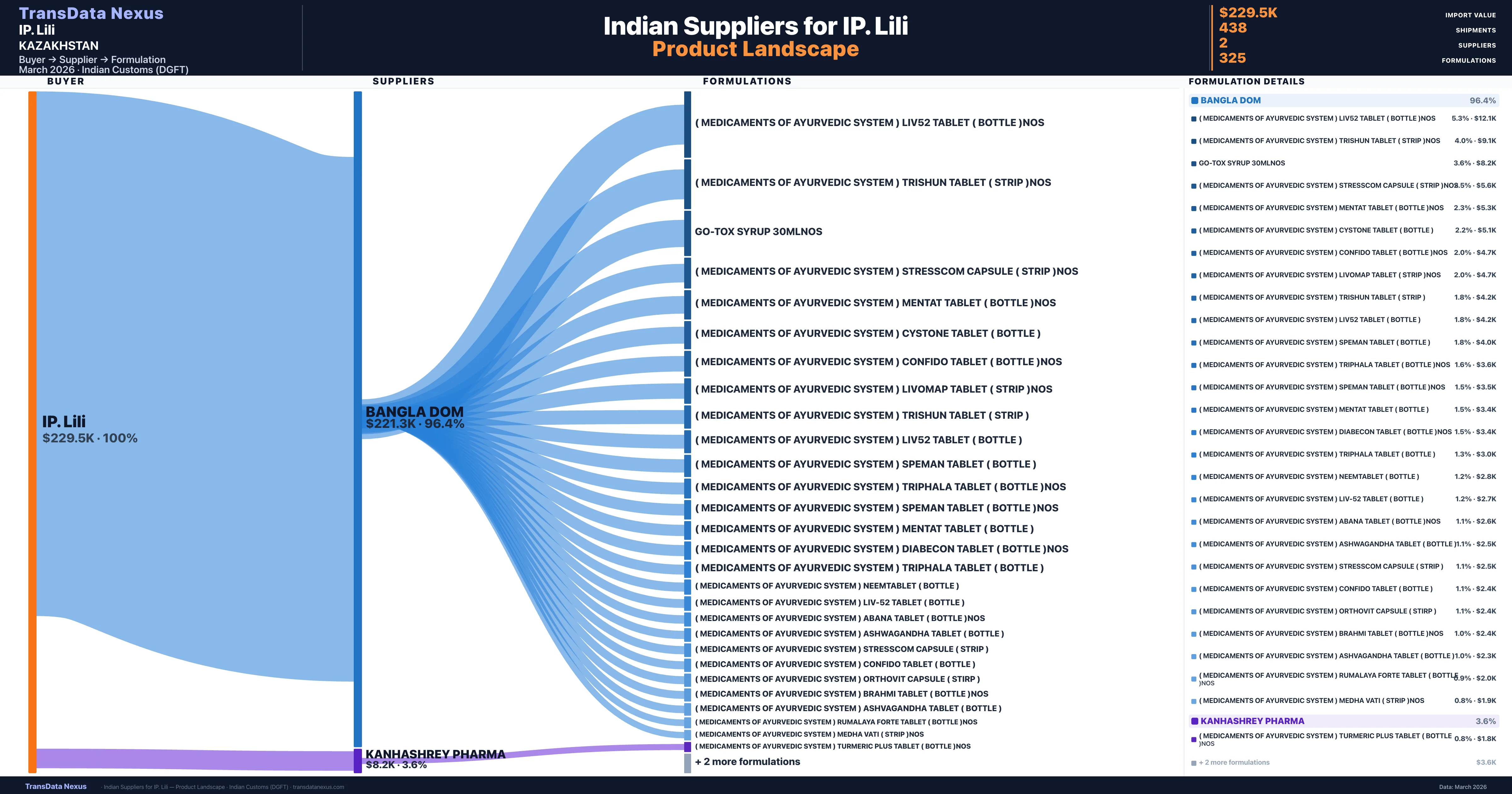
Who Are the Verified Indian Suppliers to IP. Lili?
Customs-verified supplier relationships from Indian DGFT records
| Supplier | Value | Shipments | Share |
|---|---|---|---|
| Bangla Dom | $221.3K | 436 | 96.4% |
| Kanhashrey Pharma | $8.2K | 2 | 3.6% |
IP. Lili sources from 2 verified Indian suppliers across 325 distinct formulations. The sourcing is highly concentrated — Bangla Dom accounts for 96.4% of total imports, indicating a strategic single-source relationship.
What Formulations Does IP. Lili Import?
| Formulation | Value | Ships |
|---|---|---|
| ( medicaments of ayurvedic system ) liv52 tablet ( bottle | $12.1K | 4 |
| ( medicaments of ayurvedic system ) trishun tablet ( strip | $9.1K | 3 |
| Go-tox syrup | $8.2K | 2 |
| ( medicaments of ayurvedic system ) stresscom capsule ( strip | $5.6K | 3 |
| ( medicaments of ayurvedic system ) mentat tablet ( bottle | $5.3K | 1 |
| ( medicaments of ayurvedic system ) cystone tablet ( bottle ) | $5.1K | 2 |
| ( medicaments of ayurvedic system ) confido tablet ( bottle | $4.7K | 4 |
| ( medicaments of ayurvedic system ) livomap tablet ( strip | $4.7K | 1 |
| ( medicaments of ayurvedic system ) trishun tablet ( strip ) | $4.2K | 1 |
| ( medicaments of ayurvedic system ) liv52 tablet ( bottle ) | $4.2K | 1 |
| ( medicaments of ayurvedic system ) speman tablet ( bottle ) | $4.0K | 2 |
| ( medicaments of ayurvedic system ) triphala tablet ( bottle | $3.6K | 4 |
| ( medicaments of ayurvedic system ) speman tablet ( bottle | $3.5K | 4 |
| ( medicaments of ayurvedic system ) mentat tablet ( bottle ) | $3.4K | 2 |
| ( medicaments of ayurvedic system ) diabecon tablet ( bottle | $3.4K | 4 |
IP. Lili imports 325 distinct pharmaceutical formulations. Showing top 15 by value. For full formulation-level data, contact TransData Nexus.
What Products Does IP. Lili Import?
Top Products by Import Value
IP. Lili Therapeutic Categories — 2 Specializations
IP. Lili imports across 2 therapeutic categories, with Ayurvedic & Herbal Products (89.3%), Antiviral & HIV Medications (10.7%), representing the largest segments. The portfolio is concentrated — top 5 products = 100% of total imports.
Ayurvedic & Herbal Products
2 products · 89.3% · $51.9K
Antiviral & HIV Medications
1 products · 10.7% · $6.2K
Import Portfolio — Top 3 by Import Value
| # | Product | Category | Value | Ships | Share | Rk |
|---|---|---|---|---|---|---|
| 1 | Kwatha | Ayurvedic & Herbal Products | $46.3K | 154 | 6.9% | 1 |
| 2 | Ledipasvir | Antiviral & HIV Medications | $6.2K | 4 | 0.5% | 9 |
| 3 | Gutika | Ayurvedic & Herbal Products | $5.6K | 18 | 4.5% | 5 |
IP. Lili imports 3 pharmaceutical products across 2 categories into Kazakhstan totaling $58.1K. The company is the #1 buyer for 1 product: Kwatha.
Key Metrics
Top Categories
Indian Suppliers
Related Trade Data
IP. Lili — Corporate Profile & Information
Company type, headquarters, distribution network, and industry role
1Company Overview
IP. Lili is a pharmaceutical importer and buyer based in Kazakhstan, specializing in the acquisition of finished pharmaceutical formulations, including tablets, capsules, syrups, and injections. The company plays a pivotal role in the distribution of these products within Kazakhstan, ensuring the availability of essential medications across the nation. While specific details about its headquarters and parent company are not publicly disclosed, IP. Lili's operations are integral to the pharmaceutical supply chain in Kazakhstan.
2Distribution Network
IP. Lili's distribution network encompasses multiple warehouse locations strategically situated to facilitate efficient logistics and timely delivery of pharmaceutical products throughout Kazakhstan. The company's logistics capabilities are robust, enabling it to manage a diverse portfolio of imported medications. Geographically, IP. Lili's reach extends across Kazakhstan, ensuring comprehensive coverage and accessibility of its products to various regions within the country.
3Industry Role
In Kazakhstan's pharmaceutical supply chain, IP. Lili functions primarily as a wholesaler and importer. The company sources finished pharmaceutical formulations from international suppliers, particularly from India, and distributes these products to various healthcare providers, including hospitals, clinics, and pharmacies. This role is crucial in bridging the gap between international manufacturers and the local healthcare market, ensuring the availability of a wide range of medications to meet the country's medical needs.
Supplier Relationship Intelligence — IP. Lili
Sourcing concentration, supply chain resilience, and strategic implications
1Sourcing Concentration Analysis
IP. Lili's sourcing strategy exhibits a high degree of concentration, with a significant majority of its imports originating from a single supplier, BANGLA DOM, accounting for 96.4% of the total import value. This heavy reliance on one supplier may pose risks related to supply chain disruptions, pricing fluctuations, and potential challenges in negotiating favorable terms. The limited number of suppliers—two in total—suggests a lack of diversification, which could impact the company's ability to adapt to changes in the global pharmaceutical market. The stability of the relationship with BANGLA DOM is critical; any issues with this supplier could have substantial repercussions on IP. Lili's operations.
2Supply Chain Resilience
The resilience of IP. Lili's supply chain is currently limited due to its dependence on a single supplier for the majority of its imports. The absence of backup suppliers and the lack of diversification in its product formulations further exacerbate this vulnerability. Additionally, the company's exposure to specific shipping routes and potential regulatory changes in the supplier's country could impact the consistency and reliability of its supply chain. Ensuring that key suppliers adhere to international Good Manufacturing Practice (GMP) standards is essential to maintain product quality and compliance with regulatory requirements.
3Strategic Implications
The current sourcing pattern of IP. Lili, characterized by a high concentration on a single supplier, may limit its competitive position in the Kazakhstan pharmaceutical market. This dependency could affect the company's ability to negotiate better terms, access a broader range of products, and respond swiftly to market changes. For Indian exporters, this presents an opportunity to diversify their customer base by offering alternative products and establishing relationships with IP. Lili, potentially reducing the company's reliance on a single supplier and enhancing its market resilience.
Importing Pharmaceuticals into Kazakhstan — Regulatory Framework
Regulatory authority, GMP requirements, import licensing for Kazakhstan
1Regulatory Authority & Framework
The primary regulatory authority overseeing pharmaceutical imports in Kazakhstan is the Ministry of Health. The Code of the Republic of Kazakhstan "On People's Health and Healthcare System," enacted on September 18, 2009, provides the legal framework governing the importation of medicines, medical devices, and medical equipment. This code outlines the procedures for state registration, importation, and exportation of pharmaceutical products, ensuring that all imported medications meet the country's health and safety standards. The Ministry of Health is responsible for enforcing these regulations, conducting inspections, and issuing necessary approvals for pharmaceutical imports.
2Import Licensing & GMP
Import licensing in Kazakhstan requires entities to obtain authorization from the Ministry of Health. This process involves submitting an application that includes detailed information about the pharmaceutical products, their intended use, and compliance with local regulations. Recognition of Good Manufacturing Practice (GMP) certificates is crucial; Kazakhstan acknowledges GMP certifications from reputable international bodies such as the European Union (EU), the World Health Organization (WHO), and the Pharmaceutical Inspection Co-operation Scheme (PIC/S). Importers must ensure that their suppliers hold valid GMP certificates from these recognized organizations to facilitate the importation process. Additionally, wholesale distribution authorization is mandatory, requiring importers to demonstrate compliance with local distribution standards and regulations.
3Quality & Labeling
Imported pharmaceutical products must undergo batch testing to verify their quality and safety. Stability requirements are enforced to ensure that medications maintain their efficacy and safety throughout their shelf life. Labeling must be in the Kazakh and Russian languages, providing clear and accurate information about the product's usage, dosage, and potential side effects. Serialization mandates are in place to track and trace pharmaceutical products throughout the supply chain, enhancing transparency and reducing the risk of counterfeit products entering the market.
4Recent Regulatory Changes
Between 2024 and 2026, Kazakhstan implemented several regulatory changes affecting pharmaceutical imports. Notably, the Rules on Wholesale and Retail Sale of Medicines and Medical Devices were amended by the Order of the Minister of Health of the Republic of Kazakhstan No. 98 dated June 2, 2023. These amendments introduced provisions on the return of medicines and prohibited the sale of medicines to children. Additionally, the importation of bulk pharmaceutical products was restricted, emphasizing the need for finished pharmaceutical formulations in the market. These changes aim to enhance the safety and quality of pharmaceutical products available to consumers in Kazakhstan.
IP. Lili — Procurement Pattern Analysis
Product strategy, sourcing profile, and market positioning
1Product Strategy
IP. Lili's focus on Ayurvedic and herbal products, comprising 89.3% of its imports, and antiviral and HIV medications, accounting for 10.7%, indicates a strategic alignment with prevalent health concerns in Kazakhstan. The demand for Ayurvedic and herbal products reflects a growing interest in alternative and traditional medicine among the Kazakhstani population. The inclusion of antiviral and HIV medications addresses the ongoing need for treatments related to infectious diseases, highlighting the company's responsiveness to public health priorities.
2Sourcing Profile
IP. Lili's sourcing strategy is predominantly focused on generic drugs, with a particular emphasis on Ayurvedic and herbal formulations. The company's preference for finished pharmaceutical formulations aligns with regulatory requirements in Kazakhstan, which mandate the importation of registered and approved products. India's established pharmaceutical industry, known for its compliance with international GMP standards, positions it as a key supplier for IP. Lili's procurement needs.
3Market Positioning
Based on its product mix, IP. Lili serves a diverse segment of the Kazakhstan pharmaceutical market, including retail pharmacies, hospitals, government tenders, and wholesale distribution. The company's extensive portfolio of Ayurvedic and herbal products caters to consumers seeking alternative medicine options, while its range of antiviral and HIV medications meets the needs of healthcare providers addressing infectious diseases. This comprehensive approach enables IP. Lili to maintain a significant presence across various market segments.
Seller's Guide — How to Become a Supplier to IP. Lili
Opportunity assessment, qualifications, and practical approach strategy
1Opportunity Assessment
There is a realistic opportunity for new Indian suppliers to engage with IP. Lili, particularly in the areas of Ayurvedic and herbal products, as well as antiviral and HIV medications. Diversifying the supplier base could mitigate risks associated with over-reliance on a single source and enhance the resilience of IP. Lili's supply chain. Potential gaps in IP. Lili's current sourcing include the need for additional suppliers offering a broader range of products and formulations, which could be addressed by establishing partnerships with new Indian exporters.
2Requirements & Qualifications
Indian exporters aiming to supply IP. Lili and the Kazakhstan market must ensure that their products are registered and approved by the Ministry of Health of Kazakhstan. Compliance with international GMP standards recognized by Kazakhstan, such as those from the EU, WHO, and PIC/S, is essential. Additionally, products must meet labeling requirements in Kazakh and Russian languages and adhere to serialization mandates for traceability. Obtaining wholesale distribution authorization in Kazakhstan is also necessary to facilitate the importation and distribution of pharmaceutical products.
3How to Approach
Indian exporters should initiate engagement with IP. Lili by presenting a comprehensive portfolio of their pharmaceutical products, emphasizing compliance with international GMP standards and alignment with Kazakhstan's regulatory requirements. Participating in government tenders and demonstrating the ability to meet the specific needs of the Kazakhstani market can enhance the attractiveness of the partnership. Developing a clear regulatory filing strategy, including the preparation of necessary documentation in Kazakh and Russian languages, and establishing realistic timelines for product registration and market entry are crucial steps in building a successful relationship with IP. Lili.
Frequently Asked Questions — IP. Lili
What products does IP. Lili import from India?
IP. Lili imports 3 pharmaceutical products across 2 categories. Top imports: Kwatha ($46.3K), Ledipasvir ($6.2K), Gutika ($5.6K).
Who supplies pharmaceuticals to IP. Lili from India?
IP. Lili sources from 2 verified Indian suppliers. The primary supplier is Bangla Dom (96.4% of imports, $221.3K).
What is IP. Lili's total pharmaceutical import value?
IP. Lili's total pharmaceutical import value from India is $58.1K, based on 176 verified shipments in Indian Customs (DGFT) data.
What therapeutic categories does IP. Lili focus on?
IP. Lili imports across 2 categories. The largest: Ayurvedic & Herbal Products (89.3%), Antiviral & HIV Medications (10.7%).
Get Full IP. Lili Import Intelligence
Access shipment-level details, supplier connections, pricing data, and competitive analysis. TransData Nexus provides verified Indian Customs (DGFT) data trusted by pharmaceutical trade professionals worldwide.
Official References & Regulatory Resources
Verify import regulations and drug registration requirements with the agencies above.
Research Methodology & Data Transparency
Suresh Sormare
Verified AuthorPharmaceutical Export-Import Analyst & Trade Intelligence Expert
Suresh Sormare is a pharmaceutical export-import analyst with deep expertise in Indian Customs (DGFT) data, HS code classification, and global pharmaceutical supply chains. His analysis covers 10M+ shipment records across 150+ countries and is used by manufacturers, procurement agencies, and trade consultants worldwide. Suresh specializes in identifying verified suppliers and buyers from customs records, mapping bilateral pharmaceutical trade corridors, analyzing tariff structures and regulatory frameworks across 170+ destination markets, and benchmarking competitive positioning for finished pharmaceutical formulations. His methodology combines granular customs transaction data with regulatory intelligence from FDA, EMA, WHO, CDSCO, and 40+ national drug authorities to deliver actionable trade insights for the pharmaceutical formulations sector.
linkedin.com/in/sureshsormarePrimary Data Source
All trade data is sourced from Indian Customs (DGFT) official shipping bill records — the authoritative government database for India's pharmaceutical trade. Each verified record contains exporter name, consignee (buyer) name, detailed product description, quantity, declared FOB value (USD), port of loading, destination country, and shipment date.
Analysis Methodology
- 1.Buyer Matching: IP. Lili identified across shipments using consignee name normalization, aggregating 2 name variants.
- 2.Statistical Normalization: Shipment values are statistically normalized to ensure accurate market share representation.
- 3.Market Share: Calculated per product as IP. Lili's capped value divided by total Indian exports for that product.
- 4.Shipment Count: Based on 176 individual customs records matching IP. Lili.
- 5.Supplier Verification: IP. Lili sources from 2 verified Indian suppliers across 325 formulations, confirmed from customs records.
Government-Sourced Data
Official DGFT customs records
Transparent Methodology
Calculations fully disclosed above
3 Products Tracked
2 therapeutic categories
Expert-Reviewed
By pharmaceutical trade specialists
Data Source & Methodology
Trade data sourced from Indian Customs (DGFT) export shipment records. Values represent FOB export value in USD. Profile aggregates 2 company name variants from customs records. For current shipment-level data, contact TransData Nexus.