Erra
Pharmaceutical Importer · Ghana · Antimalarial & Antiparasitic Focus · $500.0K Total Trade · DGFT Verified
Erra is a pharmaceutical importer based in Ghana with a total trade value of $500.0K across 2 products in 1 therapeutic categories. Based on 10 verified import shipments from Indian Customs (DGFT) records, Erra is the #1 buyer in 2 products including Pyrimethamine, Sulfadoxine. Erra sources from 116 verified Indian suppliers, with Ciron Drugs And Pharmaceuticals Private Limited accounting for 12.5% of imports.
Erra — Import Portfolio & Supplier Network
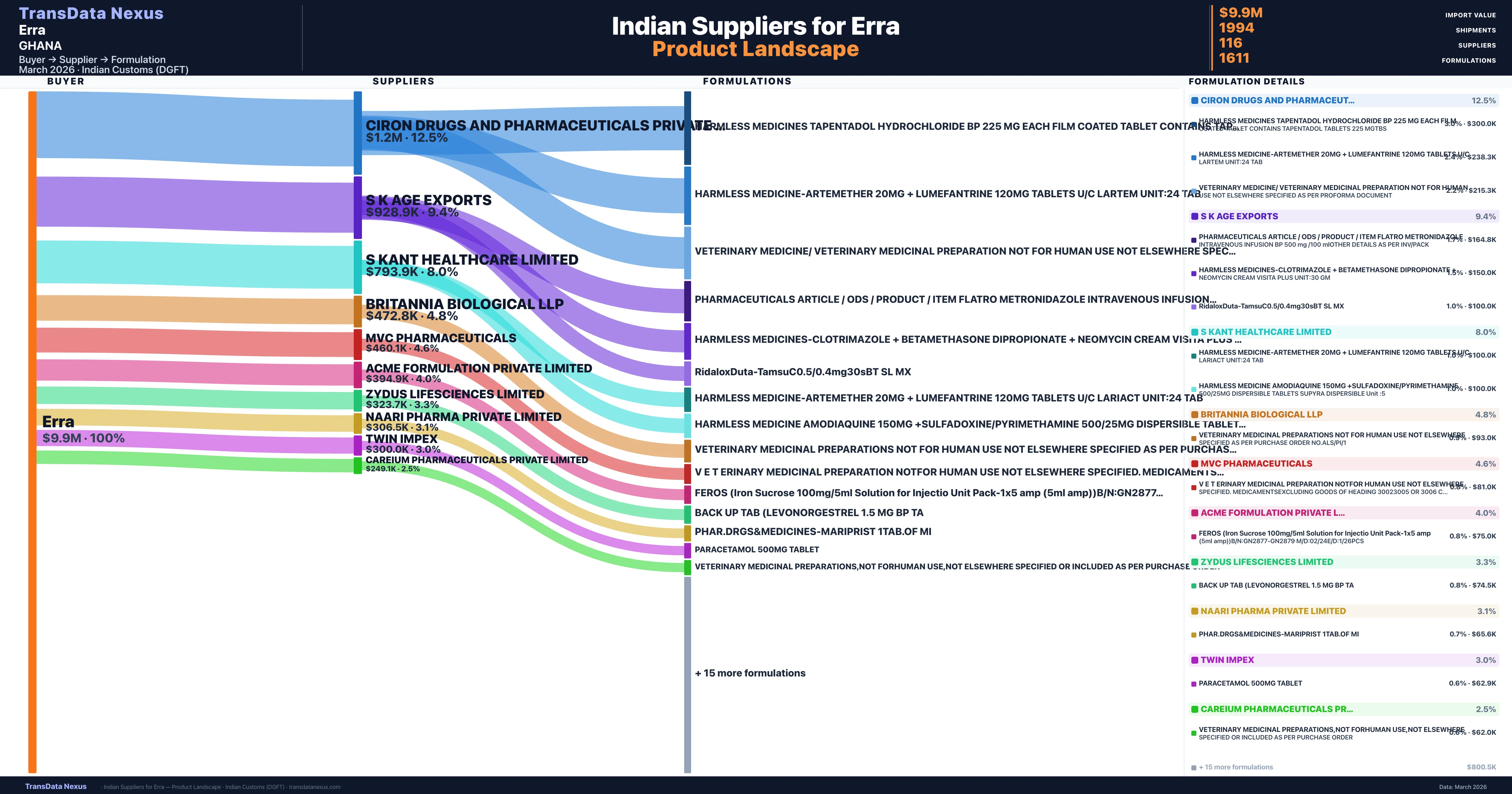
Who Are the Verified Indian Suppliers to Erra?
Customs-verified supplier relationships from Indian DGFT records
| Supplier | Value | Shipments | Share |
|---|---|---|---|
| Ciron Drugs And Pharmaceuticals Private Limited | $1.2M | 110 | 12.5% |
| S K Age Exports | $928.9K | 42 | 9.4% |
| S Kant Healthcare Limited | $793.9K | 38 | 8.0% |
| Britannia Biological Llp | $472.8K | 26 | 4.8% |
| Mvc Pharmaceuticals | $460.1K | 28 | 4.6% |
| Acme Formulation Private Limited | $394.9K | 13 | 4.0% |
| Zydus Lifesciences Limited | $323.7K | 9 | 3.3% |
| Naari Pharma Private Limited | $306.5K | 10 | 3.1% |
| Twin Impex | $300.0K | 6 | 3.0% |
| Careium Pharmaceuticals Private Limited | $249.1K | 15 | 2.5% |
| Xl Laboratories Private Limited | $235.4K | 14 | 2.4% |
| Noronic Pharmaceutical Private Limited | $222.7K | 39 | 2.2% |
| Nectar Life Sciences Limited | $219.3K | 12 | 2.2% |
| Nascent Global Impex Llp | $205.4K | 81 | 2.1% |
| Sun Pharmaceutical Industries Limited | $201.1K | 20 | 2.0% |
| Ashish Life Science Private Limited | $157.2K | 15 | 1.6% |
| J B Chemicals And Pharmaceuticals Limited | $154.3K | 49 | 1.6% |
| Jinny Marine Traders | $152.1K | 4 | 1.5% |
| Syncom Formulations India Limited | $142.2K | 57 | 1.4% |
| Otsuka Pharmaceutical India Private Limited | $127.6K | 10 | 1.3% |
| Merit Organics Limited | $126.4K | 16 | 1.3% |
| Cadila Healthcare Limited | $121.9K | 4 | 1.2% |
| Improvet Healthcare Company | $117.7K | 3 | 1.2% |
| Regoshin Healthcare Private Limited | $114.8K | 37 | 1.2% |
| Invex Health Private Limited | $113.3K | 16 | 1.1% |
| Maneesh Pharmaceuticals Limited | $102.5K | 5 | 1.0% |
| Ripharma Laboratories Limited | $100.0K | 22 | 1.0% |
| Axelia | $99.8K | 12 | 1.0% |
| Dips Bioscience Private Limited | $97.6K | 16 | 1.0% |
| Knvm Medicare Private Limited | $95.7K | 8 | 1.0% |
Erra sources from 116 verified Indian suppliers across 1,611 distinct formulations. The supply base is diversified across 116 suppliers, reducing single-source dependency risk.
What Formulations Does Erra Import?
| Formulation | Value | Ships |
|---|---|---|
| Harmless medicines tapentadol hydrochloride BP 225 MG Each film coated tablet contains tapentadol tablets 225 | $300.0K | 6 |
| Harmless medicine-artemether 20MG + lumefantrine 120MG tablets u/c lartem unit:24 TAB | $238.3K | 5 |
| Veterinary medicine/ veterinary medicinal preparation not for human use not elsewhere specified as per proforma | $215.3K | 19 |
| Pharmaceuticals article / ods / product / item flatro metronidazole intravenous infusion BP 500 MG /100 mlother details as per | $164.8K | 4 |
| Harmless medicines-clotrimazole + betamethasone dipropionate + neomycin cream visita plus unit:30 GM | $150.0K | 3 |
| Ridaloxduta-tamsuc0.5/0.4mg30sbt sl | $100.0K | 2 |
| Harmless medicine-artemether 20MG + lumefantrine 120MG tablets u/c lariact unit:24 TAB | $100.0K | 2 |
| Harmless medicine amodiaquine 150MG +sulfadoxine/pyrimethamine 500/25MG dispersible tablets supyra dispersible unit | $100.0K | 2 |
| Veterinary medicinal preparations not for human use not elsewhere specified as per purchase order | $93.0K | 8 |
| V e t erinary medicinal preparation notfor human use not elsewhere specified. medicamentsexcluding goods of heading 30023005 or 3006 consisting of mixed or unmixed products for therapeutic or prophylactic uses put up in measured dosesincluding those in | $81.0K | 4 |
| Feros (iron sucrose 100MG/5ML solution for injectio unit Pack-1x5 amp (5ML amp))b/n:gn2877-gn2879 | $75.0K | 3 |
| Back up TAB (levonorgestrel 1.5 MG BP | $74.5K | 2 |
| Phar.drgs&medicines-mariprist 1tab.of | $65.6K | 2 |
| Paracetamol 500MG | $62.9K | 2 |
| Veterinary medicinal preparations,not forhuman use,not elsewhere specified or included as per purchase | $62.0K | 3 |
Erra imports 1,611 distinct pharmaceutical formulations. Showing top 15 by value. For full formulation-level data, contact TransData Nexus.
What Products Does Erra Import?
Top Products by Import Value
Erra Therapeutic Categories — 1 Specializations
Erra imports across 1 therapeutic categories, with Antimalarial & Antiparasitic (100.0%), representing the largest segments. The portfolio is concentrated — top 5 products = 100% of total imports.
Antimalarial & Antiparasitic
2 products · 100.0% · $500.0K
Import Portfolio — Top 2 by Import Value
| # | Product | Category | Value | Ships | Share | Rk |
|---|---|---|---|---|---|---|
| 1 | Pyrimethamine | Antimalarial & Antiparasitic | $250.0K | 5 | 0.5% | 1 |
| 2 | Sulfadoxine | Antimalarial & Antiparasitic | $250.0K | 5 | 0.5% | 1 |
Erra imports 2 pharmaceutical products across 1 categories into Ghana totaling $500.0K. The company is the #1 buyer for 2 products: Pyrimethamine, Sulfadoxine.
Key Metrics
Top Categories
Indian Suppliers
Related Trade Data
Erra — Corporate Profile & Information
Company type, headquarters, distribution network, and industry role
1Company Overview
Erra is a pharmaceutical importer and buyer based in Ghana, specializing in the procurement of finished pharmaceutical formulations. The company has established itself as a significant player in the Ghanaian pharmaceutical market, focusing primarily on antimalarial and antiparasitic medications. With a total import value of $500,000 USD from India over the period from 2022 to 2026, Erra has demonstrated a consistent demand for these therapeutic categories. The company's portfolio is notably concentrated, with its top two products—Pyrimethamine and Sulfadoxine—each accounting for $250,000 USD, representing a 50% share of the total imports. This concentration indicates a strategic focus on these essential antimalarial agents, underscoring their critical role in Erra's operations.
2Distribution Network
While specific details about Erra's warehouse locations and logistics capabilities are not publicly available, the company's substantial import activities suggest a well-established distribution network within Ghana. The consistent importation of antimalarial and antiparasitic medications indicates a robust supply chain capable of meeting the country's healthcare demands. Given the critical nature of these products, it is likely that Erra collaborates with local healthcare providers, pharmacies, and hospitals to ensure timely and efficient distribution across the nation.
3Industry Role
Erra operates as a primary wholesaler in Ghana's pharmaceutical supply chain, focusing on the importation and distribution of finished pharmaceutical formulations. By sourcing antimalarial and antiparasitic medications from Indian manufacturers, Erra plays a pivotal role in supplying essential drugs to the Ghanaian market. The company's strategic emphasis on these therapeutic areas aligns with the nation's public health priorities, particularly in combating malaria and other parasitic infections prevalent in the region.
Supplier Relationship Intelligence — Erra
Sourcing concentration, supply chain resilience, and strategic implications
1Sourcing Concentration Analysis
Erra's sourcing strategy exhibits a high degree of concentration, with its top two products—Pyrimethamine and Sulfadoxine—each accounting for 50% of the total import value. This dual-source dependency suggests a strategic choice to focus on these critical antimalarial agents, potentially leveraging favorable pricing, quality, and supply chain reliability from Indian manufacturers. The shipment data reveals a stable relationship with Indian suppliers, as evidenced by the consistent importation of these products over the specified period. However, this concentration also presents a risk; any disruptions in the supply chain, such as regulatory changes, manufacturing issues, or geopolitical events affecting India, could impact Erra's ability to meet domestic demand.
2Supply Chain Resilience
Erra's supply chain resilience is closely tied to its sourcing strategy from Indian manufacturers. The company's focus on antimalarial and antiparasitic medications indicates a reliance on suppliers capable of meeting stringent quality standards and regulatory requirements. While the shipment data reflects a diverse range of Indian suppliers, the concentration on two primary products suggests limited diversification in the product portfolio. This lack of diversification could pose challenges if there are disruptions in the Indian pharmaceutical sector or changes in regulatory policies affecting the importation of these specific formulations. To enhance resilience, Erra may consider diversifying its supplier base and product offerings, thereby mitigating potential risks associated with over-reliance on a narrow product range.
3Strategic Implications
Erra's concentrated sourcing pattern positions the company as a key distributor of essential antimalarial and antiparasitic medications in Ghana. This strategic focus allows Erra to establish strong relationships with Indian exporters, potentially securing favorable terms and ensuring a reliable supply of critical drugs. For Indian exporters, Erra represents a significant market opportunity, particularly in the antimalarial segment. However, the concentration of Erra's imports on two products also indicates a potential vulnerability to market fluctuations or regulatory changes affecting these specific drugs. Indian exporters seeking to become alternative suppliers to Erra should consider offering a broader range of formulations to align with Erra's strategic focus and to mitigate risks associated with product concentration.
Importing Pharmaceuticals into Ghana — Regulatory Framework
Regulatory authority, GMP requirements, import licensing for Ghana
1Regulatory Authority & Framework
In Ghana, the Food and Drugs Authority (FDA) serves as the primary regulatory body overseeing the importation, registration, and distribution of pharmaceutical products. The FDA operates under the Public Health Act, 2012 (Act 851), which mandates that all drugs, including antimalarial and antiparasitic medications, must be registered with the authority before they can be imported or distributed within the country. This registration process ensures that imported drugs meet the necessary quality, safety, and efficacy standards required for public health protection. Additionally, the FDA enforces guidelines that govern the importation of pharmaceutical products, including requirements for import permits, labeling, and documentation to facilitate compliance and ensure the safety of imported drugs.
2Import Licensing & GMP
To import pharmaceutical products into Ghana, companies must obtain an import license from the FDA. This process involves submitting an application that includes detailed information about the products, their manufacturers, and compliance with Good Manufacturing Practice (GMP) standards. The FDA recognizes GMP certifications from reputable international bodies, such as the World Health Organization (WHO) and the Pharmaceutical Inspection Co-operation Scheme (PIC/S), provided these certifications are current and applicable to the specific products being imported. Importers must ensure that their products are accompanied by the necessary GMP certificates and that they adhere to all FDA guidelines to facilitate the importation process.
3Quality & Labeling
Imported pharmaceutical products must comply with Ghana's quality and labeling requirements as stipulated by the FDA. Each product must be accompanied by a Certificate of Analysis (CoA) or Certificate of Conformance (CoC) from a competent laboratory, preferably in the exporting country, to verify that the product meets the applicable standards. Labeling must include essential information such as the product name, list of active ingredients and their concentrations, date of manufacture and expiry, storage conditions, instructions for use, net content, name and address of the manufacturer, country of origin, batch or lot number, and any other relevant characteristics. Additionally, all imported products must have at least 60% of their shelf-life remaining upon arrival at the port of entry. For products with a shelf-life of 24 months or less, at least 80% of the shelf-life must remain upon arrival.
4Recent Regulatory Changes
Between 2024 and 2026, Ghana's FDA has implemented several regulatory changes affecting the importation of pharmaceutical products. Notably, in February 2024, the FDA issued a directive requiring all batches of imported glycerin and propylene glycol raw materials to be accompanied by a certificate of analysis testing for Diethylene Glycol (DEG) and Ethylene Glycol (EG) impurities. This measure was introduced following reports of acute kidney injuries in other countries due to these impurities in pharmaceutical syrups. Additionally, the FDA has been actively involved in discussions regarding the restriction of certain medicines to promote local manufacturing, with ongoing debates about the impact of such restrictions on the pharmaceutical import sector.
Erra — Procurement Pattern Analysis
Product strategy, sourcing profile, and market positioning
1Product Strategy
Erra's strategic focus on antimalarial and antiparasitic medications aligns with Ghana's public health priorities, particularly in combating malaria and other parasitic infections prevalent in the region. The consistent importation of Pyrimethamine and Sulfadoxine indicates a sustained market demand for these treatments. This focus allows Erra to establish strong relationships with Indian manufacturers specializing in these formulations, potentially securing favorable terms and ensuring a reliable supply of critical drugs. The choice to concentrate on these therapeutic areas may also be driven by the high burden of malaria in Ghana, necessitating a steady and dependable supply of effective treatments.
2Sourcing Profile
Erra's sourcing strategy is centered on importing finished pharmaceutical formulations from Indian manufacturers, with a particular emphasis on antimalarial and antiparasitic medications. This approach allows Erra to leverage India's established pharmaceutical manufacturing capabilities and cost advantages. The company's focus on finished products suggests a preference for ready-to-market formulations, potentially reducing the complexities associated with sourcing raw materials or active pharmaceutical ingredients (APIs). By concentrating on these specific therapeutic areas, Erra aims to meet the critical healthcare needs in Ghana while maintaining a streamlined and efficient procurement process.
3Market Positioning
Erra serves a critical segment of the Ghanaian pharmaceutical market by focusing on the importation and distribution of essential antimalarial and antiparasitic medications. The company's strategic emphasis on these therapeutic areas positions it as a key supplier to hospitals, clinics, and pharmacies that require a consistent and reliable source of these treatments. By concentrating on these specific products, Erra plays a pivotal role in supporting the healthcare infrastructure's ability to address prevalent infectious diseases in Ghana.
Seller's Guide — How to Become a Supplier to Erra
Opportunity assessment, qualifications, and practical approach strategy
1Opportunity Assessment
There is a realistic opportunity for new Indian suppliers to enter the Ghanaian market by offering antimalarial and antiparasitic formulations that meet the FDA's regulatory standards. Erra's existing focus on these therapeutic areas indicates a sustained demand for such products. However, potential suppliers must navigate Ghana's regulatory landscape, including obtaining the necessary import licenses and ensuring compliance with quality and labeling requirements. Additionally, establishing relationships with local distributors or directly with Erra could facilitate market entry. Understanding the competitive dynamics and aligning with Erra's sourcing preferences will be crucial for success.
2Requirements & Qualifications
Indian exporters seeking to supply Erra and the Ghanaian market must ensure that their products are registered with the FDA and comply with all applicable quality standards. This includes obtaining GMP certifications from recognized international bodies such as WHO or PIC
Frequently Asked Questions — Erra
What products does Erra import from India?
Erra imports 2 pharmaceutical products across 1 categories. Top imports: Pyrimethamine ($250.0K), Sulfadoxine ($250.0K).
Who supplies pharmaceuticals to Erra from India?
Erra sources from 116 verified Indian suppliers. The primary supplier is Ciron Drugs And Pharmaceuticals Private Limited (12.5% of imports, $1.2M).
What is Erra's total pharmaceutical import value?
Erra's total pharmaceutical import value from India is $500.0K, based on 10 verified shipments in Indian Customs (DGFT) data.
What therapeutic categories does Erra focus on?
Erra imports across 1 categories. The largest: Antimalarial & Antiparasitic (100.0%).
Get Full Erra Import Intelligence
Access shipment-level details, supplier connections, pricing data, and competitive analysis. TransData Nexus provides verified Indian Customs (DGFT) data trusted by pharmaceutical trade professionals worldwide.
Official References & Regulatory Resources
Verify import regulations and drug registration requirements with the agencies above.
Research Methodology & Data Transparency
Suresh Sormare
Verified AuthorPharmaceutical Export-Import Analyst & Trade Intelligence Expert
Suresh Sormare is a pharmaceutical export-import analyst with deep expertise in Indian Customs (DGFT) data, HS code classification, and global pharmaceutical supply chains. His analysis covers 10M+ shipment records across 150+ countries and is used by manufacturers, procurement agencies, and trade consultants worldwide. Suresh specializes in identifying verified suppliers and buyers from customs records, mapping bilateral pharmaceutical trade corridors, analyzing tariff structures and regulatory frameworks across 170+ destination markets, and benchmarking competitive positioning for finished pharmaceutical formulations. His methodology combines granular customs transaction data with regulatory intelligence from FDA, EMA, WHO, CDSCO, and 40+ national drug authorities to deliver actionable trade insights for the pharmaceutical formulations sector.
linkedin.com/in/sureshsormarePrimary Data Source
All trade data is sourced from Indian Customs (DGFT) official shipping bill records — the authoritative government database for India's pharmaceutical trade. Each verified record contains exporter name, consignee (buyer) name, detailed product description, quantity, declared FOB value (USD), port of loading, destination country, and shipment date.
Analysis Methodology
- 1.Buyer Matching: Erra identified across shipments using consignee name normalization.
- 2.Statistical Normalization: Shipment values are statistically normalized to ensure accurate market share representation.
- 3.Market Share: Calculated per product as Erra's capped value divided by total Indian exports for that product.
- 4.Shipment Count: Based on 10 individual customs records matching Erra.
- 5.Supplier Verification: Erra sources from 116 verified Indian suppliers across 1,611 formulations, confirmed from customs records.
Government-Sourced Data
Official DGFT customs records
Transparent Methodology
Calculations fully disclosed above
2 Products Tracked
1 therapeutic categories
Expert-Reviewed
By pharmaceutical trade specialists
Data Source & Methodology
Trade data sourced from Indian Customs (DGFT) export shipment records. Values represent FOB export value in USD. For current shipment-level data, contact TransData Nexus.