Cipla Malaysia SDN BHD
Pharmaceutical Importer · Malaysia · Respiratory Focus · $4.1M Total Trade · DGFT Verified
Cipla Malaysia SDN BHD is a pharmaceutical importer based in Malaysia with a total trade value of $4.1M across 2 products in 1 therapeutic categories. Based on 154 verified import shipments from Indian Customs (DGFT) records, the company actively imports across multiple product segments. Cipla Malaysia SDN BHD sources from 2 verified Indian suppliers, with Cipla Limited accounting for 59.4% of imports.
Cipla Malaysia SDN BHD — Import Portfolio & Supplier Network
Who Are the Verified Indian Suppliers to Cipla Malaysia SDN BHD?
Customs-verified supplier relationships from Indian DGFT records
| Supplier | Value | Shipments | Share |
|---|---|---|---|
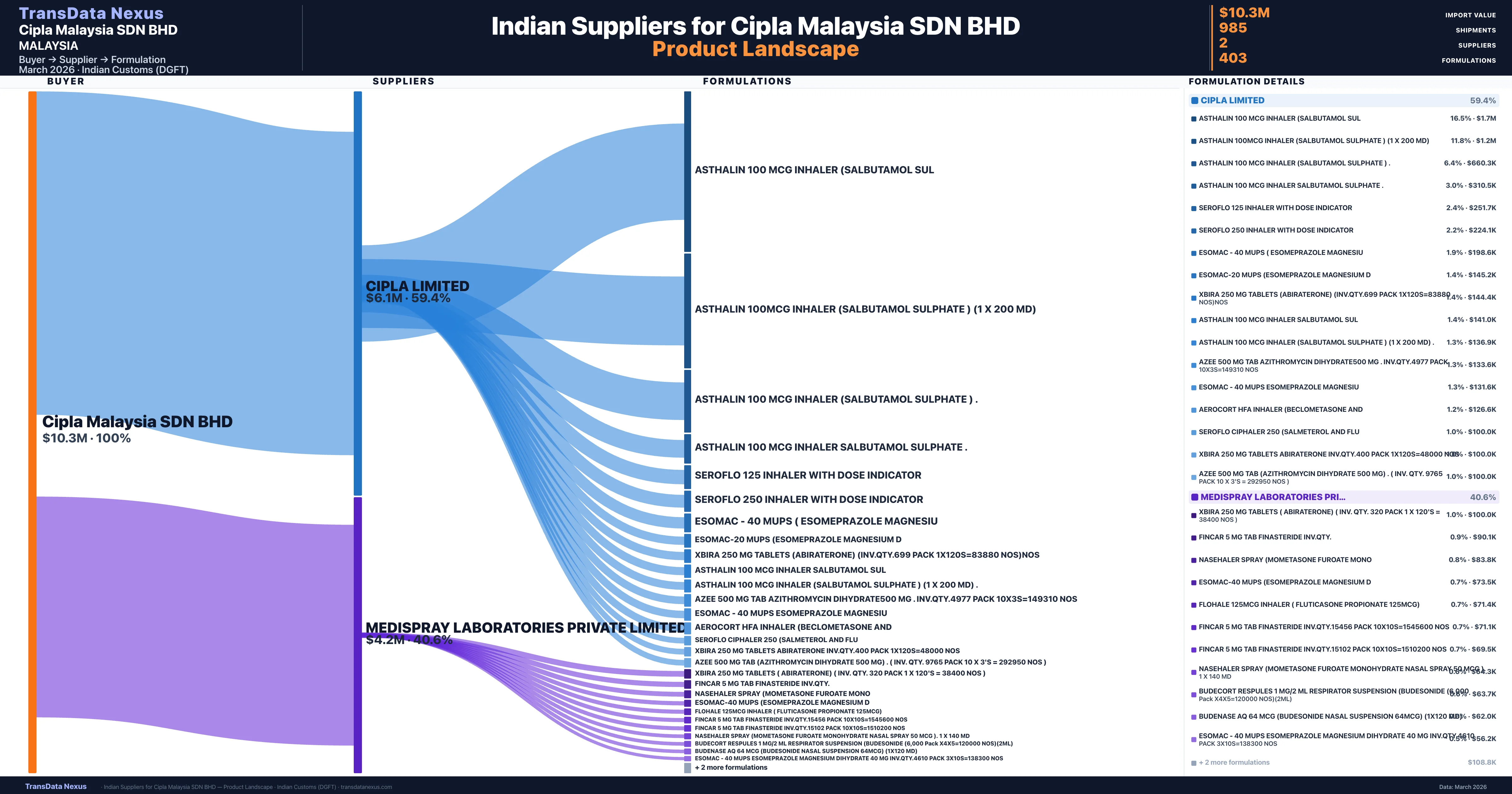
| Cipla Limited | $6.1M | 708 | 59.4% |
| Medispray Laboratories Private Limited | $4.2M | 277 | 40.6% |
Cipla Malaysia SDN BHD sources from 2 verified Indian suppliers across 403 distinct formulations. Total import value: $10.3M across 985 shipments.
What Formulations Does Cipla Malaysia SDN BHD Import?
| Formulation | Value | Ships |
|---|---|---|
| Asthalin 100 MCG inhaler (salbutamol | $1.7M | 50 |
| Asthalin 100mcg inhaler (salbutamol sulphate ) (1 x 200 md) | $1.2M | 35 |
| Asthalin 100 MCG inhaler (salbutamol sulphate ) . | $660.3K | 47 |
| Asthalin 100 MCG inhaler salbutamol sulphate . | $310.5K | 10 |
| Seroflo 125 inhaler with dose | $251.7K | 11 |
| Seroflo 250 inhaler with dose | $224.1K | 7 |
| Esomac - 40 mups ( esomeprazole magnesiu | $198.6K | 15 |
| Esomac-20 mups (esomeprazole magnesium | $145.2K | 10 |
| Xbira 250 MG tablets (abiraterone) (inv.qty.699 Pack 1x120s=83880 nos | $144.4K | 3 |
| Asthalin 100 MCG inhaler salbutamol | $141.0K | 8 |
| Asthalin 100 MCG inhaler (salbutamol sulphate ) (1 x 200 md) . | $136.9K | 8 |
| Azee 500 MG TAB azithromycin dihydrate500 MG . inv.qty.4977 Pack 10x3s=149310 | $133.6K | 3 |
| Esomac - 40 mups esomeprazole magnesiu | $131.6K | 5 |
| Aerocort hfa inhaler (beclometasone | $126.6K | 8 |
| Seroflo ciphaler 250 (salmeterol and | $100.0K | 2 |
Cipla Malaysia SDN BHD imports 403 distinct pharmaceutical formulations. Showing top 15 by value. For full formulation-level data, contact TransData Nexus.
What Products Does Cipla Malaysia SDN BHD Import?
Top Products by Import Value
Cipla Malaysia SDN BHD Therapeutic Categories — 1 Specializations
Cipla Malaysia SDN BHD imports across 1 therapeutic categories, with Respiratory (100.0%), representing the largest segments. The portfolio is concentrated — top 5 products = 100% of total imports.
Respiratory
2 products · 100.0% · $4.1M
Import Portfolio — Top 2 by Import Value
| # | Product | Category | Value | Ships | Share | Rk |
|---|---|---|---|---|---|---|
| 1 | Salbutamol | Respiratory | $3.9M | 149 | 2.6% | 5 |
| 2 | Ipratropium | Respiratory | $250.0K | 5 | 0.4% | 9 |
Cipla Malaysia SDN BHD imports 2 pharmaceutical products across 1 categories into Malaysia totaling $4.1M.
Key Metrics
Top Categories
Indian Suppliers
Related Trade Data
Need Detailed Data?
Shipment-level records, supplier connections & pricing for Cipla Malaysia SDN BHD.
Request DemoCipla Malaysia SDN BHD — Corporate Profile & Information
Company type, headquarters, distribution network, and industry role
1Company Overview
Cipla Malaysia SDN BHD, established on March 20, 2013, is a subsidiary of Cipla Limited, an Indian multinational pharmaceutical company headquartered in Mumbai. The Malaysian entity operates from Unit No. 1101, Amcorp Tower, Amcorp Trade Centre, No. 18 Persiaran Barat, Petaling Jaya, Selangor, Malaysia. Cipla Limited, founded in 1935, is renowned for its extensive portfolio in respiratory, cardiovascular, and anti-infective medications, among others.
In Malaysia, Cipla Malaysia SDN BHD functions primarily as a pharmaceutical importer and distributor, focusing on the importation and distribution of finished pharmaceutical formulations. This role is pivotal in ensuring the availability of Cipla's products within the Malaysian market, thereby contributing to the country's healthcare sector by providing a range of essential medications.
2Distribution Network
Cipla Malaysia SDN BHD's distribution network is centralized at its headquarters in Petaling Jaya, Selangor. While specific details regarding warehouse locations and logistics capabilities are not publicly disclosed, the company's strategic position in Selangor suggests efficient access to major transportation hubs, facilitating nationwide distribution. The proximity to Port Klang, Malaysia's principal port, likely enhances the company's ability to import and distribute pharmaceutical products effectively across the country.
3Industry Role
Within Malaysia's pharmaceutical supply chain, Cipla Malaysia SDN BHD serves as a key importer and distributor of finished pharmaceutical formulations. By sourcing a diverse range of products from its parent company, Cipla Limited, and other suppliers, the company ensures a steady supply of essential medications to the Malaysian market. This role is crucial in meeting the healthcare needs of the population and maintaining the availability of quality pharmaceutical products.
Supplier Relationship Intelligence — Cipla Malaysia SDN BHD
Sourcing concentration, supply chain resilience, and strategic implications
1Sourcing Concentration Analysis
Cipla Malaysia SDN BHD's sourcing strategy exhibits a high degree of concentration, with 59.4% of its imports valued at $6.1 million from Cipla Limited and 40.6% from Medispray Laboratories Private Limited, totaling $4.2 million. This dual-supplier model indicates a strategic choice to maintain strong relationships with key suppliers, ensuring a consistent and reliable supply of pharmaceutical products. The substantial volume of shipments—708 from Cipla Limited and 277 from Medispray Laboratories—reflects a stable and ongoing partnership, reducing the risk of supply chain disruptions.
2Supply Chain Resilience
Cipla Malaysia SDN BHD's supply chain demonstrates resilience through its diversified sourcing from two primary suppliers: Cipla Limited and Medispray Laboratories Private Limited. This approach mitigates the risks associated with single-source dependency. The importation of 403 unique formulations indicates a broad product portfolio, enhancing the company's ability to meet diverse market demands. While specific details about backup suppliers and shipping routes are not publicly available, the established relationships with these suppliers suggest a robust and adaptable supply chain capable of navigating potential disruptions.
3Strategic Implications
The concentrated sourcing pattern of Cipla Malaysia SDN BHD positions the company to leverage strong partnerships with its suppliers, ensuring a steady supply of quality pharmaceutical products. For Indian exporters, this presents an opportunity to establish or strengthen relationships with Cipla Malaysia SDN BHD, particularly if they can offer complementary products or competitive advantages. Understanding the company's sourcing dynamics is essential for potential suppliers aiming to enter the Malaysian market through this channel.
Importing Pharmaceuticals into Malaysia — Regulatory Framework
Regulatory authority, GMP requirements, import licensing for Malaysia
1Regulatory Authority & Framework
In Malaysia, the National Pharmaceutical Regulatory Agency (NPRA) under the Ministry of Health (MOH) is responsible for regulating pharmaceutical products. The key legislation governing pharmaceutical imports includes the Sale of Drugs Act 1952 and the Control of Drugs and Cosmetics Regulations 1984. These regulations ensure that imported pharmaceutical products meet the required safety, efficacy, and quality standards before they are marketed in Malaysia.
2Import Licensing & GMP
Importers like Cipla Malaysia SDN BHD must obtain an import license from the NPRA to legally import pharmaceutical products into Malaysia. Additionally, imported products must be accompanied by a Good Manufacturing Practice (GMP) certificate from the country of origin, recognized by the NPRA. Certificates from reputable authorities such as the European Union (EU) GMP, World Health Organization (WHO) GMP, or Pharmaceutical Inspection Co-operation Scheme (PIC/S) are typically accepted. Furthermore, importers must hold a valid wholesale distribution authorization issued by the NPRA to distribute pharmaceutical products within Malaysia.
3Quality & Labeling
Imported pharmaceutical products are subject to batch testing by the NPRA to ensure compliance with Malaysian standards. Stability studies are required to confirm that products maintain their quality throughout their shelf life. Labeling must be in the Malay language, with mandatory information including product name, active ingredients, dosage form, batch number, manufacturing date, and expiry date. Serialization may be mandated for certain products to enhance traceability and prevent counterfeit drugs.
4Recent Regulatory Changes
Between 2024 and 2026, Malaysia has implemented several regulatory changes affecting pharmaceutical imports. These include stricter GMP certification requirements, enhanced labeling standards, and the introduction of serialization mandates for specific product categories. These changes aim to improve the safety and quality of pharmaceutical products in the Malaysian market.
Cipla Malaysia SDN BHD — Procurement Pattern Analysis
Product strategy, sourcing profile, and market positioning
1Product Strategy
Cipla Malaysia SDN BHD's focus on respiratory products, particularly salbutamol and ipratropium, aligns with the high prevalence of respiratory conditions in Malaysia. The substantial import value of salbutamol ($3.9 million) and ipratropium ($250,000) indicates strong market demand and the company's strategic emphasis on meeting this need. By prioritizing these therapeutic areas, Cipla Malaysia SDN BHD positions itself as a key supplier of essential respiratory medications in the Malaysian market.
2Sourcing Profile
Cipla Malaysia SDN BHD's sourcing strategy is centered on importing generic drug formulations, primarily from its parent company, Cipla Limited, and Medispray Laboratories Private Limited. This approach ensures access to a wide range of pharmaceutical products, leveraging India's robust pharmaceutical manufacturing capabilities. The company's focus on finished formulations allows it to meet the diverse needs of the Malaysian market effectively.
3Market Positioning
By importing a diverse range of pharmaceutical products, Cipla Malaysia SDN BHD serves multiple segments of the Malaysian market, including retail pharmacies, hospitals, and government tenders. The company's emphasis on respiratory products positions it as a key supplier in the hospital and retail pharmacy sectors, addressing the significant demand for respiratory medications.
Seller's Guide — How to Become a Supplier to Cipla Malaysia SDN BHD
Opportunity assessment, qualifications, and practical approach strategy
1Opportunity Assessment
There is a realistic opportunity for new Indian suppliers to collaborate with Cipla Malaysia SDN BHD, especially if they can offer complementary products or competitive advantages in the respiratory therapeutic area. Identifying gaps in the current sourcing strategy, such as unmet market needs or emerging therapeutic areas, can provide avenues for new suppliers to enter the Malaysian market through this channel.
2Requirements & Qualifications
Indian exporters seeking to supply Cipla Malaysia SDN BHD must ensure that their products comply with Malaysian regulatory standards, including obtaining GMP certifications recognized by the NPRA. Products must meet the quality, safety, and efficacy requirements set by the NPRA, and labeling must adhere to Malaysian regulations. Establishing a relationship with Cipla Malaysia SDN BHD may also require demonstrating the ability to meet supply demands and regulatory compliance.
3How to Approach
Indian exporters should initiate contact with Cipla Malaysia SDN BHD by presenting their product portfolios, emphasizing compliance with Malaysian regulatory standards, and highlighting any unique selling propositions. Participating in relevant industry events and forums can facilitate networking opportunities. Understanding the regulatory filing process and ensuring timely submission of necessary documentation will be crucial. Setting realistic timelines for product registration and market entry, in alignment with Cipla Malaysia SDN BHD's procurement cycles, will enhance the likelihood of successful collaboration.
Frequently Asked Questions — Cipla Malaysia SDN BHD
What products does Cipla Malaysia SDN BHD import from India?
Cipla Malaysia SDN BHD imports 2 pharmaceutical products across 1 categories. Top imports: Salbutamol ($3.9M), Ipratropium ($250.0K).
Who supplies pharmaceuticals to Cipla Malaysia SDN BHD from India?
Cipla Malaysia SDN BHD sources from 2 verified Indian suppliers. The primary supplier is Cipla Limited (59.4% of imports, $6.1M).
What is Cipla Malaysia SDN BHD's total pharmaceutical import value?
Cipla Malaysia SDN BHD's total pharmaceutical import value from India is $4.1M, based on 154 verified shipments in Indian Customs (DGFT) data.
What therapeutic categories does Cipla Malaysia SDN BHD focus on?
Cipla Malaysia SDN BHD imports across 1 categories. The largest: Respiratory (100.0%).
Get Full Cipla Malaysia SDN BHD Import Intelligence
Access shipment-level details, supplier connections, pricing data, and competitive analysis. TransData Nexus provides verified Indian Customs (DGFT) data trusted by pharmaceutical trade professionals worldwide.
Official References & Regulatory Resources
Verify import regulations and drug registration requirements with the agencies above.
Research Methodology & Data Transparency
Suresh Sormare
Verified AuthorPharmaceutical Export-Import Analyst & Trade Intelligence Expert
Suresh Sormare is a pharmaceutical export-import analyst with deep expertise in Indian Customs (DGFT) data, HS code classification, and global pharmaceutical supply chains. His analysis covers 10M+ shipment records across 150+ countries and is used by manufacturers, procurement agencies, and trade consultants worldwide. Suresh specializes in identifying verified suppliers and buyers from customs records, mapping bilateral pharmaceutical trade corridors, analyzing tariff structures and regulatory frameworks across 170+ destination markets, and benchmarking competitive positioning for finished pharmaceutical formulations. His methodology combines granular customs transaction data with regulatory intelligence from FDA, EMA, WHO, CDSCO, and 40+ national drug authorities to deliver actionable trade insights for the pharmaceutical formulations sector.
linkedin.com/in/sureshsormarePrimary Data Source
All trade data is sourced from Indian Customs (DGFT) official shipping bill records — the authoritative government database for India's pharmaceutical trade. Each verified record contains exporter name, consignee (buyer) name, detailed product description, quantity, declared FOB value (USD), port of loading, destination country, and shipment date.
Analysis Methodology
- 1.Buyer Matching: Cipla Malaysia SDN BHD identified across shipments using consignee name normalization.
- 2.Statistical Normalization: Shipment values are statistically normalized to ensure accurate market share representation.
- 3.Market Share: Calculated per product as Cipla Malaysia SDN BHD's capped value divided by total Indian exports for that product.
- 4.Shipment Count: Based on 154 individual customs records matching Cipla Malaysia SDN BHD.
- 5.Supplier Verification: Cipla Malaysia SDN BHD sources from 2 verified Indian suppliers across 403 formulations, confirmed from customs records.
Government-Sourced Data
Official DGFT customs records
Transparent Methodology
Calculations fully disclosed above
2 Products Tracked
1 therapeutic categories
Expert-Reviewed
By pharmaceutical trade specialists
Data Source & Methodology
Trade data sourced from Indian Customs (DGFT) export shipment records. Values represent FOB export value in USD. For current shipment-level data, contact TransData Nexus.