Centre Specialites Pharmaceutiques
Pharmaceutical Importer · France · Diabetes & Endocrine Focus · $7.3M Total Trade · DGFT Verified
Centre Specialites Pharmaceutiques is a pharmaceutical importer based in France with a total trade value of $7.3M across 3 products in 3 therapeutic categories. Based on 158 verified import shipments from Indian Customs (DGFT) records, the company actively imports across multiple product segments. Centre Specialites Pharmaceutiques sources from 8 verified Indian suppliers, with Micro Labs Limited accounting for 74.6% of imports.
Centre Specialites Pharmaceutiques — Import Portfolio & Supplier Network
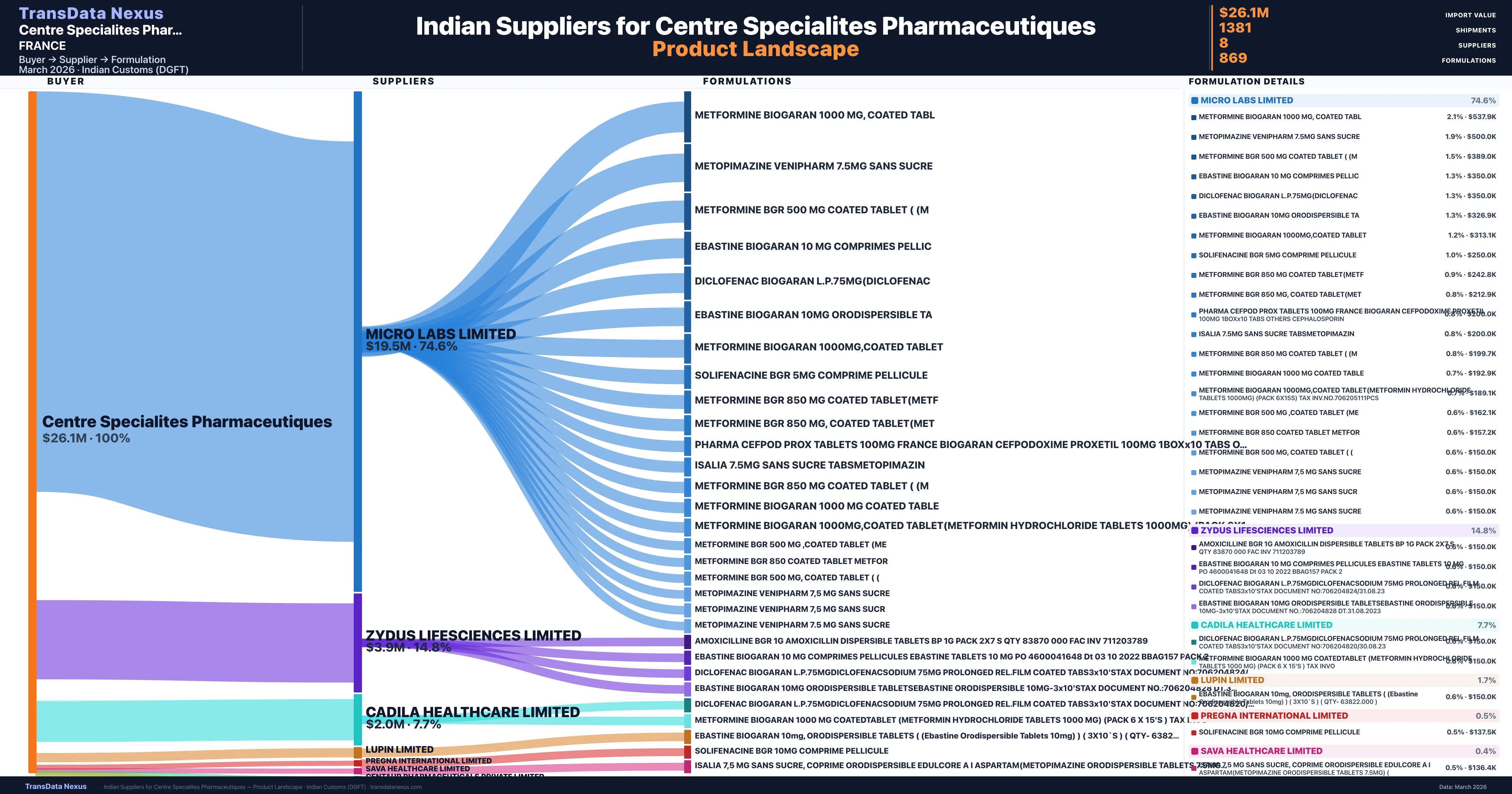
Who Are the Verified Indian Suppliers to Centre Specialites Pharmaceutiques?
Customs-verified supplier relationships from Indian DGFT records
| Supplier | Value | Shipments | Share |
|---|---|---|---|
| Micro Labs Limited | $19.5M | 868 | 74.6% |
| Zydus Lifesciences Limited | $3.9M | 323 | 14.8% |
| Cadila Healthcare Limited | $2.0M | 160 | 7.7% |
| Lupin Limited | $448.4K | 11 | 1.7% |
| Pregna International Limited | $126.7K | 6 | 0.5% |
| Sava Healthcare Limited | $98.4K | 7 | 0.4% |
| Centaur Pharmaceuticals Private Limited | $50.0K | 1 | 0.2% |
| Ind Swift Limited | $49.0K | 5 | 0.2% |
Centre Specialites Pharmaceutiques sources from 8 verified Indian suppliers across 869 distinct formulations. The supply base is diversified across 8 suppliers, reducing single-source dependency risk.
What Formulations Does Centre Specialites Pharmaceutiques Import?
| Formulation | Value | Ships |
|---|---|---|
| Metformine biogaran 1000 MG, coated | $537.9K | 15 |
| Metopimazine venipharm 7.5MG sans | $500.0K | 10 |
| Metformine bgr 500 MG coated tablet | $389.0K | 8 |
| Ebastine biogaran 10 MG comprimes | $350.0K | 7 |
| Diclofenac biogaran l.p.75MG(diclofenac | $350.0K | 7 |
| Ebastine biogaran 10MG orodispersible | $326.9K | 7 |
| Metformine biogaran 1000MG,coated | $313.1K | 8 |
| Solifenacine bgr 5MG comprime | $250.0K | 5 |
| Metformine bgr 850 MG coated | $242.8K | 7 |
| Metformine bgr 850 MG, coated | $212.9K | 5 |
| Pharma cefpod prox tablets 100MG france biogaran cefpodoxime proxetil 100MG 1boxx10 tabs others | $200.0K | 4 |
| Isalia 7.5MG sans sucre | $200.0K | 4 |
| Metformine bgr 850 MG coated tablet | $199.7K | 5 |
| Metformine biogaran 1000 MG coated | $192.9K | 6 |
| Metformine biogaran 1000MG,coated tablet(metformin hydrochloride tablets 1000MG) (Pack 6x15s) tax | $189.1K | 6 |
Centre Specialites Pharmaceutiques imports 869 distinct pharmaceutical formulations. Showing top 15 by value. For full formulation-level data, contact TransData Nexus.
What Products Does Centre Specialites Pharmaceutiques Import?
Top Products by Import Value
Centre Specialites Pharmaceutiques Therapeutic Categories — 3 Specializations
Centre Specialites Pharmaceutiques imports across 3 therapeutic categories, with Diabetes & Endocrine (80.8%), Analgesics & Antipyretics (17.8%), Cardiovascular (1.4%) representing the largest segments. The portfolio is concentrated — top 5 products = 100% of total imports.
Diabetes & Endocrine
1 products · 80.8% · $5.9M
Analgesics & Antipyretics
1 products · 17.8% · $1.3M
Cardiovascular
1 products · 1.4% · $100.0K
Import Portfolio — Top 3 by Import Value
| # | Product | Category | Value | Ships | Share | Rk |
|---|---|---|---|---|---|---|
| 1 | Metformin | Diabetes & Endocrine | $5.9M | 130 | 1.3% | 12 |
| 2 | Diclofenac | Analgesics & Antipyretics | $1.3M | 26 | 0.4% | 12 |
| 3 | Atenolol | Cardiovascular | $100.0K | 2 | 0.2% | 13 |
Centre Specialites Pharmaceutiques imports 3 pharmaceutical products across 3 categories into France totaling $7.3M.
Key Metrics
Top Categories
Indian Suppliers
Related Trade Data
Need Detailed Data?
Shipment-level records, supplier connections & pricing for Centre Specialites Pharmaceutiques.
Request DemoCentre Specialites Pharmaceutiques — Corporate Profile & Information
Company type, headquarters, distribution network, and industry role
1Company Overview
Centre Spécialités Pharmaceutiques (CSP) is a French import and export company specializing in the wholesale distribution of pharmaceutical products. Established in 1957, CSP is headquartered at 76 Avenue du Midi, Cournon-d'Auvergne, Auvergne, France. The company operates under the legal structure of a Société par Actions Simplifiée (SAS), a form of simplified joint-stock company in France. CSP employs between 500 and 999 individuals, reflecting its significant presence in the pharmaceutical distribution sector. (data-prospection.fr)
CSP plays a pivotal role in France's pharmaceutical supply chain by acting as a primary wholesaler and distributor. The company manages the storage, handling, and distribution of pharmaceutical products, ensuring that these products reach healthcare professionals and institutions across the country. This involves overseeing the logistics of pharmaceutical goods from production lines to end-users, thereby facilitating the efficient delivery of healthcare products.
2Distribution Network
CSP's distribution network is strategically designed to cover a wide geographic area within France. The company's main facility is located in Cournon-d'Auvergne, Auvergne, serving as a central hub for operations. Additionally, CSP operates multiple secondary establishments, including locations in Saint-Amant-Tallende and other regions, to enhance its logistical capabilities and ensure timely delivery of pharmaceutical products. (data-prospection.fr)
The company's logistics infrastructure is equipped to handle a diverse range of pharmaceutical products, including finished formulations such as tablets, capsules, syrups, and injections. This capability underscores CSP's commitment to maintaining a robust and efficient distribution network that meets the needs of healthcare providers throughout France.
3Industry Role
In France's pharmaceutical supply chain, CSP functions primarily as a wholesaler and distributor. The company is responsible for sourcing pharmaceutical products from various manufacturers, including those based in India, and ensuring their distribution to healthcare professionals and institutions across the country. This role is critical in maintaining the flow of pharmaceutical goods from producers to end-users, thereby supporting the healthcare system's operational efficiency.
CSP's operations also involve managing the complexities associated with importing pharmaceutical products, including compliance with regulatory requirements and maintaining quality standards. By fulfilling these responsibilities, CSP contributes significantly to the accessibility and availability of pharmaceutical products in the French market.
Supplier Relationship Intelligence — Centre Specialites Pharmaceutiques
Sourcing concentration, supply chain resilience, and strategic implications
1Sourcing Concentration Analysis
CSP's sourcing strategy exhibits a high degree of concentration, with a significant portion of its pharmaceutical imports originating from India. Between 2022 and 2026, CSP imported finished pharmaceutical formulations totaling $7.3 million USD from India, encompassing 158 shipments and 869 unique formulations. The top five products imported include Metformin ($5.9 million, 1.3% share), Diclofenac ($1.3 million, 0.4% share), and Atenolol ($100,000, 0.2% share).
The supplier base from India is diverse, comprising eight unique suppliers. The largest supplier, Micro Labs Limited, accounted for 74.6% of the total import value, followed by Zydus Lifesciences Limited (14.8%) and Cadila Healthcare Limited (7.7%). This distribution indicates a strategic choice by CSP to establish strong partnerships with key Indian pharmaceutical manufacturers.
While the concentration on a few suppliers may offer benefits such as streamlined logistics and potentially favorable pricing, it also introduces risks associated with over-reliance on specific sources. Any disruptions in the supply chain from these suppliers could impact CSP's ability to meet market demand. Therefore, CSP's sourcing strategy reflects a balance between leveraging established supplier relationships and managing potential supply chain vulnerabilities.
2Supply Chain Resilience
CSP's supply chain resilience is influenced by its sourcing strategy, which heavily relies on a select group of Indian pharmaceutical manufacturers. The company's top five suppliers from India—Micro Labs Limited, Zydus Lifesciences Limited, Cadila Healthcare Limited, Lupin Limited, and Pregna International Limited—account for the majority of its pharmaceutical imports. This concentration suggests that CSP has developed strong, long-term relationships with these suppliers, which can enhance supply chain stability.
However, the limited number of suppliers may pose risks in terms of supply chain disruptions. Any operational challenges faced by these key suppliers could affect CSP's ability to maintain consistent product availability. To mitigate such risks, CSP may consider diversifying its supplier base and establishing contingency plans to ensure continuity of supply.
3Strategic Implications
CSP's sourcing pattern, characterized by a high concentration of imports from a few Indian pharmaceutical manufacturers, has several strategic implications. For CSP, this approach allows for streamlined operations and potentially better pricing agreements due to the volume of business with these suppliers. It also facilitates the development of strong partnerships, which can lead to improved collaboration and reliability in the supply chain.
For Indian exporters, CSP's sourcing strategy presents both opportunities and challenges. Suppliers already engaged with CSP may benefit from increased order volumes and a stable partnership. However, new entrants seeking to supply CSP would need to demonstrate their ability to meet CSP's quality standards, regulatory compliance requirements, and logistical expectations. Understanding CSP's sourcing preferences and aligning with its operational needs would be crucial for establishing a successful partnership.
Importing Pharmaceuticals into France — Regulatory Framework
Regulatory authority, GMP requirements, import licensing for France
1Regulatory Authority & Framework
In France, the primary regulatory authority overseeing the pharmaceutical sector is the Agence nationale de sécurité du médicament et des produits de santé (ANSM). ANSM is responsible for ensuring the safety, efficacy, and quality of pharmaceutical products available in the French market. The regulatory framework governing pharmaceutical imports includes compliance with the French Public Health Code, which outlines the requirements for manufacturing, importing, and distributing medicinal products.
For Indian pharmaceutical manufacturers exporting to France, obtaining a Certificate of Compliance with Good Manufacturing Practices (GMP) is essential. This certificate, recognized by ANSM, attests that the manufacturing facilities adhere to the quality standards set forth by the European Union. Additionally, products must undergo batch testing and meet stability requirements to ensure their safety and efficacy upon reaching the French market.
2Import Licensing & GMP
Import licensing requirements for pharmaceutical products in France are stringent. Indian exporters must obtain an import license from ANSM, which involves demonstrating compliance with EU GMP standards. This process includes providing evidence of quality control measures, manufacturing processes, and product testing protocols. Recognition of GMP certificates from reputable authorities, such as the World Health Organization (WHO) or the Pharmaceutical Inspection Co-operation Scheme (PIC/S), can facilitate the approval process.
In addition to GMP compliance, Indian exporters must ensure that their products are authorized for sale in France. This involves obtaining marketing authorization from ANSM, which requires submitting detailed product dossiers, including clinical trial data, labeling information, and evidence of safety and efficacy. Adhering to these regulatory requirements is crucial for gaining access to the French pharmaceutical market.
3Quality & Labeling
Pharmaceutical products imported into France must undergo batch testing to verify their quality, safety, and efficacy. This testing ensures that each batch meets the standards set by ANSM and is consistent with the product's specifications. Stability studies are also required to confirm that the product maintains its quality over its intended shelf life.
Labeling requirements are stringent, with all information provided in French. Labels must include details such as the product name, active ingredients, dosage form, strength, batch number, expiration date, storage conditions, and instructions for use. Serialization mandates are in place to prevent counterfeit products, requiring unique identifiers on packaging to track and trace products throughout the supply chain.
4Recent Regulatory Changes
Between 2024 and 2026, France implemented several regulatory changes affecting pharmaceutical imports. These changes include updates to the French Public Health Code, introducing more stringent requirements for GMP compliance and import licensing. Additionally, ANSM has enhanced its monitoring and enforcement mechanisms to ensure product safety and quality. Indian pharmaceutical exporters must stay informed about these regulatory updates to maintain compliance and ensure uninterrupted access to the French market.
Centre Specialites Pharmaceutiques — Procurement Pattern Analysis
Product strategy, sourcing profile, and market positioning
1Product Strategy
CSP's product strategy focuses on therapeutic areas with high demand in the French market, particularly in the categories of Diabetes & Endocrine, Analgesics & Antipyretics, and Cardiovascular. The company's imports from India reflect this focus, with Metformin, Diclofenac, and Atenolol being among the top imported products. This strategic selection aligns with the prevalent health concerns in France, where chronic conditions such as diabetes, pain management, and cardiovascular diseases are significant public health issues.
By concentrating on these therapeutic areas, CSP aims to meet the needs of healthcare providers and patients, ensuring the availability of essential medications. The company's sourcing decisions are driven by market demand, regulatory considerations, and the goal of providing high-quality pharmaceutical products to the French market.
Frequently Asked Questions — Centre Specialites Pharmaceutiques
What products does Centre Specialites Pharmaceutiques import from India?
Centre Specialites Pharmaceutiques imports 3 pharmaceutical products across 3 categories. Top imports: Metformin ($5.9M), Diclofenac ($1.3M), Atenolol ($100.0K).
Who supplies pharmaceuticals to Centre Specialites Pharmaceutiques from India?
Centre Specialites Pharmaceutiques sources from 8 verified Indian suppliers. The primary supplier is Micro Labs Limited (74.6% of imports, $19.5M).
What is Centre Specialites Pharmaceutiques's total pharmaceutical import value?
Centre Specialites Pharmaceutiques's total pharmaceutical import value from India is $7.3M, based on 158 verified shipments in Indian Customs (DGFT) data.
What therapeutic categories does Centre Specialites Pharmaceutiques focus on?
Centre Specialites Pharmaceutiques imports across 3 categories. The largest: Diabetes & Endocrine (80.8%), Analgesics & Antipyretics (17.8%), Cardiovascular (1.4%).
Get Full Centre Specialites Pharmaceutiques Import Intelligence
Access shipment-level details, supplier connections, pricing data, and competitive analysis. TransData Nexus provides verified Indian Customs (DGFT) data trusted by pharmaceutical trade professionals worldwide.
Official References & Regulatory Resources
Verify import regulations and drug registration requirements with the agencies above.
Research Methodology & Data Transparency
Suresh Sormare
Verified AuthorPharmaceutical Export-Import Analyst & Trade Intelligence Expert
Suresh Sormare is a pharmaceutical export-import analyst with deep expertise in Indian Customs (DGFT) data, HS code classification, and global pharmaceutical supply chains. His analysis covers 10M+ shipment records across 150+ countries and is used by manufacturers, procurement agencies, and trade consultants worldwide. Suresh specializes in identifying verified suppliers and buyers from customs records, mapping bilateral pharmaceutical trade corridors, analyzing tariff structures and regulatory frameworks across 170+ destination markets, and benchmarking competitive positioning for finished pharmaceutical formulations. His methodology combines granular customs transaction data with regulatory intelligence from FDA, EMA, WHO, CDSCO, and 40+ national drug authorities to deliver actionable trade insights for the pharmaceutical formulations sector.
linkedin.com/in/sureshsormarePrimary Data Source
All trade data is sourced from Indian Customs (DGFT) official shipping bill records — the authoritative government database for India's pharmaceutical trade. Each verified record contains exporter name, consignee (buyer) name, detailed product description, quantity, declared FOB value (USD), port of loading, destination country, and shipment date.
Analysis Methodology
- 1.Buyer Matching: Centre Specialites Pharmaceutiques identified across shipments using consignee name normalization.
- 2.Statistical Normalization: Shipment values are statistically normalized to ensure accurate market share representation.
- 3.Market Share: Calculated per product as Centre Specialites Pharmaceutiques's capped value divided by total Indian exports for that product.
- 4.Shipment Count: Based on 158 individual customs records matching Centre Specialites Pharmaceutiques.
- 5.Supplier Verification: Centre Specialites Pharmaceutiques sources from 8 verified Indian suppliers across 869 formulations, confirmed from customs records.
Government-Sourced Data
Official DGFT customs records
Transparent Methodology
Calculations fully disclosed above
3 Products Tracked
3 therapeutic categories
Expert-Reviewed
By pharmaceutical trade specialists
Data Source & Methodology
Trade data sourced from Indian Customs (DGFT) export shipment records. Values represent FOB export value in USD. For current shipment-level data, contact TransData Nexus.