AL Hilal Pharmacy
Pharmaceutical Importer · Yemen · Gastrointestinal Focus · $1.4M Total Trade · DGFT Verified
AL Hilal Pharmacy is a pharmaceutical importer based in Yemen with a total trade value of $1.4M across 5 products in 3 therapeutic categories. Based on 29 verified import shipments from Indian Customs (DGFT) records, the company actively imports across multiple product segments. AL Hilal Pharmacy sources from 3 verified Indian suppliers, with Innova Captab Limited accounting for 97.7% of imports.
AL Hilal Pharmacy — Import Portfolio & Supplier Network
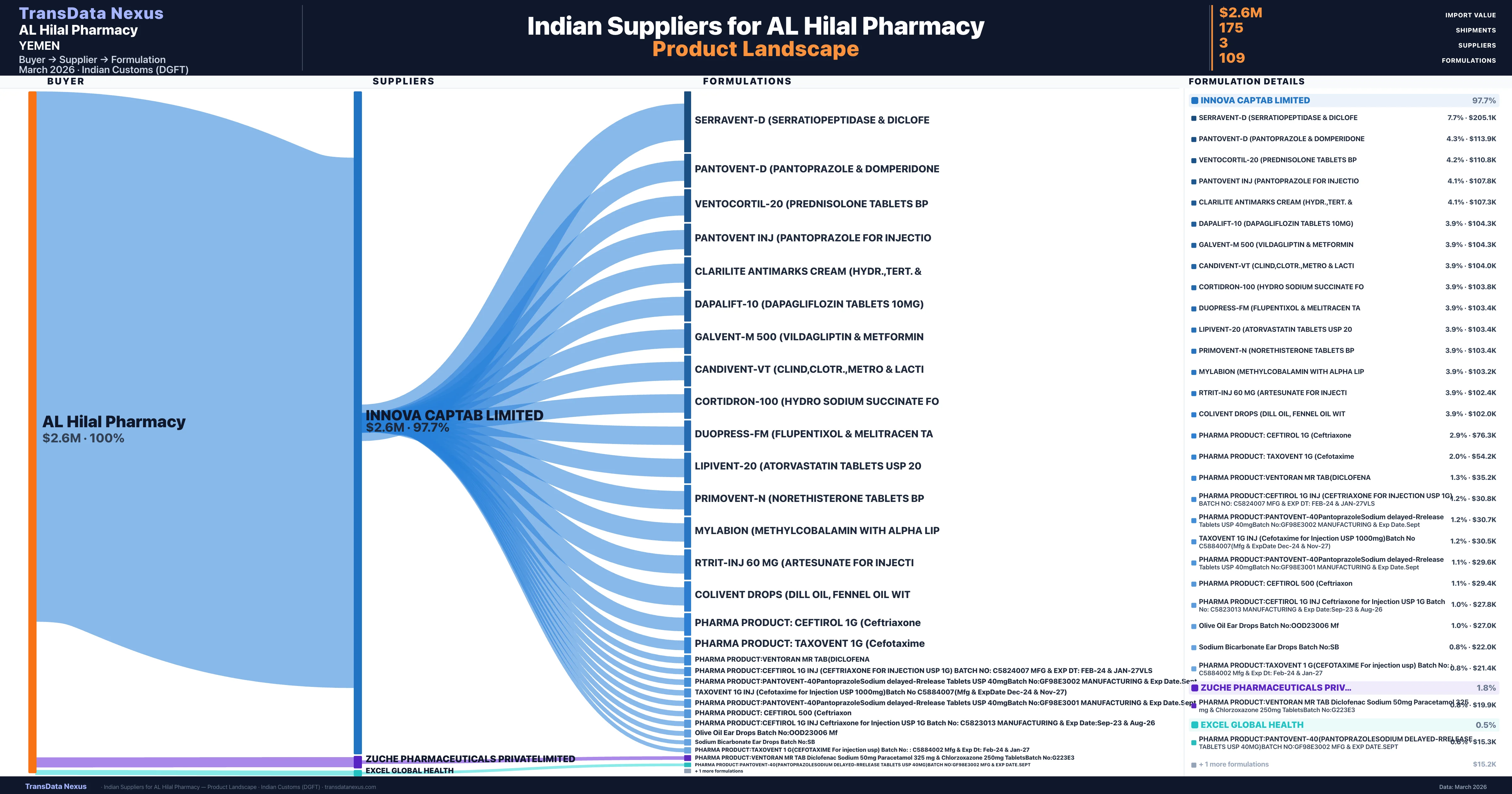
Who Are the Verified Indian Suppliers to AL Hilal Pharmacy?
Customs-verified supplier relationships from Indian DGFT records
| Supplier | Value | Shipments | Share |
|---|---|---|---|
| Innova Captab Limited | $2.6M | 169 | 97.7% |
| Zuche Pharmaceuticals Privatelimited | $49.0K | 4 | 1.8% |
| Excel Global Health | $12.5K | 2 | 0.5% |
AL Hilal Pharmacy sources from 3 verified Indian suppliers across 109 distinct formulations. The sourcing is highly concentrated — Innova Captab Limited accounts for 97.7% of total imports, indicating a strategic single-source relationship.
What Formulations Does AL Hilal Pharmacy Import?
| Formulation | Value | Ships |
|---|---|---|
| Serravent-d (serratiopeptidase & | $205.1K | 6 |
| Pantovent-d (pantoprazole & | $113.9K | 3 |
| Ventocortil-20 (prednisolone tablets | $110.8K | 3 |
| Pantovent INJ (pantoprazole for | $107.8K | 3 |
| Clarilite antimarks cream (hydr.,tert. | $107.3K | 3 |
| Dapalift-10 (dapagliflozin tablets 10MG) | $104.3K | 3 |
| Galvent-m 500 (vildagliptin & | $104.3K | 3 |
| Candivent-vt (clind,clotr.,metro & | $104.0K | 3 |
| Cortidron-100 (hydro sodium succinate | $103.8K | 3 |
| Duopress-fm (flupentixol & melitracen | $103.4K | 3 |
| Lipivent-20 (atorvastatin tablets USP | $103.4K | 3 |
| Primovent-n (norethisterone tablets | $103.4K | 3 |
| Mylabion (methylcobalamin with alpha | $103.2K | 3 |
| Rtrit-INJ 60 MG (artesunate for | $102.4K | 3 |
| Colivent drops (dill oil, fennel oil | $102.0K | 3 |
AL Hilal Pharmacy imports 109 distinct pharmaceutical formulations. Showing top 15 by value. For full formulation-level data, contact TransData Nexus.
What Products Does AL Hilal Pharmacy Import?
Top Products by Import Value
AL Hilal Pharmacy Therapeutic Categories — 3 Specializations
AL Hilal Pharmacy imports across 3 therapeutic categories, with Gastrointestinal (62.1%), Advanced Diabetes Medications (27.6%), Respiratory (10.3%) representing the largest segments. The portfolio is concentrated — top 5 products = 100% of total imports.
Gastrointestinal
2 products · 62.1% · $900.0K
Advanced Diabetes Medications
2 products · 27.6% · $400.0K
Respiratory
1 products · 10.3% · $150.0K
Import Portfolio — Top 5 by Import Value
| # | Product | Category | Value | Ships | Share | Rk |
|---|---|---|---|---|---|---|
| 1 | Pantoprazole | Gastrointestinal | $750.0K | 15 | 0.1% | 16 |
| 2 | Dapagliflozin | Advanced Diabetes Medications | $200.0K | 4 | 0.4% | 18 |
| 3 | Vildagliptin | Advanced Diabetes Medications | $200.0K | 4 | 2.0% | 3 |
| 4 | Domperidone | Gastrointestinal | $150.0K | 3 | 0.5% | 2 |
| 5 | Prednisolone | Respiratory | $150.0K | 3 | 0.2% | 12 |
AL Hilal Pharmacy imports 5 pharmaceutical products across 3 categories into Yemen totaling $1.4M.
Key Metrics
Top Categories
Indian Suppliers
Related Trade Data
Need Detailed Data?
Shipment-level records, supplier connections & pricing for AL Hilal Pharmacy.
Request DemoAL Hilal Pharmacy — Corporate Profile & Information
Company type, headquarters, distribution network, and industry role
1Company Overview
AL Hilal Pharmacy is a pharmaceutical importer and distributor based in Aden, Yemen. Established in 2007, the company has been instrumental in supplying a diverse range of pharmaceutical products to the Yemeni market. Operating as a key player in Yemen's pharmaceutical distribution network, AL Hilal Pharmacy imports finished pharmaceutical formulations, including tablets, capsules, syrups, and injections, primarily from India. The company's mission is to provide high-quality medicines at accessible prices, ensuring availability across the country.
Over the years, AL Hilal Pharmacy has developed a robust portfolio, importing a total of 109 unique formulations across five product categories. The company's strategic focus on sourcing from India has enabled it to offer a wide array of pharmaceutical products, catering to various therapeutic needs within Yemen. This approach underscores AL Hilal Pharmacy's commitment to meeting the healthcare demands of the Yemeni population through reliable and diverse pharmaceutical imports.
2Distribution Network
While specific details about AL Hilal Pharmacy's warehouse locations and logistics capabilities are not publicly disclosed, the company is known to operate from Aden, Yemen. Given Aden's strategic position as a major port city, it is likely that AL Hilal Pharmacy utilizes this advantage to facilitate the importation and distribution of pharmaceutical products. The company's distribution network is presumed to cover major cities and regions within Yemen, ensuring that imported medicines reach a broad customer base. However, without explicit information on their logistics infrastructure, a comprehensive assessment of their geographic coverage and logistics capabilities remains speculative.
3Industry Role
AL Hilal Pharmacy plays a pivotal role in Yemen's pharmaceutical supply chain as a primary wholesaler and importer. By sourcing finished pharmaceutical formulations from international suppliers, particularly from India, the company ensures a steady supply of essential medicines to the Yemeni market. This role is crucial in a country where access to a diverse range of pharmaceutical products is vital for public health. Through its import and distribution activities, AL Hilal Pharmacy contributes significantly to the healthcare infrastructure of Yemen, facilitating the availability of necessary medications across the nation.
Supplier Relationship Intelligence — AL Hilal Pharmacy
Sourcing concentration, supply chain resilience, and strategic implications
1Sourcing Concentration Analysis
AL Hilal Pharmacy's sourcing strategy exhibits a high degree of concentration, with a significant majority of its imports originating from a single supplier, INNOVA CAPTAB LIMITED. This supplier accounts for approximately 97.7% of the total import value, indicating a strong reliance on this partnership. Such a concentrated sourcing approach can offer benefits like streamlined procurement processes and potentially favorable pricing. However, it also introduces risks associated with supplier dependency, including potential disruptions in supply due to issues like production delays, quality concerns, or geopolitical factors affecting trade relations.
The stability of AL Hilal Pharmacy's relationship with INNOVA CAPTAB LIMITED is suggested by the consistent volume of imports over the years. Nonetheless, the lack of diversification in sourcing could pose challenges in maintaining a continuous and reliable supply chain. To mitigate these risks, it would be prudent for AL Hilal Pharmacy to consider diversifying its supplier base, thereby enhancing supply chain resilience and reducing potential vulnerabilities associated with over-reliance on a single supplier.
2Supply Chain Resilience
The resilience of AL Hilal Pharmacy's supply chain is closely tied to its sourcing strategy, which is predominantly concentrated on a single supplier, INNOVA CAPTAB LIMITED. This concentration can lead to vulnerabilities, as any disruptions affecting this supplier—such as production issues, quality control problems, or geopolitical tensions—could significantly impact AL Hilal Pharmacy's ability to meet market demand. The absence of publicly available information regarding backup suppliers or alternative sourcing strategies further underscores the potential risks associated with this dependency.
To bolster supply chain resilience, AL Hilal Pharmacy might consider establishing relationships with additional suppliers, both within India and internationally. Diversifying the supplier base would provide alternative sources for pharmaceutical products, thereby mitigating the impact of potential disruptions from a single supplier. Additionally, expanding the range of imported formulations could reduce the risk associated with over-reliance on specific products or therapeutic categories. Implementing these strategies would enhance the company's ability to maintain a consistent and reliable supply of medicines to the Yemeni market.
3Strategic Implications
AL Hilal Pharmacy's concentrated sourcing pattern, primarily from INNOVA CAPTAB LIMITED, positions the company to benefit from streamlined procurement processes and potentially favorable pricing structures. This strategic choice may also foster strong supplier relationships, leading to better terms and priority access to products. However, the lack of supplier diversification introduces risks related to supply chain disruptions, which could affect the company's ability to meet market demand consistently.
For Indian exporters seeking to become alternative suppliers to AL Hilal Pharmacy, understanding the company's current sourcing dynamics is crucial. Offering a diverse range of high-quality pharmaceutical products and demonstrating reliability in supply can position new suppliers as attractive partners. Additionally, highlighting the ability to provide competitive pricing and flexible terms may appeal to AL Hilal Pharmacy's strategic objectives. By addressing these factors, Indian exporters can effectively position themselves as viable alternatives, potentially expanding their market presence in Yemen.
Importing Pharmaceuticals into Yemen — Regulatory Framework
Regulatory authority, GMP requirements, import licensing for Yemen
1Regulatory Authority & Framework
In Yemen, the primary regulatory authority overseeing pharmaceutical imports is the Ministry of Public Health and Population. This ministry is responsible for establishing and enforcing regulations related to the importation, registration, and distribution of pharmaceutical products. Key legislation governing pharmaceutical imports includes the Customs Law No. 14 of 1990 and its subsequent amendments, which outline the procedures and requirements for importing goods into Yemen. Notably, Law No. 5 of 2020 amended the Customs Law to exempt certain pharmaceutical production inputs from customs duties, aiming to facilitate the availability of essential medicines in the country.
The marketing authorization pathway for Indian generics involves several steps. Initially, the pharmaceutical product must be registered with the Ministry of Public Health and Population, which includes submitting a Certificate of Pharmaceutical Products (COPP) issued by the competent authority in the country of origin, such as the U.S. FDA. This certificate verifies the authenticity and regulatory compliance of the product. The COPP must undergo legalization to be recognized by Yemeni authorities, a process that involves certification and embassy verification to confirm the document's authenticity.
2Import Licensing & GMP
To import pharmaceutical products into Yemen, companies must obtain an import license from the Ministry of Public Health and Population. This process requires registration as an importer with the Ministry of Industry and Trade and may involve additional licenses depending on the product category. Compliance with Good Manufacturing Practice (GMP) standards is mandatory, and imported products must be accompanied by certificates confirming adherence to recognized GMP standards, such as EU GMP, WHO GMP, or PIC/S. Additionally, wholesale distribution authorization is required to operate as a distributor within Yemen, ensuring that all imported pharmaceutical products are handled and distributed in accordance with national regulations.
3Quality & Labeling
Imported pharmaceutical products must undergo batch testing to ensure they meet Yemeni quality standards. Stability requirements are enforced to guarantee the efficacy and safety of medicines throughout their shelf life. Labeling must be in Arabic, providing essential information such as dosage instructions, storage conditions, and expiration dates. Serialization mandates may be implemented to enhance traceability and prevent counterfeit products from entering the market, ensuring the integrity of the pharmaceutical supply chain.
4Recent Regulatory Changes
Between 2024 and 2026, Yemen has implemented several policy changes affecting pharmaceutical imports. Notably, the amendment of the Customs Law in May 2020, which exempted certain pharmaceutical production inputs from customs duties, continues to influence the import landscape. This exemption aims to reduce costs for pharmaceutical manufacturers and improve the availability of essential medicines. While specific regulatory changes between 2024 and 2026 are not detailed in the available sources, it is advisable for stakeholders to consult the Ministry of Public Health and Population for the most current information on import regulations and policies.
AL Hilal Pharmacy — Procurement Pattern Analysis
Product strategy, sourcing profile, and market positioning
1Product Strategy
AL Hilal Pharmacy's product strategy focuses on importing pharmaceutical formulations across five categories, with a significant emphasis on gastrointestinal medications (62.1%), advanced diabetes medications (27.6%), and respiratory treatments (10.3%). This strategic focus aligns with the prevalent health concerns in Yemen, where gastrointestinal disorders, diabetes, and respiratory diseases are common. By concentrating on these therapeutic areas, AL Hilal Pharmacy addresses critical healthcare needs, ensuring that essential medications are accessible to the Yemeni population.
The market demand driving these imports is influenced by factors such as the prevalence of specific diseases, demographic trends, and the availability of healthcare services. For instance, the high incidence of diabetes in Yemen necessitates a steady supply of advanced diabetes medications. Similarly, the prevalence of gastrointestinal and respiratory conditions underscores the need for effective treatments in these categories. AL Hilal Pharmacy's product strategy is thus a direct response to these market demands, aiming to improve health outcomes by providing targeted pharmaceutical solutions.
2Sourcing Profile
AL Hilal Pharmacy's sourcing strategy is predominantly focused on importing generic drugs, primarily from India.
Frequently Asked Questions — AL Hilal Pharmacy
What products does AL Hilal Pharmacy import from India?
AL Hilal Pharmacy imports 5 pharmaceutical products across 3 categories. Top imports: Pantoprazole ($750.0K), Dapagliflozin ($200.0K), Vildagliptin ($200.0K), Domperidone ($150.0K), Prednisolone ($150.0K).
Who supplies pharmaceuticals to AL Hilal Pharmacy from India?
AL Hilal Pharmacy sources from 3 verified Indian suppliers. The primary supplier is Innova Captab Limited (97.7% of imports, $2.6M).
What is AL Hilal Pharmacy's total pharmaceutical import value?
AL Hilal Pharmacy's total pharmaceutical import value from India is $1.4M, based on 29 verified shipments in Indian Customs (DGFT) data.
What therapeutic categories does AL Hilal Pharmacy focus on?
AL Hilal Pharmacy imports across 3 categories. The largest: Gastrointestinal (62.1%), Advanced Diabetes Medications (27.6%), Respiratory (10.3%).
Get Full AL Hilal Pharmacy Import Intelligence
Access shipment-level details, supplier connections, pricing data, and competitive analysis. TransData Nexus provides verified Indian Customs (DGFT) data trusted by pharmaceutical trade professionals worldwide.
Official References & Regulatory Resources
Verify import regulations and drug registration requirements with the agencies above.
Research Methodology & Data Transparency
Suresh Sormare
Verified AuthorPharmaceutical Export-Import Analyst & Trade Intelligence Expert
Suresh Sormare is a pharmaceutical export-import analyst with deep expertise in Indian Customs (DGFT) data, HS code classification, and global pharmaceutical supply chains. His analysis covers 10M+ shipment records across 150+ countries and is used by manufacturers, procurement agencies, and trade consultants worldwide. Suresh specializes in identifying verified suppliers and buyers from customs records, mapping bilateral pharmaceutical trade corridors, analyzing tariff structures and regulatory frameworks across 170+ destination markets, and benchmarking competitive positioning for finished pharmaceutical formulations. His methodology combines granular customs transaction data with regulatory intelligence from FDA, EMA, WHO, CDSCO, and 40+ national drug authorities to deliver actionable trade insights for the pharmaceutical formulations sector.
linkedin.com/in/sureshsormarePrimary Data Source
All trade data is sourced from Indian Customs (DGFT) official shipping bill records — the authoritative government database for India's pharmaceutical trade. Each verified record contains exporter name, consignee (buyer) name, detailed product description, quantity, declared FOB value (USD), port of loading, destination country, and shipment date.
Analysis Methodology
- 1.Buyer Matching: AL Hilal Pharmacy identified across shipments using consignee name normalization.
- 2.Statistical Normalization: Shipment values are statistically normalized to ensure accurate market share representation.
- 3.Market Share: Calculated per product as AL Hilal Pharmacy's capped value divided by total Indian exports for that product.
- 4.Shipment Count: Based on 29 individual customs records matching AL Hilal Pharmacy.
- 5.Supplier Verification: AL Hilal Pharmacy sources from 3 verified Indian suppliers across 109 formulations, confirmed from customs records.
Government-Sourced Data
Official DGFT customs records
Transparent Methodology
Calculations fully disclosed above
5 Products Tracked
3 therapeutic categories
Expert-Reviewed
By pharmaceutical trade specialists
Data Source & Methodology
Trade data sourced from Indian Customs (DGFT) export shipment records. Values represent FOB export value in USD. For current shipment-level data, contact TransData Nexus.